
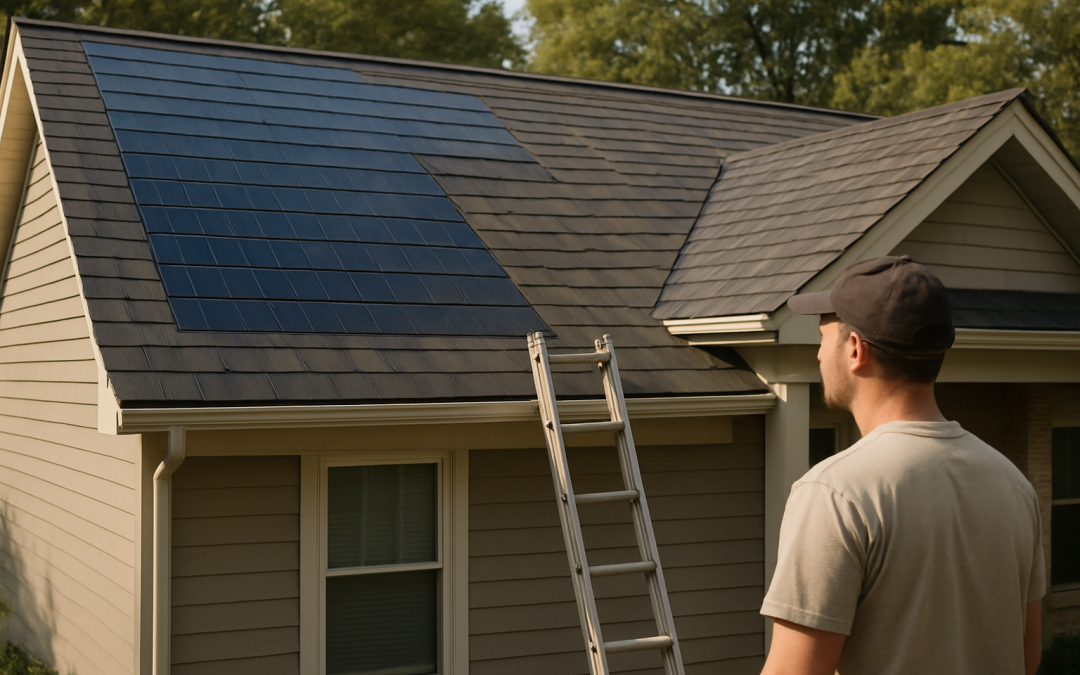
Solar roof shingles are small, shingle-sized solar modules that replace traditional roofing materials while generating electricity. They work like standard solar panels but are integrated into your roof for a more seamless look. Compared with conventional solar panels, solar shingles usually cost more, produce slightly less power per square foot, and are best suited for new roofs or full roof replacements. For many homeowners, they are a style-driven choice rather than the lowest-cost way to go solar.
In this guide, you’ll learn how solar roof shingles work, how they compare to regular solar panels, what they really cost, and when they are (and are not) worth it. It’s written for U.S. homeowners who want clear, honest information before talking to an installer or getting quotes.
Table of Contents
- What Are Solar Roof Shingles?
- How Do Solar Roof Shingles Work?
- Solar Roof Shingles vs. Traditional Solar Panels
- Costs, Savings, and Key Numbers for Solar Shingles
- When Solar Roof Shingles Make Sense
- When Solar Roof Shingles Don’t Make Sense
- Location, Roof Type, and Other Factors That Matter
- How to Evaluate Solar Roof Shingle Quotes
- Frequently Asked Questions
- Summary: Are Solar Roof Shingles Worth It?
- What to Do Next
What Are Solar Roof Shingles?
Solar roof shingles (also called solar tiles or building-integrated photovoltaics, BIPV) are roofing products that generate electricity and act as part of your weatherproof roof at the same time. Instead of mounting large panels on top of your existing roof, solar shingles replace some or all of the roofing material itself.
They are designed to blend in visually, often looking like premium asphalt shingles, slate, or tile. Popular brands include Tesla Solar Roof, CertainTeed, GAF Energy Timberline Solar, and others, each with slightly different designs and performance levels.
Key features in simple terms
- Dual purpose: They are both your roof and your solar power system.
- Low-profile look: They sit flush with the roof for a cleaner aesthetic than rack-mounted panels.
- Weather protection: Properly installed, they protect against rain, wind, and snow like a normal roof.
- Electricity generation: Each shingle or tile contains solar cells that convert sunlight into electricity.
Who solar shingles are typically for
- Homeowners planning a full roof replacement soon.
- Those in neighborhoods with strict HOA or aesthetic rules.
- People who value a sleek, integrated look enough to pay more for it.
- New construction projects where the roof and solar can be designed together.
How Do Solar Roof Shingles Work?
Solar roof shingles work on the same basic principle as any solar panel: sunlight hits semiconductor materials (usually silicon), creating an electric current. The system then converts that current into usable electricity for your home.
Step-by-step: from sunlight to usable power
- Sunlight hits the shingles. Each solar shingle contains solar cells that absorb sunlight.
- DC electricity is produced. The cells generate direct current (DC) electricity.
- Wiring connects shingles together. Shingles are wired in strings or groups, similar to solar panels.
- An inverter converts DC to AC. A device called an inverter turns DC into alternating current (AC), which your home uses.
- Your home uses the power first. Your appliances and lights draw from your solar power before pulling from the grid.
- Excess power may go to the grid or a battery. Extra electricity can be exported to your utility (often for bill credits) or stored in a battery if you have one.
Equipment in a typical solar shingle system
- Solar shingles or tiles (the roof surface that generates power)
- Inverter(s) – either:
- String inverter: one central unit for the whole system, or
- Microinverters: small inverters attached to each shingle or group of shingles
- Mounting and flashing components integrated into the roofing system
- Electrical wiring, disconnects, and safety equipment
- Optional solar battery for backup power and time-of-use savings
If you’re considering adding storage, it helps to understand the pros and cons of batteries; our guide Do I Need a Solar Battery? Honest Pros and Cons walks through when they make sense.
How efficient are solar shingles?
Efficiency is how much of the sunlight hitting a surface is turned into electricity. As of 2026:
- Typical solar panels on homes: about 19–22% efficiency.
- Many solar shingles: often in the 14–20% efficiency range, depending on brand and model.
This means you usually need more roof area covered with solar shingles to produce the same power as a smaller area of high-efficiency panels.
Solar Roof Shingles vs. Traditional Solar Panels
For most homeowners, the real question is: “Should I install solar shingles or regular solar panels?” The answer usually comes down to cost, appearance, roof condition, and how much energy you want to offset.
Side-by-side comparison
| Factor | Solar Roof Shingles | Traditional Solar Panels |
|---|---|---|
| Upfront cost | Higher per watt; often 20–50% more overall | Lower per watt; best value for most homes |
| Appearance | Very sleek, integrated, low-profile | Visible panels on top of roof |
| Best use case | New roof or full roof replacement | Good existing roof with 10+ years of life left |
| Efficiency | Generally lower per square foot | Higher; easier to hit energy goals on smaller roofs |
| Installation complexity | More complex; fewer experienced installers | Standardized; many qualified installers |
| Repair/replacement | Can be more involved; roofing + electrical | Panels can be removed/replaced without re-roofing |
| Payback period | Often longer due to higher cost | Typically shorter; 7–9 years is common nationally |
When solar shingles have an advantage
- You must replace your roof anyway and like the idea of combining both projects.
- Your HOA or local design board is hostile to visible solar panels.
- You’re building a custom or high-end home where aesthetics are a top priority.
- You have a large, simple roof with good sun exposure, so slightly lower efficiency is not a problem.
When traditional solar panels win
- You want the lowest cost per watt and the fastest payback period.
- Your existing roof is in good condition and doesn’t need replacing soon.
- You have a smaller roof and need high-efficiency panels to meet your energy needs.
- You want more installer options and easier service over the life of the system.
Costs, Savings, and Key Numbers for Solar Shingles
Because solar roof shingles are both a roof and a solar system, the numbers can be confusing. It helps to separate the roofing cost from the solar power cost and then look at the combined picture.
Baseline numbers for traditional solar panels
For context, here are typical U.S. residential solar panel numbers as of 2026:
- Average system size: 6–10 kW (about 15–25 panels)
- Average cost per watt: $2.50–$3.50 before incentives
- Total cost: about $28,000–$32,000 before incentives
- After 30% federal tax credit: about $19,600–$22,400 (if you qualify)
- Average annual bill savings: roughly $1,300–$1,500
- Typical payback period: about 7–9 years nationally
- Panel lifespan: 25–30 years performance warranty; 30–35 years typical life
These are national averages; your actual numbers depend on your roof, sun exposure, local rates, and incentives. For a deeper dive into how these numbers work, see the site’s solar cost and savings guide.
Typical costs for solar roof shingles
Solar shingle pricing varies widely by brand and project, but as of 2026, realistic ranges are:
- Solar shingle systems (solar portion only): often in the $3.50–$6.00 per watt range before incentives.
- Full roof + solar shingle systems: commonly $40,000–$70,000+ for an average home, depending on:
- Roof size and complexity
- How much of the roof is “active” solar vs. non-solar tiles
- Local labor costs and brand chosen
Some manufacturers quote a combined price that includes both the roof and the solar. In that case, you’ll want to compare it to the cost of a high-quality roof plus a separate solar panel system.
How incentives work with solar shingles
- The 30% federal solar tax credit (ITC) generally applies to the solar-generating portion of the roof (not the entire roofing cost).
- Some manufacturers and installers will break out:
- Solar shingles (eligible for ITC)
- Non-solar roofing materials (not eligible)
- Associated electrical and labor (partially eligible)
- State and local incentives may also apply, but rules vary.
Because tax rules are complex and can change, it’s important to consult a tax professional to confirm what portion of your project qualifies before you rely on any projected tax credit.
Expected savings and payback with solar shingles
In many cases, solar shingles will produce similar annual savings to a panel system of the same size, but with a higher upfront cost. That usually means:
- Annual bill savings: often similar to panels (e.g., $1,300–$1,500+ for a typical system), assuming similar system size and sun exposure.
- Payback period: often longer than 7–9 years, and in some cases 10–15+ years, depending on:
- How much more you pay for shingles vs. panels
- Your local electricity rates and rate increases
- Available incentives and net metering policies
In other words, solar shingles can still pay off over time, but they are usually not the fastest financial payback option.
When Solar Roof Shingles Make Sense
Solar shingles are a niche product, but in the right situation they can be a smart choice. The key is matching the technology to your priorities and timing.
Good scenarios for solar shingles
- You need a new roof soon. If your roof is at the end of its life, you’re already facing a major expense. Combining a roof replacement with solar shingles can:
- Offset part of the roofing cost with energy savings
- Allow you to claim incentives on the solar portion
- You care deeply about aesthetics. If you strongly dislike the look of traditional panels or live in a high-end neighborhood, the integrated look may be worth the premium.
- Your HOA or design review board restricts panels. Some communities are more open to solar shingles than to visible rack-mounted panels.
- You have a large, simple, sunny roof. A big south-facing roof with minimal shading makes it easier for solar shingles to meet your energy needs despite slightly lower efficiency.
- You’re building a new home. Designing the roof and solar together from day one can simplify installation and improve performance.
Non-financial reasons some homeowners choose solar shingles
- They want a modern, minimalist look with no visible panels or rails.
- They value architectural integration and curb appeal as much as raw financial return.
- They’re willing to pay more for a “one system” solution rather than separate roof and solar projects.
When Solar Roof Shingles Don’t Make Sense
For many homeowners, traditional solar panels are still the more practical and cost-effective choice. It’s important to be honest about when solar shingles are not the right fit.
Situations where you should think twice
- Your roof is relatively new. If your roof has 10–20 years of life left, tearing it off for solar shingles usually doesn’t pencil out.
- You’re mainly motivated by financial return. If your top priority is the fastest payback and highest ROI, conventional panels almost always win.
- You have a small or complex roof. Dormers, hips, valleys, and multiple roof faces can limit how many solar shingles you can install, making it hard to offset much of your usage.
- You live in an area with low electricity rates. In regions with cheap power, the extra cost of shingles vs. panels is harder to justify.
- There are few experienced installers nearby. Solar shingles are more specialized; a lack of local expertise can mean higher costs and more risk.
Common downsides and risks
- Higher upfront cost: Even when you factor in the cost of a new roof, shingles are often more expensive than a good roof plus a standard solar array.
- Longer payback period: The extra cost can add several years to your break-even timeline.
- Fewer installer options: You may be limited to one or two certified installers in your area, reducing your ability to compare quotes.
- Service complexity: Repairs may require both roofing and electrical expertise, and replacement parts may be brand-specific.
- Technology and brand risk: The solar shingle market is newer and smaller than the panel market; some products have come and gone over the years.
Location, Roof Type, and Other Factors That Matter
Whether solar roof shingles are worth it for your home depends heavily on where you live and what your roof looks like. Two similar homes in different states can see very different results.
Sun exposure and climate
- High-sun states (CA, AZ, NV, NM, CO, TX, FL, etc.) generally see:
- Higher annual energy production per kW of solar
- Shorter payback periods
- Cloudier or northern states can still benefit from solar, but:
- Systems produce less energy per year
- Payback may be longer, especially with higher-cost shingles
- Snow and hail: Quality solar shingles are designed to meet roofing standards, but you’ll want to confirm:
- Snow load ratings
- Hail impact ratings
- Wind ratings for your region
Roof orientation and shading
- Best orientation: South-facing roofs are ideal; west and east can also work well.
- Shading: Trees, chimneys, and nearby buildings can significantly reduce output. Because shingles cover more area, shading patterns matter a lot.
- Roof pitch: Most products work well on common roof slopes (e.g., 4:12 to 9:12), but very steep or very low-slope roofs may be limited.
Roofing material and structure
- Solar shingles are typically designed to replace asphalt shingles or similar materials.
- On complex roofs with many angles, valleys, and penetrations, you may end up with:
- A mix of solar and non-solar shingles
- Less total solar capacity than you expected
- Your installer should evaluate:
- Roof age and condition
- Structural capacity
- Any needed upgrades (decking, underlayment, etc.)
Local incentives and utility policies
- State and local incentives: Some states offer extra rebates or tax credits that can improve the economics of solar shingles.
- Net metering: Policies that credit you for excess solar sent to the grid can significantly impact your savings.
- Time-of-use rates: In areas with higher evening rates, pairing solar shingles with a battery can improve savings, but also increases upfront cost.
For a broader look at how incentives affect solar economics, see the site’s solar incentives and tax credits guide.
How to Evaluate Solar Roof Shingle Quotes
If you’re serious about solar roof shingles, getting multiple detailed quotes is essential. Because products and pricing vary so much, you want to compare apples to apples as much as possible.
Information to gather before getting quotes
- Your average monthly electricity usage in kWh (check 12 months of bills).
- Photos or plans of your roof, including:
- Roof dimensions if available
- Any shading from trees or nearby buildings
- Roof age and material (e.g., “10-year-old asphalt shingle roof”).
- Your goals:
- Offset as much usage as possible?
- Target a specific budget?
- Maximize aesthetics?
Key questions to ask a solar shingle installer
- What brand and model of solar shingles are you proposing? Ask for spec sheets and warranties.
- How many kW of solar capacity will the system have? Compare this to your annual usage.
- What is the estimated annual energy production (kWh)? Ask what assumptions they used (sun hours, shading, degradation).
- How is the price broken down? Request separate line items for:
- Solar shingles (active)
- Non-solar roofing materials
- Inverters and electrical components
- Labor and permits
- What portion is expected to qualify for the federal tax credit? Then confirm with a tax professional.
- What are the warranties? Look for:
- Product warranty (roofing and electrical)
- Power output warranty (e.g., 80–85% after 25 years)
- Workmanship warranty from the installer
- How many solar shingle installations have you completed? Ask for references or photos of past projects.
- What is the expected payback period and lifetime savings? Use this as a comparison point with panel quotes.
Why getting multiple quotes matters
- Solar shingle products and pricing vary more than standard panels.
- Different installers may propose different system sizes and roof coverage.
- Comparing at least two or three quotes helps you:
- Spot unrealistic promises
- Understand the range of options (shingles vs. panels vs. hybrid)
- Negotiate better terms
Frequently Asked Questions
Are solar roof shingles as good as solar panels?
Solar roof shingles can produce similar electricity to panels if you have enough roof area, but they are usually less efficient per square foot and more expensive per watt. For most homeowners focused on cost and payback, traditional panels are the better value, while shingles are more of a premium, aesthetics-driven choice.
How long do solar roof shingles last?
Most solar shingles are designed to last 25–30 years or more, similar to quality solar panels. Look for at least a 25-year performance warranty and a strong product warranty that covers both the roofing and electrical functions.
Can I put solar shingles on only part of my roof?
Yes, many systems use solar shingles on the sunniest roof sections and non-solar shingles elsewhere. Your installer should design a layout that targets the best-producing areas while keeping the roof visually consistent.
Do solar roof shingles work in cloudy or cold climates?
Solar shingles can still generate power in cloudy or cold climates, but total yearly production will be lower than in sunny states. The economics can still work, but the higher cost of shingles makes careful analysis especially important in lower-sun regions.
Can I add a battery to a solar shingle system?
Yes, most solar shingle systems can be paired with a home battery for backup power and better use of your solar energy. The battery is a separate component, so you’ll want to discuss compatible options and added costs with your installer.
Are solar roof shingles worth it?
Solar roof shingles can be worth it if you need a new roof anyway and place a high value on aesthetics, especially in sunny areas with good incentives. If your main goal is maximum savings for the lowest cost, a standard roof plus traditional solar panels is usually the better financial choice.
Summary: Are Solar Roof Shingles Worth It?
- Solar roof shingles combine roofing and solar power in one product, offering a sleek look but usually at a higher cost per watt than traditional panels.
- Typical solar panel systems cost about $28,000–$32,000 before incentives and pay back in roughly 7–9 years, while solar shingles often cost more and take longer to pay off.
- Solar shingles make the most sense when you already need a new roof, have a large sunny roof, and care deeply about aesthetics or HOA restrictions.
- They are less attractive if your roof is in good shape, your budget is tight, or you want the fastest financial return from going solar.
- The best next step is to get multiple quotes that compare solar shingles with conventional panels so you can see the real trade-offs for your specific home.
What to Do Next
Because every home, roof, and utility bill is different, the only way to know if solar roof shingles are truly worth it for you is to see real numbers for your property. Getting a few personalized quotes will let you compare solar shingles against traditional panels and a standard roof replacement side by side.
If you’re ready to see what solar could look like on your home, you can start by getting competitive, no-obligation estimates at /get-my-quote/. Use those quotes, along with the questions in this guide, to choose the option that fits your budget, your roof, and your long-term plans.