
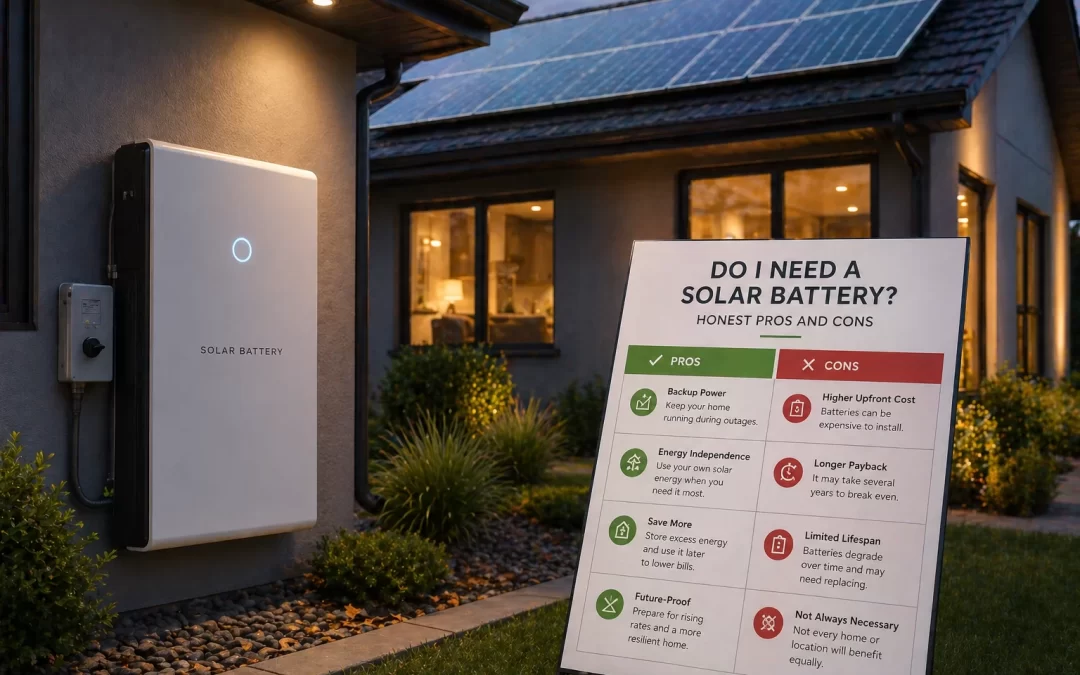
Most U.S. homeowners do not strictly need a solar battery, but many can benefit from one. A battery makes the most sense if you have frequent power outages, high evening electricity rates, or limited net metering (low credits for sending power back to the grid). If your utility offers full retail net metering and your grid is reliable, a battery often adds comfort and resilience more than pure financial savings. Because batteries are still expensive, it’s important to run the numbers for your specific home and utility before deciding.
Deciding whether you need a solar battery is one of the biggest choices in a home solar project. This guide is written for U.S. homeowners who want a clear, honest look at when batteries are worth it, and when they’re not. We’ll walk through real numbers, common scenarios, and how to decide if a battery belongs in your solar quote.
Table of Contents
- What Is a Solar Battery and How Does It Work?
- Do I Need a Solar Battery? Quick Decision Guide
- Solar Battery Pros and Cons (Honest Look)
- Solar Battery Costs, Savings, and Key Numbers
- When a Solar Battery Makes Sense
- When a Solar Battery Usually Isn’t Worth It
- State and Utility Factors That Change the Answer
- How to Choose a Solar Battery (If You Decide to Get One)
- Questions to Ask Installers About Batteries
- Decision Guide: What to Do Next
- Frequently Asked Questions
- Summary: Do You Really Need a Solar Battery?
What Is a Solar Battery and How Does It Work?
Simple explanation
A solar battery is a large rechargeable battery that stores extra electricity from your solar panels. Instead of sending all excess power back to the grid, your system can charge the battery during the day and use that stored energy later, usually in the evening or during an outage.
Most modern home batteries are “lithium-ion” units (similar chemistry to an electric car battery) that mount on a wall or floor in your garage, basement, or outside. They connect to your solar system and home electrical panel through an inverter and a small control system.
What a solar battery actually does for your home
- Stores excess solar power produced during the day.
- Runs your home at night using stored energy instead of grid power (up to the battery’s capacity).
- Provides backup power during grid outages for selected “critical loads” (fridge, lights, Wi‑Fi, some outlets).
- Helps avoid high rates if your utility charges more during peak evening hours.
Key battery terms in plain language
- Capacity (kWh): How much energy the battery can store. A typical home battery is 10–15 kWh.
- Power (kW): How much energy the battery can deliver at once. This affects how many things you can run at the same time.
- Depth of discharge (DoD): How much of the battery’s capacity you can use regularly without shortening its life.
- Round-trip efficiency: How much energy you get back compared to what you put in (most are around 90%).
Do I Need a Solar Battery? Quick Decision Guide
Fast yes/no checklist
You are more likely to benefit from a solar battery if:
- You have frequent or long power outages and want backup power.
- Your utility has time-of-use (TOU) rates with high evening prices.
- Your state has limited or no net metering, or low export rates for solar.
- You strongly value energy independence and resilience, even if payback is longer.
- You have or plan to get an electric vehicle and want to maximize self-consumption of solar.
You are less likely to need a solar battery if:
- Your utility offers full retail net metering (1:1 credit for solar exports).
- Your grid is very reliable and outages are rare and short.
- You are mainly focused on fastest payback and maximum financial return.
- Your budget is tight and adding a battery would stretch your finances.
How batteries change the role of your solar system
Without a battery, your solar system mainly reduces your electric bill by sending extra power to the grid and drawing from the grid when you need more. With a battery, your system becomes more of a “mini power plant” that can keep some or all of your home running even when the grid is down, and can shift when you use grid power to cheaper times.
Solar Battery Pros and Cons (Honest Look)
Pros of adding a solar battery
- Backup power during outages
Keep essentials like your refrigerator, some lights, Wi‑Fi, and medical devices running when the grid goes down. Multiple batteries or careful load management can even support central AC or a well pump. - Better use of your own solar power
Instead of sending excess solar back to the grid for a low credit, you can store it and use it later. This is especially valuable where export rates are low. - Protection from time-of-use rates
If your utility charges more from, say, 4–9 p.m., a battery can power your home during those hours and reduce expensive grid usage. - Improved energy independence
You rely less on the grid and utility pricing changes. This is more of a lifestyle and peace-of-mind benefit than a pure financial one. - Quiet, automatic backup vs. generators
Batteries turn on automatically, are nearly silent, and don’t require fuel storage or regular manual starting like gas generators.
Cons of adding a solar battery
- High upfront cost
A typical installed home battery often adds $10,000–$16,000 to a solar project before incentives. That’s a major cost on top of your panels and inverters. - Longer payback period
While solar panels alone often pay back in 7–9 years on average, adding a battery can extend payback to 10–15+ years, depending on your rates and incentives. - Limited backup capacity
One battery usually cannot run your whole home as if nothing happened. You’ll likely need to choose critical loads and may need multiple batteries for heavy loads like central AC. - Complexity and potential maintenance
More equipment means more components that could fail or need service over 10–15 years, especially electronics like inverters and control systems. - Not always the best financial move
In states with strong net metering and low outage risk, a battery may not significantly improve your savings compared to solar panels alone.
Bottom line on pros and cons
A solar battery is usually a comfort and resilience upgrade first, and a financial upgrade second. If you expect it to pay for itself quickly everywhere, you may be disappointed. If you value backup power and more control over your energy, the trade-offs can be worth it.
Solar Battery Costs, Savings, and Key Numbers
Typical solar system costs (without a battery)
For context, here are national-average numbers for a residential solar system in 2026:
- Average system cost: $28,000–$32,000 before incentives.
- After 30% federal tax credit (ITC): roughly $19,600–$22,400 (consult a tax professional to confirm your eligibility).
- Cost per watt: about $2.50–$3.50.
- Average annual bill savings: around $1,300–$1,500.
- Typical payback period: about 7–9 years, depending on your utility rates and incentives.
- Average panels needed: usually 15–25 panels for a typical U.S. home.
- Panel lifespan: 25–30 years performance warranty, with many systems lasting 30–35 years or more.
These are national averages; your actual numbers will depend on your roof, usage, and local rates. For a deeper dive into system costs and savings, see the solar cost and savings guide.
How much a solar battery typically costs
- Single battery (10–15 kWh) installed: usually $10,000–$16,000 before incentives.
- Two batteries (for larger homes or more backup): often $18,000–$28,000 before incentives.
- Incremental cost when added to a new solar install is usually lower than adding a battery later, because you share labor and some equipment.
Many batteries qualify for the 30% federal tax credit when installed with solar (and in some cases even when added later), but you should confirm current rules with a tax professional and your installer. Some states and utilities also offer battery-specific rebates that can significantly reduce net cost.
How a battery affects your payback period
Adding a battery changes the math in a few ways:
- Higher upfront cost increases your total investment.
- Extra savings may come from:
- Using more of your own solar power instead of buying from the grid.
- Avoiding expensive peak rates under time-of-use pricing.
- Reducing demand charges in some utility territories.
In many areas, the battery’s extra savings are smaller than the extra cost, so the combined payback stretches out. In areas with high evening rates or poor net metering, the battery can meaningfully improve your overall return.
What affects battery costs and savings the most
- Your utility rate structure (flat vs. time-of-use, demand charges).
- Net metering or export credit rules in your state.
- Available incentives (state rebates, utility programs, tax credits).
- How much electricity you use at night vs. during the day.
- Battery size and brand (larger and premium brands cost more).
- Installation complexity (panel upgrades, trenching, long wire runs).
When a Solar Battery Makes Sense
1. You have frequent or long power outages
If your area sees regular outages from storms, wildfires, or grid issues, a battery can be a strong choice. It can:
- Keep your refrigerator, lights, and internet running.
- Support medical equipment or home office needs.
- Reduce the need for a noisy, fuel-based generator.
In this case, you’re paying partly for resilience and peace of mind, not just financial return.
2. You’re on time-of-use (TOU) rates with high evening prices
Many utilities now charge more for electricity during late afternoon and evening hours. A battery can:
- Charge during low-cost or solar hours.
- Discharge during high-cost evening periods.
- Lower your average cost per kWh from the grid.
In strong TOU markets, this “rate arbitrage” can significantly improve the financial case for a battery.
3. Your state has weak net metering or low export rates
In some states, utilities pay much less for the solar you send to the grid than what they charge you for power. A battery helps by:
- Letting you store excess solar instead of selling it cheaply.
- Increasing your self-consumption of solar energy.
- Reducing your reliance on low-value export credits.
4. You prioritize energy independence and sustainability
If your main goal is to use as much clean energy as possible and rely less on the grid, a battery supports that lifestyle. You may accept a longer payback in exchange for:
- Higher percentage of your usage covered by solar.
- Less exposure to future rate hikes.
- More control over when and how you use grid power.
5. You have high night-time usage or an EV
Homes that use a lot of power in the evening or overnight (for example, EV charging, electric heating, or large families) can benefit more from a battery. Storing daytime solar to cover those night loads increases your solar utilization and can improve your overall savings.
When a Solar Battery Usually Isn’t Worth It
1. You have strong net metering and a reliable grid
If your utility offers full retail net metering and outages are rare, a battery often doesn’t add much financial value. In this case:
- The grid already acts like a “virtual battery” for your excess solar.
- You get full credit for power you send to the grid.
- The extra cost of a battery may not pay back within its warranty period.
2. Your main goal is fastest payback and highest ROI
If you’re focused on the shortest payback period, you’ll usually get better results by:
- Installing solar panels without a battery.
- Optimizing system size and equipment for cost-effectiveness.
- Possibly adding a battery later if rates or rules change.
3. Your budget is tight
Because batteries add $10,000–$16,000+ to a typical project, they can push a solar system out of reach for some homeowners. In that case, it’s usually better to:
- Install solar panels only.
- Design the system so a battery can be added later.
- Revisit the battery option when finances or incentives improve.
4. You rarely lose power and don’t mind short outages
If your lights blink off once or twice a year for an hour, a battery is unlikely to feel “worth it” day to day. A small portable generator or simply waiting out rare outages may be more practical.
5. Your home’s electrical setup makes installation very complex
Some homes need major electrical upgrades to support a battery (for example, full panel replacement, long trenching runs, or service upgrades). If your installer flags unusually high installation costs, the economics can quickly tilt against adding a battery now.
State and Utility Factors That Change the Answer
Why your location matters so much
Whether you “need” a solar battery depends heavily on your state and utility. The same battery can be a smart move in one area and a poor investment in another. Key factors include:
- Net metering rules or export credit rates.
- Time-of-use pricing and peak rate levels.
- Local incentives for batteries and solar.
- Grid reliability and outage frequency.
Examples of where batteries often make more sense
- States with time-of-use rates and high evening prices.
- Areas with frequent outages from storms, wildfires, or grid constraints.
- States or utilities that have moved away from full retail net metering to lower export rates.
- Regions offering strong battery rebates or incentive programs.
Examples of where batteries may be harder to justify
- States with full retail net metering and stable policies.
- Areas with very reliable grids and few outages.
- Utilities with flat, relatively low rates and no TOU pricing.
Because policies change, it’s important to review current net metering and rate structures with a local installer. They can model how a battery would perform under your specific tariff.
How to Choose a Solar Battery (If You Decide to Get One)
Key questions to answer first
- What do you want the battery to do?
- Backup only for critical loads?
- Bill savings under TOU rates?
- Maximum energy independence?
- How long do you want backup to last?
- Just a few hours?
- Overnight?
- Multiple days with some solar recharging?
- Which appliances are truly essential?
- Fridge, lights, Wi‑Fi, medical devices, well pump, furnace fan, etc.
Right-sizing your battery
Most homes start with a 10–15 kWh battery for basic backup and TOU savings. You might consider more capacity if:
- You have a large home or high evening usage.
- You want to run central AC or a well pump during outages.
- You live in an area with multi-day outages and good solar production.
Oversizing a battery “just in case” can get expensive quickly, so it’s important to match capacity to realistic needs.
Comparing battery brands and systems
Major brands differ in capacity, power output, warranty, software, and integration with inverters. For a detailed comparison of leading options like Tesla Powerwall, Enphase, and Franklin, see the best solar batteries of 2026 guide.
What to look for in a battery warranty
- Warranty length: typically 10 years.
- Guaranteed energy throughput or cycle count.
- End-of-warranty capacity: often 60–70% of original capacity.
- Coverage details: parts, labor, and performance guarantees.
Questions to Ask Installers About Batteries
Key questions to protect yourself and get a good design
- “Can you show me a quote with and without a battery, side by side?”
This helps you see the true incremental cost and impact on payback. - “What loads will the battery back up, specifically?”
Ask for a clear list (fridge, lights, outlets, etc.) and whether central AC, heat, or well pumps are included. - “How long can I expect the battery to run those loads during an outage?”
Have them walk through a realistic scenario (for example, summer vs. winter, cloudy vs. sunny days). - “How does my utility’s rate plan and net metering affect the value of a battery?”
A good installer should be able to model your bill with and without a battery. - “What incentives or rebates are available for batteries in my area?”
They should know about state, local, and utility programs, but you should still verify independently. - “Is my system designed so I can add a battery later?”
If you’re unsure now, make sure your inverter and wiring can support a future battery.
Why getting multiple quotes matters
Battery pricing and design can vary widely between installers. Getting at least 2–3 quotes helps you:
- Compare equipment brands and system sizes.
- See how different companies model savings and backup performance.
- Spot unrealistic claims or overly aggressive assumptions.
Decision Guide: What to Do Next
Step 1: Clarify your priorities
Before you talk to installers, decide what matters most to you:
- Financial return and fastest payback → Solar panels only may be best.
- Backup power and comfort during outages → Strong case for a battery.
- Energy independence and using more of your own solar → Battery can help, with a longer payback.
Step 2: Gather your information
Have these ready when you request quotes:
- 12 months of electric bills (kWh usage and costs).
- Your utility rate plan (flat vs. TOU, any demand charges).
- Any known outage issues in your area.
- List of appliances you want backed up.
Step 3: Get quotes with and without a battery
Ask each installer to provide:
- A solar-only quote.
- A solar-plus-battery quote.
- Modeled bill savings and payback for both scenarios.
This side-by-side comparison will show you clearly whether a solar battery is worth it for your home under current conditions.
Step 4: Revisit the decision every few years
Even if a battery doesn’t make sense now, that can change as:
- Utility rates and net metering rules evolve.
- Battery prices continue to fall.
- New incentives or programs become available.
Designing your system to be “battery-ready” keeps your options open.
Frequently Asked Questions
Do I need a solar battery for my solar panels to work?
No, you do not need a solar battery for your panels to work. Most home solar systems in the U.S. are grid-tied and operate without batteries, reducing your bill by sending excess power to the grid. A battery is an optional add-on that provides backup power and can improve savings in certain rate structures.
Will a solar battery power my whole house during an outage?
Usually, a single home battery will not power your entire house as if nothing happened. Most systems are designed to back up a “critical loads” panel with essentials like the fridge, some lights, Wi‑Fi, and key outlets. You may need multiple batteries and careful design to support large loads like central AC or electric heating.
How long does a solar battery last during a power outage?
A typical 10–15 kWh battery can often run essential loads for 8–24 hours, depending on how much you use and whether your solar panels can recharge it during the day. Heavy usage or running large appliances will shorten that time, while conservative use can extend it, especially with good sun.
Can I add a battery to my existing solar system later?
Yes, many existing solar systems can be upgraded with a battery later, especially if they use compatible inverters or were designed to be “battery-ready.” However, adding a battery after the fact can be more expensive and complex, so it’s worth discussing future plans with your installer now.
Does a solar battery qualify for the 30% federal tax credit?
In many cases, a battery installed with a residential solar system can qualify for the 30% federal Investment Tax Credit, and some standalone batteries may also qualify under current rules. Because tax law can change and eligibility depends on your situation, you should confirm details with a tax professional and your installer.
Is a solar battery better than a generator for backup power?
A battery is quieter, automatic, and uses your solar power, while a generator can often run longer during extended outages if you have fuel. Batteries are ideal for frequent short outages and homeowners who want clean, low-maintenance backup, while generators can be better for very long outages or high-power needs on a tighter budget.
Summary: Do You Really Need a Solar Battery?
- Most homeowners do not strictly need a solar battery, but many can benefit from one for backup power, time-of-use savings, or energy independence.
- A typical battery adds about $10,000–$16,000 to a solar project and often extends payback beyond the 7–9 year average for solar panels alone.
- The value of a battery depends heavily on your utility rates, net metering rules, outage frequency, and available incentives.
- Batteries make the most sense when you have frequent outages, high evening rates, or weak net metering, or when you strongly value resilience.
- The best next step is to get side-by-side quotes for solar with and without a battery and review them with a trusted installer and, where relevant, a tax professional.
If you’re unsure whether a solar battery is right for you, personalized quotes based on your roof, usage, and utility plan will give you a clear answer. Getting multiple bids through our quote request page can help you compare solar-only vs. solar-plus-battery options with no pressure, so you can decide what truly fits your home and budget.