
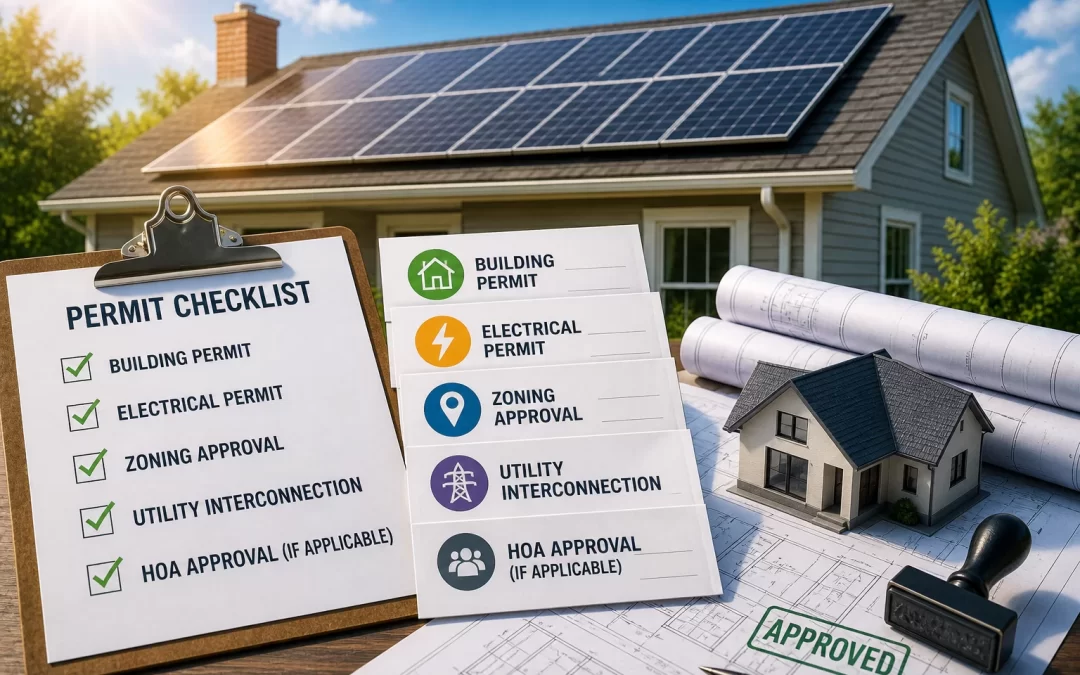
To install solar panels on a home in the U.S., you typically need three main permits: an electrical permit, a building/structural permit, and sometimes a zoning or planning permit. Your installer usually handles the paperwork and submits plans to your city or county, but DIY projects require you to apply yourself. Exact requirements, fees, and timelines vary by state, utility, and even neighborhood, and homeowners associations (HOAs) may have additional rules. Always confirm with your local building department before starting any work, because installing solar without proper permits can lead to fines, removal orders, or problems when selling your home.
This guide explains which permits you need to install solar panels, how the process works, and what to expect as a homeowner. It’s written for U.S. homeowners considering rooftop solar, whether you’re just starting research or already comparing quotes. By the end, you’ll know which approvals matter, who usually handles them, and how permits affect your project timeline and cost.
Table of Contents
- Why Solar Permits Matter and Who Handles Them
- What Permits Do You Need to Install Solar Panels?
- How Permit Requirements Vary by State and City
- Solar Permit Process and Timeline
- Permit Costs, System Costs, and Key Numbers
- When Permitting Works in Your Favor (and When It Doesn’t)
- DIY vs. Professional Installation: Permits and Risk
- What to Do Before You Apply or Sign a Contract
- Frequently Asked Questions
- Summary: Key Takeaways on Solar Permits
- Ready for Next Steps?
Why Solar Permits Matter and Who Handles Them
What solar permits are really about
Solar permits exist to make sure your system is:
- Safe for your home’s electrical system
- Structurally sound for your roof or mounting surface
- Compliant with local fire, building, and electrical codes
- Properly connected to the utility grid
Permits are not just red tape. They protect you from unsafe work, reduce fire and roof failure risk, and help avoid problems with insurance or future home inspections.
Who usually handles solar permits?
For most homeowners who hire a professional installer:
- The installer designs the system and prepares permit drawings.
- They submit applications to your city/county and utility.
- They schedule inspections and handle corrections if needed.
If you install solar yourself, you are responsible for all permit applications, plan sets, and inspections. This is where many DIY projects get delayed or denied.
What happens if you skip permits?
Installing solar without required permits can lead to:
- Stop-work orders and fines from your city or county
- Being forced to remove or redo the system at your expense
- Home insurance refusing claims related to the system
- Problems when selling or refinancing (failed inspections, lower appraised value)
Because of these risks, reputable installers will not install without proper permits and approvals.
What Permits Do You Need to Install Solar Panels?
Core permits most homeowners need
Most U.S. residential solar projects require three main types of permits or approvals:
- Electrical permit – Confirms wiring, breakers, and equipment meet the National Electrical Code (NEC) and local rules.
- Building/structural permit – Ensures your roof or structure can safely support the weight and wind/snow loads of the panels and racking.
- Zoning or planning approval – Confirms the system meets local land-use rules (setbacks, height limits, historic district rules, etc.). Sometimes this is folded into the building permit.
In addition, you almost always need:
- Utility interconnection approval – Permission from your electric utility to connect your system to the grid and use net metering or similar programs.
- Permission to Operate (PTO) – Final written approval from the utility to turn the system on after inspections.
Electrical permit: what it covers
The electrical permit focuses on safety and code compliance. It typically covers:
- Wiring diagrams and one-line drawings
- Breaker sizes and panelboard changes
- Conductor and conduit sizes and routing
- Grounding and bonding methods
- Location of disconnects and inverters
An electrical inspector will visit after installation to verify the work matches the approved plans and meets code.
Building/structural permit: what it covers
The building permit ensures your roof or structure can handle the added load and wind uplift. It often includes:
- Roof framing details (rafter size, spacing, span)
- Mounting hardware and attachment spacing
- Wind and snow load calculations for your area
- Fire access pathways on the roof (for firefighters)
In some jurisdictions, a licensed structural engineer must sign off on the design, especially for older homes or heavy snow/wind regions.
Zoning, planning, and design review
Depending on where you live, you may also need:
- Zoning clearance for ground-mounted systems, large arrays, or rural properties.
- Historic district approval if your home is in a designated historic area.
- Design review in communities with strict aesthetic rules.
These approvals focus more on appearance, placement, and neighborhood impact than on technical details.
Utility interconnection and PTO
Separate from city/county permits, your utility must approve how your system connects to the grid. This usually involves:
- An interconnection application with system size and equipment details
- Net metering or similar agreement, if available
- Meter upgrade or replacement, if required
- Final Permission to Operate (PTO) after inspections
For a deeper dive into this step, see what Permission to Operate (PTO) is and why it takes so long.
HOA approvals (not technically permits, but important)
If you live in a community with a homeowners association (HOA):
- You may need HOA approval for panel placement and appearance.
- Many states have “solar access” or “solar rights” laws that limit how much an HOA can restrict solar, but they can still set reasonable guidelines.
- Installers often help prepare HOA submittals, but you remain responsible for complying with HOA rules.
How Permit Requirements Vary by State and City
Why there’s no one-size-fits-all answer
Permit rules are set locally, so they vary by:
- State (California vs. Texas vs. Florida)
- City or county (even neighboring towns can differ)
- Utility (each has its own interconnection process)
Some areas have streamlined, solar-friendly processes; others still treat solar like a complex custom construction project.
Examples of state-level differences
Here are some common patterns across the U.S. (details change over time, so always confirm locally):
- California – Many jurisdictions use standardized, expedited permits for typical rooftop systems. State law caps certain permit fees and encourages fast processing.
- Arizona, Nevada, Colorado – Often have clear solar permitting paths, but structural reviews can be strict in snow or high-wind regions.
- Florida, Gulf Coast states – Strong focus on hurricane wind loads and attachment methods; engineering sign-off is common.
- Northeast (MA, NY, NJ) – More likely to involve historic districts, tight lot lines, and detailed fire access requirements.
- Rural areas – Sometimes simpler, but ground mounts may trigger more zoning review.
Local factors that change what permits you need
Your specific permit requirements can change based on:
- System size – Larger systems may need more detailed engineering or utility review.
- Roof type and age – Older roofs or unusual structures may require structural engineering or roof replacement first.
- Mounting type – Ground mounts and carports often need more zoning and structural review than standard rooftop systems.
- Historic or coastal zones – Extra design or environmental review may apply.
Because of these variables, the best first step is a quick call or website check with your local building department to see their current solar checklist.
Solar Permit Process and Timeline
Typical steps from design to permission to operate
For a professionally installed rooftop system, the permit and approval process usually looks like this:
- Site evaluation and design – Installer measures your roof, reviews your electrical panel, and designs a system.
- Permit application – Installer submits plans for electrical and building permits, plus utility interconnection.
- Permit review – City/county staff review plans, ask questions, or request revisions.
- Permit issuance – Once approved, permits are issued and installation can be scheduled.
- Installation – Panels, racking, wiring, and equipment are installed.
- Inspections – Electrical and building inspectors visit, often on the same or separate days.
- Utility inspection and PTO – Utility may do its own inspection or rely on city sign-off, then issues Permission to Operate.
For more detail on how this fits into the full project, see our full solar installation timeline guide.
How long do permits take?
Timelines vary widely, but for a typical residential project:
- Permit review – 1 to 4 weeks in many areas; same-day to 2 days in some streamlined jurisdictions; 4–8+ weeks in slower or high-volume offices.
- Inspections – Often scheduled within 3–10 business days after installation, depending on inspector availability.
- Utility PTO – Commonly 2–6 weeks after final inspection, but can be faster or slower depending on the utility.
Overall, permits and approvals can add 3–10 weeks to your project timeline, sometimes more in busy markets.
What can delay your permits?
Common causes of delay include:
- Incomplete or incorrect application documents
- Missing structural calculations or engineering stamps
- Backlogs at the building department or utility
- Design changes after submission (e.g., changing panel layout or inverter type)
- Historic district or HOA reviews that require multiple meetings
Choosing an experienced installer who knows your local rules is one of the best ways to avoid these delays.
Permit Costs, System Costs, and Key Numbers
Typical permit and inspection fees
Permit fees vary by jurisdiction, but for a standard residential rooftop system you might expect:
- Electrical permit – Around $50–$300
- Building/structural permit – Around $100–$500
- Plan review or zoning fees – Sometimes included, sometimes an extra $50–$200
Some states cap solar permit fees or require “reasonable” costs. In many cases, your installer bundles these fees into your total project price so you never pay them separately.
How permits fit into overall solar costs
To put permit costs in context, consider typical U.S. residential solar numbers as of 2026:
- Average system size: 6–10 kW (about 15–25 panels for a typical home)
- Average system cost: $28,000–$32,000 before incentives
- Cost after 30% federal tax credit: roughly $19,600–$22,400 (if you qualify and claim it)
- Average cost per watt: $2.50–$3.50
- Average annual bill savings: about $1,300–$1,500
- Typical payback period: 7–9 years nationally
- Panel lifespan: 25–30 years performance warranty; 30–35 years typical useful life
Permit and inspection fees are usually a small fraction of the total cost—often a few hundred dollars out of tens of thousands. However, delays in permitting can affect how quickly you start seeing those savings.
Individual results vary based on your location, utility rates, roof, and incentives. For a deeper look at how costs and savings work, see our solar cost and savings guide. Always consult a tax professional about how incentives like the 30% federal tax credit apply to your situation.
What affects your total cost and payback the most
Permits themselves don’t usually change your payback period much, but related factors can:
- Roof condition – If a permit review reveals you need a new roof, that adds cost but can prevent future headaches.
- Structural upgrades – Required reinforcements can increase upfront cost but improve safety.
- Utility rules – Interconnection limits or reduced net metering can affect your long-term savings.
- Local incentives – Some cities or states offer extra rebates that require proof of permits and inspections.
When Permitting Works in Your Favor (and When It Doesn’t)
How permits protect you as a homeowner
Permits and inspections can feel like a hassle, but they offer real benefits:
- Quality control – Inspectors provide a second set of eyes on your installer’s work.
- Safety – Proper electrical and structural review reduces fire and roof failure risk.
- Resale value – Permitted, documented systems are easier to appraise and sell with the home.
- Insurance and financing – Lenders and insurers are more comfortable with permitted systems.
When permitting can be a headache
On the other hand, permitting can work against you when:
- Your local building department is understaffed or unfamiliar with solar.
- You’re in a historic district or HOA with strict aesthetic rules.
- You’re trying to DIY without experience in plans, codes, and inspections.
- Utility interconnection rules are outdated or restrictive.
In these situations, expect more back-and-forth, longer timelines, and possibly design compromises (like moving panels away from street-facing roofs).
Red flags to watch for with installers and permits
Be cautious if an installer:
- Says permits are “optional” or suggests skipping them.
- Asks you to pull permits as an owner-builder when they are doing the work.
- Can’t clearly explain your local permit and inspection process.
- Has a history of failed inspections or complaints with your city.
A reputable installer will be transparent about permits, timelines, and any known local challenges. Our guide on how to choose a solar installer covers more warning signs and what to look for.
DIY vs. Professional Installation: Permits and Risk
Permits for DIY solar projects
If you plan to install solar yourself, you’ll need to:
- Prepare or purchase detailed electrical and structural plans.
- Submit permit applications and respond to plan review comments.
- Schedule and attend inspections personally.
- Handle all utility interconnection paperwork.
Many building departments are stricter with DIY projects because they can’t rely on an installer’s track record or standard designs.
Why many homeowners let installers handle permits
Professional installers usually:
- Use standard, pre-approved designs that speed up review.
- Know local inspectors and what they look for.
- Can quickly revise plans if the city requests changes.
- Bundle permit and engineering costs into your project price.
This doesn’t mean you should ignore the process—you should still ask for copies of all permits and approvals—but it does remove a lot of the legwork.
If you’re weighing DIY vs. hiring a pro, our article on DIY solar vs. professional installation walks through the risks, including permitting challenges.
When DIY might not be worth it
DIY solar is usually not a good fit if:
- Your city has complex or slow permitting processes.
- You’re in a historic district, HOA, or coastal/high-wind zone.
- You’re not comfortable reading codes or electrical diagrams.
- You want the project done quickly with minimal back-and-forth.
In these cases, the time and risk of handling permits yourself can outweigh the labor savings.
What to Do Before You Apply or Sign a Contract
Step 1: Check your local requirements
Before you get too far into design or quotes, take 10–15 minutes to:
- Visit your city or county building department website.
- Search for “residential solar permit” or “photovoltaic permit.”
- Download any checklists or standard plan sets they provide.
- Note which permits are required and typical timelines.
This gives you a baseline to evaluate what installers tell you later.
Step 2: Gather key information about your home
To get accurate quotes and smooth permitting, you’ll want:
- Your most recent 12 months of electric bills (or at least a few recent ones).
- Basic roof details: age, material (asphalt shingle, tile, metal), and any known issues.
- Photos of your electrical panel and main breaker.
- Any HOA rules or historic district information, if applicable.
This information helps installers design a system that will pass permit review the first time.
Step 3: Ask installers specific permit questions
When you talk to installers, ask:
- “Which permits will my project need in this city?”
- “Do you handle all permit and utility applications, or do I?”
- “What are typical permit and PTO timelines in this area?”
- “Have you installed in my city/neighborhood before?”
- “Will I get copies of all permits, inspection reports, and PTO letters?”
Clear, confident answers are a good sign that the installer knows your local process and can navigate it efficiently.
Step 4: Decide if now is the right time
It may be a good time to move forward if:
- Your roof is in good shape and unlikely to need replacement soon.
- Your local permit timelines are reasonable (or your installer has a plan for managing them).
- Your electric bills are high enough that solar savings matter to your budget.
- You’re comfortable with a 7–9 year payback and 25–30 year system life.
If you’re unsure whether solar makes sense for your home at all, our honest overview on whether solar is worth it can help you decide before you worry about permits.
Frequently Asked Questions
Do I always need a permit to install solar panels on my house?
In most U.S. cities and counties, yes—at least an electrical permit and often a building/structural permit are required for rooftop solar. Some very small off-grid or portable systems may be exempt, but any system tied into your home’s wiring or the utility grid almost always needs permits and inspections.
Can I install solar panels without telling my utility company?
You should not connect a solar system to your home’s electrical system or the grid without utility approval. Doing so can be dangerous for line workers, violate your service agreement, and lead to fines or forced removal. Proper interconnection approval and Permission to Operate (PTO) are essential steps in any grid-tied solar project.
How much do solar permits cost?
For a typical residential rooftop system, permit and inspection fees often range from about $150 to $800 total, depending on your city or county. Many installers include these fees in your overall project price, so you may not see them as separate line items on your invoice.
How long does it take to get solar permits approved?
In many areas, solar permits are approved within 1–4 weeks, but timelines can be shorter in streamlined jurisdictions or longer in busy or understaffed offices. Utility Permission to Operate (PTO) often adds another 2–6 weeks after final inspections, so permits and approvals together can add several weeks to your project.
Will my HOA stop me from installing solar panels?
Many states have laws that limit how much an HOA can restrict rooftop solar, but HOAs can still set reasonable rules about placement and appearance. You’ll usually need to submit plans to your HOA for approval, and a good installer can help you design a system that meets both HOA guidelines and local permit requirements.
Can I pull my own solar permits as a homeowner?
In many jurisdictions you can apply as an “owner-builder,” but you then take full responsibility for code compliance, inspections, and safety. This is manageable for some experienced DIYers, but most homeowners prefer to have a licensed installer handle permits and utility paperwork to avoid delays and costly mistakes.
Summary: Key Takeaways on Solar Permits
- Most U.S. homeowners need at least an electrical permit, a building/structural permit, and utility interconnection approval to install grid-tied solar panels.
- Permit fees are usually a few hundred dollars, a small part of a typical $28,000–$32,000 system that can pay back in about 7–9 years.
- Requirements and timelines vary widely by state, city, and utility, and can be stricter in historic districts, HOAs, and high-wind or heavy-snow areas.
- Permits and inspections protect you by enforcing safety and quality standards, but they can cause delays if applications are incomplete or your installer lacks local experience.
- The smartest next step is to confirm your local rules and then get quotes from installers who clearly explain how they handle permits and Permission to Operate.
Ready for Next Steps?
Permits can feel complicated, but the right installer will handle the details and keep you informed at each step. To see how solar—and the permitting process—would look for your specific home, it helps to compare a few personalized quotes. When you’re ready, you can start that process at /get-my-quote/ and talk with installers who work with your local building department every day.