
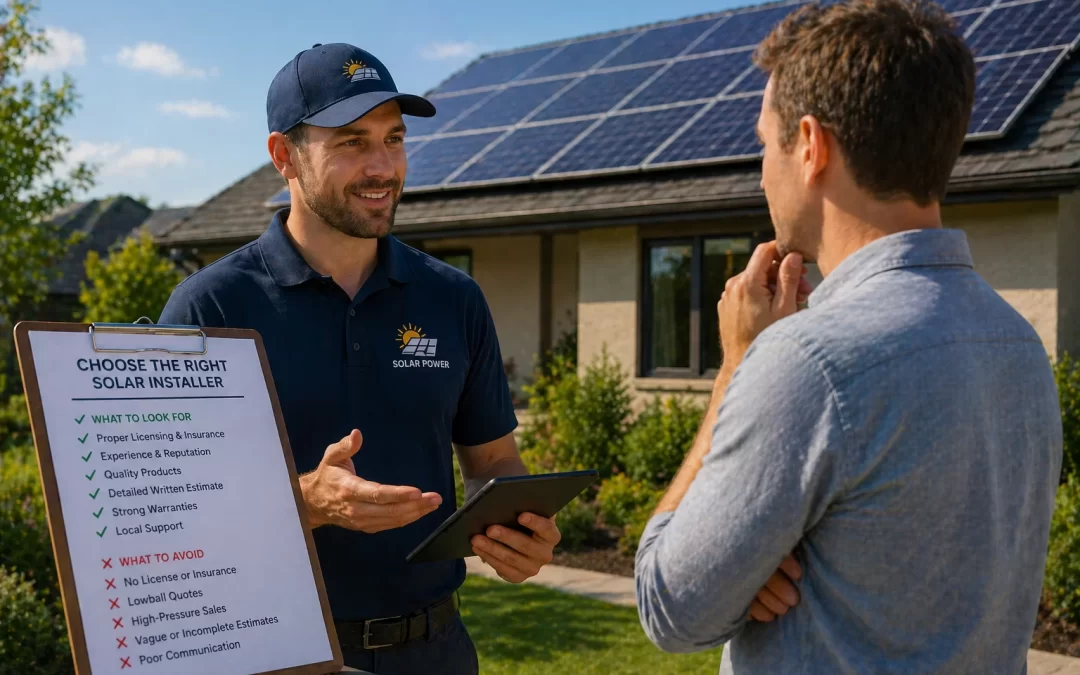
To choose a solar installer, focus on proven experience, proper licenses and insurance, strong warranties, and clear, pressure-free communication. Get at least 3 quotes from local, well-reviewed companies, and compare not just price but equipment quality, workmanship warranty, and projected savings. A good installer will explain your options in plain language, show you real numbers, and customize the system to your roof and utility rates. No installer is perfect, but avoiding high-pressure sales, vague contracts, and unrealistic savings claims will protect you from most bad experiences.
Choosing a solar installer is often the biggest and most confusing step in going solar. This guide is for U.S. homeowners who want straightforward, practical advice on how to pick the right company and avoid costly mistakes. We’ll walk through what to look for, what to question, and how to compare quotes so you can move forward confidently—or decide that now isn’t the right time.
Table of Contents
- How to Choose a Solar Installer: The Big Picture
- Licenses, Insurance, and Certifications
- Experience, Reputation, and Reviews
- Equipment Quality and Warranties
- Pricing, Proposals, and Real Numbers
- Red Flags: What to Avoid in a Solar Installer
- Local and Utility Factors That Matter
- Key Solar Numbers: Costs, Savings, and Payback
- How to Decide and What to Do Next
- Frequently Asked Questions
- Summary: How to Choose a Solar Installer
How to Choose a Solar Installer: The Big Picture
Choosing a solar installer is less about finding the absolute lowest price and more about finding a company you trust to design, build, and support a system on your roof for 25+ years. A good installer will act like a long-term partner, not a one-time salesperson.
At a high level, you want to evaluate each installer on:
- Credentials: Proper licenses, insurance, and (ideally) certifications
- Experience: Years in business and number of residential installs
- Reputation: Reviews, referrals, and how they handle problems
- Equipment: Panel, inverter, and racking brands and warranties
- Design quality: System size, layout, and realistic production estimates
- Financials: Clear pricing, payment options, and no hidden fees
- Support: Monitoring, maintenance, and how to get help if something breaks
Most homeowners will talk to a mix of local installers and larger regional or national companies. Each has pros and cons, so your job is to compare them on the same criteria and see who fits your home, budget, and comfort level best.
Licenses, Insurance, and Certifications
What this means and why it matters
Solar is electrical work on your roof, tied into your home’s main service panel and the utility grid. If it’s done wrong, you can face roof leaks, electrical hazards, or denied insurance claims. That’s why licenses and insurance are non-negotiable.
At minimum, your installer should have:
- The required state electrical or solar contractor license
- General liability insurance (commonly $1–$2 million coverage)
- Workers’ compensation insurance for their employees
Key credentials to look for
- State contractor license: Most states require a licensed electrical or solar contractor. Ask for the license number and verify it on your state’s contractor licensing website.
- NABCEP certification (optional but valuable): The North American Board of Certified Energy Practitioners (NABCEP) offers respected certifications for solar professionals. It’s not required, but it’s a good sign of training and professionalism.
- Manufacturer certifications: Some panel and inverter manufacturers certify installers. This can be required for extended warranties.
How to verify
- Ask the salesperson: “What licenses does your company hold, and under whose name?”
- Look up the company and license holder on your state’s licensing board website.
- Request a certificate of insurance showing current coverage and policy limits.
When credentials work in your favor
- They reduce the risk of unsafe work or failed inspections.
- They help protect you if there’s property damage or an injury on your property.
- They can be required by your utility or local building department for interconnection.
When credentials may be a concern
- If the company can’t or won’t provide a license number or proof of insurance.
- If the license is very new, but the company claims decades of experience.
- If the person doing the work is “working under” someone else’s license in a way that seems unclear or questionable.
Experience, Reputation, and Reviews
Why installer experience matters
Solar systems are expected to operate for 25–30 years. You want a company that knows how to design for your climate, roof type, and utility rules—and that is likely to be around to honor warranties.
Experience shows up in:
- How they size your system and explain your options
- How they handle tricky roofs, shading, or older electrical panels
- How smoothly they navigate permits and utility approvals
What to look for in reputation
- Years in business: Aim for at least 3–5 years installing residential solar under the current business name.
- Number of installs: Hundreds of completed residential projects is a good benchmark for a local installer; thousands for larger companies.
- Online reviews: Check Google, Yelp, Better Business Bureau, and solar-specific sites. Look at:
- Overall rating (4.0+ is a good sign)
- Recent reviews (last 6–12 months)
- How they respond to negative reviews
- Referrals: Ask for 2–3 recent customers in your area you can contact.
Red flags in reviews
- Repeated complaints about leaks, poor communication, or unfinished work
- Many reviews mentioning surprise costs or “bait and switch” pricing
- Recent reviews showing a sudden drop in service quality (could indicate new ownership or rapid growth they can’t handle)
When experience and reputation work in your favor
- Local installers with a long track record in your city often know your utility, inspectors, and roof types very well.
- Installers with many positive reviews and detailed responses to issues tend to handle problems better when they do arise.
When they might not
- A very large national company may offer lower prices but slower, less personal service.
- A newer company might be hungry and attentive but has less of a track record to rely on.
There’s no single “right” choice—just make sure you understand the trade-offs.
Equipment Quality and Warranties
Understanding the main components
Every quote you get should clearly list the major equipment:
- Solar panels: Convert sunlight into electricity.
- Inverter(s): Convert DC power from panels into AC power your home can use.
- Racking/mounting: Hardware that attaches panels to your roof.
- Monitoring system: Lets you track your system’s performance.
- Optional battery: Stores energy for backup or time-of-use savings.
Understanding what you’re getting helps you compare installers fairly.
Key numbers and warranty benchmarks
- Panel performance warranty: Typically 25–30 years, guaranteeing around 80–92% of original output at year 25.
- Panel product warranty: Usually 12–25 years against defects.
- Inverter warranty: Commonly 10–12 years for string inverters, 20–25 years for many microinverters and some optimizers.
- Workmanship (labor) warranty from installer: Often 5–10 years; better installers may offer 15–25 years.
What affects equipment choice
- Roof space: Smaller roofs may benefit from higher-efficiency panels.
- Shading: Shaded roofs often perform better with microinverters or optimizers.
- Budget: Premium brands cost more but may offer better warranties and performance.
- Local climate: Hot climates may favor panels with better temperature performance.
When equipment and warranties work in your favor
- When the installer offers tier-one panel brands with long warranties and a strong manufacturer behind them.
- When the installer’s workmanship warranty is long enough to cover roof and electrical issues that might show up later.
- When the quote clearly explains who handles warranty claims—you or the installer.
When they don’t
- If the installer uses unknown brands with short or vague warranties just to hit a low price.
- If the workmanship warranty is only 1–2 years, leaving you exposed to roof or wiring issues later.
- If the installer can’t explain the differences between equipment options in plain language.
Before you compare installers, it helps to understand the basics of panels, inverters, and batteries; our solar panels and equipment guide walks through the main choices in more detail.
Pricing, Proposals, and Real Numbers
How much does a solar system typically cost?
For a typical U.S. home, a residential solar system usually costs:
- Total system cost: About $28,000–$32,000 before incentives
- After 30% federal tax credit: Roughly $19,600–$22,400 (if you qualify and can use the credit—always confirm with a tax professional)
- Cost per watt: Typically $2.50–$3.50 installed
- Average panels needed: Around 15–25 panels for most homes, depending on panel wattage and your energy use
These are national averages; your actual cost will depend on your location, roof, equipment choices, and installer.
What should be in a good solar proposal?
A strong proposal from a reputable installer should include:
- Total system size: In kilowatts (kW), e.g., 8.5 kW
- Equipment list: Panel brand/model, inverter type, racking, and any battery
- System layout: A drawing showing where panels will go on your roof
- Production estimate: How many kilowatt-hours (kWh) per year the system should produce, with assumptions clearly stated
- Total price and cost per watt: Before and after incentives, with all fees included
- Incentives: Estimated federal and state/local incentives (with a note to confirm with a tax professional)
- Financing terms: If applicable—interest rate, term, fees, and total cost over time
- Warranties: For equipment and workmanship, in writing
What affects your price and savings
- Location and labor costs: Solar tends to cost more in high-cost-of-living areas.
- Roof complexity: Steep, multi-level, or tile roofs usually cost more than simple asphalt shingle roofs.
- Electrical upgrades: Older homes may need panel or service upgrades.
- Utility rates: Higher electricity rates usually mean higher savings from solar.
- Incentives: State and local rebates or performance payments can significantly change the math.
Realistic savings and payback
On average, U.S. homeowners see:
- Average annual savings: About $1,300–$1,500 on electricity bills
- Payback period: Roughly 7–9 years nationally, depending on your rates and incentives
- System life: Panels typically have a 25–30 year performance warranty and often last 30–35 years or more
Individual results vary widely. A good installer will show you a clear, conservative savings estimate based on your actual utility bills and local rates. For a deeper dive into how these numbers work, see our solar cost and savings guide.
When pricing and proposals work in your favor
- When you get at least 3 quotes and compare them on cost per watt, equipment, and warranties—not just total price.
- When the installer uses conservative assumptions for utility rate increases and system performance.
- When all fees (permits, interconnection, monitoring, etc.) are clearly included.
When they don’t
- If the proposal promises “no electric bill ever again” or extremely short payback periods (3–4 years) without solid justification.
- If the salesperson can’t clearly explain the financing terms, especially for loans or leases.
- If the price seems far below other quotes with similar equipment—this can signal corners being cut.
Red Flags: What to Avoid in a Solar Installer
Common warning signs
Some installers rely on aggressive sales tactics or cut corners to offer very low prices. Watch out for:
- High-pressure sales: “This price is only good today,” or “You’ll miss out on incentives if you don’t sign now.”
- Unrealistic claims: Guaranteed bill elimination, guaranteed home value increase, or “free solar” without explaining how.
- Vague contracts: Missing equipment details, no clear timeline, or unclear warranty terms.
- Door-to-door reps who can’t answer basic questions: Especially about who actually installs the system and who you call for service.
- Refusal to provide documentation: No license number, no proof of insurance, or no written proposal.
Contract and financing red flags
- Hidden escalators: Solar leases or power purchase agreements (PPAs) with annual payment increases you don’t fully understand.
- Large non-refundable deposits before design or permitting is complete.
- Ownership confusion: Not being clear whether you own the system, the lender does, or a third party does.
When to walk away
- If you feel rushed or pressured at any point.
- If the installer won’t put verbal promises in writing.
- If the numbers don’t add up or you don’t fully understand the proposal after asking questions.
A trustworthy installer will welcome your questions, encourage you to compare quotes, and give you time to think.
Local and Utility Factors That Matter
Why location changes the installer decision
Solar rules are highly local. Your state, city, and utility company all affect how your system is designed, what it’s worth, and how complex the process is. A good installer will be very familiar with your specific area.
Key local factors
- Net metering rules: How your utility credits you for extra solar power you send to the grid.
- Time-of-use (TOU) rates: Higher rates at certain times of day can change the value of solar and batteries.
- Local incentives: State or utility rebates, performance payments, or property tax exemptions.
- Permit and inspection process: Some cities are fast and straightforward; others are slow and strict.
- Roof and weather: Snow, hail, hurricanes, or extreme heat can affect equipment choices and mounting methods.
Questions to ask about local experience
- “How many systems have you installed in my city or with my utility?”
- “How does my utility’s net metering policy affect my savings?”
- “What local incentives might apply to my project?”
- “What’s the typical timeline for permits and utility approval here?”
When local expertise works in your favor
- Installers who regularly work with your utility can often avoid delays and design systems that maximize your credits.
- Local companies may better understand roof types common in your area and how they hold up over time.
When it might not
- A company new to your state or utility territory may underestimate permitting or interconnection challenges.
- Some national companies use subcontractors who may not be as familiar with local codes.
To understand the full process from contract to “permission to operate” with your utility, see our guide on how long solar installation takes and what happens at each step.
Key Solar Numbers: Costs, Savings, and Payback
Typical system size and cost
For a typical U.S. single-family home:
- System size: Often 6–10 kW, which usually means 15–25 panels depending on panel wattage.
- Installed cost: Around $28,000–$32,000 before incentives, or $2.50–$3.50 per watt.
- After 30% federal tax credit: Net cost often falls to about $19,600–$22,400, if you qualify and can use the credit (confirm with a tax professional).
Typical savings and payback
- Average annual bill savings: About $1,300–$1,500, depending on your electricity rates and system size.
- Payback period: Roughly 7–9 years nationally.
- System life: Panels usually have a 25–30 year performance warranty and often last 30–35 years or more.
Over the life of the system, many homeowners see total savings in the tens of thousands of dollars, but the exact amount depends heavily on your local utility rates and policies.
What most affects your personal numbers
- Your current electric bill: Higher bills usually mean more potential savings.
- Sun exposure: Shading, roof orientation, and local weather all affect production.
- Utility rate structure: Flat rates vs. time-of-use, and how net metering works.
- Incentives: Federal, state, and local incentives can significantly reduce net cost.
- Financing: Cash, loan, lease, or PPA all change your monthly cash flow and long-term cost.
When the numbers work in your favor
- You have high electric rates (often $0.18/kWh or more) and good sun exposure.
- Your state or utility offers strong incentives on top of the 30% federal tax credit.
- You plan to stay in your home at least 7–10 years to realize the payback.
When they might not
- Your electric rates are very low, or your usage is already minimal.
- Your roof is heavily shaded or faces mostly north (in the U.S.).
- You expect to move in a few years and your local market doesn’t yet value solar highly.
If you’re still deciding whether solar makes sense at all, our honest guide on whether solar is worth it walks through these trade-offs in more detail.
How to Decide and What to Do Next
Is now the right time to choose a solar installer?
It may be the right time to move forward if:
- You’ve gathered your last 12 months of electric bills.
- You plan to stay in your home for at least 7–10 years.
- Your roof is in good condition with no major replacement needed soon.
- You’re comfortable investing for long-term savings, not instant payoff.
If your roof is older or questionable, it’s wise to address that first; our guide on whether you need a new roof before solar can help you decide.
Information to gather before getting quotes
- 12 months of electric bills (or at least your average monthly kWh usage).
- Basic roof information: age, material (asphalt shingle, tile, metal), and any known issues.
- Your goals: maximum savings, lowest upfront cost, backup power, or environmental impact.
- Any plans that might change your usage: EV purchase, home addition, pool, or electrifying heating.
Questions to ask every installer
- “How did you size my system, and what percentage of my usage will it cover?”
- “What equipment brands and models are you proposing, and why?”
- “What are your workmanship and roof penetration warranties, in writing?”
- “Who handles permits, inspections, and utility interconnection?”
- “What is the total cost, cost per watt, and what is included or not included?”
- “How do you estimate my savings, and what assumptions are you using?”
- “If something breaks, who do I call and how quickly do you respond?”
Should you get multiple quotes?
Yes—getting at least three quotes is one of the best ways to protect yourself and find a good fit. Multiple quotes help you:
- See a realistic price range for your home and area.
- Compare equipment, warranties, and design approaches.
- Spot outliers—both very high and suspiciously low bids.
Once you have quotes in hand, compare them side by side on system size, cost per watt, equipment, warranties, and projected savings—not just the monthly payment.
Frequently Asked Questions
How many solar installer quotes should I get?
Aim for at least three quotes from reputable installers in your area. This gives you a realistic price range, lets you compare equipment and warranties, and makes it easier to spot offers that are too good to be true or overpriced.
Is it better to choose a local or national solar company?
Local installers often provide more personalized service and may know your utility and permitting process better. Larger national companies may offer lower prices or more financing options but can sometimes be slower or less flexible; the best choice is the company—local or national—that offers strong credentials, clear communication, and a solid track record in your area.
What is a good workmanship warranty from a solar installer?
A good workmanship warranty is typically at least 5–10 years, covering roof penetrations, wiring, and installation-related issues. Some higher-end installers offer 15–25 years; whatever the length, make sure the warranty is in writing and clearly states what is and isn’t covered.
How do I know if a solar installer is licensed and insured?
Ask the installer for their state contractor license number and proof of general liability and workers’ compensation insurance. You can verify the license on your state’s contractor licensing website and request a certificate of insurance showing current coverage.
Should I choose the cheapest solar quote?
Not automatically. A very low quote can mean cheaper equipment, shorter warranties, or rushed installation; instead, compare cost per watt, equipment quality, warranties, and the installer’s reputation. If a bid is much lower than others, ask detailed questions to understand what’s different before deciding.
Can I install solar panels myself instead of hiring an installer?
DIY solar is possible but comes with significant safety, permitting, and warranty risks, especially for roof-mounted, grid-tied systems. Most homeowners are better off with a professional installer; our guide on DIY solar vs. professional installation explains the trade-offs in detail.
Summary: How to Choose a Solar Installer
- Choose a solar installer with proper licenses, insurance, solid reviews, and clear, written warranties—these matter more than the absolute lowest price.
- Expect typical system costs of about $28,000–$32,000 before incentives and $19,600–$22,400 after the 30% federal tax credit, with a 7–9 year average payback, though your results will vary.
- Compare proposals on system size, cost per watt, equipment brands, workmanship warranty, and realistic production and savings estimates.
- Watch for red flags like high-pressure sales, vague contracts, and unrealistic promises such as “free solar” or guaranteed bill elimination.
- Your best next step is to gather your electric bills, clarify your goals, and get at least three detailed quotes from reputable installers so you can make a confident, informed decision.
If you’re ready to see what solar could look like on your home, the most helpful step is to get personalized quotes based on your roof, utility, and energy use. Start comparing trusted installers and real numbers at /get-my-quote/—no pressure, just clear information to help you decide if now is the right time to go solar.