
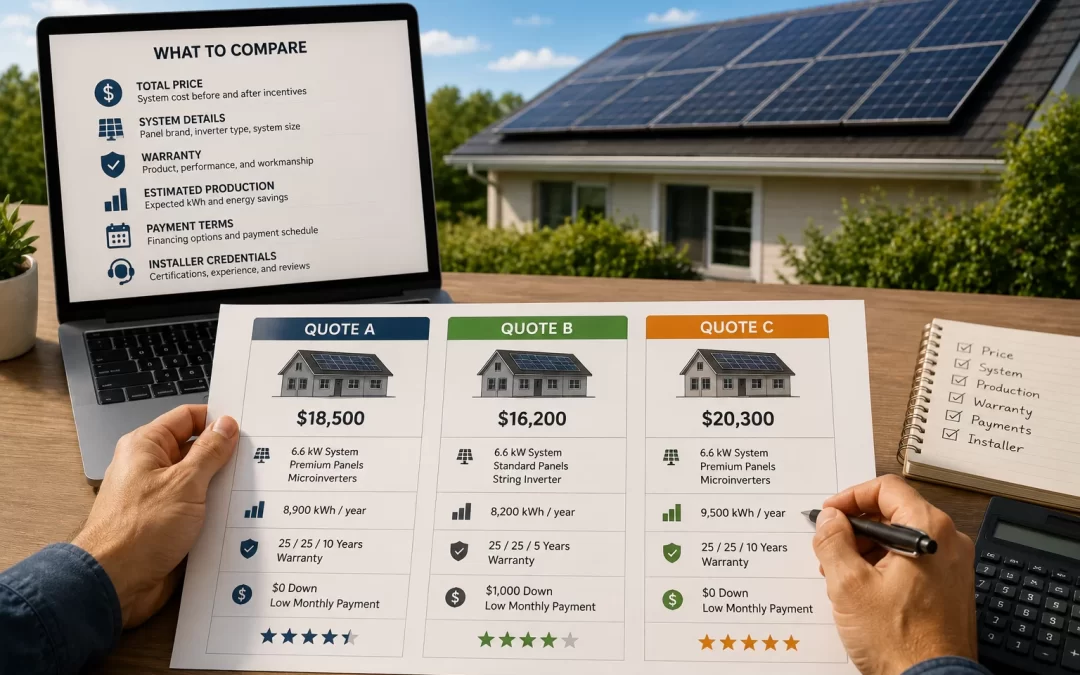
To read and compare solar quotes side by side, break each proposal into the same core pieces: system size (kW), total price, cost per watt, equipment quality, warranties, financing terms, and estimated savings. Put these numbers into a simple comparison table so you can see which quote offers the best value, not just the lowest monthly payment. Expect some differences in design and equipment between installers, and focus on long-term cost and reliability rather than short-term discounts. Keep in mind that every home is different, so the “best” quote is the one that fits your roof, budget, and risk tolerance, not necessarily the cheapest.
This guide walks you through exactly how to do that, step by step, using plain language and real numbers.
If you’re a U.S. homeowner collecting solar quotes and feeling overwhelmed, this article will help you understand what you’re looking at, what matters most, and how to choose confidently. We’ll also cover when solar quotes are a red flag and when it makes sense to walk away.
Table of Contents
- Why Comparing Solar Quotes Matters
- Anatomy of a Solar Quote: What Should Be Included
- Key Numbers to Compare Side by Side
- Comparing Cash, Loan, Lease, and PPA Quotes
- Equipment Quality and Warranties: Reading Between the Lines
- Energy Use, Assumptions, and Savings Modeling
- State, Utility, and Roof Factors That Change the Math
- Real Numbers: Typical Costs, Savings, and Payback
- Solar Quote Red Flags (When to Be Careful or Walk Away)
- How Many Quotes You Need and What to Do Next
- Frequently Asked Questions
- Summary: How to Choose the Best Solar Quote for You
Why Comparing Solar Quotes Matters
What this means in plain English
Two solar quotes that look similar on the surface can be very different in value. One might use higher-efficiency panels, better warranties, and more realistic savings estimates, while another leans on aggressive assumptions and low-quality equipment to look cheaper.
Comparing quotes side by side helps you:
- Avoid overpaying for the same size system
- Spot unrealistic savings or “too good to be true” offers
- Understand what you’re actually buying and who stands behind it
Why you can’t just look at the monthly payment
Many quotes highlight a low monthly payment, but that doesn’t tell you:
- The total cost over the life of the loan or lease
- Whether you or the solar company gets the 30% federal tax credit
- How long the equipment will last or how strong the warranties are
Always compare total system price, cost per watt, and long-term savings, not just the monthly number.
When comparing quotes works in your favor
- In competitive markets where multiple installers want your business
- When you’re flexible on equipment brands and installation dates
- When you’re willing to ask questions and push back on unclear terms
When comparing quotes can be misleading
- If you compare a small system to a much larger one without adjusting for size
- If one quote includes a battery and the others don’t
- If you only look at upfront price and ignore warranties and quality
Anatomy of a Solar Quote: What Should Be Included
Core elements every solar quote should show
A solid residential solar quote should clearly list:
- System size in kilowatts (kW)
- Number and model of panels (e.g., 20 × 400W panels)
- Inverter type and brand (string inverter, microinverters, or optimizers)
- Total system price before incentives
- Estimated net price after incentives (with a clear note that incentives are estimates)
- Cost per watt (total price ÷ total watts)
- Estimated annual production in kWh
- Estimated bill savings and payback period
- Warranties (equipment, workmanship, roof penetration)
- Financing details (loan term, interest rate, fees, who gets the tax credit)
What’s often missing (but you should ask for)
- Panel and inverter spec sheets (performance details)
- Shade analysis or production modeling assumptions
- Roof layout drawing showing panel placement
- Details on monitoring (app access, data granularity, fees)
- Who handles permits, inspections, and utility paperwork
How to quickly check if a quote is complete
Use this quick checklist:
- Do you see system size (kW), total price, and cost per watt?
- Are equipment brands and models named, not just “Tier 1 panels”?
- Are warranties spelled out in years and coverage, not just “industry leading”?
- Are financing terms (if any) fully disclosed?
If any of these are missing, ask the installer to update the quote before you compare it to others.
Key Numbers to Compare Side by Side
1. System size (kW) and number of panels
System size tells you how much power your solar array can produce under ideal conditions. It’s calculated as:
Number of panels × panel wattage ÷ 1,000 = system size in kW
For a typical U.S. home:
- Average system size: 6–10 kW
- Average panels needed: 15–25 panels, depending on panel wattage and your energy use
When comparing quotes, make sure you’re comparing similar system sizes. A 6 kW quote will almost always be cheaper than a 10 kW quote, but it may not cover your usage.
2. Total price and cost per watt
Two key numbers:
- Total system cost before incentives: typically $28,000–$32,000 for a standard residential system
- Cost per watt: typically $2.50–$3.50 per watt for professionally installed rooftop solar
Cost per watt lets you compare quotes of different sizes fairly. For example:
- Quote A: 8 kW system for $24,000 → $24,000 ÷ 8,000W = $3.00/W
- Quote B: 9 kW system for $27,000 → $27,000 ÷ 9,000W = $3.00/W
Even though Quote B is more expensive in total, both are the same cost per watt. Then you can compare equipment, warranties, and installer quality.
3. Incentives and the 30% federal tax credit
Most quotes will show an “after incentives” price. The biggest one is usually the 30% federal Investment Tax Credit (ITC), available through at least 2032. For a $30,000 system, the potential federal credit is about $9,000, bringing the net cost to around $21,000.
Important notes:
- Whether you can actually use the full tax credit depends on your tax situation — always confirm with a tax professional.
- Some leases and PPAs give the tax credit to the solar company, not you.
- State and utility incentives vary widely and may change over time.
4. Estimated savings and payback period
Most quotes will show:
- Estimated annual savings: often in the range of $1,300–$1,500 per year nationally
- Payback period: how many years until your savings equal your net cost, often 7–9 years on average
When comparing quotes:
- Check if they used the same utility rate and escalation (future rate increases).
- Be wary of very short payback claims (e.g., 3–4 years) unless you’re in a uniquely high-cost electricity market with strong incentives.
- Look for a realistic range, not a single “best case” number.
5. Warranties and workmanship
Key warranty numbers to compare:
- Panel performance warranty: typically 25–30 years
- Panel product warranty: usually 12–25 years
- Inverter warranty: often 10–25 years, depending on type and brand
- Workmanship / labor warranty: commonly 10–25 years
- Roof penetration warranty: often 10+ years
Longer, clearer warranties from reputable manufacturers and installers usually justify a slightly higher cost per watt.
Comparing Cash, Loan, Lease, and PPA Quotes
Cash purchase
With a cash purchase, you pay the full system cost upfront and own the system immediately.
- You typically get the 30% federal tax credit (if eligible).
- You avoid interest and financing fees.
- Your payback period is usually the shortest.
Cash is best if you have the funds available and plan to stay in your home for several years.
Solar loans
Solar loans let you spread the cost over time while still owning the system. When comparing loan-based quotes:
- Look at interest rate, loan term (often 10–25 years), and fees.
- Check whether the quote assumes you’ll make a large payment when you receive the tax credit.
- Compare the total amount paid over the life of the loan, not just the monthly payment.
A low monthly payment with a very long term can mean you pay much more overall.
Leases and Power Purchase Agreements (PPAs)
With a lease or PPA, a third party owns the system and you pay a fixed monthly fee or a per-kWh rate for the solar energy.
- You usually do not receive the tax credit — the solar company does.
- Upfront costs are often low or zero.
- Contracts typically last 20–25 years and may include annual price escalators.
When comparing a lease/PPA quote to ownership:
- Compare your total expected payments over the contract term to your current and projected utility bills.
- Check if there’s an escalator (e.g., 2–3% per year) and how that affects long-term savings.
- Understand what happens if you sell your home — can the contract transfer easily?
When each option works in your favor
- Cash: Best long-term savings if you can afford it.
- Loan: Good balance of ownership and manageable payments.
- Lease/PPA: May work if you can’t use the tax credit or don’t want to own the system, but read the contract very carefully.
Equipment Quality and Warranties: Reading Between the Lines
Panels: efficiency, brand, and warranty
Panel differences that matter:
- Efficiency: Higher-efficiency panels produce more power in the same roof space, helpful on small or shaded roofs.
- Brand reputation: Well-known manufacturers with long track records are generally safer bets.
- Warranty length: Look for at least 25-year performance and 20–25-year product warranties on premium panels.
Typical panel lifespan is 30–35 years, even though the performance warranty is usually 25–30 years.
Inverters: the “brains” of your system
Inverters convert DC power from panels into AC power for your home. Types include:
- String inverters: One central unit; often lower cost but less flexible with shading.
- Microinverters: One per panel; better for complex roofs and shading, often with longer warranties.
- Optimizers + string inverter: A hybrid approach that improves performance under shade.
Compare:
- Brand and model
- Warranty length (aim for 10–25 years)
- Monitoring capabilities
Workmanship and roof warranties
Even the best equipment can underperform if installed poorly. Look for:
- Workmanship warranty of at least 10 years, ideally longer
- Roof penetration warranty that covers leaks caused by the installation
- Clear language on what’s covered and how to file a claim
If your roof is older, it’s worth reading this guide on whether you need a new roof before installing solar so you don’t pay twice for roof work.
When paying more for better equipment makes sense
- You have limited roof space and need high-efficiency panels.
- Your roof has shading or multiple roof planes where microinverters or optimizers help.
- You plan to stay in the home long term and value long warranties and reliability.
When a lower-cost system may be fine
- You have plenty of unshaded roof space.
- You’re comfortable with standard-efficiency panels from a reputable brand.
- You prioritize upfront savings over premium features.
Energy Use, Assumptions, and Savings Modeling
How installers estimate your savings
Solar savings estimates are based on:
- Your past 12 months of electricity usage (in kWh)
- Your utility’s current rates and any time-of-use schedules
- Local sun conditions (solar resource)
- Shading, roof orientation, and tilt
- Assumed future utility rate increases (often 2–4% per year)
Two quotes can show very different savings if they use different assumptions, even for the same system size.
What to check in the assumptions
- Did they use your actual utility bills or just a rough estimate?
- What annual utility rate increase did they assume?
- Did they model shading from trees, chimneys, or nearby buildings?
- Are they assuming you’ll shift usage to daytime or add electric vehicles?
Ask each installer to share a summary of their modeling assumptions so you can compare apples to apples.
When savings estimates are likely realistic
- They’re based on your actual usage history.
- The assumed utility rate increase is modest (around 2–3% per year).
- The installer explains shading and production losses clearly.
When to be skeptical
- Very high projected savings with little explanation.
- Assumed utility rate increases of 5–7%+ every year without justification.
- No shading analysis or roof layout provided.
State, Utility, and Roof Factors That Change the Math
Location and utility policy
Where you live has a big impact on how to read and compare solar quotes:
- Electricity rates: Higher rates (e.g., parts of California, New England, Hawaii) usually mean faster payback.
- Net metering or export credits: Some states credit you at full retail rates for excess solar; others pay less.
- State incentives: Rebates, state tax credits, and performance payments can significantly lower net cost.
Two identical systems in different states can have very different savings and payback periods.
Roof condition and layout
Your roof affects both system design and cost:
- Roof age and condition: An older roof may need replacement before solar, adding to your total project cost.
- Roof complexity: Multiple roof planes, dormers, and obstructions can increase labor and hardware costs.
- Shading: Trees and nearby buildings can reduce production and change equipment choices.
If one quote is significantly more expensive, ask if your roof requires extra work or specialized equipment.
When your situation favors solar
- You have high electricity rates and good sun exposure.
- Your roof is in good condition with plenty of south-, east-, or west-facing space.
- Your state or utility offers strong incentives or fair net metering.
When solar may not be the right move (for now)
- Your roof needs major work soon and you’re not ready to replace it.
- You have heavy shading that can’t be reasonably addressed.
- Your electricity rates are very low and there are few incentives, making payback very long.
If you’re unsure whether solar makes sense at all, our honest solar worth-it guide walks through the main factors in more detail.
Real Numbers: Typical Costs, Savings, and Payback
National averages (your numbers will vary)
As of 2026, typical ranges for a professionally installed residential solar system in the U.S. are:
- System size: 6–10 kW for a typical home
- Total cost before incentives: $28,000–$32,000
- Cost per watt: $2.50–$3.50/W
- Net cost after 30% federal ITC: roughly $19,600–$22,400 (if you can use the full credit)
- Average annual bill savings: $1,300–$1,500
- Typical payback period: 7–9 years nationally
- Panel performance warranty: 25–30 years
- Typical panel life: 30–35 years
These are averages — your actual numbers depend on your usage, roof, local rates, and incentives.
How to use these numbers when comparing quotes
- If your cost per watt is far above $3.50/W without a clear reason (complex roof, battery, premium equipment), ask why.
- If your projected payback is much longer than 9–10 years, ask the installer to walk you through the assumptions.
- If your quote’s projected savings are far above the national average without strong justification, be cautious.
For a deeper dive into how costs and savings work together, see our solar cost and savings guide.
Solar Quote Red Flags (When to Be Careful or Walk Away)
Common red flags in solar quotes
- High-pressure tactics: “This price is only good today” or “You must sign now to get the incentive.”
- Vague equipment descriptions: “Tier 1 panels” with no brand or model listed.
- Unclear ownership: You’re not sure if it’s a loan, lease, or PPA.
- Missing total cost: Only a monthly payment is shown.
- Unrealistic claims: “Free solar,” “no cost to you,” or guaranteed huge savings.
Contract and warranty concerns
- Very short workmanship warranties (e.g., 1–5 years).
- Confusing or one-sided lease/PPA terms.
- No clear explanation of what happens if you sell your home.
- Penalties for early payoff or contract termination that seem excessive.
When to slow down or get a second opinion
- You feel rushed or pressured to sign.
- The salesperson can’t clearly explain the numbers or assumptions.
- The quote is dramatically cheaper than others without a clear reason.
In these cases, it’s wise to get additional quotes and consider working with installers who are transparent and patient in answering your questions. Our guide on how to choose a solar installer can help you know what to look for and avoid.
How Many Quotes You Need and What to Do Next
How many solar quotes should you get?
For most homeowners, 3–4 quotes from reputable installers is the sweet spot:
- One quote can be misleading.
- Two quotes give you a basic comparison.
- Three or four quotes show you the real price range and options in your area.
Information to gather before getting quotes
- 12 months of recent electric bills (kWh usage and total cost).
- Basic roof information: age, material, and any known issues.
- Your goals: lower bills, backup power, environmental impact, or all of the above.
- Whether you might add an EV, heat pump, or other major electric loads soon.
Questions to ask every installer
- What is the total system size (kW), total price, and cost per watt?
- Which panel and inverter brands and models are you quoting, and why?
- What are the equipment, workmanship, and roof warranties?
- How did you estimate my energy usage and savings?
- Who handles permits, inspections, and utility interconnection?
- What is the expected timeline from contract to permission to operate?
For a full overview of the installation process and timing, you can review our solar installation guide after you’ve narrowed down your quotes.
Is now the right time to act?
It may be a good time to move forward if:
- You’ve collected at least 3 quotes and understand the differences.
- The numbers (cost, savings, payback) look reasonable for your situation.
- Your roof is in good condition and you plan to stay in your home for several years.
It may be better to wait or reconsider if:
- Your roof needs replacement soon and you’re not ready to address it.
- Your quotes show very long payback periods or minimal savings.
- You feel pressured or confused by the offers you’ve received.
Frequently Asked Questions
What is the most important number to compare in solar quotes?
The most important number to compare is the cost per watt, because it lets you fairly compare different system sizes. After that, focus on equipment quality, warranty lengths, and realistic savings estimates, not just the lowest monthly payment.
How do I know if a solar quote is too expensive?
Compare the quote’s cost per watt to typical ranges of $2.50–$3.50 per watt for residential systems. If your quote is much higher without a clear reason (like a complex roof, premium equipment, or a battery), ask the installer to explain the difference and get additional quotes.
Should I choose the cheapest solar quote?
Not necessarily. A cheaper quote may use lower-quality equipment, weaker warranties, or overly optimistic savings assumptions. It’s usually better to choose a competitively priced quote from a reputable installer with strong warranties and clear, realistic projections.
How many solar quotes should I get before deciding?
Most homeowners should get 3–4 quotes from reputable installers. This gives you a good sense of the normal price range in your area and helps you spot outliers that are either too expensive or suspiciously cheap.
What if two solar quotes use different system sizes?
First, compare cost per watt to see which is priced more competitively. Then, check how much of your annual usage each system is designed to cover and whether the larger system is actually necessary for your goals and budget.
How can I tell if the savings in a solar quote are realistic?
Ask what assumptions the installer used for your energy usage, utility rate increases, and system production. Savings are more likely to be realistic if they’re based on your actual bills, modest rate increase assumptions, and a clear shading and production analysis.
Summary: How to Choose the Best Solar Quote for You
- Compare solar quotes side by side using the same key numbers: system size (kW), total price, cost per watt, equipment, warranties, financing terms, and estimated savings.
- Typical professionally installed systems cost about $28,000–$32,000 before incentives, or roughly $19,600–$22,400 after the 30% federal tax credit if you can use it.
- Average annual savings are around $1,300–$1,500, with a national payback period of 7–9 years, but your results depend heavily on your location, roof, and utility rates.
- Don’t choose based on price alone — installer reputation, equipment quality, and warranty strength often matter more over 25–30 years.
- Get 3–4 quotes, ask the same questions of each installer, and move forward when you understand the differences and the numbers make sense for your home.
Personalized quotes based on your roof, utility, and energy use are the only way to know which offer truly fits your home and budget. When you’re ready to see real numbers for your situation, you can request multiple competitive estimates through our site at /get-my-quote/ — with no pressure and no obligation to move forward.