
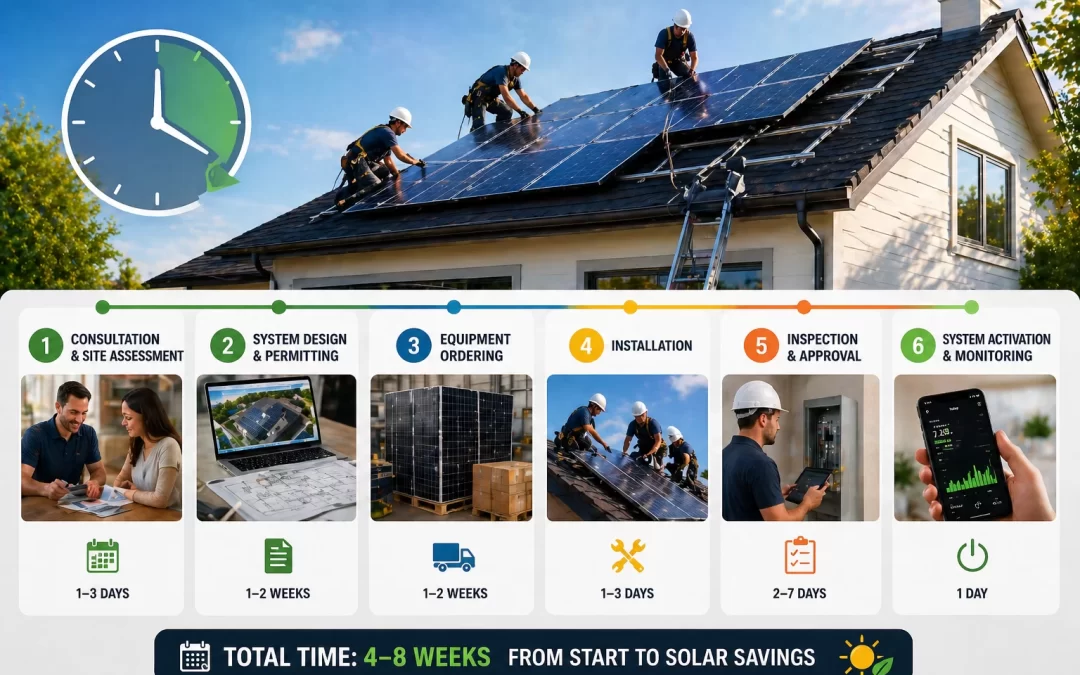
Most home solar installations take about 1–3 days of actual on-roof work, but the full solar installation timeline from signing a contract to turning your system on is usually 6–10 weeks. In some areas with slower permitting or utility approval, it can stretch to 3–4 months. The biggest delays are almost never the physical installation itself, but paperwork, inspections, and waiting for “permission to operate” from your utility. Timelines also vary based on your roof condition, local rules, and how busy your installer and utility are.
When homeowners ask “How long does solar installation take?”, they’re usually trying to understand how disruptive the process will be and when they’ll actually start saving money. This guide walks through the full timeline step-by-step, from your first quote to the day your system is turned on. It’s written for U.S. homeowners with little or no solar experience who want realistic expectations, not sales promises.
Table of Contents
- Solar Installation Timeline at a Glance
- Step-by-Step: From Quote to Turn-On
- What Affects How Long Solar Installation Takes?
- State and Utility Differences in Solar Timelines
- Key Numbers: Time, Cost, Savings, and Payback
- When Solar Moves Quickly — and When It Doesn’t
- What to Do Before You Sign a Solar Contract
- Frequently Asked Questions
- Summary: How Long Solar Installation Takes
- Next Step: Get a Timeline and Quote for Your Home
Solar Installation Timeline at a Glance
There are really two timelines to think about:
- On-site installation time – how long crews are at your home
- Full project timeline – from contract to system turn-on
For a typical U.S. home:
- On-site installation: 1–3 days for most roof-mounted systems
- Design & permitting: 2–6 weeks, depending on your city/county
- Inspections & utility approval (PTO): 2–6 weeks after installation
- Total project time: about 6–10 weeks is common, 3–4 months in slower areas
The physical work is relatively quick. The “hurry up and wait” parts are usually:
- Local building permits
- Utility interconnection approval
- Scheduling city/utility inspections
Step-by-Step: From Quote to Turn-On
1. Initial Research and Quotes (1–3 weeks)
This is the part you control most. You’re:
- Learning whether solar makes sense for your home and bills
- Gathering quotes from 2–3 reputable installers
- Comparing equipment, warranties, and pricing
Most homeowners spend 1–3 weeks here, but you can move faster or slower. Before diving into timelines, it can help to understand the bigger picture of costs and savings; our solar cost and savings guide walks through the key numbers.
2. Site Visit and Final Proposal (3–10 days)
Once you’ve narrowed down installers, they’ll usually:
- Do a virtual or in-person site visit
- Measure your roof and check shading
- Review your electric bills
- Confirm your main electrical panel can handle solar
After this, you’ll receive a final proposal with system size, layout, equipment, and price. This step typically takes 3–10 days from first contact to a final, signable proposal.
3. Contract Signing and Financing Approval (1–7 days)
Once you choose an installer and sign:
- Cash buyers move forward immediately
- Loan or lease customers complete a credit check and loan documents
Financing approval is often same-day, but can take up to a week. After this, your installer can start formal design and permitting.
4. System Design and Engineering (3–14 days)
Next, the installer’s design team creates:
- A detailed roof layout (where each panel goes)
- Electrical diagrams
- Structural calculations if required by your building department
For a typical home, this design phase takes about 3–14 days. Complex roofs, ground mounts, or battery systems can take longer.
5. Permitting and Utility Interconnection Application (2–6 weeks)
This is often the longest part of the solar installation timeline and is mostly out of your and your installer’s control. Your installer will:
- Submit plans to your city or county building department for a permit
- Submit an interconnection application to your utility (for grid connection and net metering, if available)
Typical timeframes:
- Fast jurisdictions: 1–2 weeks
- Average: 3–4 weeks
- Slow or backlogged areas: 6+ weeks
Some cities and utilities approve quickly; others are known for delays. Your installer should be able to tell you what’s typical in your area.
6. Scheduling Your Installation Day (3–14 days)
Once permits are approved and materials are ready, your installer will schedule the installation crew. How long this takes depends on:
- How busy the installer is (seasonal demand can spike)
- Weather conditions
- Your availability for installation dates
Most homeowners are scheduled within 3–14 days after permits are in hand, but in peak seasons it can be longer.
7. On-Site Solar Installation (1–3 days)
This is the part most people think of when they ask “How long does solar installation take?” For a typical 5–10 kW residential system (about 15–25 panels):
- 1 day – simple, single-story roof, no upgrades
- 2 days – average home, minor electrical work
- 3+ days – complex roofs, tile roofs, or systems with batteries
During installation, crews will:
- Install roof mounts and racking
- Attach and wire the solar panels
- Install inverters and safety shutoffs
- Connect to your main electrical panel
If you want a detailed walkthrough of what happens on installation day, see what to expect on solar installation day.
8. City/County Inspection (3–14 days after install)
After the system is installed but before it can be turned on, your local building department usually needs to inspect it. The inspector checks:
- That the system matches the approved plans
- Electrical safety and labeling
- Roof attachments and structural elements
Scheduling and passing inspection typically takes 3–14 days, depending on how busy your local inspectors are. If the inspector requires corrections, your installer will fix them and schedule a re-inspection.
9. Utility Permission to Operate (PTO) (2–6 weeks)
Even after passing inspection, you usually can’t turn your system on until your utility grants Permission to Operate (PTO). This is the utility’s formal approval to connect your solar system to the grid.
Typical PTO timelines:
- Fast utilities: 1–2 weeks
- Average: 3–4 weeks
- Slow or high-volume utilities: 6+ weeks
Some utilities also require a separate meter swap or net meter installation, which can add time. For a deeper dive into this step, see our guide on what Permission to Operate is and why it takes so long.
10. System Turn-On and Monitoring Setup (Same day as PTO)
Once PTO is granted, your installer (or you, following their instructions) will:
- Turn on the system breakers and inverter
- Confirm the system is producing power
- Set up your monitoring app or web portal
This usually happens the same day you receive PTO or within a day or two, depending on scheduling.
What Affects How Long Solar Installation Takes?
Even with a typical 6–10 week solar installation timeline, your actual experience can be faster or slower. The main factors are:
1. Your Location and Local Government
Every city and county has its own permitting process. Timelines depend on:
- Whether your area has streamlined solar permitting
- How busy the building department is
- Whether your home is in a historic district or HOA
Some jurisdictions offer “over-the-counter” or same-week permits for standard solar designs. Others may take several weeks and require multiple review cycles.
2. Your Utility Company
Utilities control how quickly they:
- Review and approve interconnection applications
- Schedule meter swaps (if needed)
- Issue Permission to Operate
Utilities with lots of solar experience tend to be faster. In areas where solar is newer or growing quickly, backlogs are common.
3. Roof Condition and Electrical Upgrades
Your home’s condition can add time if upgrades are needed before or during installation:
- Roof issues: If your roof is near the end of its life, you may need to replace it before installing solar, which can add weeks. Our guide on whether you need a new roof before solar explains how to decide.
- Main panel upgrade: If your electrical panel is old or undersized, upgrading it can add 1–3 weeks for permitting and scheduling.
- Structural work: Rare, but possible for older homes or unusual roof structures.
4. System Complexity
Simple systems move faster. More complex setups take longer to design, permit, and install. Complexity factors include:
- Adding battery storage
- Multiple roof planes or steep roofs
- Ground-mounted systems
- Large systems (for very high usage homes)
5. Installer Workload and Organization
Not all installers manage timelines equally well. Your experience depends on:
- How many crews they have
- How organized their permitting and scheduling teams are
- How busy they are in your area
When comparing companies, ask each one for their current average timeline from contract to PTO in your city. Our guide on how to choose a solar installer covers what else to look for and avoid.
6. Your Responsiveness
A smaller factor, but still important. Delays can happen if:
- You take a long time to sign documents or approve designs
- The installer can’t reach you to schedule site visits or inspections
- HOA approvals are slow because paperwork isn’t submitted promptly
State and Utility Differences in Solar Timelines
Solar installation timelines vary across the U.S. because of different policies, permitting rules, and utility processes.
States Where Solar Often Moves Faster
States with mature solar markets and streamlined processes tend to have smoother timelines, such as:
- California
- Arizona
- Nevada
- New Jersey
- Massachusetts
- New York (certain utilities and municipalities)
These states often have:
- Standardized solar permit checklists
- Online permit submissions
- Utilities familiar with high solar volumes
States Where Timelines Can Be Less Predictable
In some regions, timelines can be more variable because solar is newer or policies are changing quickly, including:
- Parts of the Midwest and Southeast
- Rural areas with smaller utilities or co-ops
- Regions with recent changes to net metering or interconnection rules
In these areas, it’s especially important to ask local installers about:
- Typical permitting times in your city or county
- How long your specific utility is taking for PTO
- Any known bottlenecks or seasonal slowdowns
HOAs and Historic Districts
If you live in a homeowners association (HOA) or historic district:
- You may need HOA or design review board approval before permitting
- There may be restrictions on panel placement visible from the street
- Approval can add 1–4 weeks depending on meeting schedules
Many states have “solar access” laws that limit how much HOAs can restrict solar, but they can still influence aesthetics and add time to the process.
Key Numbers: Time, Cost, Savings, and Payback
Understanding how long solar installation takes is easier when you see it alongside the main financial numbers most homeowners care about.
Typical System Size and Equipment
- Average system size: 6–10 kW for a typical U.S. home
- Average number of panels: 15–25 panels, depending on panel wattage
- Panel lifespan: 25–30 years performance warranty, 30–35 years typical life
Larger systems may add a bit of time to installation day, but they don’t usually change permitting or PTO timelines significantly.
Cost and Payback Benchmarks
As of 2026, national averages for residential solar are roughly:
- Cost per watt: $2.50–$3.50
- Total system cost: $28,000–$32,000 before incentives for a typical home
- After 30% federal tax credit (ITC): about $19,600–$22,400 (if you qualify; consult a tax professional)
- Average annual electric bill savings: $1,300–$1,500
- Typical payback period: 7–9 years nationally
These are broad averages. Your actual numbers depend on:
- Your local electricity rates
- How much sun your roof gets
- State and local incentives
- Whether you add batteries or other upgrades
For a deeper look at whether the wait and upfront cost are worth it for your home, see our honest guide on whether solar is worth it.
How Time to Install Relates to Financial Benefits
While waiting a few extra weeks for permits or PTO can be frustrating, it usually doesn’t change the long-term math much. Over a 25–30 year system life:
- A 2–3 month project timeline is a small fraction of the total benefit period
- Most of your savings come from decades of lower electric bills, not from starting a few weeks earlier
Where time does matter is if:
- A major incentive or net metering policy is scheduled to change soon
- You’re planning to sell your home in the near future and want solar installed beforehand
When Solar Moves Quickly — and When It Doesn’t
When Solar Installation Timelines Work in Your Favor
You’re more likely to have a smooth, relatively fast experience if:
- Your roof is in good condition and doesn’t need replacement
- Your electrical panel is modern and has enough capacity
- You choose a straightforward roof-mounted system without batteries
- You live in a city with streamlined solar permitting
- Your utility has a clear, established PTO process
- You respond quickly to design approvals and paperwork
In these situations, it’s realistic to go from contract to turn-on in about 6–8 weeks.
When Solar Timelines Can Be Long or Frustrating
On the other hand, you may face a longer timeline (10–16+ weeks) if:
- Your roof needs replacement before solar
- You need a main panel upgrade or other electrical work
- You’re adding battery storage, especially in areas where it’s less common
- Your city or county has slow or paper-based permitting
- Your utility is backlogged with interconnection applications
- You live in an HOA or historic district with extra approval steps
None of these are deal-breakers, but they do mean you should start the process earlier if you’re trying to hit a specific deadline (like summer air-conditioning season or a move date).
When Waiting Might Be the Right Choice
There are also situations where it might make sense to delay starting your solar project:
- You know you’ll be replacing your roof in the next 1–2 years
- You’re planning a major remodel that will change your roof layout or electrical system
- You’re uncertain about staying in the home long enough to see the payback
- Your local policies or incentives are in flux and may improve soon
In these cases, it can still be useful to get quotes now so you understand your options, but you may choose to wait before signing a contract.
What to Do Before You Sign a Solar Contract
Because so much of the solar installation timeline depends on factors outside your control, it’s important to focus on what you can control before you sign.
1. Gather Key Information About Your Home
Before getting quotes, have these ready:
- 12 months of electric bills (or at least a few recent ones)
- Basic roof details: age, material (asphalt shingle, tile, metal), and any known issues
- Photos of your main electrical panel (inside and outside with the door open)
- Any HOA or historic district rules you’re aware of
2. Ask Installers Specific Timeline Questions
When you talk to installers, ask:
- “What is your average timeline from contract to PTO in my city and with my utility?”
- “What are the biggest causes of delays in this area?”
- “Do you handle all permitting and utility paperwork, or will I need to do anything?”
- “If my project is delayed, how will you keep me updated?”
Good installers will answer these clearly and honestly, and they’ll base their answers on recent projects in your area.
3. Decide If You Need a New Roof or Electrical Upgrades First
If your roof is older than about 15–20 years, or if you have an older electrical panel, it’s worth asking:
- “Do you recommend replacing my roof before installing solar?”
- “Will my main panel need to be upgraded, and how does that affect the timeline?”
Handling these proactively can prevent mid-project surprises that add weeks to your schedule.
4. Get Multiple Quotes
Because installers differ in how they manage design, permitting, and scheduling, getting 2–3 quotes is smart. You’ll see:
- Different proposed system sizes and equipment
- Different price points and financing options
- Different promised timelines and communication styles
Comparing these side by side helps you choose not just the best price, but the company most likely to deliver a smooth, on-time installation.
Frequently Asked Questions
How long does it take to install solar panels on my roof?
For most homes, the actual on-roof solar installation takes 1–3 days of work by a professional crew. The full process, including design, permits, inspections, and utility approval, usually takes 6–10 weeks from contract signing to system turn-on.
What part of the solar installation process takes the longest?
The longest parts are usually permitting and utility Permission to Operate (PTO), not the physical installation. Local building departments and utilities can take anywhere from 2–6 weeks each to review and approve your project, depending on how busy they are.
Can I speed up the solar installation timeline?
You can’t control permitting or utility timelines, but you can help by choosing an experienced local installer, responding quickly to design approvals and paperwork, and resolving roof or electrical issues before starting. Asking installers about their recent average timelines in your area also helps you avoid chronic delays.
Do I need to be home during solar installation?
You typically need to be home at the start and end of installation so the crew can access your electrical panel and any locked areas. For most of the 1–3 day installation, you don’t need to be actively involved, and you can usually stay in the home as normal.
Will bad weather delay my solar installation?
Yes, heavy rain, snow, or high winds can delay roof work for safety reasons. If weather forces a reschedule, your installer will typically move you to the next available slot, which may add a few days to your timeline during busy seasons.
How far in advance should I start the solar process?
If you have a target date in mind—like summer cooling season or a move date—start the solar process 3–4 months ahead to be safe. That gives you time for research, quotes, permitting, and any unexpected delays without rushing decisions.
Summary: How Long Solar Installation Takes
- Most homeowners see a 6–10 week total solar installation timeline from contract to system turn-on, with 1–3 days of actual on-site work.
- The slowest steps are usually permitting and utility Permission to Operate, not the physical installation.
- Location, utility, roof condition, system complexity, and installer organization have the biggest impact on how long your project takes.
- Typical systems cost $28,000–$32,000 before incentives and pay back in about 7–9 years on average, with 25–30 years of expected panel performance.
- Your best next step is to gather your electric bills, ask local installers for their recent timelines, and compare 2–3 detailed quotes.
Next Step: Get a Timeline and Quote for Your Home
Every home, utility, and city is a little different, so the only way to know your true solar installation timeline is to get a personalized assessment. A good installer will look at your roof, your electric usage, and your local permitting and utility processes to give you a realistic schedule—not just a best-case promise.
If you’re ready to see what solar would look like for your home, including timing, cost, and savings, you can request multiple no-obligation quotes at /get-my-quote/. Comparing offers side by side helps you choose the right installer and start your project with clear expectations.