
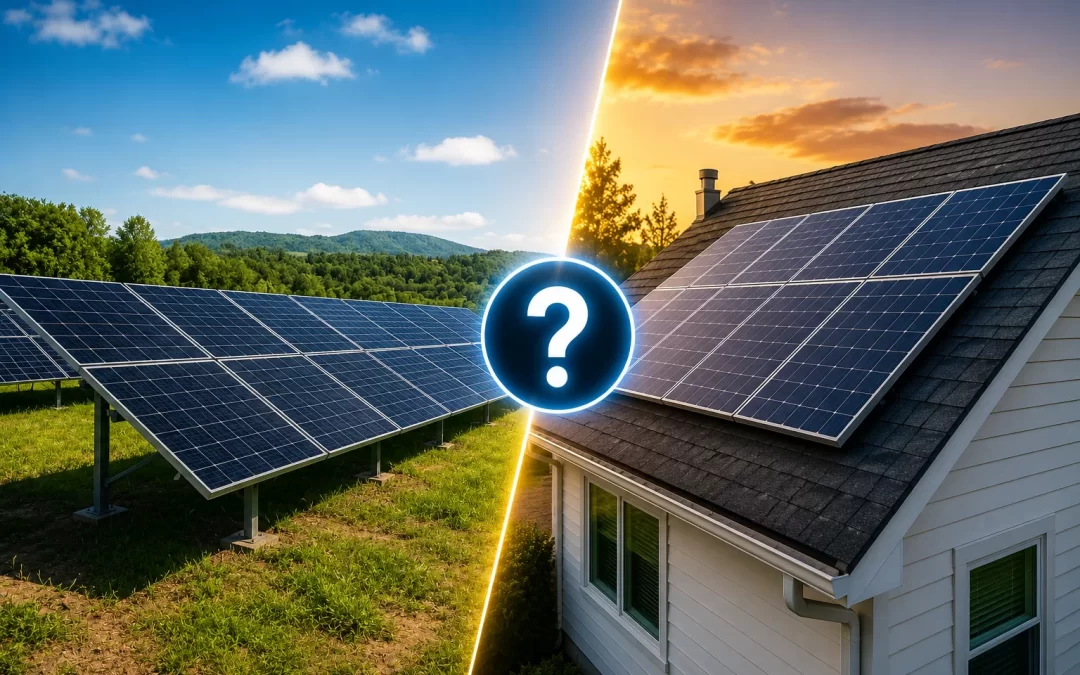
Ground-mounted vs. rooftop solar: which is right for you? For most U.S. homeowners, rooftop solar is the default choice because it usually costs less, uses existing space, and is simpler to permit. Ground-mounted solar makes more sense if your roof is shaded, too small, in poor condition, or you have plenty of open land and want maximum production. In many cases, both options can work, but the “best” choice depends on your roof, yard, budget, and local rules. A reputable installer should price and model both options so you can compare real numbers, not just theory.
Choosing between ground-mounted and rooftop solar is one of the first big decisions in a solar project. This guide is written for U.S. homeowners who want clear, no-jargon guidance on which option fits their home, property, and budget. We’ll walk through costs, performance, permitting, and real-world pros and cons so you can move toward quotes with confidence.
Table of Contents
- Ground-Mounted vs. Rooftop Solar: The Basics
- Cost Comparison: Ground-Mounted vs. Rooftop Solar
- Performance and Efficiency Differences
- Property and Site Factors That Affect Your Choice
- Permitting and Utility Considerations
- Maintenance, Durability, and Lifespan
- When Rooftop Solar Usually Makes More Sense
- When Ground-Mounted Solar Usually Makes More Sense
- Key Numbers: Costs, Savings, and Payback
- Decision Guide: How to Choose and What to Do Next
- Frequently Asked Questions
- Summary: Key Takeaways
Ground-Mounted vs. Rooftop Solar: The Basics
What each option actually is
Rooftop solar means panels are attached to your home’s roof using rails and mounting hardware. The roof structure supports the weight, and wiring runs down into your electrical panel.
Ground-mounted solar uses posts or a metal frame anchored into the ground, usually in your yard or on unused land. Panels sit on this structure instead of on your house.
Both systems use the same core equipment:
- Solar panels
- Inverters (to convert DC to AC power)
- Racking (mounting hardware)
- Wiring and safety disconnects
Key differences in plain language
- Location: Roof vs. yard or open land.
- Cost: Ground mounts usually cost more per watt because of extra materials and labor.
- Flexibility: Ground mounts can be placed and angled for best sun; roofs are fixed.
- Space: Rooftop uses space you already have; ground mounts take up yard or land.
- Access: Ground systems are easier to reach for cleaning and repairs.
Who each option is usually best for
Rooftop solar is usually best if:
- Your roof is in good condition and gets decent sun
- You don’t want to give up yard space
- You want the lowest upfront cost for the same size system
Ground-mounted solar is usually best if:
- Your roof is shaded, complex, or near the end of its life
- You have a large, sunny yard or acreage
- You want to maximize production or plan for future electric loads (EVs, heat pumps, pool, etc.)
Cost Comparison: Ground-Mounted vs. Rooftop Solar
Typical cost ranges
For a typical U.S. home, a residential solar system (rooftop or ground) generally falls in these ranges:
- Average system size: 6–10 kW (about 15–25 panels)
- Average rooftop cost: $2.50–$3.50 per watt installed
- Typical rooftop system price: $28,000–$32,000 before incentives for a full system
- After 30% federal tax credit (ITC): about $19,600–$22,400 (if you qualify; talk to a tax professional)
Ground-mounted systems usually cost more per watt because of extra materials (posts, concrete, trenching) and labor:
- Typical ground-mount cost: roughly $3.00–$4.25 per watt in many markets
- That same 8 kW system might cost $24,000–$34,000 before incentives
These are national averages; your actual quote will depend on your location, roof or soil conditions, equipment choices, and installer pricing.
Why ground mounts usually cost more
Ground-mounted solar adds costs that rooftop systems avoid:
- Foundations: Posts driven into the ground or concrete footings
- Trenching: Digging and conduit to run wires from the array to your home
- Extra racking: More steel or aluminum to support the array
- Site work: Grading, vegetation clearing, or fencing in some areas
On the other hand, rooftop solar uses your existing roof structure as the base, so less material is needed.
When rooftop solar is cheaper
Rooftop solar usually wins on cost when:
- Your roof is in good shape and doesn’t need replacement soon
- You have a simple roof (few dormers, chimneys, or complex angles)
- Your electrical panel is reasonably close to the roof area
In these cases, installers can work faster and use less material, which keeps your cost per watt down.
When ground mounts can be cost-competitive
Ground-mounted solar can be closer in price—or even cheaper—when:
- Your roof is very complex or steep, increasing rooftop labor costs
- Your roof needs replacement or structural upgrades to support solar
- You have very easy ground conditions (flat, open, good soil, short trench run)
- You want a larger system than your roof can handle, spreading fixed costs over more watts
In some rural or suburban areas with plenty of land and simple installations, the cost gap between rooftop and ground mount can be small.
Performance and Efficiency Differences
How much more energy can a ground mount produce?
Ground-mounted solar often produces more energy per panel because you can:
- Point the panels directly south (in the U.S.) for maximum sun
- Set the tilt angle close to your latitude for better year-round output
- Avoid shading from trees, chimneys, or nearby buildings more easily
Depending on your roof’s orientation and shading, a well-designed ground mount can produce 5–25% more energy from the same number of panels.
Roof orientation and tilt vs. ground flexibility
Rooftop solar is limited by your existing roof:
- If your best roof face is east or west, you’ll get less midday production than a south-facing array
- If your roof is low-slope or flat, tilt racks may be needed, adding cost and wind considerations
Ground-mounted solar is flexible:
- Installers can choose the best orientation and tilt for your location
- Rows can be spaced to avoid one row shading another in winter
- In some cases, you can use tracking systems that follow the sun (higher cost, higher output)
Impact on payback and savings
Higher production from a ground mount can improve your long-term savings, but only if the extra energy outweighs the higher upfront cost. For example:
- If a rooftop system costs $25,000 and produces 10,000 kWh/year
- And a ground mount costs $30,000 but produces 11,500 kWh/year (15% more)
- The ground mount may still have a slightly longer payback because of the higher initial price
Your installer should model both options with your actual utility rates and usage so you can compare payback periods side by side.
Property and Site Factors That Affect Your Choice
Roof condition and age
If your roof is near the end of its life, rooftop solar may require a replacement first. Many installers recommend your roof have at least 15–20 years of life left before adding solar.
If you’re unsure about your roof, it’s worth reviewing whether you need a new roof before installing solar. If a new roof is required, that cost can tilt the math toward a ground mount, especially if you have good land available.
Yard space and layout
Ground-mounted solar needs clear, usable space. As a rough guide:
- Each kilowatt (kW) of solar needs about 75–100 square feet of area
- A typical 8 kW system may need 600–800 square feet of open, sunny ground
Ground mounts work best when you have:
- A relatively flat or gently sloped area
- Minimal shading from trees or buildings
- Room to maintain setbacks from property lines and structures (often 3–10 feet, depending on local code)
Shading and trees
Shading is one of the biggest performance killers for solar. If your roof is shaded for much of the day, a ground mount placed in a sunnier part of your property can dramatically improve output.
However, if your entire property is heavily treed and you don’t want to remove trees, neither rooftop nor ground-mounted solar may perform well enough to justify the investment.
Soil, frost, and ground conditions
Ground-mounted systems rely on posts or concrete in the soil. Costs can increase if:
- Your soil is rocky or hard to drill
- You’re in a cold climate with deep frost lines (requiring deeper foundations)
- Your site is on a steep slope that needs grading
In contrast, rooftop systems are more affected by roof structure and materials than by soil conditions.
HOA and aesthetic considerations
Some homeowners associations (HOAs) are more comfortable with rooftop solar than with visible ground arrays, while others may prefer ground mounts that are out of sight.
- Many states have “solar access” or “solar rights” laws that limit HOA restrictions, but rules vary
- Ground mounts may require fencing or landscaping to meet aesthetic or safety requirements
If aesthetics or HOA rules are a concern, get written guidelines from your HOA early and share them with your installer.
Permitting and Utility Considerations
Permits for rooftop vs. ground-mounted solar
Both rooftop and ground-mounted solar usually require:
- Electrical permits
- Building or structural permits
- Sometimes zoning or planning approvals (especially for ground mounts)
Ground mounts can trigger extra review because they are considered separate structures. Local rules may address:
- Height limits
- Setbacks from property lines, roads, and buildings
- Stormwater or erosion control in some areas
For a deeper look at the process, see what permits you need to install solar panels and how they affect your timeline.
Utility interconnection and PTO
Whether your system is on the roof or on the ground, your utility company still needs to approve how it connects to the grid. This process is called interconnection, and final approval is often known as Permission to Operate (PTO).
Ground mounts don’t usually change the utility process, but they can add:
- Longer wire runs, which may require larger wire sizes
- More detailed site plans for utility review
For timing expectations, it helps to understand what Permission to Operate is and why it can take a while.
Timeline differences
Rooftop solar is often faster to install because:
- Permitting is more standardized
- No site grading or foundation work is needed
- Install crews are very familiar with rooftop workflows
Ground mounts can add days or weeks for:
- Site prep and trenching
- Concrete curing (if used)
- Additional inspections
Overall, a full solar project (design, permits, installation, and PTO) often takes 1–3 months. Ground mounts tend to be on the longer end of that range. For a step-by-step view, see how long solar installation takes from start to finish.
Maintenance, Durability, and Lifespan
Panel lifespan and warranties
Both rooftop and ground-mounted systems use the same panels and inverters, so core lifespans are similar:
- Panel performance warranty: typically 25–30 years
- Real-world panel life: often 30–35+ years with gradual output decline
- Inverters: usually 10–15 years for string inverters, 20–25 years for many microinverters (warranties vary)
Mounting location doesn’t change the basic lifespan, but it can affect how easy it is to maintain the system.
Maintenance differences
Ground-mounted solar is easier to access:
- Cleaning panels (if needed) is safer and simpler from the ground
- Inspecting wiring and connections is more straightforward
- Repairs don’t require roof work or specialized fall protection
Rooftop solar is more “set and forget” for most homeowners:
- Panels are out of the way and less likely to be disturbed
- Snow may slide off more easily on steeper roofs
- Less risk of physical damage from lawn equipment or people
Weather and damage risk
Both system types are designed to withstand local wind and snow loads according to building codes. However:
- Ground mounts may be more exposed to damage from vehicles, lawn mowers, or animals
- Rooftop systems rely on the roof’s integrity; leaks or roof damage can affect the array
In high-wind or heavy-snow regions, your installer will design the mounting system (roof or ground) to meet local structural requirements.
When Rooftop Solar Usually Makes More Sense
Situations where rooftop is the better fit
Rooftop solar is often the right choice when:
- Your roof is in good condition with at least 15–20 years of life left
- You have a large, mostly south-, east-, or west-facing roof with minimal shading
- You live on a small lot or don’t want to give up yard space
- You want the lowest upfront cost for a given system size
- Your HOA or local rules favor less-visible installations
Advantages of rooftop solar
- Lower cost per watt: No need for ground foundations or long trench runs
- Space-efficient: Uses existing roof area instead of your yard
- Often faster to permit and install: More standardized process
- Less visible in many cases: Especially on back roof faces
When rooftop solar may not be ideal
Rooftop solar can be a poor fit when:
- Your roof is heavily shaded and you’re unwilling to remove trees
- Your roof is old or needs replacement soon, adding major cost
- Your roof layout is chopped up with dormers, skylights, or vents, limiting panel space
- You have structural concerns (very old framing, unusual materials)
In these cases, a ground mount—or waiting until after a roof replacement—may be smarter.
When Ground-Mounted Solar Usually Makes More Sense
Situations where ground mounts shine
Ground-mounted solar is often the better choice when:
- You have a large, sunny yard or acreage
- Your roof is shaded, small, or near the end of its life
- You want a larger system to cover future electric loads (EVs, electric heating, pool, etc.)
- You care more about performance and access than about using roof space
Advantages of ground-mounted solar
- Optimized performance: Panels can be oriented and tilted for maximum sun
- Easier maintenance: Simple access for cleaning and repairs
- Scalability: Easier to expand later if you add more loads
- No roof concerns: Avoids roof penetrations and roof replacement timing issues
Drawbacks and limitations of ground mounts
Ground-mounted solar is not ideal when:
- You have limited yard space or want to preserve open lawn
- Your property is very sloped, rocky, or heavily treed
- Local zoning makes ground arrays difficult or requires large setbacks
- You’re very sensitive to upfront cost and want the absolute lowest price per watt
Ground mounts can also be more visible from the street or neighboring properties, which may matter in some neighborhoods.
Key Numbers: Costs, Savings, and Payback
National average solar numbers
For a typical U.S. homeowner installing solar (rooftop or ground-mounted), here are useful benchmarks:
- System size: 6–10 kW (about 15–25 panels)
- Installed cost (rooftop): $2.50–$3.50 per watt
- Installed cost (ground mount): often $3.00–$4.25 per watt
- Total system price (average home): $28,000–$32,000 before incentives
- After 30% federal ITC: about $19,600–$22,400 (if you qualify; consult a tax professional)
- Average annual bill savings: roughly $1,300–$1,500
- Typical payback period: about 7–9 years nationally
- Panel lifespan: 25–30 years performance warranty; 30–35 years typical life
These are averages; your actual numbers will depend heavily on your electric rates, sun exposure, system size, and local incentives.
How system type affects these numbers
Rooftop solar:
- Usually lower upfront cost, which can shorten payback
- May have slightly lower annual production if roof orientation or shading isn’t ideal
- Often the best balance of cost and savings for typical suburban homes
Ground-mounted solar:
- Higher upfront cost per watt due to extra materials and labor
- Often higher annual production per panel thanks to optimal placement
- Payback can be similar or slightly longer, depending on how much extra energy you produce
Local incentives and rate structures
State and utility incentives can significantly change the math:
- Some states offer additional rebates or tax credits for solar
- Net metering or other credit programs affect how much you save on your bill
- Time-of-use rates can make system orientation and production timing more important
To understand how incentives work and what you might qualify for, review a dedicated solar incentives and tax credits guide and speak with a tax professional before making decisions based on tax benefits.
Decision Guide: How to Choose and What to Do Next
Step 1: Evaluate your roof honestly
Before you decide on ground-mounted vs. rooftop solar, take stock of your roof:
- Age and condition (any leaks, curling shingles, or known issues?)
- Orientation (which way do the main roof faces point?)
- Shading (trees, chimneys, nearby buildings?)
- Available area (is there enough clear space for 15–25 panels?)
If your roof is in poor shape or heavily shaded, that’s a strong signal to consider a ground mount or to plan a roof replacement first.
Step 2: Look at your yard and property
Walk your property and ask:
- Do I have 600–800 square feet of sunny, reasonably flat space?
- Would a ground array interfere with how we use the yard (kids, pets, gardening, views)?
- How close could a ground array be to the house to minimize trenching?
- Would a ground array create aesthetic or HOA issues?
Step 3: Decide what matters most to you
Different homeowners prioritize different things. Rank these for yourself:
- Lowest upfront cost
- Maximum long-term energy production
- Keeping the yard open and uncluttered
- Ease of maintenance and access
- Appearance from the street or backyard
Your top priorities will often point clearly toward rooftop or ground-mounted solar.
Step 4: Get site-specific quotes for both options
The most reliable way to decide is to see real numbers for your property. When you request quotes, ask installers to:
- Model both rooftop and ground-mounted options if your site allows
- Provide expected annual production (kWh) for each design
- Show total installed cost and cost per watt for each
- Estimate payback period and 25-year savings for each option
To make sense of the proposals, use a resource like a side-by-side guide to reading and comparing solar quotes so you’re comparing apples to apples.
Step 5: Questions to ask potential installers
When you talk with installers, consider asking:
- “Can you show me a rooftop vs. ground-mount design for my property and explain the differences?”
- “How will shading and orientation affect each option’s production?”
- “What additional costs are involved with a ground mount (trenching, concrete, grading)?”
- “How will this choice affect my permitting timeline?”
- “If I plan to add an EV or electric heating, which option scales better?”
It’s wise to get at least 2–3 quotes from reputable installers. For help choosing, see a guide on what to look for and avoid when selecting a solar installer.
Frequently Asked Questions
Is ground-mounted solar more expensive than rooftop solar?
Yes, ground-mounted solar is usually more expensive per watt because it requires additional materials like posts, concrete, and trenching, plus more labor. In many areas, the same size system might cost 10–25% more as a ground mount than on your roof, though exact differences depend on your site conditions and local pricing.
Does ground-mounted solar produce more electricity than rooftop solar?
A well-designed ground-mounted system often produces more electricity per panel because it can be oriented and tilted for maximum sun and placed away from shade. Depending on your roof’s orientation and shading, a ground mount can sometimes generate 5–25% more energy from the same number of panels.
How much land do I need for a ground-mounted solar system?
As a rough rule, you’ll need about 75–100 square feet of clear, sunny space per kilowatt of solar. A typical 8 kW residential system might require 600–800 square feet of ground area, plus room for setbacks and access.
Will a ground-mounted solar array hurt my property value?
Most studies show that owned solar systems, whether rooftop or ground-mounted, tend to increase property value by lowering electric bills. However, the impact of a ground array on value can depend on aesthetics, how it affects yard use, and local buyer preferences.
Can I switch from rooftop to ground-mounted solar later?
You can add a ground-mounted system later, but it’s usually more cost-effective to plan your long-term needs up front. If you expect to add big loads like EVs or electric heating, discuss both rooftop and ground options with your installer now so you don’t end up with a system that’s too small or awkward to expand.
Is rooftop or ground-mounted solar better for snow and cleaning?
Rooftop panels on steeper roofs often shed snow more easily, but they’re harder to reach for cleaning or maintenance. Ground-mounted panels are simple to access for snow removal and washing, but they may accumulate more debris or be more exposed to damage from people and equipment.
Summary: Key Takeaways
- Rooftop solar is usually the best fit for most U.S. homeowners because it costs less per watt, uses existing space, and is often faster to permit and install.
- Ground-mounted solar makes sense when your roof is shaded, small, or aging, or when you have plenty of sunny land and want maximum production and easy access.
- Typical residential systems cost about $28,000–$32,000 before incentives and $19,600–$22,400 after the 30% federal tax credit, with a 7–9 year average payback, but ground mounts often sit on the higher end of that range.
- Your roof condition, yard space, shading, local rules, and personal priorities (cost vs. performance vs. aesthetics) are the biggest factors in choosing between rooftop and ground-mounted solar.
- The smartest next step is to get multiple site-specific quotes that model both options so you can compare real costs, production, and payback for your property.
If you’re ready to see what rooftop or ground-mounted solar would look like for your home, the most helpful move is to get personalized quotes from vetted installers. Comparing a few proposals side by side will show you which option truly fits your roof, yard, and budget. You can start that process today at /get-my-quote/, with no obligation and a focus on clear, honest numbers.