
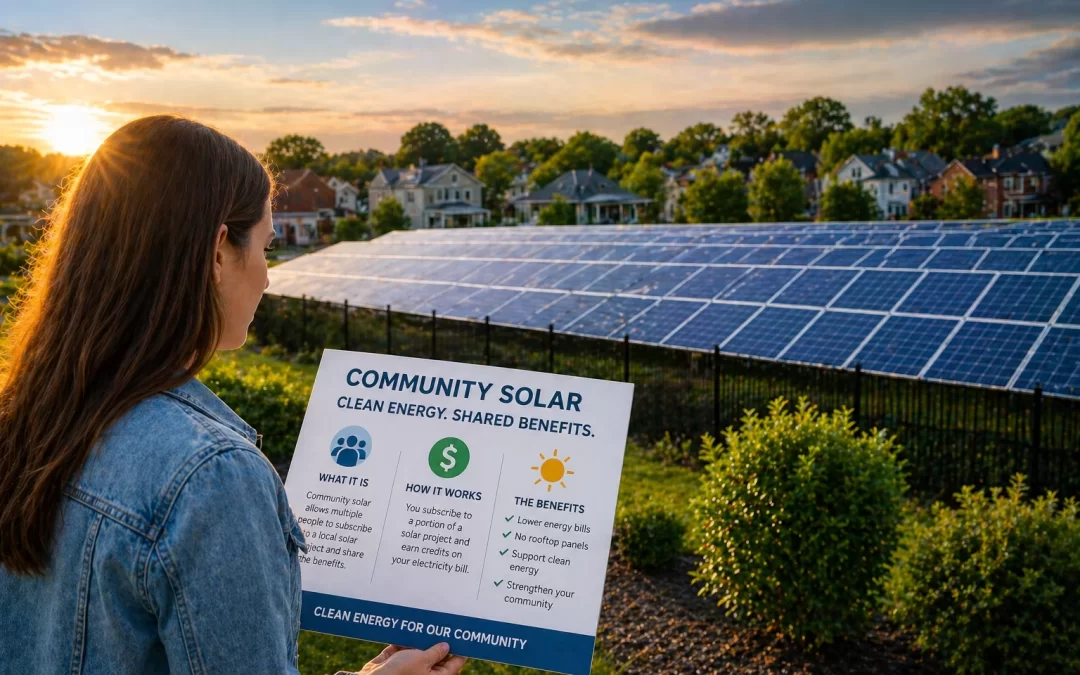
Community solar lets you subscribe to a share of a larger solar farm in your area and get credits on your electric bill, without putting panels on your roof. It can be a good fit if you rent, have a shaded or unsuitable roof, or don’t want the upfront cost of a home solar system. Most subscribers save a modest but real amount on electricity (often 5%–15% off the solar portion of their bill), but savings and availability vary a lot by state and utility. If you own a sunny home and can afford a rooftop system, traditional residential solar usually delivers higher long‑term savings than community solar.
Community solar is one of the most flexible ways to benefit from solar power without installing panels on your home. This guide explains what community solar is, how it works on your electric bill, and whether it’s a better fit than rooftop solar for your situation. It’s written for U.S. homeowners who want clear, no‑hype answers before signing up for anything.
Table of Contents
- What Is Community Solar?
- How Community Solar Works on Your Bill
- Community Solar vs. Rooftop Solar
- Key Numbers: Costs, Savings, and Payback
- Who Community Solar Is Best For
- When Community Solar Might Not Make Sense
- State and Utility Differences
- How to Evaluate a Community Solar Offer
- Deciding Your Next Step
- Frequently Asked Questions
- Summary
- What to Do Before Getting Quotes
What Is Community Solar?
Simple definition
Community solar is a shared solar project where many customers subscribe to a portion of a larger solar farm and receive credits on their electric bills based on the power that their share produces. You don’t own the panels; you’re essentially paying for access to the electricity they generate.
Instead of putting panels on your roof, the solar array is built off‑site, often on open land or a large commercial rooftop. The utility tracks how much energy the project produces and applies bill credits to each subscriber’s account.
Key features in plain language
- No rooftop installation: No construction on your home, no equipment on your roof.
- Low or no upfront cost: Most programs are subscription‑based with no big down payment.
- Flexible commitment: Many allow you to cancel with notice, though some have minimum terms or fees.
- Bill credits instead of direct power: You still get power from the grid; the solar shows up as a credit line on your bill.
How it’s different from “green power” or utility add‑ons
Community solar is not the same as a “green power” or renewable energy certificate (REC) add‑on where you pay extra to support clean energy. With community solar:
- You usually save money compared to your normal bill.
- Your subscription is tied to a specific solar project in your region.
- Your credits are based on actual energy production, not just a flat fee.
How Community Solar Works on Your Bill
The basic flow
Here’s how a typical community solar subscription works for a homeowner:
- You sign up and authorize the provider to connect your subscription to your utility account.
- The provider assigns you a “share” of the solar farm sized to match some or most of your annual usage.
- Each month, your share produces a certain number of kilowatt‑hours (kWh).
- Your utility applies bill credits based on those kWh and the program’s credit rate.
- You pay the community solar provider, usually at a discount to the value of the credits.
Example bill math
Numbers vary by state and program, but a common structure looks like this:
- Your share produces: 800 kWh in a month
- Utility credit rate: $0.15 per kWh
- Bill credits applied: 800 × $0.15 = $120 credit on your utility bill
- Subscription price: 10% discount to credit value
- You pay provider: $108 for that month’s solar
- Net savings: $120 credit − $108 payment = $12 saved that month
In this example, you save about 10% on the solar portion of your bill. Some programs offer 5% discounts; others go up to 20% in very favorable markets.
What happens to the rest of your bill?
Community solar usually only offsets the “energy supply” portion of your bill, not all charges. You’ll still see:
- Delivery or distribution charges
- Customer or meter fees
- Taxes and other surcharges
This is why community solar typically reduces your total bill by a percentage, not to zero. For many homeowners, that works out to 5%–15% total bill savings, depending on local rates and program design.
Contract types you’ll see
- Subscription (most common): No ownership; you pay monthly based on credits received.
- Fixed discount: You always pay, for example, 10% less than the value of your credits.
- Fixed rate per kWh: You pay a set price per kWh of solar, which may or may not be lower than your utility rate over time.
- Ownership (less common for households): You buy a set number of panels in the project and receive credits for their output.
Community Solar vs. Rooftop Solar
Big‑picture differences
For homeowners, the main choice is usually between:
- Rooftop solar: You own a system installed on your home.
- Community solar: You subscribe to a share of a shared solar farm.
Rooftop solar: typical numbers
For context, a typical U.S. home solar system in 2026 looks like this:
- System size: 6–10 kW (about 15–25 panels)
- Installed cost: $28,000–$32,000 before incentives
- After 30% federal tax credit: roughly $19,600–$22,400 (if you qualify; consult a tax professional)
- Cost per watt: $2.50–$3.50
- Average annual bill savings: $1,300–$1,500
- Payback period: 7–9 years on average, with 25–30 years of panel performance warranty
Over 25–30 years, many homeowners see tens of thousands of dollars in net savings, especially in high‑electricity‑cost states. For a deeper dive into these numbers, see the national overview in our honest “Is Solar Worth It?” guide.
Community solar: typical numbers
Community solar doesn’t follow the same “payback period” model because you’re not buying an asset. Instead, you’re trading your normal utility rate for a discounted solar credit. Typical ranges:
- Upfront cost: $0–$100 (often none)
- Contract length: Month‑to‑month up to 20 years, depending on program
- Discount on credits: 5%–20% off the credited value
- Annual savings: Often a few hundred dollars per year for an average home
- Equipment ownership: None; you don’t own panels or inverters
Which usually saves more?
- Rooftop solar usually delivers much higher lifetime savings if:
- Your roof is sunny and in good condition
- You have a suitable credit profile or cash to invest
- Your state has decent net metering or similar policies
- Community solar usually delivers modest, low‑risk savings if:
- You can’t or don’t want to install rooftop solar
- You prefer no long‑term equipment responsibility
- You want flexibility to move or change plans
Risk and responsibility comparison
- Rooftop solar: You’re responsible for the system, roof coordination, and long‑term maintenance (though systems are low‑maintenance and warranties are long). For more on what ownership involves, see our solar maintenance and troubleshooting guide.
- Community solar: The project owner handles all equipment, performance, and maintenance. Your main risk is program or policy changes, not hardware issues.
Key Numbers: Costs, Savings, and Payback
How community solar savings compare to typical home solar economics
To understand whether community solar is “worth it,” it helps to compare it to the standard rooftop solar benchmarks:
- Rooftop solar average payback: 7–9 years
- Panel lifespan: 25–30 years performance warranty, often 30–35 years of useful life
- Average annual savings: $1,300–$1,500 for a typical system
- Lifetime savings: Often $25,000–$40,000+ in many states, depending on rates and incentives
Community solar doesn’t have a “payback period” because you’re not investing capital. Instead, think in terms of:
- Annual percentage savings: 5%–15% off your total electric bill is common
- Dollar savings: If your annual electric bill is $1,800, a 10% savings is about $180 per year
- Time horizon: Savings start immediately and continue as long as you stay subscribed
What affects your community solar savings
- Your utility’s rates: Higher electricity prices usually mean higher‑value credits.
- Program discount: A 15% discount on credits saves more than a 5% discount.
- How much of your usage is covered: If your subscription only covers 50% of your usage, your total bill savings will be lower.
- Seasonal production: Solar farms produce more in summer, less in winter; some programs “bank” excess credits.
- Fees and minimums: Some programs charge small monthly fees that reduce your net savings.
What affects rooftop solar numbers (for comparison)
If you’re deciding between community solar and rooftop solar, remember that rooftop economics depend heavily on:
- Your state’s net metering or credit rules
- Local installation costs per watt
- Roof orientation, shading, and size
- Available incentives and tax credits (federal ITC is 30% through 2032, subject to tax eligibility)
- Your current and future electricity rates
To see how these variables play out for your home, our solar payback period calculator can help you estimate rooftop payback and compare it to a community solar subscription.
Who Community Solar Is Best For
Situations where community solar shines
Community solar is often the better choice when:
- Your roof isn’t suitable: Too much shade, complex rooflines, or an old roof that needs replacement soon.
- You rent or live in a condo: You don’t control the roof or can’t get HOA approval.
- You may move in a few years: You don’t want to commit to a 25‑year rooftop system.
- You don’t want debt or a big purchase: You prefer a simple monthly subscription with no loan.
- You want to support local clean energy: You care about emissions but still want to save money.
Homeowner profiles that fit community solar well
- Early‑stage homeowners: You bought recently and aren’t ready for a major project yet.
- Retirees on fixed income: You want lower bills without taking on a large loan or project risk.
- Busy families: You don’t have time to manage a rooftop installation or compare complex quotes.
How much should you expect to save?
Realistically, most homeowners should think of community solar as a way to:
- Shave 5%–15% off their annual electric costs
- Avoid upfront spending and long‑term equipment commitments
- Start saving immediately, with little effort
If you’re hoping to eliminate your bill or lock in very large long‑term savings, rooftop solar is usually the better tool for that job, assuming your home qualifies.
When Community Solar Might Not Make Sense
When rooftop solar is clearly better
Community solar may not be your best option if:
- Your roof is sunny, in good condition, and has room for 15–25 panels.
- You plan to stay in your home at least 7–10 years.
- You can qualify for financing or pay cash for a system.
- Your state has strong net metering or similar credit policies.
In these cases, owning a rooftop system often delivers much higher lifetime savings than a community solar subscription. Our detailed comparison in solar vs. staying on the grid over 25 years shows how big that gap can be in many states.
Program‑specific red flags
Be cautious or consider skipping a community solar offer if you see:
- Long, inflexible contracts: 20‑year terms with high cancellation fees.
- Unclear pricing: You can’t easily see how your payment compares to the value of your credits.
- No guaranteed discount: You’re promised “potential savings” but no minimum discount.
- High monthly fees: Fixed fees that eat up a big chunk of your expected savings.
- Hard‑sell tactics: Door‑to‑door reps pushing you to sign immediately without clear documentation.
When doing nothing might be better (for now)
It can make sense to wait or skip community solar if:
- Your local program only offers very small discounts (for example, 1%–2%).
- You’re actively planning a rooftop solar installation in the next year or two.
- You’re likely to move outside the utility’s service area soon and the program doesn’t transfer easily.
If neither rooftop solar nor community solar looks attractive, our guide on when solar doesn’t make sense and what to do instead covers other ways to cut your electric costs.
State and Utility Differences
Where community solar is available
Community solar is expanding, but it’s not nationwide yet. As of 2026, it’s most common in states that have passed specific community solar legislation and rules, such as:
- New York
- Massachusetts
- Minnesota
- Colorado
- Maryland
- Illinois
- New Jersey
- California (select utility territories)
Other states have pilot programs or utility‑specific offerings. Availability can vary even within a state, depending on your utility.
How state policy affects your savings
Your potential savings depend heavily on:
- Credit rate structure: Some states credit at the full retail rate; others use lower “avoided cost” rates.
- Program caps: Limits on how many customers or how much capacity can participate.
- Low‑income incentives: Some programs offer higher discounts for income‑qualified households.
Because these rules change, it’s important to look at current program details in your specific state and utility territory. To see whether rooftop solar is attractive where you live, you can also check our state‑by‑state “Is solar worth it?” breakdown.
Utility‑specific considerations
Even within the same state, different utilities may offer:
- Different credit rates and structures
- Different contract terms and cancellation rules
- Different caps on how much of your usage can be offset
Always review program documents that are specific to your utility, not just generic marketing materials from a provider.
How to Evaluate a Community Solar Offer
Key questions to ask
Before signing up, ask the provider (and get answers in writing where possible):
- What exact discount do you guarantee compared to the value of my credits?
- Are there any monthly fees, minimum charges, or enrollment fees?
- How long is the contract, and what are the cancellation terms and fees?
- What happens if I move within the same utility territory? Outside it?
- How much of my annual usage will my subscription be sized to cover?
- When will my credits start appearing on my bill?
How to estimate your savings
To get a realistic picture of your savings:
- Look at your last 12 months of electric bills and total up your annual cost.
- Ask the provider what percentage of your usage they plan to cover (for example, 80%).
- Multiply your annual bill by that percentage and then by the promised discount.
- Example: $1,800 annual bill × 80% × 10% discount ≈ $144/year in savings.
- Subtract any fixed annual fees from that number.
This won’t be perfect, but it will tell you whether you’re looking at meaningful savings or just a few dollars per month.
Comparing to rooftop solar quotes
If you’re also considering rooftop solar, compare:
- Upfront cost vs. no upfront cost
- Payback period (7–9 years typical) vs. immediate but smaller savings
- Long‑term ownership benefits vs. flexibility and simplicity
Before you compare, it helps to understand typical system sizes, equipment, and pricing. Our solar cost and savings guide explains what to expect in a rooftop solar quote so you can make an apples‑to‑apples decision.
Deciding Your Next Step
Is now the right time to act?
Consider moving forward with community solar now if:
- There’s an open program in your area with a clear, guaranteed discount.
- You’re not ready or able to install rooftop solar in the next 1–2 years.
- You want immediate, low‑effort savings with minimal risk.
It may be better to wait or focus on rooftop solar if:
- You’re already collecting rooftop solar quotes and your home is a strong candidate.
- Local community solar offers have very small discounts or restrictive terms.
- You expect to move soon and the program doesn’t transfer easily.
Information to gather before getting quotes
Whether you’re leaning toward community solar, rooftop solar, or both, it helps to have:
- 12 months of electric bills (usage in kWh and total cost)
- Your utility and rate plan name
- How long you plan to stay in your home
- Your roof age and condition (for rooftop solar)
Questions to ask any solar provider (community or rooftop)
- How exactly will this change my monthly bill in year one?
- What are all the fees, minimums, and potential price escalators?
- What happens if I move or want to exit the agreement early?
- What are the main risks or downsides I should understand?
Getting multiple quotes or offers is almost always smart. It gives you leverage, helps you spot outliers, and makes it easier to see what “normal” looks like in your area.
Frequently Asked Questions
Does community solar really save money?
Most community solar programs do save money, but usually in the range of 5%–15% off your total electric bill, not 50% or more. Your actual savings depend on your utility’s rates, the program’s discount, and how much of your usage is covered. Always ask for a clear, written explanation of the discount and any fees before enrolling.
Can I do community solar and rooftop solar at the same time?
In some areas you can, but it’s not always allowed or beneficial. If your rooftop system already offsets most of your usage, there may be little room left for community solar credits, and you could end up over‑subscribed. Check with both your rooftop installer and the community solar provider to see how they would interact on your bill.
What happens if I move after joining a community solar program?
If you move within the same utility territory, many programs let you transfer your subscription to your new address. If you move outside the territory, you may need to cancel or transfer your subscription to someone else, which can involve notice periods or fees depending on the contract.
Do I still get the 30% federal tax credit with community solar?
Most community solar subscribers do not receive the 30% federal solar tax credit because they are not purchasing and owning a residential solar system. In some less common ownership‑style community solar models, tax benefits may flow to investors or project owners instead. For any tax questions, it’s important to consult a qualified tax professional.
Is community solar available in every state?
No, community solar is only available where state policy and utilities support it, and even then, not all customers will have access. It’s most common in states like New York, Massachusetts, Minnesota, Colorado, and a growing list of others. You’ll need to check programs specific to your state and utility to know what’s available.
Can community solar eliminate my electric bill?
Community solar almost never eliminates your entire bill because it typically only offsets the energy supply portion, not delivery charges, fees, and taxes. In a strong program, you might see a noticeable reduction, but you should still expect a monthly bill from your utility.
Summary
- Community solar lets you subscribe to a share of a solar farm and get bill credits, usually saving about 5%–15% on your total electric costs with little or no upfront cost.
- Rooftop solar typically offers much higher long‑term savings (average payback 7–9 years, with 25–30 years of panel life) but requires an upfront investment and a suitable home.
- Your community solar savings depend mainly on your utility’s rates, the program’s guaranteed discount, and how much of your usage is covered.
- Community solar is ideal if you can’t or don’t want rooftop solar, while a well‑designed rooftop system is usually better for maximizing lifetime savings.
- The best next step is to compare real numbers for your home, your utility, and your state before committing to any contract.
What to Do Before Getting Quotes
If you’re deciding between community solar and rooftop solar, the most reliable way to move forward is to look at personalized numbers for your home and utility. Gather your recent electric bills, think about how long you’ll stay in your home, and then compare a community solar offer with at least one or two rooftop solar quotes.
When you’re ready to see what rooftop solar could save you, you can get multiple, no‑obligation quotes through our site at /get-my-quote/. Clear, side‑by‑side offers will make it much easier to see whether community solar, rooftop solar, or staying as you are is the smartest move for your household.