
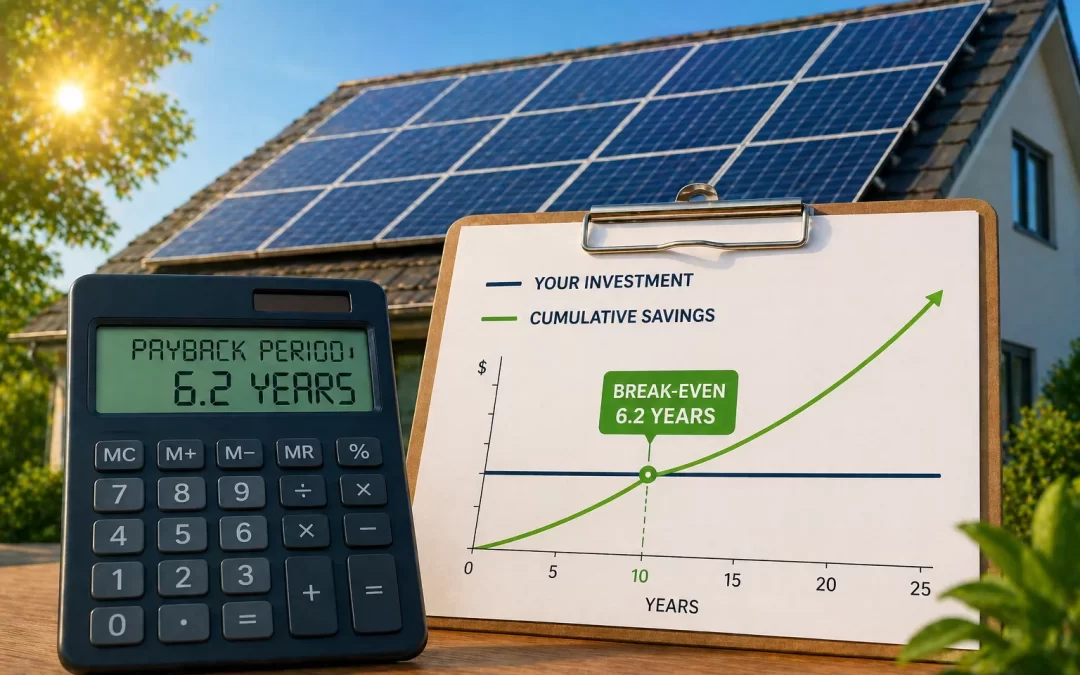
The solar payback period is how long it takes for your electric bill savings to equal what you paid for your solar panels. For most U.S. homeowners, solar panels pay for themselves in about 7–9 years, assuming average system costs and electricity rates. After that, your power is effectively “net free” for the rest of the system’s 25–30+ year life. Your actual payback can be shorter or longer depending on your roof, local incentives, electric rates, and how you pay for the system.
Wondering when your solar panels will actually pay for themselves? The solar payback period calculator concept is all about turning that big upfront price tag into a simple “years until break-even” number. This guide walks U.S. homeowners through how payback works, what numbers to plug in, and how to know if solar is worth it for your home.
Table of Contents
- What Is a Solar Payback Period?
- How to Calculate Your Solar Payback Period (Step-by-Step)
- Key Solar Cost and Payback Numbers in 2026
- What Affects Your Solar Payback Period?
- How Location and State Policies Change Payback
- When Solar Payback Works in Your Favor
- When Solar Payback Is Long (or Solar Isn’t a Good Fit)
- What to Do Before Getting Quotes
- Frequently Asked Questions
- Summary: Key Takeaways
What Is a Solar Payback Period?
Simple definition
The solar payback period is the number of years it takes for your total savings on electricity to equal what you spent on your solar system. After that point, your system has “paid for itself,” and any additional savings are financial gain.
Think of it like this: if you spend $20,000 on solar and save $2,500 per year on your electric bill, your payback period is about 8 years ($20,000 ÷ $2,500 = 8).
Two ways to look at payback
- Simple payback: System cost divided by average yearly savings. Easy to calculate, good for a quick estimate.
- Full financial analysis: Includes loan interest, maintenance, rate increases, and opportunity cost. This is more detailed and usually done with a professional or advanced calculator.
Most homeowners start with simple payback to see if solar is in the right ballpark, then refine the numbers when comparing quotes.
Typical U.S. payback range
- National average solar payback period: 7–9 years
- Shorter payback (5–7 years): Common in high-electricity-cost states with strong incentives
- Longer payback (10–15+ years): More likely where power is cheap, incentives are weak, or roofs are shaded
How to Calculate Your Solar Payback Period (Step-by-Step)
Step 1: Estimate your system cost
For a typical U.S. home, a residential solar system usually costs:
- $28,000–$32,000 before incentives
- $19,600–$22,400 after the 30% federal tax credit (if you qualify)
- Average cost per watt: $2.50–$3.50
- Average system size: 6–10 kW (about 15–25 panels)
Your installer will give you a specific quote, but you can use these ranges for a first estimate.
Step 2: Estimate your annual electricity savings
Your annual savings depend on:
- Your current electric bill
- How much of your usage solar can cover
- Your local electricity rate (cents per kWh)
- Whether your state has full, partial, or no net metering (credit for extra solar you send to the grid)
Nationally, homeowners who go solar typically save around $1,300–$1,500 per year on average. In high-cost electricity states, annual savings can be much higher.
Step 3: Apply incentives (especially the 30% federal tax credit)
The 30% federal solar Investment Tax Credit (ITC) is available through 2032 for qualifying systems. It reduces your federal tax liability by 30% of your system cost.
- On a $30,000 system, 30% ITC = $9,000 potential tax credit
- Net cost after ITC (if you can use the full credit) = $21,000
Tax rules are complex and individual situations vary, so it’s wise to confirm details with a tax professional. For a quick payback estimate, most homeowners use the after-ITC cost.
Step 4: Use the simple payback formula
Simple payback period (years) = Net system cost ÷ Average annual savings
Example:
- System cost after ITC: $21,000
- Average annual savings: $1,500
- Payback period: $21,000 ÷ $1,500 = 14 years
Change the savings to $2,800 per year (common in high-cost states), and the payback becomes:
- $21,000 ÷ $2,800 ≈ 7.5 years
Step 5: Adjust for how you pay (cash vs. loan)
- Cash purchase: Simple payback works well; you’re trading upfront cash for long-term bill savings.
- Solar loan: You’ll have a monthly loan payment instead of (or in addition to) an electric bill. In many cases, the loan payment plus a small remaining electric bill is still less than your old bill, so you see net savings from year one.
For loans, payback is better thought of as: “How many years until my total savings exceed the total I paid in principal and interest?” A good installer or financial advisor can help you model this.
Key Solar Cost and Payback Numbers in 2026
National averages to use in your own “calculator”
As of 2026, here are realistic benchmarks for U.S. residential solar:
- System cost before incentives: $28,000–$32,000
- System cost after 30% ITC: $19,600–$22,400 (if you can use the full credit)
- Cost per watt: $2.50–$3.50
- Average annual savings: $1,300–$1,500 (can be $2,000+ in high-rate states)
- Typical payback period: 7–9 years nationally
- Panel performance warranty: 25–30 years
- Typical panel lifespan: 30–35 years
- Average number of panels: 15–25 for a typical home
These are averages. Your actual numbers will depend heavily on your roof, your usage, and your local utility rates.
How to quickly estimate your own payback
You can do a rough “back-of-the-envelope” calculation in a few minutes:
- Look at your last 12 months of electric bills and total them.
- Estimate that solar could offset 70–100% of that amount (depending on roof and system size).
- Use a system cost of $20,000–$22,000 after ITC as a starting point.
- Divide the cost by your estimated annual savings.
If the result is under 10 years, solar is often a strong financial candidate. If it’s over 15 years, you’ll want to look more closely at your situation and alternatives.
What Affects Your Solar Payback Period?
Your current electric bill and rate
This is usually the biggest factor.
- Higher electric rates = faster payback (each kWh you avoid is worth more).
- Lower electric rates = slower payback.
For example, if you pay $0.30/kWh in California, your savings per kWh are roughly double someone paying $0.15/kWh in a low-cost state, assuming similar sun and system size.
How much sun your roof gets
Solar works best on:
- South- or west-facing roofs
- Minimal shading from trees, chimneys, or nearby buildings
- Roof pitches that match your local sun angle reasonably well
Shading or poor orientation reduces your system’s output, which increases your payback period because you save less each year.
System size and design
- Right-sized systems that closely match your usage usually give the best payback.
- Oversized systems may produce more than you can use or get credit for, stretching your payback.
- Premium equipment (high-efficiency panels, advanced inverters, batteries) can increase cost; sometimes the extra production or resilience is worth it, sometimes it just lengthens payback.
Incentives and tax credits
In addition to the 30% federal ITC, some states and utilities offer:
- State tax credits or rebates
- Upfront cash incentives
- Performance-based incentives (payments per kWh produced)
These can shorten your payback by several years. Our solar incentives and tax credits guide explains the main programs and how they affect your costs.
Net metering and utility policies
Net metering determines how you’re credited for extra solar power you send back to the grid.
- Full retail net metering: You get credited at the same rate you pay. This usually gives the fastest payback.
- Reduced or “net billing” rates: You’re credited at a lower rate, which can slow payback.
- No net metering: You may need to size the system more carefully or consider batteries; payback can be longer.
How you finance the system
- Cash: Best long-term savings and straightforward payback calculation.
- Loan: Can still be a good deal, especially if your loan payment is lower than your old electric bill, but interest costs slightly extend payback.
- Lease or power purchase agreement (PPA): You typically don’t “own” the system, so traditional payback math doesn’t apply. Instead, you compare your new monthly solar payment to your old bill.
How Location and State Policies Change Payback
High-cost electricity states (often faster payback)
States like California, New York, Massachusetts, Connecticut, and Hawaii tend to have:
- High electricity rates
- Reasonable or strong solar incentives (though policies change)
- Good to excellent sun exposure (varies by region)
In these areas, it’s not unusual to see payback periods in the 5–8 year range, especially with solid incentives and good roofs.
Moderate-cost states (typical 7–10 year payback)
Many states in the Midwest, Mid-Atlantic, and Southeast fall into this category. With average rates and decent sun, payback often lands near the national average of 7–9 years, assuming you can use the federal ITC.
Low-cost electricity states (longer payback)
Some states, especially those with abundant local energy resources, have relatively low power prices. In these areas:
- Each kWh you offset is worth less money.
- Payback can stretch into the 10–15+ year range, depending on incentives and system cost.
Solar can still make sense, but the financial case is more sensitive to system price and incentives.
Weather and sun exposure
Even within the same state, local climate matters:
- Sunny regions (Southwest, parts of the Southeast) generally see higher production and faster payback.
- Cloudier regions (Pacific Northwest, some northern states) still work for solar, but systems produce less, which can lengthen payback.
When Solar Payback Works in Your Favor
Signs you’ll likely have a strong payback
- Your average electric bill is $120/month or higher.
- Your roof gets good sun and has minimal shading.
- Your state offers net metering or fair compensation for excess solar.
- You can use the full 30% federal tax credit (confirm with a tax professional).
- You plan to stay in your home for at least 5–10 years.
In these situations, it’s common to see payback in the 6–9 year range, with 15–20+ years of useful system life after break-even.
Non-financial benefits that still matter
- More predictable energy costs over decades
- Reduced exposure to utility rate hikes
- Potential increase in home value
- Lower carbon footprint and cleaner energy
These don’t show up directly in a payback calculator, but they’re important reasons many homeowners move forward even when payback is in the middle of the typical range.
When Solar Payback Is Long (or Solar Isn’t a Good Fit)
Common situations with slow payback
- Very low electric bills (e.g., under $60–$70/month on average)
- Heavily shaded roofs or poor orientation that limit solar production
- Short time horizon (you plan to move in 3–5 years and aren’t sure about recouping the investment through resale)
- Weak incentives and low electricity rates in your area
- High-cost quotes that are well above the $2.50–$3.50 per watt range without a clear reason
When rooftop solar may not be the best option
There are cases where rooftop solar simply isn’t the right move:
- Your roof is in poor condition and needs replacement soon, but you’re not ready to do both projects.
- You live in a heavily shaded area where even a well-designed system would produce too little.
- You rent your home or live in a condo where you can’t install panels.
In these situations, it’s worth looking at alternatives like efficiency upgrades or shared solar. Our guide on when solar doesn’t make sense walks through practical next steps, and community solar can be a good option if you can’t install panels on your own roof.
Why a long payback isn’t always a deal-breaker
Even if your payback is 12–15 years, solar can still be reasonable if:
- You value long-term bill stability and energy independence.
- You expect electricity rates to rise faster than inflation.
- You care about the environmental benefits and are comfortable with a slower financial return.
The key is to understand the numbers clearly so you’re making an informed choice, not a pressured one.
What to Do Before Getting Quotes
Information to gather for accurate payback estimates
Before you talk to installers or use a detailed solar payback calculator, collect:
- 12 months of electric bills (total kWh and total cost)
- Photos of your roof from the ground and, if safe, from a ladder
- Your roof age and material (asphalt shingle, metal, tile, etc.)
- Your utility provider and current rate plan
- Any plans to add big loads (EV, heat pump, pool, etc.) that could increase usage
Questions to ask potential installers
When you’re ready to get quotes, ask each installer:
- “What is the estimated payback period for this system, and what assumptions are you using?”
- “How much of my current usage will this system offset in year one?”
- “What electricity rate escalation (future price increases) are you assuming?”
- “How are you accounting for net metering or my utility’s solar policy?”
- “What incentives or tax credits are included in your payback estimate?”
- “Can you show me a cash vs. loan comparison with total costs and savings over 25 years?”
Why multiple quotes matter
Solar pricing and assumptions can vary a lot between companies. Getting at least 2–3 quotes helps you:
- Spot outliers (quotes that are much higher or lower than others)
- Compare payback estimates and see who is being realistic vs. overly optimistic
- Understand different equipment options and warranties
Before you dive into quotes, it can help to review a broader overview of the pros, cons, and long-term math in our 25-year solar vs. grid cost comparison and our main “Is solar worth it?” guide.
Frequently Asked Questions
What is a good solar payback period for a home system?
For most U.S. homeowners, a solar payback period of about 7–10 years is considered good. In high-cost electricity states with strong incentives, 5–7 years is excellent, while 10–15 years can still be acceptable if you value long-term bill stability and environmental benefits.
How do I calculate my solar payback period?
Take your total system cost after incentives and divide it by your estimated annual bill savings. For example, if your net cost is $20,000 and you expect to save $2,000 per year, your simple payback is 10 years. A good installer can refine this with more detailed assumptions about rate increases and financing.
Do solar panels still save money after the payback period?
Yes. Once your system has paid for itself, the electricity it produces for the rest of its life is effectively “net free,” aside from minor maintenance costs. With panels typically lasting 25–35 years, many homeowners enjoy 10–20+ years of savings after break-even.
Does the 30% federal tax credit affect my payback period?
The 30% federal solar tax credit significantly shortens your payback period by reducing your net system cost. If you can use the full credit, a $30,000 system effectively costs $21,000, which can cut several years off your payback. Always confirm your eligibility and specific tax situation with a tax professional.
Is solar worth it if my payback period is more than 12 years?
A 12+ year payback can still be reasonable, especially if you expect to stay in your home long term and anticipate rising electricity rates. However, you should look closely at your quotes, incentives, and roof conditions, and compare solar to other options like efficiency upgrades or community solar if rooftop solar isn’t ideal.
How does financing with a loan change my solar payback?
A loan spreads your solar cost over time, so instead of a simple payback you compare your loan payment plus remaining electric bill to your old bill. If your combined new costs are lower than your old bill, you’re effectively saving from day one, though interest charges mean your total payback in years may be slightly longer than with a cash purchase.
Summary: Key Takeaways
- Most U.S. homeowners see a solar payback period of about 7–9 years, with systems lasting 25–30+ years.
- Typical systems cost $28,000–$32,000 before incentives and $19,600–$22,400 after the 30% federal tax credit, with average annual savings of $1,300–$1,500 or more.
- Your payback depends most on your electric rates, roof sun exposure, local incentives, and how you finance the system.
- Solar works best when your bills are moderate to high, your roof gets good sun, and you plan to stay in your home for several years.
- The smartest next step is to gather your bills, understand your goals, and compare multiple quotes so you can see your personalized payback clearly.
If you’re ready to see real numbers for your home instead of averages, the next step is to get personalized solar quotes. Comparing a few offers side by side will show you your actual payback period, long-term savings, and whether solar is truly worth it for your situation. You can start that process here: get my quote.