
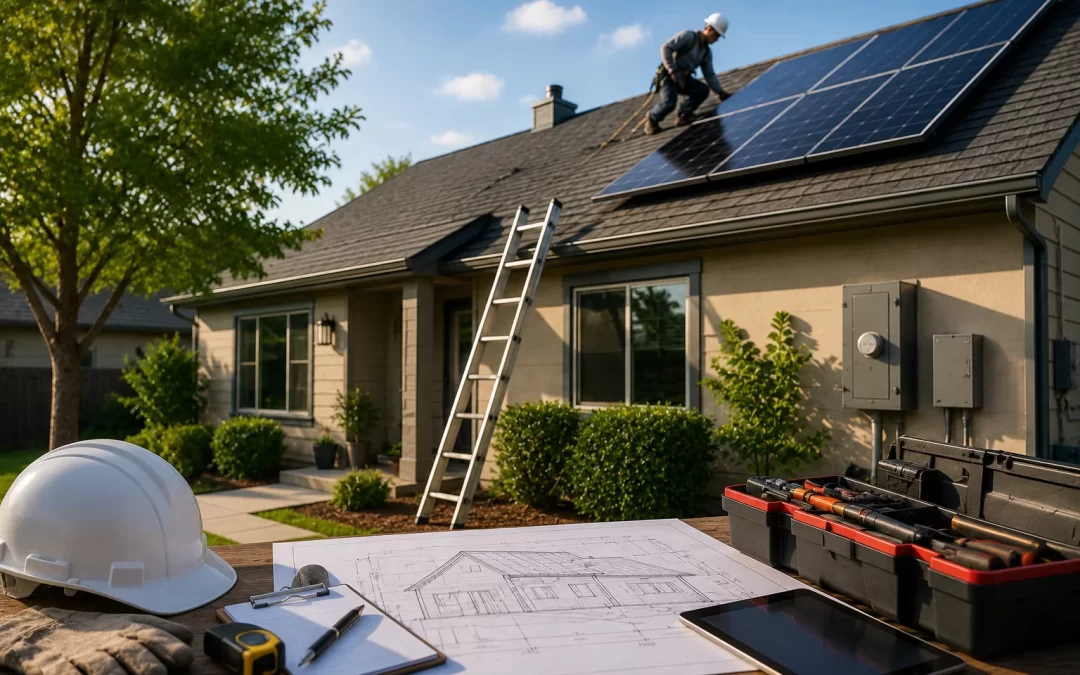
Direct answer: To prepare your home for solar installation, you’ll want to confirm your roof is in good condition, understand your electric usage, check for shading, and make sure your electrical panel can handle a solar system. Most of this prep is simple and can be done with a walkthrough of your home and a review of a recent power bill, followed by an on-site visit from a qualified installer. In some cases, you may need roof repairs, tree trimming, or an electrical panel upgrade before panels can be installed. A good installer will help you identify what’s truly necessary so you don’t spend money on work you don’t need.
Getting your home ready for solar is mostly about planning ahead so installation day goes smoothly and your system performs well for 25+ years. This guide is for U.S. homeowners who are considering solar and want to know what to fix, check, or decide before signing a contract. We’ll walk through roof readiness, electrical requirements, permits, costs, and what to expect so you can move forward with confidence—or decide to wait if the timing isn’t right.
Table of Contents
- Why Preparing Your Home for Solar Installation Matters
- Step 1: Check If Your Roof Is Ready for Solar
- Step 2: Evaluate Your Electrical Panel and Wiring
- Step 3: Review Shading, Roof Layout, and Home Orientation
- Step 4: Understand Your Energy Usage and System Size
- Step 5: Permits, HOA Rules, and Utility Requirements
- Step 6: Home Preparation for Installation Day
- Key Numbers: Costs, Savings, and What Affects Them
- When Preparing for Solar Makes Sense (and When It Doesn’t)
- How to Decide Your Next Step and Get Ready for Quotes
- Frequently Asked Questions
- Summary
- What to Do Next
Why Preparing Your Home for Solar Installation Matters
What “preparing your home for solar” really means
Preparing your home for solar installation means making sure your roof, electrical system, and property are ready to safely support solar panels for decades. It’s less about doing the work yourself and more about knowing what needs to be checked or upgraded. A little preparation up front can prevent delays, surprise costs, and performance issues later.
Why this step is worth your time
- Avoid surprise upgrades: Identifying roof or electrical issues early helps you budget realistically.
- Speed up the project: When your home is ready, permitting and installation usually move faster.
- Protect a 25+ year investment: Solar panels often last 25–30 years, so you want the roof and wiring beneath them to last too.
- Improve system performance: Good roof orientation, minimal shade, and the right system size all affect your long-term savings.
How this fits into the overall solar process
Home preparation happens before you sign a contract and continues through the site visit and design phase. If you want a full overview of the entire process from start to finish, including timelines, see how long solar installation takes and what happens at each step.
Step 1: Check If Your Roof Is Ready for Solar
Why your roof is the first thing to evaluate
Your roof is the foundation of your solar system. Panels add weight and are typically bolted into the roof structure, so you want a roof that’s structurally sound and not near the end of its life. Replacing a roof after installing solar is possible but adds cost and complexity because panels must be removed and reinstalled.
Key questions to ask about your roof
- Roof age: How old is your roof, and what is its expected lifespan?
- Roof condition: Are there missing shingles, leaks, soft spots, or visible damage?
- Roof material: Asphalt shingles, metal, and tile can all work, but some materials are easier and cheaper to install on.
- Available space: Is there enough clear, unshaded area for 15–25 panels (often 250–450 square feet or more)?
Typical roof lifespans
- Asphalt shingle: 20–30 years (common on U.S. homes)
- Metal: 40–70 years
- Clay/concrete tile: 40–50+ years
- Flat roofs (membrane/foam): 20–30 years, depending on material and climate
If your roof has less than 10 years of life left, many installers will recommend replacing it before installing solar. This avoids paying twice for labor to remove and reinstall panels later.
When you may need a new roof before solar
You should strongly consider roof work before solar if:
- Your asphalt shingle roof is 15–20+ years old and showing wear.
- You’ve had recent leaks or visible water damage in the attic or ceilings.
- There are sagging areas, soft spots, or structural concerns.
- Your roofer has already suggested replacement in the near future.
For a deeper dive into this decision, see our guide on whether you need a new roof before installing solar.
When your roof is probably fine as-is
Your roof is usually ready for solar if:
- It’s less than 10–12 years old (for asphalt shingles) and in good condition.
- There are no leaks, missing shingles, or obvious damage.
- A roofer or home inspector has recently given it a clean bill of health.
Action steps for homeowners
- Find out the age of your roof (from records, the previous owner, or a roofer).
- Do a simple visual check from the ground for curling, missing, or cracked shingles.
- Consider a roof inspection if your roof is older than 12–15 years.
- Share any roof reports or concerns with your solar installer during the quote process.
Step 2: Evaluate Your Electrical Panel and Wiring
Why your electrical system matters for solar
Solar panels connect into your home’s electrical panel (breaker box), which then connects to the utility grid. If your panel is too small, outdated, or already full, it may need an upgrade to safely handle the additional power from solar.
What installers look for in your panel
- Main breaker size: Many homes have 100-amp or 200-amp service. Larger solar systems often work better with 200 amps.
- Available breaker space: There must be room for new breakers or a safe way to add them.
- Panel condition: Rust, heat damage, or very old equipment can be red flags.
- Brand and model: Some older panels (like certain Federal Pacific or Zinsco models) are known safety concerns and are often recommended for replacement.
Signs you might need an electrical upgrade
- Frequent tripped breakers when using multiple appliances.
- A very old panel (often 40+ years) with fuses instead of breakers.
- Plans to add other high-power loads soon (EV charger, hot tub, electric HVAC).
Typical costs and impact
- Panel upgrade: Often ranges from $1,500–$4,000 depending on size and complexity.
- Service upgrade (e.g., from 100A to 200A): Can be $2,000–$5,000+ if utility work is required.
These are ballpark figures; actual costs vary widely by region and home. Your installer or a licensed electrician can provide a specific quote.
What you can do before getting quotes
- Take a clear photo of your electrical panel (with the door open) to share with installers.
- Note your main breaker size (e.g., 100A, 150A, 200A) printed on the main switch.
- Gather any recent electrical inspection reports if you have them.
Step 3: Review Shading, Roof Layout, and Home Orientation
Why shade and orientation affect solar performance
Solar panels produce the most energy when they get direct sunlight for most of the day. Heavy shading from trees, chimneys, or nearby buildings can significantly reduce output and lengthen your payback period. Orientation (which direction your roof faces) also affects how much energy your system can generate.
Ideal roof conditions for solar
- Orientation: South-facing roofs are best in the U.S., followed by southwest and southeast.
- Pitch (slope): Roofs with a 15–40° pitch generally work well.
- Shade: Minimal shading between 9 a.m. and 3 p.m. is ideal.
- Obstructions: Few vents, chimneys, or skylights in the main solar area.
How to do a quick shade check yourself
- Walk around your home at different times of day and note where shadows fall on the roof.
- Look for tall trees or buildings on the south, southeast, or southwest sides.
- Consider whether nearby trees are likely to grow significantly in the next 10–20 years.
When shade is a serious problem
Solar may not be a good fit—or may require a smaller system—if:
- Your roof is heavily shaded most of the day, especially in winter.
- Large trees cannot be trimmed or removed due to local rules or personal preference.
- Nearby buildings permanently block sunlight on your best roof surfaces.
What installers can do about shade
- Use microinverters or power optimizers so each panel performs independently.
- Design around shaded areas and focus on the sunniest roof planes.
- Recommend tree trimming or selective removal where appropriate.
- Consider ground-mounted systems if you have open land and local rules allow it.
Step 4: Understand Your Energy Usage and System Size
Why your electric bill matters before solar
Your past electricity usage is the starting point for sizing a solar system. Installers typically look at 12 months of utility bills to understand how many kilowatt-hours (kWh) you use and how that usage changes seasonally. This helps them design a system that offsets a realistic portion of your bill without oversizing.
What to gather before talking to installers
- 12 months of electric bills (PDFs or screenshots are fine).
- Your current rate per kWh (often listed as “energy charge” or similar).
- Any known upcoming changes (EV purchase, switching to electric heating, adding a pool, etc.).
Typical system sizes for U.S. homes
- Average U.S. home uses about 10,000–11,000 kWh per year.
- This often translates to a solar system in the 6–10 kW range.
- That usually means about 15–25 panels, depending on panel wattage (commonly 350–450 watts per panel).
These are national averages; your needs may be higher or lower based on home size, climate, and lifestyle.
When a smaller or larger system makes sense
- Smaller system: If your roof space is limited, your budget is tight, or your usage is low.
- Larger system: If you plan to add an EV, electrify heating, or if your utility has favorable net metering rules.
How this affects your savings and payback
Right-sizing your system is key to a good payback period. Oversizing can lead to extra cost without proportional benefit, especially if your utility doesn’t credit excess production generously. Undersizing may leave you with higher ongoing utility bills than necessary.
Step 5: Permits, HOA Rules, and Utility Requirements
Permits and inspections
Most U.S. cities and counties require permits for solar installations. Your installer typically handles:
- Building and electrical permits.
- Structural review if required.
- Scheduling final inspections with the local authority.
This process can take anywhere from a couple of weeks to a few months, depending on your local permitting office.
HOA and neighborhood rules
If you live in a community with a homeowners association (HOA):
- Review your HOA’s rules on solar panels and exterior changes.
- Ask what documents they require (plans, color samples, placement diagrams).
- Know that many states have “solar access” or “solar rights” laws that limit how much an HOA can restrict solar, but details vary by state.
Utility company requirements
Your utility must approve your solar system before you can turn it on and send power to the grid. This process is often called “interconnection” and ends with “permission to operate” (PTO). For more detail on this step and why it can take time, see our guide to permission to operate (PTO).
What you can do to speed things up
- Have your utility account number and contact information ready for your installer.
- Respond quickly to any requests for signatures or documents.
- Submit HOA applications early if required.
Step 6: Home Preparation for Installation Day
What to expect on installation day
On installation day, a crew will be on-site to mount panels, run wiring, and connect your system to your electrical panel. This usually takes 1–3 days for a typical residential system, depending on size and roof complexity. For a detailed walkthrough, see what to expect on solar installation day.
How to prepare your home and property
- Clear access: Move vehicles out of the driveway and clear pathways to your electrical panel, attic, and yard.
- Pets and kids: Keep pets secured and children away from work areas for safety.
- Attic access: If your installer needs attic access, clear a path and move stored items away from the access hatch.
- Outdoor obstacles: Trim bushes or move items that block access to walls or roof edges where ladders will go.
Noise and power interruptions
- Expect some noise from drilling, hammering, and workers on the roof.
- There may be short power interruptions when the system is connected to your panel.
- Most installers will let you know in advance when they need to shut off power.
Key Numbers: Costs, Savings, and What Affects Them
Typical solar system costs
As of 2026, national averages for residential solar in the U.S. are:
- System cost: About $28,000–$32,000 before incentives for a typical home system.
- Cost per watt: Roughly $2.50–$3.50 per watt installed.
- After 30% federal tax credit (ITC): Net cost often around $19,600–$22,400, assuming you’re eligible and can use the credit. Always confirm details with a tax professional.
Typical savings and payback
- Average annual bill savings: About $1,300–$1,500, depending on your rates and system size.
- Payback period: Often 7–9 years on a cash purchase, based on national averages.
- Panel lifespan: Most panels have a 25–30 year performance warranty and can last 30–35 years or more.
These are broad averages; your actual numbers will depend on your location, utility rates, incentives, and how well your home is prepared (roof, shade, orientation).
How home preparation affects these numbers
- Roof condition: A roof that doesn’t need replacement soon avoids extra labor costs later.
- Shade: Less shade means more production, better savings, and a shorter payback period.
- Electrical readiness: If your panel is already adequate, you may avoid a $1,500–$4,000 upgrade.
- System size: Right-sizing based on your usage helps you hit that 7–9 year payback range.
Incentives and tax credits
The federal solar Investment Tax Credit (ITC) is currently 30% through 2032 for qualifying systems. Many states and utilities also offer rebates, performance payments, or other incentives. Because tax situations are personal and incentives change, it’s wise to review our solar incentives and tax credits guide and consult a tax professional before making decisions based on incentives.
When Preparing for Solar Makes Sense (and When It Doesn’t)
Situations where solar preparation is likely worth it
You’re a strong candidate for solar if:
- Your roof is in good condition with 10+ years of life left.
- You have a mostly unshaded south, southeast, or southwest roof.
- Your electric bills are consistently $100+/month.
- Your state has reasonable net metering or solar-friendly policies.
- You plan to stay in your home for at least 5–7 years.
Situations where you may want to wait or skip solar
- Major roof work is imminent: If you know you’ll replace your roof in the next 1–3 years, it may be better to do that first.
- Heavy, unavoidable shade: If you can’t trim trees or move obstructions, your system may underperform.
- Very low usage: If your electric bills are under $50/month, the payback may be long.
- Uncertain plans: If you expect to move in the next 1–3 years, you may not see full financial benefits (though solar can help with resale value).
- Challenging roof layout: Very small, chopped-up, or complex roofs can limit system size or increase costs.
Honest expectations
Solar is a long-term investment, not a quick win. When your home is well-prepared and your local policies are supportive, it can significantly reduce your electric bills over 25+ years. When roof, shade, or electrical issues are severe, it may be smarter to address those first or reconsider whether solar is the right fit.
How to Decide Your Next Step and Get Ready for Quotes
Is now the right time to act?
It’s usually a good time to start getting information if:
- Your roof is in decent shape and you don’t anticipate major renovations soon.
- Your utility rates have been rising or are already high.
- You’re planning to stay in your home for several years.
If your roof is near the end of its life or you’re unsure about moving, it may be worth resolving those questions first.
Information to have ready before getting quotes
- 12 months of electric bills (or at least 3–6 months as a starting point).
- Roof age and any recent roof inspection reports.
- Photos of your roof from the ground and your electrical panel.
- Any HOA rules or requirements, if applicable.
- Your goals: lower bills, backup power, EV charging, or all of the above.
Questions to ask potential installers
- How do you evaluate whether my roof is ready for solar?
- Will I need an electrical panel upgrade, and why?
- How do you account for shade and roof orientation in your design?
- What permits and utility paperwork do you handle?
- What are the total project costs, including any roof or electrical work?
- What warranties do you provide on equipment, workmanship, and roof penetrations?
For a deeper look at vetting companies, see how to choose a solar installer and what to look for in their proposals.
Why getting multiple quotes is smart
- Pricing can vary by thousands of dollars for similar systems.
- Different installers may propose different layouts, equipment, or solutions to roof/electrical issues.
- Comparing at least 2–3 quotes helps you understand what’s standard and what’s an upsell.
When you’re ready, our guide to reading and comparing solar quotes can help you evaluate offers side by side.
Frequently Asked Questions
How do I know if my roof is strong enough for solar panels?
Most modern roofs can handle the weight of solar panels, but the key questions are age, condition, and structure. A solar installer or roofer will check for signs of damage, sagging, or weak decking and may recommend repairs or replacement if the roof is near the end of its life. If your roof is in good shape with 10+ years of life left, it’s usually strong enough for solar.
Do I need to upgrade my electrical panel before installing solar?
You only need an upgrade if your current panel can’t safely handle the added solar circuits or is outdated. Many homes with 200-amp service and some with 100-amp service can support solar as-is, but older or crowded panels may require replacement. An installer or licensed electrician can evaluate your panel and explain whether an upgrade is necessary and why.
Should I replace my roof before going solar?
If your roof is older or has less than about 10 years of life left, replacing it before solar often makes financial and practical sense. This avoids paying to remove and reinstall panels later when you do replace the roof. If your roof is relatively new and in good condition, you can usually install solar without roof work.
How much does it cost to prepare a home for solar installation?
Many homes need little or no extra work beyond the solar system itself. When upgrades are needed, common costs include $1,500–$4,000 for an electrical panel upgrade and several thousand dollars or more for roof replacement, depending on size and materials. Your total project cost will depend on your home’s condition, local labor rates, and system size.
Can I trim trees myself to reduce shade for solar?
Light trimming of small branches may be a DIY job, but significant tree work is usually safer and more effective when done by a professional arborist. They can advise on how much to trim without harming the tree and whether removal is appropriate. Always check local rules and HOA guidelines before removing or heavily trimming trees.
How long does the whole solar installation process take once my home is ready?
Once your home is prepared and you’ve signed a contract, the full process—design, permits, installation, inspections, and utility approval—typically takes 1–3 months, depending on your area. The actual installation on your roof usually takes 1–3 days for a typical residential system.
Summary
- Preparing your home for solar installation means checking roof condition, electrical capacity, shading, and local rules before you sign a contract.
- A typical U.S. solar system costs about $28,000–$32,000 before incentives and $19,600–$22,400 after the 30% federal tax credit, with a 7–9 year average payback and 25–30 year panel warranties.
- Your roof’s age and condition, shade levels, and electrical panel size have the biggest impact on whether solar is straightforward or requires extra work.
- Solar works best when you have a solid roof, decent sun exposure, and electric bills high enough that savings of $1,300–$1,500 per year make a difference.
- Your next step is to gather bills, roof info, and photos, then get multiple quotes from reputable installers so you can compare options and decide with real numbers.
What to Do Next
If your roof is in decent shape and your electric bills are significant, preparing your home for solar now can set you up for decades of lower energy costs. The most reliable way to see if solar makes sense for your specific home is to get personalized quotes that account for your roof, shade, and electrical system.
When you’re ready, you can compare offers from vetted installers and see real numbers for your home at /get-my-quote/—with no pressure and no obligation to move forward.