
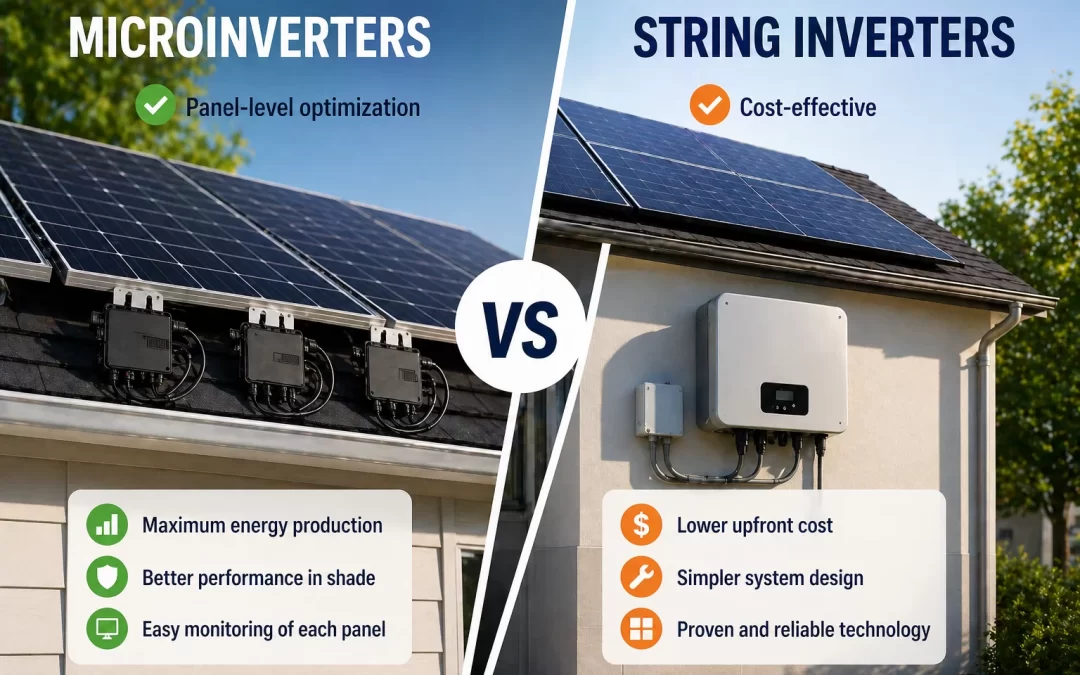
Microinverters are usually best if your roof has shade, multiple roof faces, or you care about panel-level monitoring and future flexibility. String inverters are usually better if you have a simple, unshaded roof and want to keep upfront costs lower. For most U.S. homes, both options can work well, but the “right” choice depends on your roof layout, budget, and whether you plan to add panels or batteries later. A good installer should price and explain both so you can see the real trade-offs for your home.
Choosing between microinverters and string inverters is one of the most important equipment decisions in a home solar project. Both convert your panels’ DC power into usable AC power, but they do it in very different ways. This guide walks U.S. homeowners through the pros, cons, costs, and real-world scenarios so you can decide which inverter type fits your roof, budget, and long-term plans.
Table of Contents
- What Are Microinverters and String Inverters?
- How They Work: Simple Explanation
- Key Numbers: Costs, Savings, and Lifespan
- Microinverters: Pros, Cons, and Best Use Cases
- String Inverters: Pros, Cons, and Best Use Cases
- Shade, Roof Layout, and Performance Differences
- Reliability, Warranties, and Maintenance
- Batteries and Future Expansion
- Location and Code Considerations
- How to Decide: Microinverters vs. String Inverters
- Frequently Asked Questions
- Summary: Key Takeaways
- What to Do Next
What Are Microinverters and String Inverters?
Every solar panel produces DC (direct current) electricity, but your home uses AC (alternating current). An inverter is the device that converts DC to AC so your home and the grid can use the power.
There are two main types used in U.S. homes:
- Microinverters: A small inverter is installed on each panel (or sometimes one per two panels). Each panel operates independently.
- String inverters: One larger inverter (sometimes two) is installed on a wall, usually near your electrical panel or meter. Groups of panels are wired together in “strings” to that central inverter.
Both can power a typical home effectively. The main differences show up in cost, performance in shade, monitoring detail, and how easy it is to expand or service your system later.
How They Work: Simple Explanation
How a string inverter works
With a string inverter, panels are wired together in series, like old-style Christmas lights:
- Panels in a “string” share the same current.
- If one panel’s output drops (from shade, dirt, or a defect), it can pull down the performance of the whole string.
- The central inverter converts the combined DC power from all strings into AC power.
Many modern string inverter systems add DC optimizers at each panel. These help reduce the “weakest panel drags down the string” problem while still using a central inverter.
How microinverters work
With microinverters, each panel has its own mini inverter:
- Each panel converts DC to AC right on the roof.
- Panels operate independently, so shade or a problem on one panel has little effect on the others.
- AC power from all panels is combined and sent to your home’s electrical panel.
This design tends to shine on complex roofs or where some panels will see shade at different times of day.
Key concept: panel-level vs. string-level control
- Microinverters = panel-level control, monitoring, and optimization.
- String inverters = system-level control, with optional panel-level optimization if you add DC optimizers.
That difference drives most of the trade-offs you’ll see in cost, performance, and reliability.
Key Numbers: Costs, Savings, and Lifespan
Inverter choice is just one part of your total solar cost, but it does affect both price and performance. Here are realistic 2026 benchmarks for a typical U.S. home solar system (6–10 kW, about 15–25 panels):
- Average system cost (before incentives): $28,000–$32,000
- Average system cost (after 30% federal tax credit): $19,600–$22,400
Note: Always confirm tax details with a tax professional. - Cost per watt: $2.50–$3.50 installed
- Average annual bill savings: $1,300–$1,500
- Typical payback period: 7–9 years (national average, varies by state and utility rates)
- Panel performance warranty: 25–30 years
- Typical panel life: 30–35 years
- Average panels needed: 15–25 for a typical U.S. home
How inverter type affects cost
These are general ranges; actual quotes vary by brand, installer, and location:
- String inverter system: Often at the lower end of the range, around $2.50–$3.00 per watt for a straightforward roof.
- Microinverter system: Often $0.10–$0.30 per watt more, so roughly $2.70–$3.30+ per watt.
On a 8 kW system, that difference might be roughly $800–$2,400 more for microinverters, depending on brands and labor. In some markets, competition has narrowed this gap, especially where Enphase and similar systems are common.
What affects these numbers most
- Your roof complexity (multiple roof faces, steep pitch, obstacles)
- How much shade you have and when it hits your roof
- Local labor rates and permitting costs
- Whether you add a battery now or plan to later
- Equipment brands (premium vs. value options)
For a deeper dive into overall system pricing and savings, see the broader context in the solar cost and savings guide.
Microinverters: Pros, Cons, and Best Use Cases
Microinverter advantages
- Better performance in shade and mixed conditions
Each panel works independently, so:- Shade on one panel doesn’t drag down the others.
- Panels facing different directions (east, south, west) can all perform optimally.
- Detailed panel-level monitoring
You can see exactly how each panel is performing in your monitoring app. This makes it easier to:- Spot issues early (like a failed panel or debris).
- Verify that your system is producing what was promised.
- High system uptime
If one microinverter fails, the rest of the system keeps running. You lose only that panel’s output, not the whole string. - Long warranties
Leading microinverter brands often offer 20–25 year warranties, closer to the life of your panels. - Flexible system expansion
Adding a few more panels later is usually simpler, because you don’t have to worry as much about string sizing or voltage limits.
Microinverter disadvantages
- Higher upfront cost
Expect to pay somewhat more than a basic string inverter system, especially on simple, unshaded roofs. - More components on the roof
You have many small electronic devices exposed to heat and weather. While they’re designed for this, any failure requires roof access to repair. - Complexity for troubleshooting
More devices can mean more potential failure points, even if each one is well protected and warranted.
When microinverters usually make sense
- Your roof has partial shade from trees, chimneys, or nearby buildings.
- You have multiple roof planes (for example, some panels face southeast, others southwest).
- You value detailed monitoring and want to see performance panel by panel.
- You might add a few panels later (for an EV, heat pump, or home addition).
- You live in an area with very high electricity rates, where squeezing out extra production is worth the added cost.
When microinverters may not be worth the extra cost
- Your roof is simple and unshaded, with all panels facing the same direction.
- You’re on a tight budget and want the lowest upfront cost for a quality system.
- You don’t care about panel-level monitoring; system-level monitoring is enough.
- Your installer offers a strong, proven string inverter option with optimizers and a good warranty.
String Inverters: Pros, Cons, and Best Use Cases
String inverter advantages
- Lower upfront cost
One central inverter is usually cheaper than dozens of microinverters, especially on larger systems. - Easier to service
The main inverter is mounted on a wall at ground level. If it needs repair or replacement, no roof work is required. - Proven technology
String inverters have been the standard for decades and are widely used in residential and commercial systems. - Good performance with optimizers
When paired with DC optimizers, string systems can approach microinverter-level performance in shade while keeping some cost advantages.
String inverter disadvantages
- Shade can reduce output more
Without optimizers, one shaded or underperforming panel can reduce the performance of the entire string. - Shorter standard warranty
Many string inverters carry 10–12 year warranties, though some brands offer extended options up to 20 years (often at extra cost). - Single point of failure
If the central inverter fails, your whole system is down until it’s repaired or replaced.
When string inverters usually make sense
- Your roof is wide, open, and mostly shade-free.
- You want to minimize upfront cost while still getting a reliable system.
- You’re comfortable with system-level monitoring instead of panel-level detail.
- Your installer recommends a reputable string inverter brand and can show strong local track records.
When string inverters may not be ideal
- You have noticeable shade on part of your roof during the day.
- Your panels will face different directions or have different tilt angles.
- You strongly want panel-level monitoring for peace of mind.
- You plan to expand the system in small increments over time.
Shade, Roof Layout, and Performance Differences
Why shade matters so much
Even a small amount of shade can have an outsized impact on solar production, especially with traditional string wiring. For example:
- A single shaded panel in a string can reduce that string’s output by 10–30% during the shaded period.
- Over a year, that can translate to hundreds of kilowatt-hours of lost production, depending on your climate and shading pattern.
Microinverters vs. string inverters in shade
- Microinverters:
- Each panel operates independently.
- Shade on one panel affects only that panel’s output.
- Often the better choice for partially shaded roofs.
- String inverters without optimizers:
- Panels in a string are limited by the lowest-performing panel.
- Shade, dirt, or mismatch on one panel can reduce the whole string’s output.
- String inverters with optimizers:
- Each panel has a small device to manage voltage and maximize output.
- Performance in shade can be similar to microinverters, though details vary by brand and design.
Roof layout considerations
Microinverters tend to shine when:
- You have panels on three or more roof faces (for example, east, south, and west).
- Your roof has different tilt angles or dormers that break up panel groups.
- You need to fit panels around vents, chimneys, skylights, or other obstacles.
String inverters work best when:
- You can place most or all panels on one or two similar roof faces.
- Your roof has consistent tilt and orientation.
- There are few obstructions casting moving shadows.
Reliability, Warranties, and Maintenance
Typical warranties
- Microinverters: Commonly 20–25 years parts warranty.
- String inverters: Commonly 10–12 years, with optional extensions to 15–20 years.
- DC optimizers: Often 20–25 years, similar to microinverters.
Always read the fine print: some warranties cover parts only, while labor and shipping may be extra. Ask your installer who pays for what if an inverter fails in year 8, 15, or 22.
Failure risk and service
- Microinverters:
- More devices overall, but each handles less power and heat.
- A failure affects only one panel, but repair usually requires roof access.
- String inverters:
- One main device handling all power.
- If it fails, your whole system is down until it’s fixed.
- Replacement is simpler because it’s at ground level.
Monitoring and troubleshooting
- Microinverters:
- Panel-level monitoring makes it easy to spot exactly which panel is underperforming.
- Helpful for long-term peace of mind and verifying production guarantees.
- String inverters:
- System-level monitoring shows total production and sometimes string-level details.
- With optimizers, you may still get panel-level data, depending on the brand.
When reliability tips the decision
If you strongly prefer fewer electronic components on the roof and easier ground-level service, a string inverter (especially with a strong brand and extended warranty) may feel more comfortable. If you prefer long, panel-matched warranties and don’t mind the idea of roof-level electronics, microinverters can be attractive.
Batteries and Future Expansion
Microinverters and batteries
Many popular microinverter systems (like Enphase) integrate tightly with their own battery products. Benefits can include:
- Smoother communication between panels, inverters, and batteries.
- Unified monitoring for solar and storage.
- Cleaner backup power configurations in some cases.
However, you’re often more tied to a single ecosystem, which can limit brand flexibility.
String inverters and batteries
String inverter systems can work very well with batteries too, especially with:
- AC-coupled batteries (like Tesla Powerwall), which connect on the AC side and can pair with many inverter brands.
- Hybrid inverters that combine solar and battery control in one unit.
The right setup depends on whether you want whole-home backup, partial backup, or just bill savings. For a deeper look at storage options, see the guide to whether you need a solar battery and the comparison of the best solar batteries of 2026.
Future expansion
- Microinverters:
- Easy to add a few panels later, as long as your roof and electrical service can handle them.
- Each new panel just gets its own microinverter.
- String inverters:
- Expansion is more constrained by string sizing and inverter capacity.
- Adding a small number of panels later can be trickier or require a second inverter.
Location and Code Considerations
State and utility factors
While inverter type is mostly a design choice, your location can influence the best option:
- High-cost electricity states (CA, HI, parts of the Northeast): Squeezing out extra production with microinverters or optimizers can be more valuable.
- Snowy climates: Panel-level monitoring can help you see when snow is blocking some panels.
- Very hot climates: Roof-mounted electronics see more heat; choose brands with strong local track records and warranties.
Rapid shutdown and safety codes
U.S. electrical codes require “rapid shutdown” for rooftop solar so firefighters can safely work near panels. Both microinverters and string inverters with optimizers can meet these requirements, but:
- Microinverters inherently shut down DC at the panel level when power is cut.
- String systems may use optimizers or additional devices to comply.
Your installer should design a code-compliant system either way; this is not something you need to solve yourself, but it’s worth asking how your system will meet rapid shutdown rules.
How to Decide: Microinverters vs. String Inverters
Step 1: Look at your roof and shade
Ask yourself (or your installer):
- Do any parts of my roof get shade between 9 a.m. and 3 p.m.?
- Will panels be installed on more than two roof faces?
- Are there chimneys, trees, or nearby buildings that cast moving shadows?
If the answer is “yes” to any of these, microinverters or string inverters with optimizers are usually worth serious consideration.
Step 2: Clarify your priorities
- If your top priority is lowest upfront cost on a simple, sunny roof:
- A quality string inverter system is often the better fit.
- If your top priorities are performance in shade, detailed monitoring, and flexibility:
- Microinverters are often the better fit.
- If you want a middle ground:
- Consider a string inverter with DC optimizers, which blends some benefits of both.
Step 3: Compare actual quotes, not just theory
Ask each installer to quote both options when possible:
- One quote with microinverters.
- One quote with a string inverter (with or without optimizers).
Then compare:
- Total system price and cost per watt.
- Estimated annual production (kWh) and 25-year energy output.
- Warranties for inverters, optimizers (if any), and labor.
- Monitoring features (panel-level vs. system-level).
The “right” choice is the one that fits your roof and budget while giving you confidence over the next 20–25 years.
Step 4: Questions to ask your installer
- “Why are you recommending microinverters / string inverters for my roof specifically?”
- “Can you show me how shade affects each option on my home?”
- “What happens if an inverter fails in year 10 or 20? Who pays for parts and labor?”
- “If I want to add panels or a battery later, which option makes that easier?”
- “What monitoring will I have access to, and for how long?”
Frequently Asked Questions
Are microinverters worth the extra cost?
Microinverters are usually worth the extra cost if your roof has shade, multiple orientations, or if you value panel-level monitoring and easier expansion. On a simple, unshaded roof, a good string inverter system can perform nearly as well for less money. The best way to decide is to compare side-by-side quotes showing both options for your specific home.
Do microinverters produce more power than string inverters?
Microinverters don’t magically create more power, but they can reduce losses from shade, panel mismatch, and complex roof layouts. In real-world conditions, that often means slightly higher annual production compared to a basic string inverter system, especially on roofs with partial shade. On a wide-open, south-facing roof, the performance difference may be small.
Which is more reliable: microinverters or string inverters?
Both can be very reliable when you choose reputable brands and a good installer. Microinverters spread the work across many small devices with long warranties, while string inverters concentrate it in one unit that’s easier to replace if it fails. Reliability often comes down more to brand quality, proper design, and installation than to inverter type alone.
Can I use a battery with either microinverters or string inverters?
Yes, you can pair batteries with both microinverter and string inverter systems. Some microinverter platforms integrate tightly with their own batteries, while many string inverter systems work well with AC-coupled batteries like Tesla Powerwall. The right setup depends on your backup needs and budget, so it’s important to review options with your installer.
Do I need optimizers if I choose a string inverter?
You don’t always need optimizers with a string inverter, but they’re strongly recommended if you have shade, multiple roof orientations, or want panel-level monitoring. On a simple, unshaded roof, a standard string inverter without optimizers can work very well and keep costs lower. Your installer should model your roof both ways and explain the trade-offs.
Will inverter choice change my payback period a lot?
Inverter choice can shift your payback period by a year or two in some cases, but it usually doesn’t make or break the overall economics. Microinverters may cost more upfront but can improve production on challenging roofs, while string inverters keep costs down on simple roofs. Your installer’s production estimates and your local electricity rates will have a bigger impact on payback than inverter type alone.
Summary: Key Takeaways
- Microinverters are usually best for shaded or complex roofs and for homeowners who want panel-level monitoring and flexibility.
- String inverters are usually best for simple, sunny roofs where keeping upfront costs lower is a priority.
- Typical residential systems cost $28,000–$32,000 before incentives, and inverter choice may change that by roughly $800–$2,400 on many homes.
- Your roof layout, shade, local electricity rates, and future plans for batteries or expansion matter more than any one “best” technology on paper.
- The smartest move is to get multiple quotes that clearly compare microinverter and string inverter options for your specific home.
What to Do Next
If you’re still deciding whether solar itself makes sense, start with an honest overview like the site’s solar worth-it guide and the broader solar panels and equipment guide so you understand all the major components in your quote. Once you’re comfortable with the basics, the most useful step is to see real numbers for your roof from more than one installer.
Personalized quotes will show you exactly how microinverters vs. string inverters affect cost, production, and payback for your home. When you’re ready, you can compare offers and equipment options side by side at /get-my-quote/ with no obligation, and use this guide as a checklist of what to ask and what to look for.