
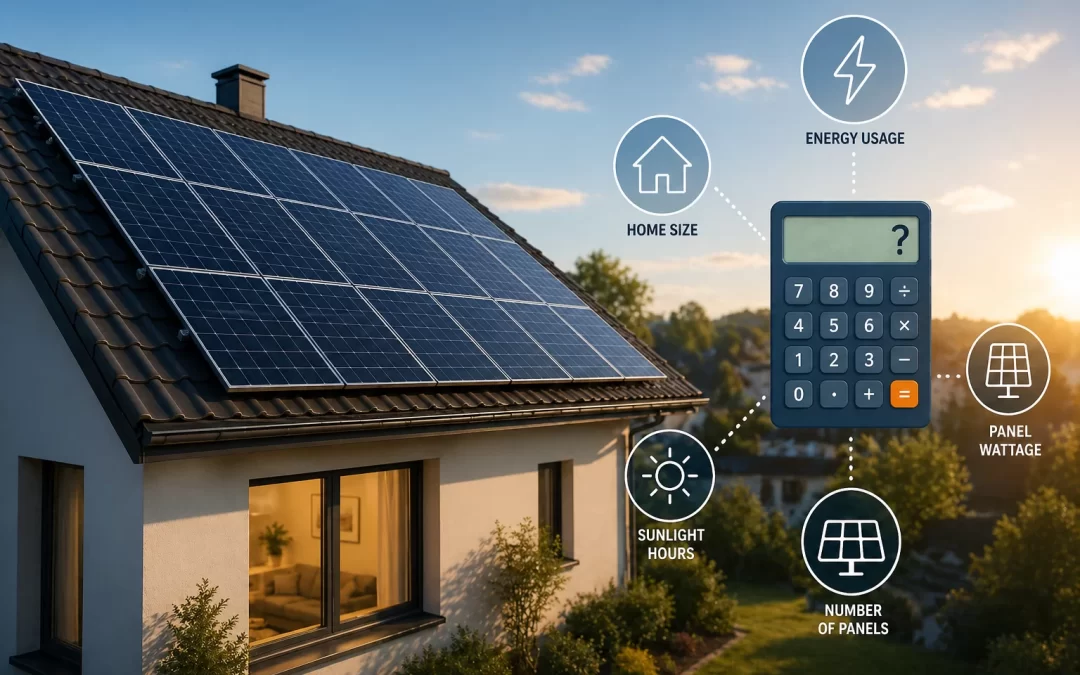
Most U.S. homes need about 15–25 solar panels to offset their electricity use, which usually works out to a 6–10 kW system. A quick way to estimate how many solar panels you need is to take your average monthly kWh usage, divide by 120, and then divide by the wattage of the panels (typically 350–450 watts each). This gives a solid ballpark, but roof size, shading, your utility rates, and whether you plan to add an electric vehicle or heat pump can change the ideal system size. For an accurate answer, you’ll need a professional quote based on your roof, your bills, and your local incentives.
Figuring out “How many solar panels do I need?” is usually the first real math question homeowners ask when they start looking at solar. The good news is you can get a solid estimate with your electric bill and a few simple numbers. This guide walks you through a step-by-step calculator, real examples, and what actually changes the number of panels you’ll need on your roof.
Table of Contents
- How many solar panels does the average home need?
- How to calculate how many solar panels you need (step-by-step)
- Key numbers: system size, cost, savings, and payback
- What affects how many solar panels you need?
- Roof, location, and shading considerations
- When solar works in your favor — and when it doesn’t
- What to do before getting quotes
- Frequently Asked Questions
- Summary: Key takeaways
- Next step: Get a personalized solar panel count
How many solar panels does the average home need?
For a typical U.S. single-family home, most systems fall in this range:
- Average system size: 6–10 kW (kilowatts)
- Average number of panels: 15–25 panels
- Typical panel wattage: 350–450 watts per panel (modern residential panels)
- Goal: Offset 80–100% of your annual electricity use, depending on your budget and roof
According to the U.S. Energy Information Administration, the average U.S. home uses about 10,500–11,000 kWh per year. In many states, a well-sized solar system can cover most or all of that usage, but the exact number of panels you need depends on your location, roof, and energy habits.
Think of “how many panels” as the result of three things working together:
- How much electricity you use (kWh)
- How much sun your roof gets (climate and shading)
- How powerful each panel is (wattage and efficiency)
How to calculate how many solar panels you need (step-by-step)
You can estimate your solar panel count at home in a few minutes. Here’s a simple, homeowner-friendly method that gets you close enough to know what to expect before you talk to installers.
Step 1: Find your average monthly electricity usage
Grab your most recent electric bill and look for “kWh used” or “energy usage.” Ideally, look at 12 months of bills to get a true average.
- Average U.S. home: about 875–900 kWh per month
- If you don’t have 12 months of history (new home), use your last 3–6 months and average them
Example: Let’s say your average is 900 kWh per month.
Step 2: Convert usage into a system size (kW)
A quick rule of thumb many designers use is that each 1 kW of solar in a decent-sun U.S. location produces around 120 kWh per month (this varies by state, but it’s a good national average).
Use this formula:
System size (kW) ≈ Monthly kWh ÷ 120
Using our example:
- 900 kWh ÷ 120 ≈ 7.5 kW system
If you live in a very sunny state (AZ, NV, parts of CA, NM, TX), you might divide by 130–150 instead. In cloudier states (WA, OR, parts of the Northeast), you might divide by 100–110. A professional installer will use local solar production data for your exact address.
Step 3: Choose an estimated panel wattage
Modern residential solar panels typically fall between 350 and 450 watts each. Higher-wattage panels produce more power in the same roof space, which is helpful on smaller or shaded roofs.
- Budget or older panels: ~300–340 W
- Common mid-range panels: ~370–410 W
- Premium/high-efficiency panels: ~420–450+ W
If you don’t know what you’ll use yet, 400 W is a reasonable default for estimating.
Step 4: Calculate how many solar panels you need
Now convert your system size into a panel count:
Number of panels ≈ (System size in kW × 1,000) ÷ Panel wattage
Using our example 7.5 kW system and 400 W panels:
- 7.5 kW × 1,000 = 7,500 watts total
- 7,500 ÷ 400 = 18.75 panels
- Round up → you’d need about 19 solar panels
Step 5: Adjust for your goals (100% offset vs. partial)
Not everyone needs or wants to cover 100% of their usage. You might choose to:
- Offset 60–80% if your roof is small or shaded
- Offset 80–100% if you have good roof space and want maximum bill reduction
- Oversize slightly if you plan to add an EV, hot tub, or electric heat pump soon (where allowed by your utility)
If you only want to cover 80% of your usage, multiply your system size by 0.8 before converting to panels. In our example:
- 7.5 kW × 0.8 = 6 kW
- 6,000 ÷ 400 = 15 panels
So you’d be looking at roughly 15 panels for 80% offset or 19 panels for close to 100% offset, depending on your roof and local sun.
Quick reference: Typical panel counts by home usage
Assuming 400 W panels and average U.S. sun (120 kWh/month per kW):
- 500 kWh/month: ~4.2 kW system → ~11 panels
- 750 kWh/month: ~6.3 kW system → ~16 panels
- 1,000 kWh/month: ~8.3 kW system → ~21 panels
- 1,250 kWh/month: ~10.4 kW system → ~26 panels
- 1,500 kWh/month: ~12.5 kW system → ~32 panels
These are ballpark numbers. A site visit, shade analysis, and your local utility rules will refine them.
Key numbers: system size, cost, savings, and payback
Once you know roughly how many solar panels you need, the next questions are usually: “How much will this cost?” and “How long until it pays for itself?” Here are realistic 2026 benchmarks for U.S. residential solar.
Typical system size and panel count
- Average U.S. system size: 6–10 kW
- Average number of panels: 15–25 panels
- Panel lifespan: 25–30 years performance warranty, 30–35 years typical life
Most homeowners who fully offset their usage end up in this range, but high-usage homes with pools, large families, or EVs may need 30+ panels.
Cost per watt and total system cost
As of 2026, national averages for residential solar are:
- Cost per watt: $2.50–$3.50 (before incentives)
- Typical system cost: $28,000–$32,000 before incentives for a standard 8–10 kW system
- After 30% federal tax credit: about $19,600–$22,400 (if you qualify and can use the credit)
These are averages. Your price can be higher or lower based on your roof complexity, equipment choices, local labor costs, and whether you add a battery.
Savings and payback period
- Average annual bill savings: $1,300–$1,500
- Typical payback period: 7–9 years nationally
- System life: 25–30+ years of useful production
In higher-electricity-cost states (CA, HI, parts of the Northeast), payback can be shorter. In low-cost power states, it can be longer. Your actual savings depend heavily on your utility rates, rate structure (time-of-use vs. flat), and how your utility credits solar exports.
Before you focus too much on payback, it can help to understand the full picture of costs and savings; our solar cost and savings guide walks through the main variables in more detail.
What affects how many solar panels you need?
Two homes with the same square footage can need very different solar systems. Here are the main factors that change your ideal panel count.
Your electricity usage (the biggest factor)
How much power you use is the single largest driver of system size.
- Higher usage = more panels. Electric heating, multiple refrigerators, a pool pump, or an EV can all push your usage up.
- Lower usage = fewer panels. Efficient appliances, LED lighting, and good insulation reduce your solar needs.
- Future plans matter. If you plan to add an EV or switch from gas to electric heat, it’s smart to tell your installer so they can size accordingly.
Sunlight in your area (solar resource)
Not all locations get the same amount of usable sun.
- Sunny states: AZ, NV, NM, parts of CA and TX can get 20–30% more production per panel than cloudier states.
- Cloudier regions: Pacific Northwest, parts of the Midwest and Northeast may need more panels to produce the same energy.
- Installers use local “solar irradiance” data to estimate how much energy each kW of solar will produce on your roof.
Roof orientation and tilt
Where and how your roof faces changes how hard each panel can work.
- Best orientation (Northern Hemisphere): south-facing roofs generally produce the most energy.
- Good orientations: southeast, southwest, and even east or west can still be very viable, just slightly less productive.
- Roof tilt: A moderate pitch (around 25–35 degrees) is often close to ideal, but installers can work with flatter or steeper roofs.
If your roof isn’t ideal, you may need a few more panels to hit the same energy target, or you may choose higher-efficiency panels.
Shading from trees, chimneys, or nearby buildings
Shade is one of the most common reasons two similar homes need different numbers of panels.
- Light, brief shading: usually manageable with good design and modern inverters.
- Heavy or all-day shading: can significantly reduce production and may make solar less attractive.
- Partial shading: often addressed with microinverters or optimizers, but you may need more panels to compensate.
A professional shade analysis (often using a tool like a solar pathfinder or drone imagery) is essential before finalizing your system size.
Panel efficiency and wattage
Higher-efficiency panels produce more power in the same space, which can reduce the number of panels you need for a given energy target.
- Standard panels: 19–21% efficiency, ~370–410 W
- Premium panels: 21–23%+ efficiency, ~420–450+ W
- Effect on panel count: Upgrading from 370 W to 430 W panels can reduce your panel count by 10–15% for the same system size.
If you want to compare brands and efficiency levels, our best solar panels of 2026 guide breaks down top options.
Utility rules and net metering
Your utility’s policies can limit or shape how big your system can be.
- Some utilities cap system size at a percentage of your past 12 months’ usage (for example, 100–120%).
- Net metering or export credit rules affect how valuable extra production is, which can influence whether you size for 80% vs. 100% offset.
- Time-of-use rates may favor west-facing panels that produce more in late afternoon, even if total annual kWh is slightly lower.
A good installer will design within your utility’s rules and explain how they affect your ideal panel count.
Roof, location, and shading considerations
Even if the math says you “need” 20 panels, your roof has to be able to safely and effectively host them. Here’s how your home’s physical layout comes into play.
How much roof space do you need?
A typical residential solar panel is roughly 3.5 feet by 5.5–6.5 feet, or about 18–22 square feet.
- Rule of thumb: Plan on about 18–20 square feet of usable roof area per panel.
- Example: 20 panels × 20 sq ft = ~400 sq ft of good, unobstructed roof space.
- Installers must also maintain clearances around roof edges, ridges, and vents, so not every square foot is usable.
Multiple roof faces and layout
Many systems are spread across more than one roof plane.
- If your south roof is small, panels can be placed on east and west roofs to reach your target size.
- Complex roofs with many hips, valleys, and dormers may limit how many panels fit cleanly.
- In some cases, ground mounts or carport structures are used when roof space is insufficient.
Structural and age considerations
Your roof needs to be in good condition and structurally sound.
- If your roof is near the end of its life, it’s often wise to replace it before or during the solar installation.
- Older homes may require a structural review to confirm the roof can handle the added weight.
- Most systems add about 2–4 pounds per square foot, which is within code for most modern roofs, but verification is important.
Location-specific considerations
Where you live changes both production and economics.
- High-sun, high-rate states: Often need fewer panels for strong savings and faster payback.
- Low-sun, low-rate states: May need more panels and see longer payback periods.
- Snowy climates: Panels can shed snow, but snow cover reduces winter production; installers may adjust tilt or layout accordingly.
If you’re unsure whether solar makes sense in your state, our honest “Is solar worth it?” guide walks through the main regional factors.
When solar works in your favor — and when it doesn’t
Solar is a great fit for many homes, but not all. Being realistic about when it does and doesn’t work builds a better long-term outcome.
When solar (and a larger panel count) works in your favor
- You have high electric bills. The more you pay per kWh, the more each solar kWh is worth.
- Your roof has good sun exposure. South, southeast, or southwest roofs with minimal shading are ideal.
- You plan to stay in your home. The longer you stay, the more you benefit from 25–30 years of production.
- You expect your usage to grow. Adding an EV or electrifying heating can make a slightly larger system more attractive (within utility rules).
When solar may not be the right move (or you may want fewer panels)
- Heavily shaded roof with limited options. If tall trees or nearby buildings block sun most of the day, even a large system may underperform.
- Very low electricity usage. If your bills are already low, the payback period can stretch out significantly.
- Uncertain home plans. If you expect to move in a few years, you may not see the full financial benefit (though solar can help with resale in some markets).
- Roof in poor condition. If your roof needs replacement soon and you’re not ready to address it, it may be better to wait.
In these situations, a reputable installer should be honest about the limitations and may recommend a smaller system, a different design, or even holding off on solar.
What to do before getting quotes
Once you have a rough idea of how many solar panels you might need, a bit of preparation will help you get better, more comparable quotes.
1. Gather your information
Before you talk to installers, have these ready:
- 12 months of electric bills (or as many as you have)
- Your utility provider and current rate plan
- Any plans to add an EV, hot tub, or electric heating/cooling
- Photos of your roof (if requested) and your electrical panel
2. Decide your goals
Installers can design more accurately if they know what you care about most:
- Maximizing bill savings vs. minimizing upfront cost
- Targeting 80% vs. 100%+ of your current usage
- Planning for future load growth (EV, heat pump, etc.)
- Whether you’re interested in backup power with a battery
If you’re considering backup power, our guide on whether you need a solar battery explains the pros and cons.
3. Questions to ask each installer
When you’re reviewing proposals, ask:
- How many kWh per year is this system expected to produce? (Not just how many panels.)
- What percentage of my current usage will this cover?
- What panel brand and wattage are you using, and why?
- How did you account for shading and roof orientation?
- What assumptions did you use for utility rate increases? (These are estimates, not guarantees.)
- What are the warranties on panels, inverters, and workmanship?
4. Get multiple quotes
Solar is a significant investment, and pricing can vary widely between installers, even for the same number of panels.
- Compare at least 2–3 quotes with similar system sizes and equipment.
- Look at cost per watt and projected annual production, not just total price.
- Be cautious of quotes that seem dramatically cheaper or larger than others without a clear explanation.
Understanding what equipment is in your quote and how it’s sized will help you compare apples to apples; our solar panels and equipment guide can help you decode the line items.
Frequently Asked Questions
How many solar panels do I need for a 2,000 sq ft house?
Square footage doesn’t directly determine how many solar panels you need — your electricity usage does. Many 2,000 sq ft homes use around 800–1,200 kWh per month, which often translates to roughly 16–24 panels (about 6–10 kW), depending on your location, roof, and panel wattage.
Can I run my whole house on solar power?
Yes, many homes can offset 80–100% of their annual electricity use with a properly sized solar system, assuming enough roof or ground space and decent sun exposure. Whether you can fully cover your usage depends on your kWh consumption, local sun, roof layout, and utility rules.
How many solar panels do I need for 1,000 kWh per month?
At 1,000 kWh per month, you’d typically need around an 8–9 kW system in an average-sun U.S. location. With 400 W panels, that works out to roughly 20–23 panels, but the exact number depends on your climate, roof orientation, and shading.
Is it better to get more lower-wattage panels or fewer high-wattage panels?
If you have plenty of roof space, standard-wattage panels can be a cost-effective choice. If your roof is small or partially shaded, higher-wattage, higher-efficiency panels let you get more power from limited space, potentially reducing the total number of panels you need.
Do I need a battery if I install solar panels?
You don’t need a battery for your solar panels to power your home during the day; most grid-tied systems work fine without one. A battery is mainly for backup power and time-of-use bill management, and whether it’s worth it depends on your utility rates, outage risk, and budget.
Will adding more panels always save me more money?
Only up to a point. Once your system is covering most of your usage, extra panels may produce power that’s credited at a lower rate by your utility, so the financial return on those additional panels can drop; a good installer should model this and explain where the “sweet spot” is for your home.
Summary: Key takeaways
- Most U.S. homes need about 15–25 solar panels (roughly 6–10 kW) to offset the bulk of their electricity use.
- A quick estimate is: system size (kW) ≈ monthly kWh ÷ 120, then divide by panel wattage (350–450 W) to get your panel count.
- Average system costs run about $28,000–$32,000 before incentives, with a typical 7–9 year payback and 25–30+ years of production.
- Your actual panel count depends most on your usage, roof sun exposure, shading, and the efficiency of the panels you choose.
- The best next step is to use your real electric bills and get a few personalized quotes that show system size, panel count, and expected annual kWh production.
Next step: Get a personalized solar panel count
Online calculators are helpful, but the only way to know exactly how many solar panels you need is to have a professional design a system for your specific roof, usage, and utility. A good installer will review your bills, analyze shading, and show you how many panels it takes to hit your savings goals.
If you’re ready to see real numbers for your home, you can get a personalized solar quote with no obligation. Seeing side-by-side proposals is the fastest way to decide whether solar — and how many panels — truly makes sense for your home.