
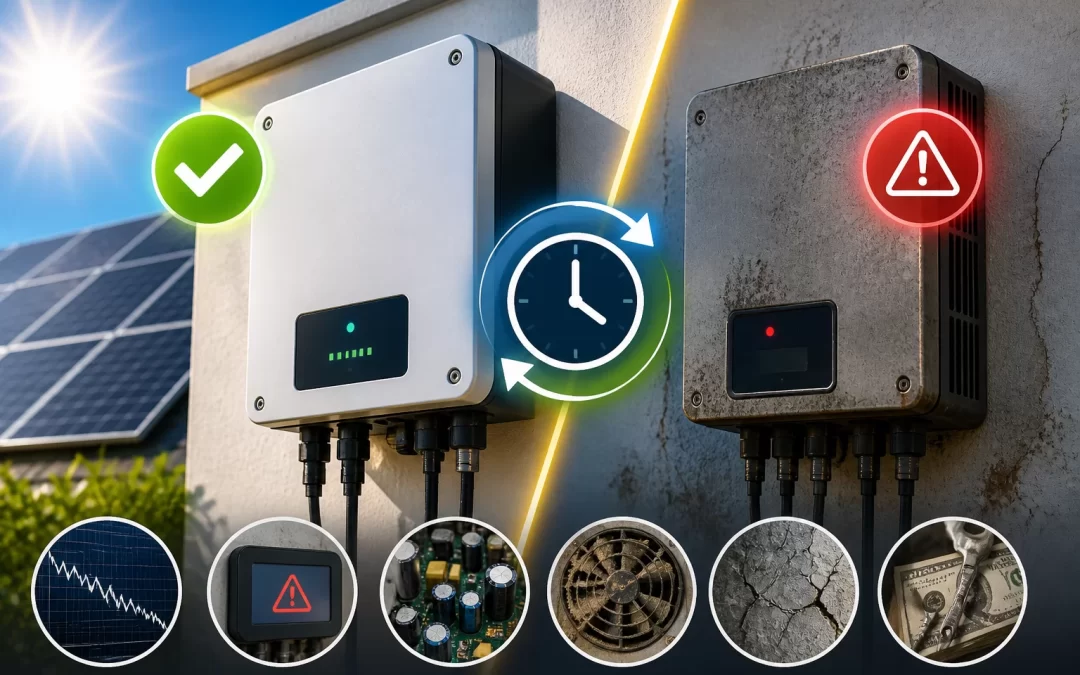
Most residential solar inverters need to be replaced about once during the life of your solar panels, typically after 10–15 years for string inverters and 20–25 years for microinverters. You should replace your solar inverter when it consistently shows error codes, your solar production drops significantly, or it fails completely and can’t be reset. A professional should confirm that the inverter is the problem (not your panels, wiring, or monitoring). In some cases, a repair or warranty replacement may make more sense than paying for a brand-new inverter.
Solar panels are built to last 25–30 years or more, but your inverter usually won’t go the distance without at least one replacement. If you’re a homeowner wondering when you should replace your solar inverter, you’re really asking, “Is my system still working the way it should, and is it worth fixing or upgrading now?” This guide walks you through how long inverters last, warning signs of failure, costs, and how to decide your next step.
Table of Contents
- What Your Solar Inverter Does (And Why It Fails First)
- Typical Lifespan: When Do Solar Inverters Usually Need Replacing?
- Signs You Should Replace Your Solar Inverter
- Repair vs. Replace: How to Decide
- Costs, Numbers, and How Inverters Affect Your Solar Payback
- Climate, Location, and Installation Factors
- When Replacing Your Inverter Helps You – And When It Doesn’t
- What to Do Next if You Think Your Inverter Is Failing
- Frequently Asked Questions
- Key Takeaways
- Get Personalized Advice and Quotes
What Your Solar Inverter Does (And Why It Fails First)
Simple explanation: the “translator” of your solar system
Your solar panels produce direct current (DC) electricity, but your home and the grid use alternating current (AC). The solar inverter is the device that converts DC to AC so your home can actually use the power your panels generate.
In most US homes, you’ll have one of three setups:
- String inverter: One main box (often near your electrical panel) that handles power from a “string” of panels.
- String inverter + DC optimizers: A central inverter plus small devices on each panel to improve performance.
- Microinverters: A tiny inverter on each panel, usually mounted under the panel on the roof.
Why inverters wear out before panels
Panels are mostly solid-state with no moving parts and very little heat stress, so they can last 25–30+ years. Inverters, on the other hand:
- Have more electronic components that run hot and cool repeatedly.
- Handle high power and voltage swings every day.
- Often sit in garages, outside, or on roofs where temperatures can be extreme.
Because of this, it’s normal to replace at least one inverter over the life of a solar system.
Typical Lifespan: When Do Solar Inverters Usually Need Replacing?
Average lifespan by inverter type
Realistic inverter lifespans for US homes are:
- String inverters: About 10–15 years typical life, with many warranties in the 10–12 year range (often extendable to 15–20 years).
- String inverters with optimizers: Similar central inverter life (10–15 years), optimizers often warrantied for 20–25 years.
- Microinverters: Often warrantied for 20–25 years, with real-world life commonly in the 20+ year range.
Since panels usually have a 25–30 year performance warranty and can last 30–35 years, it’s common for a system with a string inverter to need one replacement during the panels’ life. A microinverter system may or may not need replacement, depending on age and brand.
Key numbers and what they mean for you
- Panels: 25–30 year performance warranty, 30–35 year typical life.
- Inverter (string): 10–15 year typical life, 10–12 year standard warranty.
- Inverter (micro): 20–25 year warranty, often designed to match panel life.
In practical terms, if your system is:
- Under 5 years old: A failed inverter is usually a warranty issue, not normal wear.
- 10–15 years old: A failing string inverter is normal aging and often time to replace.
- 20+ years old: You may be deciding between inverter replacement and planning for a full system upgrade in the next 5–10 years.
Signs You Should Replace Your Solar Inverter
Clear warning signs of inverter failure
You should start seriously considering inverter replacement if you notice:
- Frequent or persistent error codes on the inverter screen or app, especially if they return after resets.
- No lights or display on the inverter when the sun is out and breakers are on.
- Solar production has dropped to near zero on sunny days, even though your panels look fine.
- Burning smell, melted plastic, or visible damage on or around the inverter (turn it off and call a pro immediately).
- Repeated tripping of the inverter or solar breaker without an obvious cause.
Symptoms that might not be the inverter
Not every performance issue means your inverter is dying. Other common causes include:
- Shading, dirt, or snow on panels reducing output.
- Weather-related drops in production (short winter days, cloudy weeks, high heat).
- Monitoring system glitches where the app shows zero, but the system is actually working.
- Loose wiring or a tripped breaker somewhere between the panels, inverter, and main panel.
If your system is just producing less than you expected, it may be worth reviewing why solar systems sometimes produce less than expected and how to monitor your solar system’s performance before assuming the inverter is the culprit.
Age + symptoms: when it’s probably time
In general, replacement becomes likely when:
- Your inverter is 10+ years old and you have repeated error codes or shutdowns.
- The inverter is out of warranty and the repair quote is a large share of a new unit’s cost.
- Your installer or a licensed electrician confirms the inverter has an internal failure.
Repair vs. Replace: How to Decide
When a repair makes sense
Repair can be the better option when:
- The inverter is still under warranty and the manufacturer will cover parts (you may still pay labor).
- The issue is minor, like a loose connection, failed fan, or simple board that’s inexpensive to replace.
- Your inverter is relatively new (under 7–8 years) and the rest of the system is in great shape.
When replacement is usually smarter
Full replacement is often the better long-term choice when:
- The inverter is 10–15+ years old and out of warranty.
- The repair quote is more than 40–50% of a new inverter.
- The model is discontinued and parts are hard to find.
- You want to upgrade features (better monitoring, battery-ready, higher efficiency).
Matching a new inverter to an older system
When replacing an inverter on an older system, a professional will need to confirm:
- The new inverter’s voltage and power ratings match your existing panel array.
- The roof and wiring are still in good condition and up to current electrical code.
- Your utility interconnection rules are still satisfied (some utilities have updated requirements).
This is why inverter replacement is almost always a job for a licensed solar installer or electrician, not DIY.
Costs, Numbers, and How Inverters Affect Your Solar Payback
Typical inverter replacement costs
Costs vary by brand, size, and local labor rates, but as of 2026, typical US homeowner ranges are:
- String inverter (residential, 5–10 kW): About $1,500–$3,000 for the hardware.
- Microinverters (per panel): About $120–$200 per microinverter, plus labor; for 20 panels, that can be $2,400–$4,000+ in hardware alone.
- Labor and permitting: Often $500–$1,500, depending on complexity and local requirements.
All in, many homeowners see total inverter replacement costs in the $2,000–$5,000 range, but complex microinverter or large systems can be higher.
How this fits into overall solar costs and savings
For context, a typical residential solar system in the US costs:
- Total system cost: About $28,000–$32,000 before incentives.
- After 30% federal tax credit (ITC): Roughly $19,600–$22,400 net cost (consult a tax professional for your specific situation).
- Cost per watt: Around $2.50–$3.50 installed.
- Average panels: 15–25 panels for a typical US home.
- Average annual savings: About $1,300–$1,500 on electricity bills.
- Payback period: Typically 7–9 years nationally, depending on utility rates and incentives.
An inverter replacement 10–15 years in is a real cost, but spread over 25–30 years of system life, it usually doesn’t ruin the economics. For many homeowners, a $2,000–$4,000 inverter replacement is roughly 1–3 years of solar savings, which is still reasonable if the system has already paid for itself or is close.
What affects inverter replacement cost most
- System size: Larger systems need larger or more inverters.
- Inverter type: Microinverters and premium brands usually cost more.
- Location: Labor rates and permitting fees vary widely by state and city.
- Access: Roof height, steepness, and distance from the main panel can increase labor time.
- Code upgrades: Older systems may need additional work to meet current electrical codes.
If you’re still in the planning phase, it’s smart to factor in at least one future inverter replacement when you’re evaluating overall solar costs and savings.
Climate, Location, and Installation Factors
How climate affects inverter life
Where you live can shorten or extend your inverter’s lifespan:
- Hot climates (AZ, NV, TX, FL): High temperatures are hard on electronics; poorly ventilated inverters may fail sooner.
- Cold climates (MN, ND, northern states): Cold itself is less of a problem, but freeze–thaw cycles and moisture can be.
- Coastal areas: Salt air can corrode outdoor equipment if it’s not rated for the environment.
Proper placement (shaded, ventilated, and protected from direct weather) can add years to an inverter’s life.
Installation quality and equipment choice
Two big non-climate factors:
- Installation quality: Clean wiring, correct sizing, and proper mounting reduce stress on the inverter.
- Equipment brand and warranty: Reputable brands with 10–12 year standard warranties (and options to extend) are usually a safer bet.
If you’re still shopping for solar, reviewing an installer’s equipment choices and workmanship standards (see our solar installation guide) can help you avoid early inverter failures.
When Replacing Your Inverter Helps You – And When It Doesn’t
When inverter replacement works in your favor
Replacing your inverter is usually a good move when:
- Your system is 10–20 years old and still structurally sound.
- You’re still saving $1,000+ per year on electricity and expect to stay in the home for several more years.
- The panels, racking, and wiring are in good shape, and only the inverter is failing.
- You want to add monitoring, battery compatibility, or better performance with a newer model.
When it may not be worth it
It may not make sense to invest in a new inverter if:
- Your system is 25+ years old and the panels are already near the end of their useful life.
- You plan to sell the home soon and won’t recoup the cost in energy savings or sale price.
- The roof needs major work or replacement soon, and you’re considering a full solar refresh anyway.
- The inverter replacement quote is very high relative to your remaining expected savings.
In these cases, it may be smarter to plan for a full system upgrade or to live with reduced production for a short time, depending on your budget and goals.
What to Do Next if You Think Your Inverter Is Failing
Step-by-step checklist
If you suspect your solar inverter needs to be replaced, here’s a practical path:
- Check your monitoring app or inverter display for error codes and note them down.
- Verify breakers and switches (solar disconnects, inverter switch, and solar breaker in your main panel) are in the ON position.
- Compare production on a clear, sunny day to past months or years to confirm a real drop.
- Inspect safely from the ground for obvious damage, burning smells, or loose conduit (do not open electrical boxes yourself).
- Contact your original installer or a reputable local solar company for a diagnostic visit.
- Ask for both repair and replacement options, including:
- What exactly failed and why.
- Whether it’s covered by warranty.
- Total cost for repair vs. new inverter, including labor and permits.
- Get at least one additional quote if the cost is significant or the system is older.
Questions to ask an installer
To make a good decision, ask:
- “Is the inverter still under manufacturer warranty, and who handles the claim?”
- “What’s the expected remaining life of my panels and wiring?”
- “If I replace the inverter, will it be compatible with batteries in the future?”
- “Are there any code upgrades or additional work required?”
- “What is the total out-of-pocket cost, and what’s the warranty on the new inverter and labor?”
For more detailed troubleshooting steps before you commit to replacement, our guide to diagnosing and fixing common solar inverter problems can help you understand what your installer is telling you.
Frequently Asked Questions
How often do solar inverters need to be replaced?
Most homeowners with string inverters will need to replace them once in 10–15 years, while microinverters often last 20–25 years. Since panels can last 25–30+ years, it’s normal to plan for at least one inverter replacement during your system’s life.
Can I upgrade my solar inverter to add a battery later?
In many cases, yes—replacing an older inverter with a newer, battery-ready model can make it easier to add energy storage in the future. You’ll need a professional to confirm compatibility with your existing panels, wiring, and local utility rules.
Is it safe to keep using a failing solar inverter?
If your inverter is just showing intermittent errors, it may still be safe but you’ll lose production. However, if you notice burning smells, melted plastic, or visible damage, you should shut the system down at the disconnects and call a professional immediately to avoid fire or shock risk.
Does my homeowner’s insurance cover inverter replacement?
Insurance may cover inverter damage from specific events like fire, lightning, or storms, but not normal wear and tear or age-related failure. You’ll need to review your policy or speak with your insurance agent to understand what’s covered in your situation.
Can I replace a solar inverter myself?
Technically, inverters can be swapped, but it involves high-voltage DC and AC wiring and must meet electrical code and utility requirements. For safety, code compliance, and warranty protection, inverter replacement should be done by a licensed electrician or qualified solar installer.
Will replacing my inverter improve my solar production?
If your old inverter was failing or shutting down, a new one will restore lost production and may improve efficiency slightly. However, it won’t make your panels produce more than their rated capacity or overcome shading, roof orientation, or weather limits.
Key Takeaways
- Most homeowners should expect to replace a string inverter after about 10–15 years, while microinverters often last 20–25 years.
- Clear signs it’s time to act include persistent error codes, zero or very low production, and confirmed internal failure by a professional.
- Typical inverter replacement costs run about $2,000–$5,000, which is a relatively small part of a system that costs $28,000–$32,000 before incentives and saves about $1,300–$1,500 per year.
- Climate, installation quality, and equipment brand all have a major impact on how long your inverter lasts.
- Your best next step is to get a professional diagnosis and at least one quote comparing repair vs. replacement, based on your system’s age and your long-term plans.
Get Personalized Advice and Quotes
Every solar system and home is different, and the “right” time to replace a solar inverter depends on your equipment, local climate, and how long you plan to stay in the home. Getting a few personalized quotes can show you exactly what repair or replacement would cost and how it affects your long-term savings.
If you’re ready to see real numbers for your situation, you can compare options and talk with vetted installers through our quote tool at /get-my-quote/—with no pressure and no obligation.