
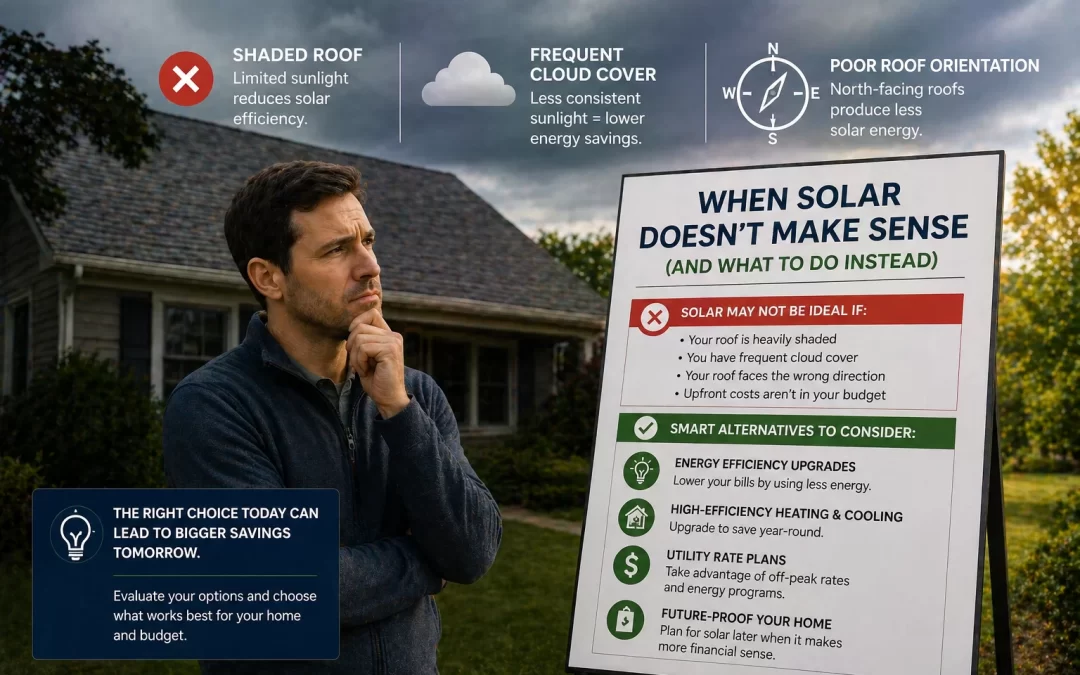
Solar doesn’t make sense when your electric bill is low, your roof or property isn’t a good fit, local incentives are weak, or you can’t use the tax credit or financing options available. In those cases, the payback period can stretch well beyond 15–20 years, and you may never fully recover your upfront cost. Instead, it often makes more sense to improve efficiency, explore community solar, or wait until your situation changes. The right move depends on your utility rates, roof, budget, and how long you plan to stay in your home.
Solar panels are a great fit for many U.S. homeowners, but not for everyone. This guide is for homeowners who want an honest look at when solar doesn’t make financial or practical sense—and what smarter alternatives you can choose instead. By the end, you’ll know whether to move forward, hit pause, or pursue a different path like community solar or efficiency upgrades.
Table of Contents
- When Solar Doesn’t Make Sense: The Big Picture
- Key Numbers: Costs, Savings, and Payback When Solar Is a Bad Fit
- 1. When Your Electric Bill Is Too Low
- 2. When Your Roof Is a Poor Fit for Solar
- 3. Heavy Shading or a Tough Location
- 4. When You Plan to Move Soon
- 5. Financing, Credit, and Cash-Flow Issues
- 6. Weak Incentives or Unfavorable Utility Policies
- 7. Renters, Condos, and Strict HOAs
- What to Do Instead When Solar Doesn’t Make Sense
- Decision Guide: Should You Move Forward, Wait, or Skip Solar?
- Frequently Asked Questions
- Summary
- Next Step: Get Numbers for Your Home
When Solar Doesn’t Make Sense: The Big Picture
For most U.S. homeowners with decent sun and average electric bills, solar can pay for itself in 7–9 years and then provide low-cost power for decades. But there are clear situations where the math or logistics simply don’t work.
Solar usually does not make sense when:
- Your average electric bill is under about $75–$100 per month.
- Your roof is heavily shaded, facing the wrong direction, or needs major work soon.
- You can’t qualify for financing and don’t have cash for the upfront cost.
- You won’t be in the home long enough to see payback.
- Your state or utility has poor incentives or unfavorable solar policies.
- You rent, live in a condo, or have an HOA that effectively blocks solar.
In these cases, you’re often better off focusing on energy efficiency, community solar, or simply waiting until your situation changes. If you’re unsure where you stand, our broader guide on whether solar is worth it walks through the main variables in more detail.
Key Numbers: Costs, Savings, and Payback When Solar Is a Bad Fit
Before looking at specific “no-go” situations, it helps to understand the typical numbers for a residential solar system in the U.S. These are national averages as of 2026; your actual numbers will vary by state, utility, and installer.
- Average system size: 6–10 kW (about 15–25 panels for a typical home)
- Cost per watt: $2.50–$3.50
- Total system cost: $28,000–$32,000 before incentives
- After 30% federal tax credit (ITC): about $19,600–$22,400 (if you qualify)
- Average annual bill savings: $1,300–$1,500
- Typical payback period: 7–9 years nationally
- Panel performance warranty: 25–30 years
- Typical panel life: 30–35 years
Solar starts to not make sense when one or more of these are true:
- Your annual savings are much lower than $1,000 per year.
- Your payback period stretches beyond 15–20 years.
- You can’t use the 30% federal tax credit (for example, very low tax liability).
- Your roof or property limits system size so much that savings are minimal.
To see how payback changes with your bill and location, tools like a solar payback period calculator can be helpful, but a local installer’s quote is the most accurate way to get real numbers.
1. When Your Electric Bill Is Too Low
Why low electric bills make solar less attractive
Solar saves you money by replacing electricity you would have bought from the utility. If you don’t spend much on electricity to begin with, there’s less to save, and it takes much longer to earn back your upfront cost.
As a rough guideline, if your average electric bill is under about $75–$100 per month, rooftop solar often doesn’t pencil out financially.
Key numbers for low-usage homes
- Monthly bill under $75: Annual bill under $900; potential annual savings from solar may be only $500–$700.
- System cost: Still likely in the $15,000–$25,000 range after incentives, even for a smaller system.
- Payback period: Can easily stretch beyond 15–20 years, sometimes longer than you plan to stay in the home.
When low usage works in your favor
Low usage is great for your wallet and the environment. It often means you’ve already done some of the cheapest, highest-impact things:
- Efficient lighting and appliances
- Good insulation and air sealing
- Smart thermostat and good thermostat habits
In this situation, you’re already enjoying low bills without a large solar investment.
When low usage works against solar
Solar becomes harder to justify when:
- Your bill is low and unlikely to increase (no plans for EVs, electric heating, or a hot tub).
- Your utility rates are relatively cheap (for example, under $0.12–$0.13 per kWh).
- Your state offers limited incentives beyond the federal tax credit.
What to do instead
- Continue focusing on efficiency upgrades (insulation, air sealing, smart controls).
- Consider community solar if available, which can offer modest savings with no equipment on your roof.
- Revisit solar if your usage increases (for example, you add an EV or switch from gas to electric heating).
2. When Your Roof Is a Poor Fit for Solar
Roof issues that can make solar a bad idea
Your roof is the foundation of a good solar installation. If it’s in poor condition or poorly oriented, solar may not be wise right now.
Solar often doesn’t make sense if:
- Your roof is old or damaged and will need replacement within 5–10 years.
- You have complex rooflines with many dormers, hips, or valleys that limit panel space.
- Your main roof faces north (in the U.S.) and you don’t have good east/west alternatives.
- Your roof is made of materials that are expensive or tricky to work with (e.g., some tile or slate roofs).
How roof problems affect the numbers
- Roof replacement cost: $8,000–$20,000+ depending on size and material.
- If you must replace the roof soon after installing solar, you’ll pay to remove and reinstall the system, often $2,000–$5,000.
- Limited roof space can reduce system size so much that your annual savings fall well below the $1,300–$1,500 national average.
When your roof situation still works for solar
Solar can still make sense if:
- You replace the roof before installing solar, so both last 25+ years together.
- You have at least one large, mostly unshaded roof plane facing south, southwest, or southeast.
- Your installer can design a system that meets most of your usage even with some roof complexity.
When your roof makes solar a poor choice
Solar is often not worth it when:
- Your roof has less than about 200–300 square feet of usable, sunny space.
- You’d have to pay for a full roof replacement only to accommodate solar, and you weren’t planning to replace it otherwise.
- Your roof orientation and pitch mean very low energy production per panel.
What to do instead
- Plan and budget for a roof replacement first, then revisit solar.
- Ask installers about ground mounts if you have land and local zoning allows it.
- Consider community solar if you can’t or don’t want to modify your roof.
3. Heavy Shading or a Tough Location
Why shading and location matter so much
Solar panels need sun. Trees, nearby buildings, and your local climate all affect how much energy your system can produce. In some locations, production is so low that solar doesn’t make financial sense.
Key factors that hurt solar performance
- Heavy tree shading for much of the day, especially between 9 a.m. and 3 p.m.
- Nearby tall buildings or hills that block the sun.
- Regions with frequent cloud cover and low solar resource (parts of the Pacific Northwest, for example).
- Homes at higher latitudes with poor roof orientation.
How shading affects the numbers
- Even 10–20% shading can reduce annual production enough to add several years to your payback period.
- In very cloudy or shaded locations, your annual savings might drop well below $1,000, making a $20,000+ investment hard to justify.
- Tree removal can cost $500–$3,000+ per tree, which adds to your effective solar cost.
When location still works in your favor
Solar can still be worthwhile if:
- You have partial shading but use modern equipment like microinverters or DC optimizers.
- Your utility rates are high (for example, $0.20+ per kWh), which boosts the value of every kWh you generate.
- Your state offers strong incentives that offset lower production.
When shading and location make solar a bad bet
Solar may not make sense when:
- Your roof is shaded for most of the prime sun hours and tree removal is not an option.
- You live in a low-sun region with low electricity rates and weak incentives.
- Even a large system would only offset a small portion of your usage.
What to do instead
- Ask an installer for a shade analysis before making any decisions.
- Consider community solar, which uses off-site solar farms not affected by your property’s shading.
- Focus on efficiency and smart usage to keep bills low without rooftop solar.
4. When You Plan to Move Soon
Why your timeline matters
Solar is a long-term investment. With a typical payback period of 7–9 years and panel lifespans of 25–30+ years, the best returns go to homeowners who stay put.
How moving affects your solar payback
- If you sell your home before payback, you may not fully recover your net cost through energy savings.
- Studies suggest solar can increase home value, but the exact amount varies by market and buyer preferences.
- Transferring warranties and explaining the system to buyers adds complexity to the sale.
When solar can still make sense if you might move
Solar may still be reasonable if:
- You expect to stay at least 7–10 years.
- Your local market values solar and energy efficiency (your agent can advise).
- You’re comfortable viewing solar as both a home improvement and a financial investment.
When moving soon makes solar a poor choice
Solar is often not worth it when:
- You plan to move within 3–5 years.
- You’re unsure whether buyers in your area value solar enough to pay more for your home.
- You don’t want the added complexity during resale.
What to do instead
- Focus on low-cost efficiency upgrades that improve comfort and appeal to buyers (insulation, LED lighting, smart thermostat).
- Ask a real estate professional how solar is viewed in your local market before committing.
- Consider waiting to install solar at your next, longer-term home.
5. Financing, Credit, and Cash-Flow Issues
Why how you pay for solar matters
Even when solar is a good technical fit, the way you pay for it can make or break the value. If financing costs are high or your cash flow is tight, solar may not be wise right now.
Common payment options and issues
- Cash purchase: Highest upfront cost, best long-term savings.
- Solar loan: Spreads cost over 10–25 years; interest rate and fees are critical.
- Lease or power purchase agreement (PPA): Low or no upfront cost, but you don’t own the system and long-term savings may be smaller.
When financing works in your favor
Solar financing can be attractive if:
- Your monthly loan payment is equal to or lower than your current electric bill.
- You qualify for a competitive interest rate and reasonable term.
- You can use the 30% federal tax credit to reduce your net cost (consult a tax professional for your specific situation).
When financing makes solar a bad deal
Solar may not make sense when:
- You have high-interest debt (credit cards, personal loans) that should be paid down first.
- Solar loan offers come with high interest rates or large dealer fees.
- Your budget is tight and you can’t comfortably handle a new monthly payment.
- You can’t use the federal tax credit and there are few other incentives.
What to do instead
- Work on improving your credit and debt situation before taking on a solar loan.
- Look into community solar or utility green power programs that don’t require upfront investment.
- Revisit solar later, when your finances are stronger and you can either pay cash or qualify for better loan terms.
6. Weak Incentives or Unfavorable Utility Policies
How incentives and policies change the math
Solar economics depend heavily on your state and utility. Incentives, net metering rules, and rate structures can make solar either very attractive or much less compelling.
Key policy and incentive factors
- Federal tax credit (ITC): 30% of system cost through 2032, if you have enough tax liability.
- State and local incentives: Rebates, state tax credits, or performance payments (varies widely by state).
- Net metering: How your utility credits you for excess solar sent back to the grid.
- Time-of-use rates: Higher rates at peak times can increase solar’s value if your system produces then.
When policies work in your favor
Solar is more likely to make sense when:
- Your state offers strong incentives in addition to the federal ITC.
- Your utility has full retail net metering or generous export rates.
- Your electricity rates are high and expected to rise.
If you’re unsure how your state stacks up, our guide on whether solar is worth it in your state can help you compare.
When weak incentives make solar less attractive
Solar may not make sense when:
- Your state offers no additional incentives beyond the federal ITC.
- Your utility pays very little for excess solar (for example, low “buyback” or avoided-cost rates).
- Your electricity rates are relatively low and stable.
What to do instead
- Monitor policy changes—solar rules can and do change over time.
- Consider smaller systems sized to maximize self-consumption rather than exporting a lot to the grid.
- Look into community solar or other programs that may be structured differently than rooftop solar.
7. Renters, Condos, and Strict HOAs
Why ownership and property rules matter
To install rooftop solar, you generally need to own the property and have the legal right to modify the roof. Renters, condo owners, and homeowners with strict HOAs may face barriers that make rooftop solar impractical or impossible.
Common barriers
- Renters: You don’t own the roof and can’t install permanent equipment.
- Condos and townhomes: Shared roofs and association rules complicate ownership and maintenance.
- HOAs: Some associations restrict panel placement or appearance, even in states with “solar rights” laws.
When solar can still work
Solar may still be an option if:
- Your HOA is open to solar with certain design guidelines.
- Your condo association has a process for shared solar or roof modifications.
- You own a standalone home in a community with reasonable solar rules.
When property rules make solar not worth the hassle
Solar often doesn’t make sense when:
- Your landlord or HOA is firmly opposed to rooftop solar.
- The legal and administrative effort to get approval is high and uncertain.
- You don’t plan to stay long enough to justify the time and cost.
What to do instead
- Explore community solar, which is designed for renters and those without suitable roofs.
- Talk to your HOA or landlord about future policy changes or shared solar options.
- Focus on portable efficiency measures (LEDs, smart plugs, window coverings) that you can take with you.
What to Do Instead When Solar Doesn’t Make Sense
1. Maximize energy efficiency first
Efficiency upgrades are often cheaper and faster to pay back than solar, especially when solar isn’t a great fit. Consider:
- Air sealing and insulation
- High-efficiency HVAC systems and water heaters
- LED lighting and Energy Star appliances
- Smart thermostats and power strips
These improvements can cut your bills by 10–30% or more, often with payback periods of just a few years.
2. Consider community solar
Community solar lets you subscribe to a share of a larger solar farm and receive credits on your bill, without installing panels on your roof. It’s especially useful if:
- You rent or live in a condo.
- Your roof is shaded or unsuitable.
- You don’t want the responsibility of owning and maintaining equipment.
Our guide to what community solar is and whether it’s right for you explains how these programs work and what to watch for.
3. Explore green power or renewable energy programs
Many utilities offer “green power” options where you pay a small premium (or sometimes save a bit) to support renewable energy projects. While this doesn’t lower your bill as much as a well-designed solar system, it can be a simple way to support clean energy.
4. Revisit solar later
Your situation can change:
- You may replace your roof, remove trees, or move to a sunnier home.
- Electricity rates may rise, improving solar economics.
- New incentives or better technology may appear in your area.
In those cases, it’s worth revisiting whether solar makes sense, using resources like our solar cost and savings guide to understand the updated numbers.
Decision Guide: Should You Move Forward, Wait, or Skip Solar?
Is this the right time to act?
Ask yourself these questions:
- Is my average electric bill at least $100–$120 per month?
- Is my roof in good condition, with 10+ years of life left?
- Do I have a mostly sunny roof area facing south, southwest, or southeast?
- Do I plan to stay in this home for at least 7–10 years?
- Can I comfortably afford the upfront cost or a reasonable loan payment?
If you answered “yes” to most of these, it’s worth getting quotes to see real numbers. If you answered “no” to several, solar may not make sense right now.
What information you need before getting a quote
- 12 months of electric bills (kWh usage and total cost).
- Basic roof information (age, material, any known issues).
- Your plans for the home (moving, major renovations, EV purchase, etc.).
- Your credit situation if you’re considering financing.
Questions to ask a solar installer
- Based on my bills and roof, what is the estimated payback period and lifetime savings?
- How do shading and my roof orientation affect production?
- What incentives and tax credits apply in my area, and how do they change the numbers?
- What happens if I move before the system is paid off?
- What are the warranties on equipment, workmanship, and production?
Should you get multiple quotes?
Yes. Getting 2–3 quotes is one of the best ways to:
- See how different installers evaluate your roof and shading.
- Compare system sizes, equipment, and projected savings.
- Spot unrealistic promises or outlier prices.
Even if you suspect solar may not make sense, a few honest quotes can confirm that—and help you avoid second-guessing later.
Frequently Asked Questions
When does solar not make financial sense for a homeowner?
Solar usually doesn’t make financial sense when your electric bill is low, your roof is shaded or in poor condition, local incentives are weak, or you can’t use the 30% federal tax credit. In those cases, the payback period can stretch beyond 15–20 years, and you may never fully recover your upfront cost. It’s often smarter to focus on efficiency or community solar instead.
Is solar worth it if my electric bill is only $50–$75 a month?
If your bill is in the $50–$75 range, rooftop solar often isn’t worth the cost because your potential annual savings are small compared to a $15,000–$25,000 investment. The payback period can easily exceed 15–20 years. In this situation, efficiency upgrades and community solar are usually better options.
Should I replace my roof before going solar?
If your roof is older or will need replacement within the next 5–10 years, it’s usually better to replace it before installing solar. Otherwise, you may have to pay to remove and reinstall the panels later, adding thousands to your total cost. A reputable installer can help you assess your roof’s remaining life.
Does it ever make sense to wait before installing solar?
Yes, waiting can make sense if you plan to move soon, your roof needs work, your finances are tight, or local policies are currently unfavorable. In those cases, focusing on efficiency and monitoring policy or rate changes is often smarter. You can revisit solar when your roof, budget, or location is a better fit.
What can I do if my roof is too shaded for solar?
If tree removal or trimming isn’t practical, rooftop solar may not be a good investment. Instead, consider subscribing to a community solar project, which lets you benefit from solar generated off-site. You can also focus on efficiency upgrades to keep your bills low without installing panels.
Is community solar a good alternative to rooftop solar?
Community solar can be an excellent alternative if your roof isn’t suitable, you rent, or you don’t want to own equipment. It typically offers modest savings and environmental benefits with little or no upfront cost. The exact value depends on the program structure and your utility, so it’s important to review terms carefully.
Summary
- Solar doesn’t make sense when your bills are low, your roof or location is a poor fit, incentives are weak, or your finances and timeline don’t support a long-term investment.
- A typical system costs around $28,000–$32,000 before incentives and pays back in 7–9 years when conditions are good—but much longer when they’re not.
- The biggest factors are your electric bill, roof condition and shading, local policies, and how long you’ll stay in the home.
- When rooftop solar isn’t right, efficiency upgrades, community solar, and green power programs are often smarter moves.
- The best next step is to gather your bills, understand your roof, and get a few honest quotes to confirm whether solar makes sense for your specific situation.
Next Step: Get Numbers for Your Home
Whether you’re leaning toward solar or suspect it may not make sense, personalized quotes are the only way to see real numbers for your home, roof, and utility. A few no-obligation quotes can confirm if solar is a smart investment now or something to revisit later. When you’re ready, you can get my quote and compare options with clear eyes and realistic expectations.