
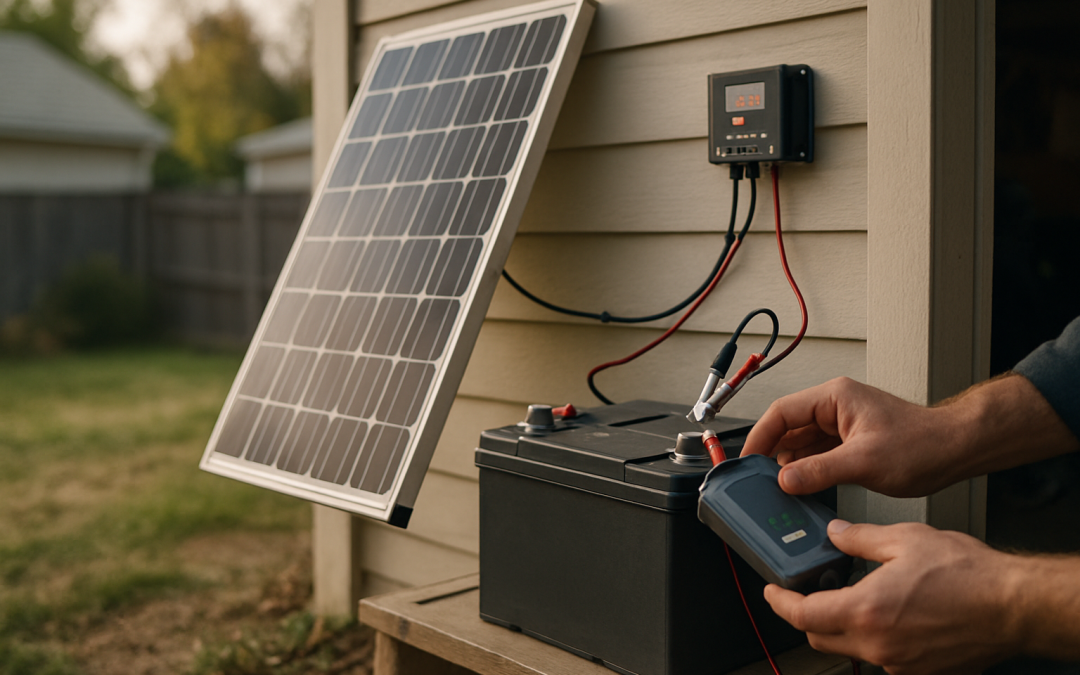
Direct answer: A solar battery maintainer is a small, low-power solar charger designed to keep a battery topped up and healthy over time, not to fully recharge a deeply drained battery. For homeowners, it’s most useful for backup batteries, RVs, boats, sheds, or off-grid equipment that sit unused for long periods. If you have a full home solar-plus-storage system that’s used daily, you usually don’t need a separate maintainer because your main inverter and charge controller already manage battery health. However, if any battery is stored for months at a time, a properly sized solar battery maintainer can significantly extend its lifespan and reduce replacement costs.
This guide explains what a solar battery maintainer is, when it makes sense for a US homeowner, and when it’s not worth the money. We’ll walk through real-world examples, typical costs, and how maintainers fit into a broader solar setup. By the end, you’ll know whether you should buy one now, add it later, or skip it entirely.
Table of Contents
- What Is a Solar Battery Maintainer?
- How a Solar Battery Maintainer Works (In Plain English)
- Do You Really Need a Solar Battery Maintainer?
- Types of Batteries and Systems That Use Maintainers
- Costs, Lifespan, and Key Numbers to Know
- When a Solar Battery Maintainer Helps — and When It Doesn’t
- How to Choose the Right Solar Battery Maintainer
- How Maintainers Fit Into Overall Solar Maintenance
- How to Decide Your Next Step
- Frequently Asked Questions
- Summary: Key Takeaways
What Is a Solar Battery Maintainer?
A solar battery maintainer is a small solar-powered device that delivers a very low, steady charge to a battery to keep it from self-discharging and sulfating (a common cause of battery failure). It’s different from a regular solar charger or full solar system, which are designed to recharge batteries from low to full.
Think of a maintainer as “battery life support” rather than a full power source. It’s ideal for batteries that:
- Sit unused for weeks or months (boats, RVs, backup generators)
- Power small off-grid loads (gate openers, fence chargers, remote cameras)
- Need to be ready in an emergency (backup sump pump, small backup battery bank)
For a typical grid-tied home solar system with a modern battery, the main system already manages charging and maintenance. In that case, a separate solar battery maintainer is usually only relevant for extra or separate batteries you own.
How a Solar Battery Maintainer Works (In Plain English)
Basic components
Most solar battery maintainers include:
- A small solar panel (often 5–20 watts)
- A charge controller or built-in regulator to prevent overcharging
- Cables and connectors to attach to the battery terminals
- Mounting hardware or suction cups (for windows or dashboards)
What it actually does all day
Here’s what happens in simple terms:
- Sunlight hits the small solar panel.
- The panel produces a low amount of DC power (direct current).
- The charge controller regulates that power to a safe voltage and current.
- The battery receives a gentle “trickle” charge that offsets its natural self-discharge.
Most maintainers are designed to keep a healthy battery topped up, not to revive a dead one. If a battery is already deeply discharged or damaged, a maintainer usually can’t fix it.
Maintainer vs. charger vs. full solar system
- Maintainer: Low power, long-term maintenance. Keeps a good battery good.
- Charger: Higher power, can recharge a partially drained battery in hours.
- Full solar system: High power, designed to run loads (your home) and manage large batteries with advanced electronics.
For most homeowners, a solar battery maintainer is a small accessory, not a core part of a whole-home solar setup.
Do You Really Need a Solar Battery Maintainer?
Situations where a maintainer makes sense
You’re a good candidate for a solar battery maintainer if you have any of these:
- Backup generator battery that only runs during outages
- RV, camper, or boat that sits parked or docked for months
- Off-grid shed, cabin, or gate with a small battery and light usage
- Standalone backup battery not tied into a full solar system
- Riding mower, ATV, or classic car that’s stored seasonally
In these cases, a maintainer can prevent the most common failure: a battery that’s dead or badly degraded when you finally need it.
When you usually do NOT need one
You probably don’t need a separate solar battery maintainer if:
- You have a grid-tied home solar system with an integrated battery (Tesla Powerwall, Enphase, SolarEdge, etc.). The system’s inverter and battery management already maintain the battery.
- Your home battery is used daily for time-of-use shifting or backup and stays within a healthy charge range.
- You don’t own any separate 12V or 24V batteries for vehicles, tools, or off-grid gear.
In these situations, adding a separate maintainer can be redundant or even risky if it conflicts with the main battery management system.
Key question to ask yourself
Ask: “Do I have any battery that sits unused for more than 1–2 months at a time?” If the answer is yes, a solar battery maintainer is worth considering. If the answer is no, you can likely skip it.
Types of Batteries and Systems That Use Maintainers
Common battery types
Solar battery maintainers are most often used with:
- Lead-acid batteries (flooded, AGM, or gel) – very common in cars, boats, RVs, and small backup systems.
- 12V or 24V deep-cycle batteries – used for trolling motors, off-grid cabins, and small solar setups.
Some maintainers are also compatible with:
- Lithium iron phosphate (LiFePO₄) batteries – increasingly common in modern solar and RV systems.
Always check that the maintainer is rated for your specific battery chemistry. Using the wrong type can shorten battery life or damage the battery.
How this relates to home solar batteries
Whole-home solar batteries (like Tesla Powerwall, Enphase IQ Battery, LG ESS, etc.) already include:
- A built-in battery management system (BMS)
- Temperature monitoring
- Charge and discharge controls
These systems are designed to keep the battery in a healthy range automatically. A separate solar battery maintainer is not used or recommended with these integrated products.
Off-grid and hybrid systems
In off-grid cabins or hybrid systems with separate battery banks, maintainers can be helpful if:
- You shut the system down seasonally.
- You have a secondary battery bank that’s not always in use.
- You store spare batteries for backup.
In these cases, a small dedicated maintainer can keep those batteries from degrading while they sit.
Costs, Lifespan, and Key Numbers to Know
Typical cost of a solar battery maintainer
As of 2026, you can expect:
- Basic 5–10W maintainer: $20–$50
- Mid-range 10–20W maintainer with better controller: $50–$120
- Heavy-duty or multi-battery maintainer kits: $120–$250+
Installation is often DIY for small systems (vehicles, small batteries). For anything tied into a larger solar or backup system, it’s wise to involve a qualified electrician or solar installer.
Battery lifespan and why maintenance matters
For context, here are typical battery lifespans when properly maintained:
- Lead-acid deep-cycle batteries: 3–7 years
- AGM or gel lead-acid: 4–8 years
- Lithium iron phosphate (LiFePO₄): 10–15+ years (with proper management)
Repeated deep discharges and long periods sitting partially discharged can cut these numbers significantly. A maintainer helps by keeping the battery near full charge when not in use, which is especially important for lead-acid batteries.
How this compares to full home solar costs
To put maintainer costs in perspective, a typical residential solar system in the US in 2026 costs:
- Total system cost: about $28,000–$32,000 before incentives
- After 30% federal tax credit (ITC): roughly $19,600–$22,400 (consult a tax professional for your situation)
- Cost per watt: around $2.50–$3.50
- Average annual savings: about $1,300–$1,500 on electricity bills
- Payback period: typically 7–9 years nationally
- Panel lifespan: 25–30 years performance warranty, 30–35 years typical life
- Average panels needed: 15–25 for a typical US home
Compared to these numbers, a $50–$100 solar battery maintainer is a very small add-on that can protect batteries worth several hundred dollars each. The value is less about energy savings and more about avoiding premature battery replacement.
What affects whether a maintainer is “worth it”
- Battery cost: The more expensive the battery, the more sense it makes to protect it.
- Storage time: Batteries stored for 3–6+ months benefit the most.
- Climate: Very hot or very cold areas increase battery stress.
- Access: Remote or hard-to-reach locations make failure more costly or inconvenient.
When a Solar Battery Maintainer Helps — and When It Doesn’t
Advantages for homeowners
A solar battery maintainer can be a smart choice when:
- You rely on a battery in an emergency. For example, a backup generator or sump pump battery that must work during an outage.
- Your batteries are hard to access. Remote gates, barns, or cabins where regular manual charging is inconvenient.
- You store seasonal vehicles or equipment. RVs, boats, ATVs, and classic cars often suffer from dead batteries after storage.
- You want a “set it and forget it” solution. Once installed correctly, maintainers require very little attention.
Limitations and when it’s not a good fit
A solar battery maintainer is not a good solution when:
- The battery is already badly degraded or dead. A maintainer can’t revive a failing battery.
- You need to power large loads. Maintainers are not designed to run appliances or charge a whole-home battery.
- You have a modern, integrated home battery system. Adding a separate maintainer can interfere with the built-in management system.
- The panel is shaded most of the time. Without enough sun, the maintainer can’t keep up with self-discharge.
Also, if you’re comfortable putting a standard plug-in battery maintainer on a timer or using it occasionally, a solar maintainer may be more convenience than necessity.
Climate and location considerations
- Cold climates: Batteries lose capacity in the cold and self-discharge more slowly, but starting engines is harder. A maintainer helps keep voltage high for reliable starts.
- Hot climates: Heat accelerates battery aging. Keeping batteries fully charged and avoiding deep discharges becomes even more important.
- Shaded or indoor storage: If your vehicle or battery is stored indoors or in deep shade, a solar maintainer may not get enough light to be effective.
How to Choose the Right Solar Battery Maintainer
1. Match the maintainer to your battery type
Check the product specs for:
- Supported voltages (commonly 12V, sometimes 24V)
- Supported chemistries (flooded lead-acid, AGM, gel, LiFePO₄)
- Recommended battery capacity range (in amp-hours, Ah)
Using a maintainer not designed for your battery chemistry can shorten battery life or void warranties.
2. Size the solar panel correctly
For maintenance (not full charging), a common rule of thumb for lead-acid batteries is:
- Panel wattage ≈ 1–3% of battery Ah capacity
Examples:
- 50Ah battery → 0.5–1.5W minimum, 5–10W is common for real-world conditions.
- 100Ah battery → 1–3W minimum, 10–20W is common.
Too small, and the battery will still slowly discharge. Too large without a proper controller, and you risk overcharging.
3. Look for a built-in charge controller
Many better-quality maintainers include:
- Overcharge protection
- Reverse-polarity protection (if you connect it backward)
- Blocking diodes to prevent nighttime discharge
For panels over about 5W, a proper charge controller is strongly recommended to avoid overcharging in bright sun.
4. Consider installation and safety
Before buying, think about:
- Mounting location: Will the panel get several hours of direct sun?
- Cable routing: Can you run wires safely without pinching or chafing?
- Weather exposure: Is the panel rated for outdoor use if needed?
- Connection method: Alligator clips, ring terminals, or a plug-in adapter (like a 12V socket)?
If you’re tying into an existing solar or backup system, consult a professional to avoid wiring conflicts or safety issues.
How Maintainers Fit Into Overall Solar Maintenance
Maintainers are one piece of the puzzle
A solar battery maintainer helps keep individual batteries healthy, but it’s only part of maintaining a solar-powered home. You’ll also want to:
- Monitor your main solar system’s performance regularly to catch issues early (see how to monitor your solar system’s performance).
- Keep panels clean and unobstructed so they produce enough power for both your home and any batteries (our guide on how to clean solar panels explains how often and how to do it safely).
- Watch for signs of panel or equipment damage that could affect charging (see how to spot solar panel damage).
For most homeowners, the main solar system takes care of its own batteries, while maintainers are used for “extra” or separate batteries around the property.
When to involve a professional
Consider calling a solar installer or electrician if:
- You want to add a maintainer to a battery that’s part of your home’s electrical system.
- You’re unsure how your existing inverter or charge controller manages batteries.
- You’re planning an off-grid or hybrid setup with multiple battery banks.
Professional help is especially important when working inside electrical panels, near your main inverter, or with high-voltage battery systems.
How to Decide Your Next Step
Is now the right time to act?
It’s worth acting soon if:
- You already have a battery that’s been sitting unused for months.
- You’ve had to replace a vehicle or equipment battery more often than expected.
- You rely on a backup battery for emergencies and aren’t sure of its condition.
If you’re still early in your solar research and don’t yet own extra batteries, you can simply keep maintainers in mind as a future accessory.
What to know before getting quotes or buying
Before you buy a solar battery maintainer or talk to an installer, gather:
- The type, voltage, and capacity of your battery (for example, 12V 100Ah AGM).
- How long the battery typically sits unused.
- Where the battery is located and how much sun that area gets.
- Whether the battery is part of a larger solar or backup system.
Questions to ask an installer or electrician
- “Is my existing solar or backup system already maintaining this battery properly?”
- “Is it safe to add a separate solar battery maintainer to this battery?”
- “What size and type of maintainer would you recommend for my setup?”
- “Will adding a maintainer affect any warranties on my battery or inverter?”
When multiple quotes make sense
If you’re only buying a small standalone maintainer for a vehicle or tool battery, you can usually compare products yourself. But if you’re:
- Adding batteries to a home solar system, or
- Designing an off-grid or hybrid setup with multiple battery banks,
then getting multiple quotes from reputable solar installers is smart. It helps you compare equipment choices, wiring approaches, and long-term maintenance plans, not just price.
Frequently Asked Questions
What is the difference between a solar battery maintainer and a solar trickle charger?
In everyday use, people often use these terms interchangeably, but there is a subtle difference. A solar battery maintainer is specifically designed to keep a healthy battery topped off long-term, usually with built-in protections to prevent overcharging. A trickle charger may simply provide a low, constant charge and, if it lacks a proper controller, can overcharge a battery if left connected indefinitely.
Can a solar battery maintainer charge a dead battery?
No, a solar battery maintainer is not designed to revive a dead or badly discharged battery. It works best on batteries that are already in good condition and near full charge, keeping them from slowly discharging over time. To recover a dead battery, you typically need a higher-powered charger and, in many cases, the battery may already be too damaged to save.
Do I need a solar battery maintainer if I have a Tesla Powerwall or similar home battery?
If you have a Tesla Powerwall, Enphase IQ Battery, or similar integrated home battery, you do not need a separate solar battery maintainer. These systems include sophisticated battery management that controls charging, discharging, and long-term health automatically. Adding an external maintainer can interfere with that management and is not recommended.
How many watts should my solar battery maintainer be?
For maintenance only, many homeowners use 5–20 watts depending on battery size and sun exposure. A common guideline is to size the panel at about 1–3% of the battery’s amp-hour capacity, then round up to account for real-world conditions like clouds and partial shading. For example, a 100Ah battery often pairs well with a 10–20W maintainer panel.
Is it safe to leave a solar battery maintainer connected all the time?
It is generally safe to leave a solar battery maintainer connected long-term if it includes a proper charge controller and is matched to your battery type. The controller prevents overcharging by limiting voltage and current as the battery reaches full. Always follow the manufacturer’s instructions and, if in doubt, consult a professional.
Will a solar battery maintainer work in winter or cloudy weather?
A solar battery maintainer will still produce some power in winter and on cloudy days, but output will be lower. As long as the panel gets a few hours of decent light most days, it can usually keep up with a battery’s slow self-discharge. In very dark or heavily shaded conditions, you may need a slightly larger panel or occasional use of a plug-in charger as backup.
Summary: Key Takeaways
- A solar battery maintainer is a low-power solar charger designed to keep a battery topped up over time, not to recharge a deeply drained battery.
- It’s most useful for backup, seasonal, or off-grid batteries that sit unused for months, not for modern whole-home solar batteries with built-in management.
- Typical maintainers cost $20–$120 and can significantly extend the life of batteries that might otherwise fail early from sitting partially discharged.
- Climate, battery type, storage time, and sun exposure all affect whether a maintainer is worth it for your situation.
- Your next step is to list any batteries you rely on but rarely use, confirm their type and size, and decide whether a small standalone maintainer or a professionally integrated solution makes more sense.
If you’re also considering a full solar system or adding a home battery, personalized quotes will give you a clear picture of costs, savings, and equipment options for your home. Getting multiple bids through our secure quote request page can help you compare installers side by side and choose the setup that protects both your energy bills and your batteries over the long term.