
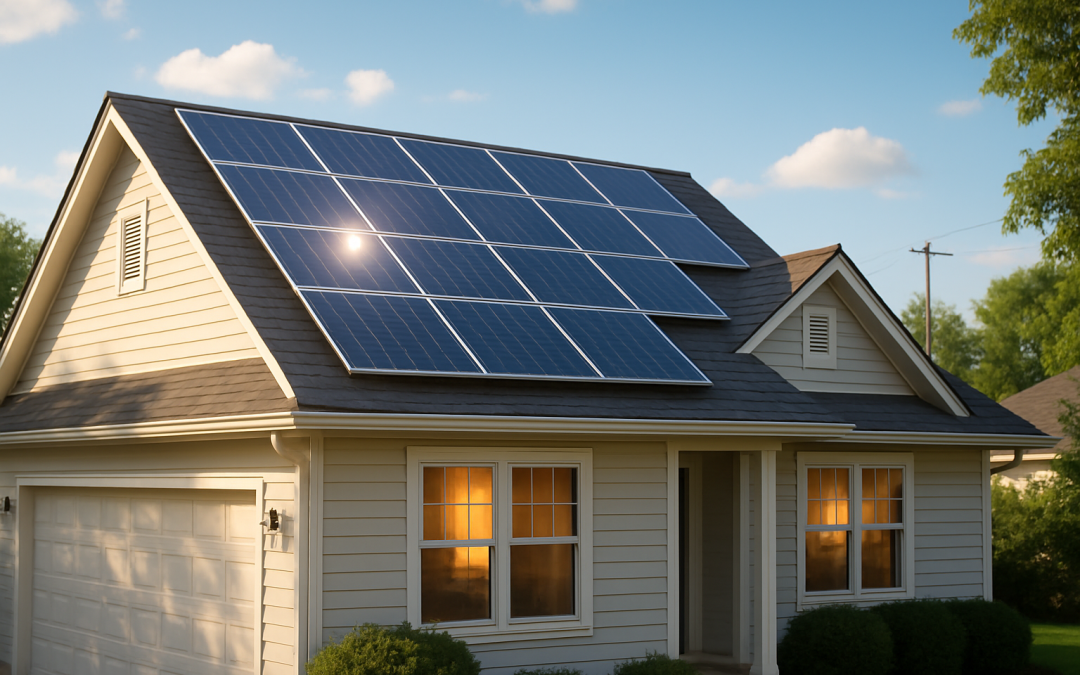
Solar panels for home electricity can significantly cut your power bills, with typical U.S. homeowners saving around $1,300–$1,500 per year and paying off their system in about 7–9 years. A typical home system costs roughly $28,000–$32,000 before incentives, or about $19,600–$22,400 after the 30% federal tax credit, and will usually last 25–30+ years. Your actual results depend heavily on your roof, local electricity rates, and incentives in your state. Solar is not the right choice for every home, especially if your roof is shaded, you plan to move soon, or your local power rates are very low.
Solar panels for home electricity are no longer a niche or experimental option — they’re a mainstream way to lock in lower energy costs and gain some independence from rising utility rates. This guide is written for U.S. homeowners who want a clear, honest picture of costs, savings, the installation process, and what to realistically expect. By the end, you should know whether it’s worth getting quotes for your home and what to ask when you do.
Table of Contents
- What Does “Solar Panels for Home Electricity” Actually Mean?
- How Much Do Home Solar Panels Cost?
- Savings, Payback Period, and Long-Term Value
- Solar Installation Process: Step-by-Step
- What Homeowners Should Expect Day-to-Day
- When Solar Panels Make Sense (and When They Don’t)
- Key Numbers and Data at a Glance
- How to Decide Your Next Step (And When to Get Quotes)
- Frequently Asked Questions
- Summary: Key Takeaways
What Does “Solar Panels for Home Electricity” Actually Mean?
Simple explanation
When people talk about solar panels for home electricity, they usually mean a “grid-tied” solar power system on the roof (or sometimes on the ground) that:
- Generates electricity from sunlight during the day
- Feeds that power into your home first, reducing what you buy from the utility
- Stays connected to the grid so you still have power at night or on cloudy days
Most systems do not include batteries by default. Batteries are an optional add-on for backup power or extra energy independence.
Main components in plain language
A typical home solar system includes:
- Solar panels: The rectangular modules on your roof that turn sunlight into DC electricity.
- Inverter(s): A device that converts DC electricity from the panels into AC electricity your home can use.
- Racking: The mounting hardware that secures panels to your roof.
- Monitoring system: An app or web portal that shows how much power your system is producing.
- Optional battery: Stores extra energy for use during outages or at night.
How it interacts with your utility
With a grid-tied system:
- Your home uses solar power first when the sun is shining.
- Any extra power usually goes back to the grid, often earning you credits through a policy called net metering (rules vary by state and utility).
- At night or when solar isn’t enough, you automatically draw power from the grid like normal.
You still get a utility bill, but it’s typically much lower. In strong solar markets, some homeowners reduce their bill to just basic connection fees.
When this setup works best
- You have a sunny, mostly unshaded roof facing south, southwest, or west.
- Your electric bill is at least $100–$150 per month.
- Your state or utility offers fair net metering or other solar-friendly policies.
- You plan to stay in your home at least 5–7 years.
When it’s less ideal
- Your roof is heavily shaded by trees or nearby buildings.
- You have an old roof that needs replacement soon.
- You live in an area with very low electricity rates and weak incentives.
- You rent or expect to move in the near future.
How Much Do Home Solar Panels Cost?
Typical system cost ranges
For a typical U.S. home, you can use these national averages as a starting point:
- System size: 6–10 kW (kilowatts), or about 15–25 panels
- Cost per watt: $2.50–$3.50
- Total cost before incentives: $28,000–$32,000
- Estimated cost after 30% federal tax credit: $19,600–$22,400
These are ballpark figures for 2026 and can vary by thousands of dollars depending on your location, roof, and equipment choices. The federal solar Investment Tax Credit (ITC) is currently 30% through 2032, but you should confirm current rules and consult a tax professional before making decisions.
What affects your solar panel cost the most
- System size: Bigger systems cost more overall but less per watt. Size is mainly driven by your annual electricity use and roof space.
- Roof type and complexity: Steep, high, or complicated roofs (multiple levels, dormers) cost more to work on.
- Local labor and permitting costs: Prices are usually higher in high-cost-of-living areas.
- Equipment choices: Premium high-efficiency panels and advanced inverters cost more but may allow more power from limited roof space.
- Batteries: Adding a battery can add $10,000–$18,000+ to the project, depending on size and brand.
Upfront purchase vs. financing
Most homeowners either:
- Pay cash: Highest upfront cost, but you get the best long-term savings and avoid interest.
- Use a solar loan: Little or no money down, with monthly payments that often replace most of your electric bill.
Solar leases and power purchase agreements (PPAs) are also available in some states, but they usually mean you don’t own the system and may see smaller long-term savings. If you’re considering financing, it’s worth understanding what credit score you need to finance solar and how different loan terms affect your monthly payment.
State and local incentives
Beyond the 30% federal tax credit, some states and utilities offer:
- State tax credits or rebates
- Performance-based incentives (payments per kWh produced)
- Property tax exemptions for the added value of solar
These can change the math dramatically. For a deeper dive into how incentives work and what to ask your installer, see the dedicated solar incentives and tax credits guide. Always confirm details with a local installer and a tax professional.
When solar panel costs are likely worth it
- Your average electric bill is high (often $150+/month).
- You qualify for the 30% federal tax credit and possibly state incentives.
- You plan to stay in the home long enough to see payback (7–9 years on average).
When the cost may not pencil out
- Your electric bill is very low (e.g., under $60–$80/month).
- You can’t use the federal tax credit (for example, no tax liability) and have no state incentives.
- Your roof needs major work soon, adding thousands to the project cost.
Savings, Payback Period, and Long-Term Value
Typical savings and payback
On a national average basis, homeowners who install solar panels for home electricity can expect:
- Average annual savings: $1,300–$1,500
- Typical payback period: 7–9 years
- System lifespan: 25–30 years performance warranty, 30–35 years typical life
Over 25 years, many homeowners see total savings in the tens of thousands of dollars, especially in states with high electricity prices and good net metering policies.
What drives your actual savings
- Your current electric rate: Higher rates mean more savings per kWh you offset with solar.
- Rate increases over time: If your utility raises rates (as many do), your solar savings grow.
- System size vs. usage: A well-sized system that covers most of your usage maximizes savings.
- Net metering rules: Full retail net metering usually gives the best payback; reduced export rates can lengthen payback.
- Shading and orientation: A sunny, south-facing roof produces more power and more savings.
State-by-state differences
Solar savings vary widely by state. For example:
- States with high electricity prices (like California, New York, Massachusetts, Hawaii) often see faster payback.
- States with lower rates or weaker policies may see slower payback, but solar can still make sense in many cases.
To see how solar pencils out where you live, it’s worth checking an analysis specific to your location, such as an “is solar worth it by state” breakdown or using a solar payback calculator. You can also compare long-term costs in more detail using a resource like a 25-year solar vs. staying on the grid cost comparison.
When solar savings are strongest
- You live in a high-rate area and your utility has a history of rate hikes.
- Your roof allows a system that covers most of your annual usage.
- You can take full advantage of the 30% federal tax credit and any local incentives.
When savings may disappoint
- Your utility pays very little for excess solar you send back to the grid.
- Your roof is partially shaded, reducing output.
- You significantly over- or under-size your system relative to your usage.
If you want a more personalized estimate, a solar payback period calculator can help you plug in your own bill, system size, and incentives to see how long it might take for panels to pay for themselves.
Solar Installation Process: Step-by-Step
1. Initial evaluation and quote
The process usually starts with a remote or in-person assessment where the installer will:
- Review your last 12 months of electric bills
- Look at your roof using satellite imagery or a site visit
- Ask about your future plans (EV purchase, heat pump, pool, etc.)
They’ll then propose a system size, layout, and estimated production, along with a quote that includes equipment, labor, permits, and any optional battery storage.
2. Site visit and final design
After you sign a contract (or sometimes before), a technician will visit your home to:
- Measure your roof and check its condition
- Inspect your electrical panel and main service line
- Confirm there are no unexpected shading or structural issues
The installer then finalizes the system design and prepares permit documents for your city or county.
3. Permitting and approvals
Your installer typically handles:
- Building and electrical permits
- Utility interconnection applications
- Any homeowners association (HOA) documentation, if needed
This stage can take anywhere from a couple of weeks to a few months, depending on local permitting speed and utility responsiveness.
4. Installation day(s)
Once permits are approved, the actual installation is usually quick:
- Most residential systems are installed in 1–3 days.
- Installers mount the racking, attach panels, run wiring, and connect to your electrical panel.
- Your power may be briefly turned off during the final electrical tie-in.
5. Inspections and “permission to operate” (PTO)
After installation:
- The local building or electrical inspector checks the system for safety and code compliance.
- Your utility may install a new bi-directional meter.
- Once everything is approved, the utility grants “permission to operate,” and you can turn the system on.
6. Monitoring and follow-up
Your installer should:
- Help you set up your monitoring app or portal
- Explain how to read your production and your new utility bill
- Review warranty coverage and how to request service if needed
For a deeper walkthrough of each stage, timelines, and what to ask at each step, a dedicated solar installation guide can be helpful.
When the process goes smoothly
- Your city and utility have clear, efficient solar processes.
- Your roof and electrical system are in good shape.
- Your installer is experienced and proactive with communication.
Common delays or issues
- Slow permitting or utility approvals.
- Unexpected roof or electrical upgrades needed.
- Scheduling bottlenecks during busy seasons.
What Homeowners Should Expect Day-to-Day
How your electric bill changes
After your solar panels are turned on, you can expect:
- A much lower energy charge on your bill, especially in sunny months.
- New line items related to net metering or solar production credits (varies by utility).
- Ongoing basic connection or service fees, even if your usage charge drops to near zero.
Maintenance and reliability
Solar panels for home electricity are generally low-maintenance:
- No moving parts in the panels themselves.
- Occasional cleaning may help in dusty or pollen-heavy areas, but rain often does the job.
- Inverters may need replacement once over a 25–30 year system life.
Most reputable installers offer workmanship warranties, and panels typically come with 25-year performance warranties. For more detail on upkeep and troubleshooting, see a resource like a solar maintenance and troubleshooting guide.
Panel lifespan and performance over time
Modern solar panels are designed to last:
- Performance warranty: 25–30 years, often guaranteeing 80–85% of original output at the end of the warranty.
- Typical lifespan: 30–35 years before output drops enough that replacement is considered.
Output declines slowly over time (often around 0.5% per year). If you want a deeper dive into what happens as panels age, including replacement options, a guide on how long solar panels actually last is useful.
What about power outages?
Most grid-tied solar systems shut off during a grid outage for safety reasons, unless you have a battery or special backup system. If backup power is important to you, discuss battery options or hybrid systems with your installer during the quote stage.
Insurance and home value
In many cases:
- Solar can increase your home’s appraised value, especially if you own the system.
- Your homeowners insurance may need to be updated to cover the system, which can slightly change your premium.
It’s wise to call your insurance provider before installation to understand coverage and any cost changes.
When Solar Panels Make Sense (and When They Don’t)
Situations where solar is usually a strong fit
- You own your home and plan to stay at least 5–7 years.
- Your roof is in good condition and gets plenty of sun.
- Your electric bill is moderate to high (often $150+/month).
- Your state or utility offers fair net metering or other supportive policies.
- You can use the 30% federal tax credit and possibly state incentives.
Situations where solar may not be worth it
- Heavy shading: Trees or nearby buildings block much of your roof’s sun.
- Short time horizon: You expect to move in just a few years and are unsure about recouping your investment through higher resale value.
- Very low usage: Your electric bill is already low, so there’s not much to offset.
- Unfavorable policies: Your utility pays very little for exported solar and has low retail rates.
- Roof issues: Your roof is near the end of its life and needs replacement first.
If several of these apply, it’s worth reading an honest breakdown of when solar doesn’t make sense and what to do instead before moving forward.
Alternatives if rooftop solar isn’t right
- Improving home efficiency (insulation, air sealing, efficient HVAC).
- Community solar programs, where available.
- Waiting until a planned roof replacement to revisit solar.
Key Numbers and Data at a Glance
Core benchmarks for home solar (2026)
- Average system size: 6–10 kW (15–25 panels for a typical U.S. home)
- Cost per watt: $2.50–$3.50
- Average system cost before incentives: $28,000–$32,000
- Estimated cost after 30% federal ITC: $19,600–$22,400
- Average annual savings: $1,300–$1,500
- Typical payback period: 7–9 years (national average)
- Federal ITC: 30% through 2032 (subject to legislative changes)
- Panel performance warranty: 25–30 years
- Typical panel lifespan: 30–35 years
What makes your numbers different from the average
- Location: Sunlight levels and local electric rates vary widely by state and even by utility.
- Roof orientation and shading: South-facing, unshaded roofs perform best; east/west or shaded roofs produce less.
- System size vs. usage: Oversizing or undersizing affects both payback and long-term savings.
- Incentives: State and local programs can significantly improve your numbers.
- Financing terms: Interest rates and loan length affect your monthly cash flow and total cost.
These benchmarks are helpful for sanity-checking quotes. If a proposal is far outside these ranges, ask the installer to explain why (it may be due to a very large system, complex roof, or premium equipment).
How to Decide Your Next Step (And When to Get Quotes)
Is now the right time to act?
It may be a good time to seriously consider solar panels for home electricity if:
- Your electric bills feel uncomfortably high or keep rising.
- Your roof is in good shape and you expect to stay in the home for several years.
- You’re able to use the 30% federal tax credit and possibly state incentives.
If you’re unsure whether solar is worth it for your situation, an honest overview like a general “is solar worth it” guide can help you think through the main variables before talking to installers.
Information to gather before getting quotes
To get accurate, apples-to-apples quotes, have these ready:
- Your last 12 months of electric bills (or at least a recent bill with usage in kWh).
- Basic roof details: age, material (asphalt shingle, tile, metal), and any known issues.
- Your plans for future electric use (EV, hot tub, electrifying heating, etc.).
- Your preferred way to pay (cash, loan, or if you’re open to lease/PPA).
Questions to ask potential installers
- How many residential systems have you installed in my area?
- What panel and inverter brands do you use, and why?
- What are the equipment and workmanship warranties, and who handles warranty claims?
- How do you estimate my system’s production, and what assumptions are you using?
- How will my utility bill change, and what net metering or export rules apply?
- What roof or electrical upgrades might be needed, and are they included in this quote?
Why getting multiple quotes matters
Solar is a long-term investment, and pricing can vary significantly between installers. Getting at least 2–3 quotes helps you:
- Compare system sizes, equipment quality, and warranties.
- Spot outliers that are unusually cheap or expensive.
- Understand different design approaches for your roof.
Look for installers who are transparent, patient with questions, and willing to explain their assumptions in plain language.
Frequently Asked Questions
How much do solar panels for a typical home cost?
For a typical U.S. home, solar panels usually cost around $28,000–$32,000 before incentives and about $19,600–$22,400 after the 30% federal tax credit, assuming you qualify. Your actual cost depends on system size, roof complexity, equipment choices, and local labor and permitting costs.
How many solar panels do I need to power my house?
Most U.S. homes need roughly 15–25 panels, or a 6–10 kW system, to offset a large portion of their electricity use. The exact number depends on your annual kWh usage, panel wattage, roof orientation, and how much of your bill you want to cover.
How long does it take for solar panels to pay for themselves?
The national average payback period is about 7–9 years, assuming typical system costs and electric rates. In high-cost electricity states with good incentives, payback can be faster; in low-cost or less supportive markets, it may take longer.
Will I still get an electric bill after installing solar?
Yes, you will still receive a bill from your utility, but it should be much lower if your system is well-sized and performing properly. Most homeowners still pay basic connection fees and may have small usage charges in low-sun months or if their system doesn’t cover 100% of their usage.
Do solar panels work during a power outage?
Standard grid-tied solar systems shut off during a power outage to protect utility workers, so they do not provide power unless you have a battery or special backup system. If backup power is important to you, ask installers about battery options and how they would operate during outages.
How long do home solar panels last?
Most modern solar panels come with 25–30 year performance warranties and often continue producing useful power for 30–35 years or more. Output slowly declines over time, but many systems remain productive well beyond their warranty period.
Summary: Key Takeaways
- Solar panels for home electricity typically cost $28,000–$32,000 before incentives and around $19,600–$22,400 after the 30% federal tax credit, with payback in about 7–9 years on average.
- Most homes need 15–25 panels (6–10 kW) and can save roughly $1,300–$1,500 per year, depending on local rates and sunlight.
- Your roof condition, shading, state policies, and ability to use incentives have the biggest impact on whether solar is a good deal.
- Solar works best for homeowners with sunny roofs, higher electric bills, and plans to stay in their home for several years.
- The smartest next step is to gather your electric bills, understand your roof’s condition, and get a few detailed quotes from reputable installers.
If you’re ready to see real numbers for your home, getting personalized quotes is the most reliable way to understand your true costs and savings. You can compare options, ask questions, and move forward only if the math makes sense for you. Start by requesting tailored estimates at /get-my-quote/ so you can make a confident, informed decision about solar panels for your home.