
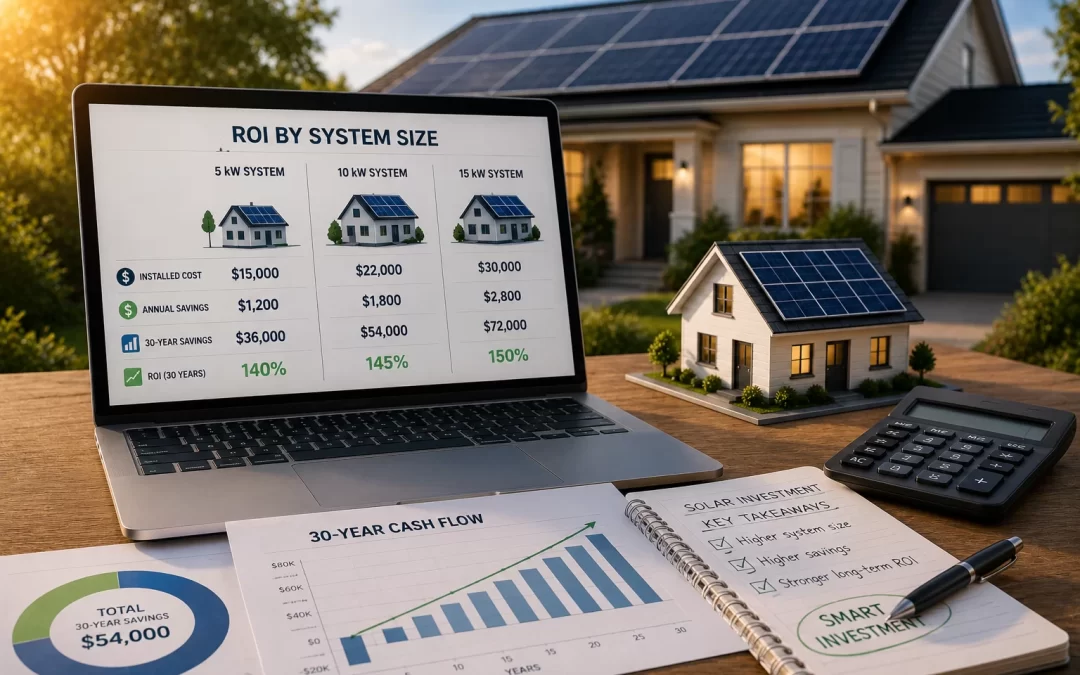
Solar panel ROI by system size is usually best in the 6–10 kW range for a typical U.S. home, with payback periods around 7–9 years and lifetime returns that can easily double your initial investment. Smaller systems (3–5 kW) cost less but often have slightly longer payback times because fixed costs are spread over fewer watts. Very large systems (12–15+ kW) can deliver strong savings if your usage and roof allow it, but oversizing beyond your real needs usually hurts ROI. Actual returns depend heavily on your electric rates, incentives, roof, and how you pay for the system.
This guide breaks down how solar ROI changes by system size, using realistic U.S. numbers and simple explanations. It’s written for homeowners who want to understand not just “Does solar pay off?” but “What size system gives me the best return?” You’ll see where solar works very well, where it doesn’t, and how to decide your next step with confidence.
Table of Contents
- What Solar ROI by System Size Really Means
- Typical ROI by System Size (3 kW to 15 kW)
- Key Numbers: Cost, Savings, and Payback
- What Affects Solar ROI the Most
- How State and Location Change ROI by System Size
- When System Size Works in Your Favor
- When System Size Hurts Your ROI
- How to Choose the Right System Size for Best ROI
- Frequently Asked Questions
- Key Takeaways
- What to Do Next
What Solar ROI by System Size Really Means
Simple definition of solar ROI
Return on investment (ROI) for solar is how much money your system saves you over its life compared to what you paid for it. In plain language: if you spend $20,000 on solar and it saves you $40,000 in electric bills over 25–30 years, your net gain is $20,000 and your ROI is 100%.
When we talk about solar panel ROI by system size, we’re asking: “Does a 5 kW system give a better return than a 10 kW system?” and “Is there a ‘sweet spot’ where the numbers work best?”
How system size is measured
- System size (kW): The total power rating of your solar array. A 7 kW system can produce up to 7,000 watts in full sun.
- Panels per system: Most modern panels are 350–450 watts each. A 7 kW system might use around 16–20 panels.
- Typical home range: Most U.S. homes end up between 6–10 kW, or about 15–25 panels, depending on usage and roof space.
How ROI is usually measured
Homeowners typically look at three related numbers:
- Payback period: How many years it takes for your electric bill savings to equal what you paid for the system.
- Lifetime savings: Total electric bill savings over 25–30 years, minus your net cost.
- Percentage ROI: (Lifetime net savings ÷ net cost) × 100.
Nationally, a well-sized system often pays for itself in 7–9 years and then keeps producing mostly free power for another 15–20+ years.
Typical ROI by System Size (3 kW to 15 kW)
National averages by size (before and after incentives)
Using a national average installed cost of $2.50–$3.50 per watt, here’s how typical system sizes compare. These are ballpark ranges; your actual quote may be higher or lower.
| System Size | Approx. Panels | Gross Cost (Before 30% ITC) | Net Cost (After 30% ITC) |
|---|---|---|---|
| 3 kW | 8–10 | $7,500–$10,500 | $5,250–$7,350 |
| 5 kW | 12–15 | $12,500–$17,500 | $8,750–$12,250 |
| 7 kW | 17–20 | $17,500–$24,500 | $12,250–$17,150 |
| 10 kW | 22–28 | $25,000–$35,000 | $17,500–$24,500 |
| 12 kW | 27–32 | $30,000–$42,000 | $21,000–$29,400 |
| 15 kW | 34–40 | $37,500–$52,500 | $26,250–$36,750 |
Note: The 30% federal Investment Tax Credit (ITC) is available through 2032 for eligible homeowners, but you should confirm your eligibility with a tax professional.
How ROI tends to change with size
In many markets, ROI follows this pattern:
- 3–5 kW (small systems): Lower total cost, but fixed costs (permits, labor, design) are spread over fewer watts, so cost per watt can be slightly higher. Payback is often similar or a bit longer than mid-sized systems.
- 6–10 kW (typical systems): Often the best balance of cost per watt and bill coverage. This range usually delivers the strongest ROI for average homes.
- 12–15+ kW (large systems): Can have good ROI if you have high usage and supportive policies, but oversizing beyond your real needs can lengthen payback and lower returns.
Example ROI by size (typical usage, average rates)
Assuming:
- Electric rate: $0.17/kWh (around current U.S. residential average in many states)
- Annual bill savings: roughly proportional to system size
- Net cost after 30% ITC
| System Size | Est. Annual Savings | Payback Period | 25-Year Net Savings (After Cost) |
|---|---|---|---|
| 3 kW | $500–$700 | 8–11 years | $8,000–$12,000 |
| 5 kW | $800–$1,100 | 8–10 years | $14,000–$20,000 |
| 7 kW | $1,100–$1,500 | 7–9 years | $20,000–$28,000 |
| 10 kW | $1,600–$2,100 | 7–9 years | $28,000–$38,000 |
| 12 kW | $1,900–$2,500 | 7–10 years | $32,000–$45,000 |
| 15 kW | $2,400–$3,100 | 8–11 years | $38,000–$55,000 |
These are broad estimates using national averages. Your actual ROI will depend heavily on your local electric rates, sun exposure, incentives, and how your utility credits extra solar power.
Key Numbers: Cost, Savings, and Payback
Core national benchmarks (2026)
Across the U.S., here are the key numbers most homeowners can use as a starting point:
- Average system cost: $28,000–$32,000 before incentives for a typical residential system.
- Net cost after 30% ITC: Around $19,600–$22,400 for that same system, if you qualify.
- Cost per watt: Typically $2.50–$3.50 installed.
- Average annual savings: About $1,300–$1,500 on electric bills.
- Payback period: 7–9 years on average nationwide.
- Panel lifespan: 25–30 years performance warranty, with many systems lasting 30–35 years or more.
- Average panels needed: 15–25 panels for a typical home, depending on panel wattage and energy use.
These averages sit right in the 6–10 kW range, which is why that size band often delivers the best solar panel ROI.
How size changes cost per watt and payback
In many markets:
- Very small systems (under 4 kW) can have higher cost per watt because fixed project costs don’t shrink much with size.
- Mid-sized systems (6–10 kW) often hit the lowest cost per watt and best payback because they spread fixed costs efficiently and offset a large share of your bill.
- Very large systems (12–15+ kW) may see cost per watt flatten or rise slightly if they require extra structural work, long wire runs, or complex roofs.
However, if your electric rate is high and you use a lot of power, a larger system can still have excellent ROI despite a slightly higher upfront cost.
Why individual results vary
Your personal ROI can be better or worse than the averages based on:
- Your electric rate (higher rates usually mean better ROI).
- Your usage (bigger bills mean more room for savings).
- Local incentives (state rebates, performance payments, property tax exemptions).
- Net metering rules (how your utility credits extra solar power).
- Roof orientation and shading (more sun = more production = better ROI).
- How you pay (cash, loan, lease, or PPA — each changes the math).
Because of these variables, it’s smart to treat national averages as a starting point, not a promise.
What Affects Solar ROI the Most
1. Your current electric bill
Solar replaces electricity you would have bought from the utility. The more you currently spend, the more you can potentially save.
- If your bill is $75–$100/month, a small system may be enough, but ROI can be modest.
- If your bill is $150–$250/month, a 6–10 kW system often delivers strong ROI.
- If your bill is $300+/month, a larger system (10–15+ kW) can make sense if your roof and utility rules support it.
2. Local electric rates and rate increases
ROI improves when:
- Your rate per kWh is high (e.g., $0.20–$0.30+).
- Your utility has a history of regular rate increases.
Even if your payback looks like 9–10 years at today’s rates, it can shorten if rates rise faster than expected.
3. Incentives and tax credits
The 30% federal tax credit is the single biggest incentive for most homeowners. Many states and utilities also offer:
- Upfront rebates or per-watt incentives.
- Performance-based incentives (payments per kWh produced).
- Property tax exemptions on the added value from solar.
These can significantly improve solar panel ROI, especially for larger systems. Always confirm details and your eligibility with a tax professional or local expert. For a deeper look at incentives, see our solar incentives and tax credits guide.
4. Net metering and export rates
Net metering is the policy that determines how you’re credited for extra solar power you send back to the grid. It has a huge impact on ROI by system size:
- With full retail net metering, oversizing a bit can still pay off because extra kWh are credited at the same rate you pay.
- With reduced export rates or time-of-use plans, oversizing too much can hurt ROI because exported power is worth less.
Our guide on what net metering is and how much it can save you explains this in more detail.
5. Roof and site conditions
Two homes with the same system size can have very different ROI if one roof is ideal and the other is shaded or poorly oriented.
- Best case: South-facing roof, minimal shade, good tilt — higher production and better ROI.
- Challenging case: Multiple roof faces, trees, or obstructions — lower production, potentially higher installation costs, and weaker ROI.
6. How you pay for the system
Financing changes how ROI feels month to month:
- Cash purchase: Highest long-term ROI and shortest payback, but requires more upfront cash.
- Solar loan: Can be cash-flow positive from day one if your loan payment is lower than your old electric bill.
- Lease or PPA: Low or no upfront cost, but you don’t own the system, and long-term ROI is usually lower.
Our comparison of solar loans vs. leases vs. PPAs walks through the tradeoffs.
How State and Location Change ROI by System Size
Why state matters as much as system size
Two identical 8 kW systems can have very different ROI depending on where they’re installed. State-level differences include:
- Average sunshine (solar resource).
- Electric rates and rate structures.
- State and utility incentives.
- Net metering or export credit rules.
In some states, a 6 kW system may be enough to deliver excellent ROI; in others, you might need 8–10 kW to see similar returns.
Examples of how location shifts the “sweet spot”
- High-rate, solar-friendly states (e.g., parts of CA, MA, HI, NY): Even mid-sized systems (6–8 kW) can have very strong ROI because each kWh is valuable. Larger systems can also do well if net metering is favorable.
- Moderate-rate, good-sun states (e.g., AZ, CO, NV, FL): 7–10 kW systems often hit the best ROI, especially with decent net metering.
- Lower-rate or less-sunny states: ROI can still be solid, but you may need to be more precise about sizing to avoid overspending.
To see how your state stacks up, our guide on solar cost by state and where solar saves the most money is a helpful reference.
When location can make solar a poor fit
Solar may not deliver strong ROI if:
- Your state has very low electric rates and few incentives.
- Your utility offers very low export credits and you can’t use most of your solar power on-site.
- Your roof is heavily shaded and you can’t reasonably remove or trim trees.
In these cases, even the “right” system size might not produce the returns you’re hoping for.
When System Size Works in Your Favor
Right-sizing to your usage
Solar panel ROI is usually strongest when your system is sized to cover most, but not wildly more than, your annual usage. A good target for many homes is to offset 80–110% of your yearly electricity consumption, depending on your net metering rules.
In practice, this often means:
- Smaller homes or low usage: 3–6 kW systems can be ideal.
- Average homes: 6–10 kW systems often hit the ROI sweet spot.
- Larger homes or high usage: 10–15 kW systems can work well if your utility policies are supportive.
Taking advantage of economies of scale
Going from a very small system (3 kW) to a mid-sized system (6–8 kW) often improves ROI because:
- Fixed costs (permits, design, interconnection) are spread over more watts.
- Installers may offer better pricing per watt on larger jobs.
- You offset a larger share of your bill, which is where most of the savings come from.
This is one reason many homeowners end up slightly upsizing from their initial estimate once they see the cost-per-watt difference.
When larger systems shine
A larger system can deliver excellent ROI when:
- You have high usage (e.g., electric heating, EVs, pool pumps).
- Your electric rate is high and likely to rise.
- Your state has strong net metering or time-of-use rates that reward daytime solar production.
- You plan to add future electric loads (EV, heat pump, etc.) and want to “future-proof” your system.
When System Size Hurts Your ROI
Oversizing beyond your real needs
Oversizing is one of the most common ways homeowners accidentally hurt their solar ROI. This happens when:
- Your system regularly produces far more than you use, and your utility pays very little for the extra.
- You size for “maybe” future usage that never materializes (like a second EV that you don’t end up buying).
- You’re persuaded to fill every inch of roof without checking how your utility credits excess power.
In these cases, the extra panels add cost but don’t deliver proportional savings.
Undersizing too much
Going too small can also hurt ROI, especially if:
- Your system only covers a small fraction of your bill, leaving you exposed to future rate hikes.
- Your cost per watt is higher because you’re installing a very small system.
- You later decide to expand, but your roof layout or equipment makes that difficult or more expensive.
That said, a smaller system can still be a good choice if your budget is tight or your roof space is limited — just know that your total savings will be smaller.
When solar may not be worth it at any size
Solar might not be the right investment if:
- Your roof is near the end of its life and you don’t plan to stay long enough to justify both a new roof and solar.
- You have very low electric bills (e.g., under $50/month) and no plans to increase usage.
- You rent, or your HOA or local rules make solar difficult or impossible.
In these situations, it can be more sensible to focus on energy efficiency or wait until your circumstances change.
How to Choose the Right System Size for Best ROI
Step 1: Understand your usage
Gather your last 12 months of electric bills and look for:
- Total kWh used per year.
- Seasonal patterns (higher in summer or winter?).
- Your average monthly bill.
Installers will use this data to recommend a system size that matches your real-world usage, not just a rule of thumb.
Step 2: Decide your coverage target
Think about how much of your bill you want solar to cover:
- Conservative: Aim for 60–80% of your usage if you’re cautious or your utility has weak net metering.
- Balanced: Aim for 80–100% in most markets with decent net metering.
- Aggressive: Aim for 100–120% if you have strong net metering and plan to add electric loads soon.
Step 3: Use a savings calculator
Before talking to installers, it can help to run your numbers through a tool that estimates savings and payback by system size. Our DIY solar savings calculator lets you plug in your usage, rates, and location to see how different system sizes might perform.
Step 4: Get multiple quotes with size options
When you request quotes, ask each installer to show:
- At least two system sizes (for example, 7 kW and 9 kW).
- Estimated annual production (kWh) for each size.
- Estimated bill savings and payback period for each size.
- How they expect your utility to credit extra power.
Comparing a couple of sizes side by side makes it much easier to see where your personal ROI sweet spot lies.
Step 5: Ask the right questions
When you talk to installers, consider asking:
- “What system size do you recommend for my usage, and why?”
- “How would a slightly larger or smaller system change my payback period?”
- “How does my utility handle extra solar power, and how does that affect the ideal size?”
- “If I add an EV or heat pump later, can this system be expanded?”
Before you commit, it can also help to review our broader solar cost and savings guide to make sure the proposal fits your overall goals.
Frequently Asked Questions
What size solar system has the best ROI for most homes?
For a typical U.S. home, systems in the 6–10 kW range usually deliver the best balance of cost, bill coverage, and payback time. This size band often pays for itself in about 7–9 years and can more than double your investment over 25–30 years, assuming average electric rates and decent sun.
Is a bigger solar system always better for ROI?
No. A bigger system only improves ROI if you can use most of the power at full value or your utility pays fairly for extra energy. Oversizing far beyond your usage, especially in areas with low export credits, can lengthen payback and reduce your overall return.
How many solar panels do I need for good ROI?
Most U.S. homes end up with about 15–25 panels, which corresponds to roughly 6–10 kW depending on panel wattage. The “right” number of panels is the one that covers most of your annual usage without producing a lot of low-value excess power under your utility’s rules.
What is a good payback period for solar panels?
Nationally, a 7–9 year payback is considered very good for residential solar, given panel lifespans of 25–30+ years. In high-cost electricity markets with strong incentives, some homeowners see payback in 5–7 years, while in lower-cost areas it may be closer to 10–12 years.
Do small solar systems still have decent ROI?
Yes, small systems (3–5 kW) can still have solid ROI, especially if your roof space or budget is limited. Their cost per watt may be slightly higher, and they cover less of your bill, so payback can be a bit longer, but they still provide long-term savings and protection from rate increases.
How do I know if solar is worth it for my home at all?
Solar is most likely to be worth it if you have a decent electric bill, good sun exposure, and access to the 30% federal tax credit and reasonable net metering. Our honest guide on whether solar is worth it walks through the key factors and can help you decide if it makes sense to get quotes for your home.
Key Takeaways
- Solar panel ROI by system size is usually strongest in the 6–10 kW range, with typical payback periods of 7–9 years and significant lifetime savings.
- National averages point to system costs of $28,000–$32,000 before incentives and $19,600–$22,400 after the 30% federal tax credit, with average annual savings of $1,300–$1,500.
- Your actual ROI depends most on your electric rates, usage, incentives, net metering rules, and roof conditions, not just system size alone.
- Oversizing or undersizing can both hurt returns; the goal is to match your system to your real usage and local utility policies.
- The smartest next step is to review your bills, run a savings estimate, and compare a few quotes that show how different system sizes affect your payback.
What to Do Next
Because solar panel ROI by system size depends so much on your home, utility, and incentives, the most reliable way to see your true numbers is to get personalized quotes. Ask each installer to model a couple of system sizes and show you the payback and lifetime savings for each.
When you’re ready, you can compare offers and see which system size gives you the best return for your situation by starting with multiple no-obligation quotes at /get-my-quote/. A few minutes of planning now can help you avoid oversizing, undersizing, or missing out on thousands of dollars in potential savings.