
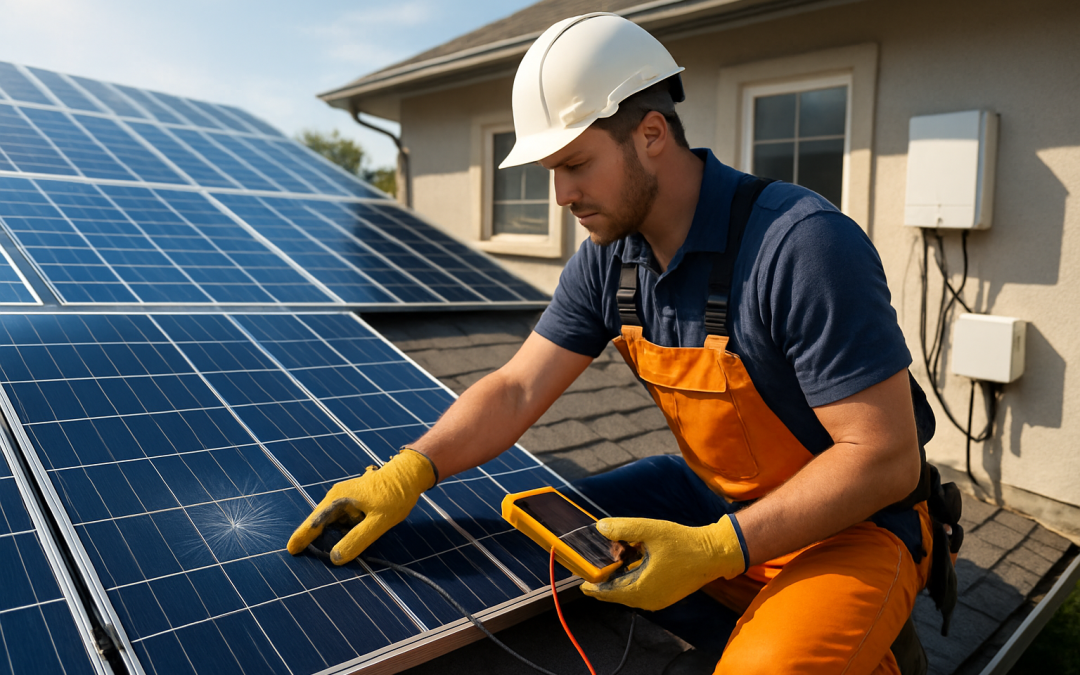
Solar panel repair near me usually involves fixing issues with wiring, inverters, broken panels, or monitoring systems, and most problems can be repaired without replacing your entire system. Homeowners typically spend between $200 and $1,500 on solar repairs, depending on what’s wrong and whether parts are under warranty. A good local solar repair service will diagnose the issue, check your warranties, and give you a clear written estimate before doing work. Some damage (like severe roof or structural issues) may make repair uneconomical, in which case replacement or a larger roof project may be the better option.
Solar panels are low-maintenance, but they’re not “set it and forget it” forever. This guide is for homeowners who already have solar, are seeing problems, and are now searching for “solar panel repair near me” to figure out what to do, what it should cost, and who to trust. We’ll walk through common problems, realistic repair costs, when repair makes sense, and how to choose the right solar repair company.
Table of Contents
- Common Solar Panel Problems That Need Repair
- Should You Repair or Replace Solar Panels?
- Solar Panel Repair Costs: What Homeowners Actually Pay
- Key Solar Numbers: Costs, Savings, and Lifespan
- When “Solar Panel Repair Near Me” Really Matters
- How to Choose the Right Solar Repair Service Near You
- DIY Solar Repair vs. Hiring a Professional
- Warranties, Insurance, and Who Pays for Repairs
- What to Do Next if Your Solar Panels Need Repair
- Frequently Asked Questions
- Summary: Key Takeaways
Common Solar Panel Problems That Need Repair
What usually goes wrong with home solar systems?
Most solar systems run for years with minimal issues, but when something does go wrong, it’s often not the panels themselves. More commonly, the problem is with:
- The inverter (the box that turns DC power from panels into AC power for your home)
- Wiring, connectors, or junction boxes
- Roof penetrations and mounting hardware
- Monitoring equipment or communication issues
- Physical damage to panels from hail, branches, or debris
Many of these issues can be repaired quickly by a qualified technician, especially if caught early.
Signs your solar panels may need repair
Watch for these real-world warning signs:
- Sudden drop in solar production on your monitoring app
- Inverter error codes or red/orange lights
- One or more panels showing zero output while others work
- Visible cracks, broken glass, or hot spots (discolored areas) on panels
- Water leaks in the attic or ceiling near where solar is mounted
- Burnt smell or visible damage near wiring or junction boxes
If your system is producing less than expected but still working, it may be a performance issue rather than a full failure. Our guide on why your solar system is producing less than expected can help you narrow that down before calling for repair.
Common repair scenarios and what they mean
- Inverter failure: Very common after 8–12 years. Often requires inverter replacement rather than repair.
- Loose or damaged wiring: Can cause intermittent production or safety issues; usually fixable on-site.
- Cracked or shattered panel glass: Typically requires panel replacement, not glass repair.
- Faulty connectors or optimizers (if installed): Can take one panel or a small section offline.
- Roof leaks at mounting points: Requires both solar and roofing expertise to fix correctly.
For a deeper dive into specific equipment issues, see our guide on solar inverter problems and how to diagnose them and our article on what to do if a solar panel breaks or stops working.
Should You Repair or Replace Solar Panels?
When repair makes the most sense
Repair is usually the right call when:
- Your system is relatively new (under 10–12 years old)
- The problem is limited (one panel, one string, or one inverter)
- Your equipment is still under warranty
- Your roof is in good condition and doesn’t need major work
- The repair cost is a small fraction of full replacement (often under 20–30%)
In these cases, a targeted repair can restore your system to near-original performance at a reasonable cost.
When replacement or a bigger project may be smarter
Sometimes, repairing is just throwing money at an aging system. Consider replacement or a larger project if:
- Your system is 20+ years old and multiple components are failing
- Your roof needs replacement soon and panels must be removed anyway
- Many panels are damaged or severely underperforming
- Your inverter is out of warranty and near the end of its expected life
- You want to expand your system significantly and your current setup limits that
Most panels have a 25–30 year performance warranty, but real-world lifespan is often 30–35 years. If you’re close to that range and facing major repairs, it’s worth asking a pro to compare repair vs. replacement costs.
How to decide: key questions to ask
Before you commit to a repair, ask your solar technician:
- What is the age of each major component (panels, inverter, racking)?
- Is this a one-time issue or a symptom of broader system aging?
- How much production (kWh) am I losing if I don’t repair this?
- What would a full system replacement cost, and how long would it take to pay back?
- Will this repair be covered by any existing warranties?
For inverter-specific decisions, our guide on when you should replace your solar inverter can help you weigh repair vs. replacement.
Solar Panel Repair Costs: What Homeowners Actually Pay
Typical solar repair cost ranges
Actual costs vary by location, roof type, and system design, but these are realistic national ranges for residential solar repairs:
- Service call / diagnostic visit: $150–$300
- Minor electrical repair (wiring, connectors): $200–$500
- Panel replacement (one panel, labor only): $200–$400 (panel cost may be covered by warranty)
- New panel (if not under warranty): $250–$450 per panel, depending on wattage and brand
- String inverter replacement: $1,200–$3,000 installed, depending on size and brand
- Optimizer or microinverter replacement (per unit): $150–$350 installed
- Roof leak repair at solar mounts: $300–$1,000+ depending on severity and roofing material
If your installer or manufacturer covers parts under warranty, you may only pay for labor. Always ask the technician to separate labor and materials on your estimate.
Factors that affect solar repair costs
Several variables can push your repair cost up or down:
- Roof type and height: Steep, high, or tile roofs cost more to work on than low-slope asphalt shingle roofs.
- System size and layout: More panels and complex layouts mean more time to diagnose and access components.
- Location: Labor rates are higher in some states and metro areas.
- Access and safety: Difficult access, required scaffolding, or special safety measures add cost.
- Warranty coverage: If parts are covered, you may only pay for labor and a service call.
- Original installer availability: If your original installer is out of business, a new company may charge more for unfamiliar systems.
How repair costs compare to full system costs
To put repair costs in context, the average residential solar system in the U.S. costs:
- $28,000–$32,000 before incentives
- $19,600–$22,400 after the 30% federal solar tax credit (if you qualify; always confirm with a tax professional)
- $2.50–$3.50 per watt installed cost
Most repairs are a small fraction of full system cost. For example, a $1,500 inverter replacement on a $25,000 system is about 6% of the original cost, which is usually worth it if the rest of the system is in good shape.
Key Solar Numbers: Costs, Savings, and Lifespan
How repairs fit into the overall economics of solar
Understanding the big picture helps you decide whether a repair is worth it. Typical U.S. homeowners with solar see:
- Average system cost: $28,000–$32,000 before incentives
- Net cost after 30% federal tax credit: $19,600–$22,400 (if eligible)
- Average annual electricity bill savings: $1,300–$1,500
- Payback period: 7–9 years on average, depending on utility rates and incentives
- Average number of panels: 15–25 panels for a typical home
- Panel performance warranty: 25–30 years
- Typical panel lifespan: 30–35 years
Individual results vary based on your utility rates, sun exposure, system size, and local incentives. A repair that restores lost production can protect your long-term savings and keep your payback period on track.
When repair clearly pays off
Repair is usually a strong financial decision when:
- Your system is still within its expected life (under 20–25 years)
- The repair cost is less than 1–2 years of your typical solar savings
- The issue is causing a significant drop in production (for example, 10–30% or more)
- You still have many years of expected system life ahead
For example, if you save $1,400 per year on electricity and a $600 repair restores full production, that repair pays for itself in about 5 months of normal operation.
When the numbers are less favorable
Repair may not be the best use of money if:
- Your system is near the end of its life (25–30+ years)
- Your roof needs replacement soon and panels will be removed anyway
- Multiple major components are failing (panels, inverter, wiring)
- Your annual savings are low due to very cheap electricity rates
In these cases, it’s worth getting quotes for both repair and replacement, and possibly a roof project at the same time. Our solar cost and savings guide can help you think through the long-term math.
When “Solar Panel Repair Near Me” Really Matters
Why local solar repair services are important
Solar repair is hands-on work. A local company that regularly works in your area offers several advantages:
- Faster response times for urgent issues or safety concerns
- Familiarity with local codes and utility rules
- Knowledge of common local issues (hail, snow loads, salty air, high winds)
- Easier follow-up if something isn’t fixed the first time
For ongoing maintenance, having a trusted local partner can extend your system’s life and catch problems early.
Climate and state-specific considerations
Where you live affects the types of repairs you’re likely to see:
- Snowy states: More stress on racking and roof attachments; potential for ice damage and snow sliding issues.
- Hail-prone regions: Higher risk of cracked or shattered panels after major storms.
- Coastal areas: Corrosion risk for metal parts and wiring; salt exposure can shorten equipment life.
- Very hot climates: Heat stress on inverters and electronics; more frequent inverter issues.
If you live in a cold or snowy climate, our guide on how solar panels perform in winter explains what to expect and what’s normal versus a true problem.
When local repair is especially urgent
Don’t delay calling a local solar repair service if you notice:
- Burning smells, smoke, or visible arcing near solar equipment
- Active roof leaks under or near solar mounts
- Panels or racking visibly loose, shifting, or at risk of falling
- Water inside electrical boxes or inverter enclosures
These are safety issues, not just performance problems, and should be handled quickly by a qualified professional.
How to Choose the Right Solar Repair Service Near You
What to look for in a solar repair company
Not all electricians or roofers are qualified to work on solar. When you search for “solar panel repair near me,” prioritize companies that:
- Specialize in solar or have a dedicated solar division
- Hold relevant licenses (electrical, solar contractor, or equivalent in your state)
- Are insured and can provide proof of coverage
- Have experience with your specific equipment brands (panels, inverter, racking)
- Offer clear, written estimates and warranties on their work
Questions to ask before you hire
Use this checklist when you talk to potential repair companies:
- How many residential solar systems have you repaired in the last year?
- Are you familiar with my inverter and panel brands?
- Do you charge a flat diagnostic fee, and is it credited toward the repair?
- Will you check my warranties and help me file any necessary claims?
- Do you provide photos or a report showing what you found and what you fixed?
- What warranty do you offer on your repair work and parts?
It’s usually wise to get at least two quotes for non-urgent repairs, especially for larger jobs like inverter replacement or major roof-related work.
Red flags to avoid
Be cautious about companies that:
- Refuse to provide a written estimate
- Push you to replace the entire system without a clear diagnosis
- Can’t explain the problem in plain language
- Ask for large upfront payments for small repair jobs
- Don’t carry proper licenses or insurance
A trustworthy solar repair service should be willing to explain your options, including when a repair may not be worth the cost.
DIY Solar Repair vs. Hiring a Professional
What homeowners can safely do themselves
There are a few low-risk steps you can take before calling a pro:
- Check your monitoring app or inverter screen for error codes
- Verify that breakers and disconnect switches are in the “on” position (if you know where they are)
- Visually inspect from the ground for obvious damage (cracked panels, loose wires, fallen branches)
- Gently clean accessible panels with water if they’re heavily soiled and you can do so safely
Our guide on how to monitor your solar system’s performance can help you understand what’s normal and what’s not.
What you should not try to repair yourself
For safety and warranty reasons, leave these to professionals:
- Opening electrical boxes, inverters, or junction boxes
- Replacing wiring, connectors, or breakers
- Working on the roof without proper fall protection
- Removing or reinstalling panels or racking
- Attempting to repair cracked or broken panel glass
Solar systems involve high DC voltages that can be dangerous even when the main breaker is off. DIY repairs can also void manufacturer warranties.
When DIY troubleshooting helps your technician
Before your appointment, gather:
- Photos of error messages or inverter screens
- Recent utility bills and any production reports you have
- Original installation paperwork and warranty documents
- Notes on when you first noticed the problem and any patterns (time of day, weather, etc.)
This information can shorten the diagnostic process and sometimes reduce your labor costs.
Warranties, Insurance, and Who Pays for Repairs
Types of solar warranties that may cover repairs
Most residential solar systems come with several layers of warranty protection:
- Panel product warranty: Typically 10–25 years against defects in materials and workmanship.
- Panel performance warranty: Guarantees a certain output level (often 80–90%) for 25–30 years.
- Inverter warranty: Usually 10–15 years for string inverters; 20–25 years for many microinverters and optimizers.
- Workmanship or labor warranty: Provided by the installer, often 5–10 years.
Our detailed guide on solar panel warranty claims explains how to check coverage and file a claim.
When homeowners insurance may help
Homeowners insurance may cover solar damage if it’s caused by a covered event, such as:
- Hail or windstorm damage
- Falling tree branches
- Fire
- Vandalism
Coverage varies by policy and state, and deductibles apply. It’s worth calling your insurance agent if you suspect storm or accident-related damage, but they cannot advise on tax or incentive issues—always consult a tax professional for those questions.
Who pays what in a typical repair scenario
In many real-world cases:
- The manufacturer may provide replacement parts (like a panel or inverter) under warranty.
- The installer or repair company charges for labor to diagnose and install the new part.
- You pay any labor charges, service call fees, and non-covered parts.
- Insurance may step in if the damage is from a covered event and exceeds your deductible.
Always ask your repair company to help you understand which costs might be covered before you approve the work.
What to Do Next if Your Solar Panels Need Repair
Is this the right time to act?
In most cases, yes—delaying repairs can reduce your energy savings and sometimes create safety or roof issues. Act quickly if:
- You see or suspect electrical hazards or roof leaks
- Your production has dropped sharply (for example, 30% or more)
- Your system is still under warranty and you’re approaching the end of the coverage period
If the issue is minor and your system is older, you still want a professional opinion, but you have more flexibility on timing.
Information to gather before getting quotes
Before you contact local solar repair services, collect:
- Your original installation contract and any change orders
- Brand and model numbers for panels, inverter, and optimizers/microinverters
- Installation date and any previous repair records
- Recent utility bills and any monitoring data or screenshots
- Photos of visible damage or error messages
Having this ready helps companies give you more accurate estimates and check warranty coverage faster.
Questions to ask when getting repair quotes
When you speak with potential repair companies, ask:
- What do you charge for a diagnostic visit, and what does it include?
- Will you provide a written report with photos of any issues you find?
- Can you estimate the range of possible repair costs before you come out?
- How soon can you schedule the repair if parts are needed?
- Do you handle warranty claims with manufacturers, or do I?
For most homeowners, getting multiple quotes makes sense, especially for repairs over a few hundred dollars or when replacement might be on the table.
Frequently Asked Questions
How much does it cost to repair a solar panel system?
Most homeowners pay between $200 and $1,500 for solar repairs, depending on the issue and whether parts are under warranty. Simple fixes like wiring repairs are on the low end, while inverter replacements or multiple panel replacements are on the higher end. A diagnostic visit alone typically costs $150–$300.
Can a cracked solar panel be repaired, or does it need to be replaced?
Cracked or shattered solar panel glass generally cannot be repaired safely or reliably and usually requires full panel replacement. In many cases, the panel manufacturer’s warranty may cover the replacement part, but you may still pay for labor. A technician should inspect the damage to confirm whether it’s cosmetic or affecting performance.
How do I know if my solar inverter needs repair or replacement?
Warning lights, error codes, or a sudden drop to zero production are common signs of inverter problems. A technician can read the error codes, test the unit, and tell you whether a simple repair, firmware update, or full replacement is needed. Many string inverters need replacement after 10–15 years, while microinverters often last longer.
Will repairing my solar panels void my warranty?
Repairs done by a qualified, licensed solar professional generally do not void your warranty, and are often required to keep it valid. DIY repairs or work by unqualified contractors can risk voiding manufacturer or installer warranties. Always check your warranty terms and use an approved or experienced service provider.
Does homeowners insurance cover solar panel repairs?
Homeowners insurance may cover solar panel repairs if the damage is caused by a covered event, such as hail, wind, fire, or falling objects. It typically will not cover normal wear and tear, equipment failure, or poor installation. Check with your insurance agent to understand your specific coverage and deductible.
Is it worth repairing an older solar system?
If your system is under 20–25 years old and the repair cost is modest compared to your annual savings, repair is often worth it. For systems near or beyond their expected life, or with multiple failing components, it may be smarter to compare repair costs with quotes for a new system. A reputable solar technician can help you evaluate both options.
Summary: Key Takeaways
- Most “solar panel repair near me” calls turn out to be fixable issues with inverters, wiring, or a small number of panels, not total system failures.
- Typical repair costs range from $200–$1,500, while a full residential system costs $28,000–$32,000 before incentives and saves $1,300–$1,500 per year on average.
- System age, warranty coverage, roof condition, and the severity of the problem are the biggest factors in deciding between repair and replacement.
- Using a qualified local solar repair service protects your safety, your roof, and your warranties, and usually leads to faster, more reliable fixes.
- The best next step is to gather your system information, document the issue, and get at least one or two professional repair quotes to understand your options.
Every solar system and home is different, so the most accurate way to understand your repair options and costs is to get personalized quotes from qualified local professionals. When you’re ready to see what repair or upgrade would look like for your home, you can start by requesting tailored estimates at /get-my-quote/. Getting multiple quotes helps you compare solutions, prices, and warranties without any pressure.