
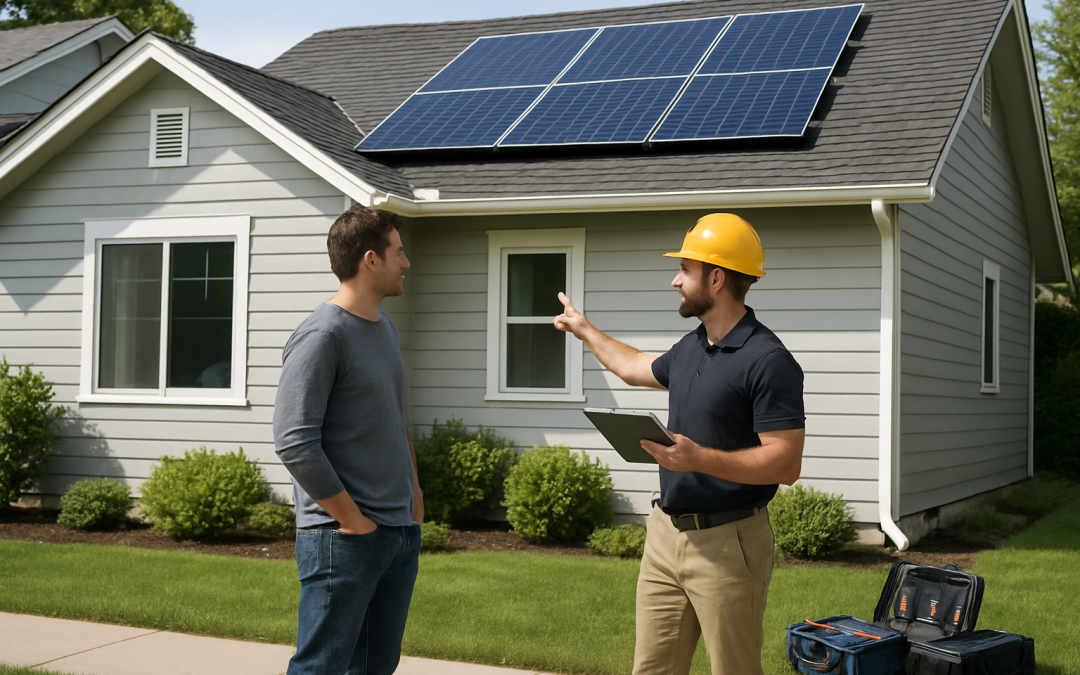
Solar panel installation cost for a typical U.S. home in 2026 ranges from about $28,000–$32,000 before incentives and $19,600–$22,400 after the 30% federal tax credit, assuming a standard 7–9 kW system. That works out to roughly $2.50–$3.50 per watt installed, with average annual electric bill savings of $1,300–$1,500 and a 7–9 year payback period. Your actual cost will depend heavily on your roof, location, electricity rates, and equipment choices. Some homes won’t see strong savings, especially if usage is low or the roof is heavily shaded.
Solar panel installation cost is one of the first things homeowners want to understand before moving forward. This guide is written for U.S. homeowners in 2026 who are trying to decide if solar is worth it, what a realistic price looks like, and how to avoid overpaying. We’ll walk through average prices, what drives costs up or down, and how to know whether now is the right time to get quotes.
Table of Contents
- Solar Panel Installation Cost in 2026: The Basics
- Key Numbers: Cost, Savings, and Payback
- What Affects Solar Panel Installation Cost?
- State and Location Differences in Solar Costs
- When Solar Installation Costs Work in Your Favor
- When Solar May Not Be a Good Financial Fit
- What to Expect: From Quote to Installation Day
- How to Decide What to Do Next (and How Many Quotes to Get)
- Frequently Asked Questions
- Summary: Key Takeaways on Solar Installation Cost
Solar Panel Installation Cost in 2026: The Basics
What “solar installation cost” actually includes
When people talk about solar panel installation cost, they usually mean the full, turnkey price for a home solar system. That typically includes:
- Solar panels
- Inverter(s) (the device that turns solar power into usable home electricity)
- Racking and mounting hardware
- Electrical work and wiring
- Design, permits, inspections, and utility paperwork
- Labor for installation
- Warranties and monitoring
This is different from just buying panels online. A professional installation price reflects equipment, labor, and all the behind-the-scenes work to get your system approved and turned on.
Average solar installation cost in 2026
For a typical U.S. home in 2026, you can expect:
- Total system cost (before incentives): $28,000–$32,000
- After 30% federal tax credit: $19,600–$22,400 (if you qualify and can use the credit)
- Cost per watt: $2.50–$3.50 installed
- Typical system size: 7–9 kW (about 15–25 panels)
These are national averages. A small, simple system in a low-cost market might be closer to $18,000 before incentives, while a large, complex system with premium equipment can easily exceed $40,000.
How long solar panels last
Solar is a long-term investment, so lifespan matters when you look at cost:
- Performance warranty: 25–30 years for most modern panels
- Typical useful life: 30–35 years or more, with gradually declining output
In other words, you’re usually paying once for equipment that will produce power for three decades or longer.
Key Numbers: Cost, Savings, and Payback
Average cost per watt and system size
Solar pricing is often discussed in “dollars per watt.” This makes it easier to compare quotes for different system sizes. In 2026:
- Average cost per watt: $2.50–$3.50 (installed, before incentives)
- Typical system size: 7–9 kW for a standard single-family home
- Average number of panels: 15–25 panels, depending on panel wattage and your energy use
Example: A 7.5 kW system at $3.00 per watt would cost about $22,500 before incentives.
Average savings and payback period
On the savings side, national averages in 2026 look like this:
- Average annual bill savings: $1,300–$1,500
- Typical payback period: 7–9 years (time for savings to equal your net cost)
After payback, most of the electricity your system produces is effectively “free,” aside from minor maintenance and any remaining utility charges.
Federal tax credit and other incentives
The single biggest incentive for most homeowners is the federal solar Investment Tax Credit (ITC):
- Federal ITC rate: 30% of eligible system costs through 2032
- Applies to: Panels, inverters, labor, permitting, and related installation costs
This is a tax credit, not a rebate. You must have enough tax liability to use it, and rules can be complex, so it’s wise to consult a tax professional. Many states and utilities also offer rebates or performance-based incentives that can further reduce your net cost.
Why your numbers may be different
Your actual cost, savings, and payback can vary significantly based on:
- Your local electricity rates and how fast they’re rising
- How much electricity your household uses
- Roof shading, orientation, and available space
- State and local incentives or utility programs
- Whether you buy, finance, or lease your system
Because of these variables, averages are a starting point, not a quote. Personalized estimates are the only way to know your real numbers.
What Affects Solar Panel Installation Cost?
1. System size and your energy usage
The biggest driver of cost is how large a system you need. That depends on:
- Your average monthly kWh usage (from your electric bills)
- How much of that usage you want solar to cover (offset percentage)
- How much sun your roof receives (more sun = fewer panels needed)
A larger system costs more overall but often less per watt. If your usage is high, you’ll pay more upfront but usually save more each year.
2. Roof type, condition, and complexity
Your roof can add or reduce installation cost:
- Simple, single-story asphalt shingle roofs are usually cheapest to install on.
- Tile, metal, or slate roofs often require special mounting hardware and more labor.
- Steep, multi-story, or cut-up roofs (with dormers, skylights, etc.) increase labor time and design complexity.
If your roof is near the end of its life, you may need to replace it before installing solar, which adds cost but can prevent having to remove and reinstall panels later. For more detail, see Do You Need a New Roof Before Installing Solar?
3. Equipment choices (panels, inverters, and extras)
Not all solar equipment is priced the same. Cost can change based on:
- Panel efficiency and brand: Premium, high-efficiency panels cost more but may produce more power in limited roof space.
- Inverter type: String inverters are often cheaper; microinverters or power optimizers cost more but can improve performance on shaded or complex roofs.
- Batteries: Adding home battery storage (for backup or time-of-use savings) can add $8,000–$15,000+ to the project.
- Monitoring and smart home integrations: Usually a smaller cost, but still a factor.
Higher-end equipment can be worth it if you have limited roof space, shading issues, or specific performance goals, but it isn’t necessary for every home.
4. Labor, permitting, and soft costs
“Soft costs” are everything that isn’t hardware:
- Site assessment and system design
- Permits and inspections
- Interconnection with your utility
- Project management and overhead
These can make up 40–60% of your total price. Areas with complex permitting or slow utility processes often have higher soft costs. If you want to understand this part of the process better, see What Permits Do You Need to Install Solar Panels?
5. Local market and installer pricing
Solar is a local business. Prices vary by:
- Regional labor costs
- Competition among installers in your area
- Company size and overhead
- Sales and marketing approach (high-pressure door-to-door vs. lean, online-focused companies)
Two quotes for similar systems in the same city can differ by thousands of dollars. This is why getting multiple quotes and knowing how to compare them is so important.
6. Financing method (cash, loan, lease, or PPA)
How you pay for solar affects both cost and savings:
- Cash purchase: Highest upfront cost, but you own the system and keep all incentives and savings.
- Solar loan: Low or no upfront cost; you pay monthly, similar to a car loan. Interest adds to total cost.
- Lease or Power Purchase Agreement (PPA): Little to no upfront cost; a third party owns the system and you pay them monthly. Total long-term savings are usually lower.
Financing terms can dramatically change your monthly cash flow, so it’s important to look at total cost over time, not just the “no money down” pitch.
State and Location Differences in Solar Costs
Why solar costs vary by state
Where you live has a major impact on solar panel installation cost and value. Key differences include:
- Electricity rates: Higher utility rates (like in California or the Northeast) make solar savings more valuable.
- Sunlight levels: Sunnier states (like Arizona or Nevada) get more production from the same system size.
- State and local incentives: Rebates, tax credits, and performance payments can significantly reduce net cost.
- Net metering rules: These determine how you’re credited for excess solar power sent to the grid.
Two identical systems can have very different payback periods depending on these local factors.
Examples of how location changes the math
Consider a 7.5 kW system costing $22,500 before incentives:
- High-rate state with good incentives: After the 30% federal tax credit and a strong state rebate, net cost might drop below $15,000, with a payback closer to 6–7 years.
- Low-rate state with few incentives: After the federal credit, net cost might be around $16,000–$18,000, with a payback closer to 9–11 years.
Neither scenario is “wrong,” but the value proposition is different. This is why local quotes and incentive research matter.
Urban vs. rural considerations
Within a state, costs can also differ between urban and rural areas:
- Urban areas may have higher labor costs but more installer competition.
- Rural areas may have fewer installers and higher travel costs, but simpler permitting.
Some rural co-ops or municipal utilities have different interconnection rules than big investor-owned utilities, which can affect both cost and timeline.
When Solar Installation Costs Work in Your Favor
Situations where solar is usually a strong financial move
Solar tends to make the most sense when:
- Your electric bill is consistently high (often $120–$150+ per month).
- Your roof has good sun exposure (south, southwest, or west-facing with minimal shade).
- You plan to stay in your home for at least 5–7 years.
- Your state offers decent incentives or fair net metering.
- You can use the 30% federal tax credit (confirm with a tax professional).
In these cases, the combination of bill savings, incentives, and long panel life often produces a solid return on investment.
Non-financial reasons homeowners still choose solar
Even when the payback is on the longer side, some homeowners still move forward because they:
- Want more predictable energy costs over the long term.
- Value reducing their home’s carbon footprint.
- Want backup power (with batteries) for outages.
- See solar as a home improvement that can increase resale appeal.
These reasons don’t replace the financial math, but they can tip the scales when the numbers are borderline.
When Solar May Not Be a Good Financial Fit
Situations where solar often doesn’t pencil out
Being honest, solar is not a slam dunk for every home. It may not be the right move if:
- Your electric bill is already low (for example, under $60–$70 per month).
- Your roof is heavily shaded by trees or nearby buildings.
- You expect to move within the next 2–3 years and your market doesn’t strongly value solar.
- Your roof is in poor condition and you’re not ready to replace it.
- Your local utility has very low rates and weak net metering or export compensation.
In these cases, the payback period can stretch well beyond 10–12 years, and your money might be better used elsewhere.
Financing pitfalls to watch out for
Even if your home is a good solar candidate, certain financing structures can make the deal less attractive:
- Loans with very long terms and high interest rates that greatly increase total cost.
- Leases or PPAs with annual escalators that rise faster than your utility rates.
- Contracts that make it difficult or costly to sell your home later.
Always read the fine print and compare total costs over the life of the agreement, not just the first-year savings.
When it may be better to wait
It can make sense to pause or delay solar if:
- You’re planning a major roof replacement or renovation soon.
- You expect to add large electrical loads (like an EV or heat pump) and want a clearer picture of your future usage.
- Your state is in the middle of changing its solar policies, and new incentives or rules are expected soon.
Waiting a year or two in these situations can help you design the right system size and avoid rework.
What to Expect: From Quote to Installation Day
Step 1: Initial quote and site assessment
Most installers start with a remote quote based on:
- Your address (for roof and sun exposure)
- Your recent electric bills (for usage)
- Your goals (bill reduction, backup power, etc.)
They’ll then refine the quote after a site visit or detailed virtual assessment. This is when they confirm roof condition, electrical panel capacity, and any special challenges.
Step 2: Final design, permits, and approvals
Once you sign a contract, the installer will:
- Finalize the system design and equipment list
- Apply for building and electrical permits
- Submit interconnection paperwork to your utility
This phase can take a few weeks to a few months, depending on your local permitting office and utility. For a deeper look at the full schedule, see How Long Does Solar Installation Take? (Full Timeline).
Step 3: Installation day and inspection
Most residential solar installations take 1–3 days on-site, depending on system size and roof complexity. You can expect:
- Racking and panels mounted to your roof or ground-mount structure
- Inverter and electrical work completed
- System testing and cleanup
After installation, a local inspector and your utility will need to sign off before you can turn the system on. For a homeowner-friendly walkthrough, see What to Expect on Solar Installation Day and What Is Permission to Operate (PTO) and Why Does It Take So Long?
Step 4: Permission to Operate (PTO) and monitoring
Once your utility grants Permission to Operate, you can flip the switch and start generating power. Your installer will usually:
- Help you set up monitoring (often via a phone app)
- Review basic maintenance and safety
- Explain your warranties and support process
From there, your system should run mostly on its own, with occasional check-ins to make sure production matches expectations.
How to Decide What to Do Next (and How Many Quotes to Get)
Is now the right time to act?
In 2026, the 30% federal tax credit is still in place, and equipment prices have stabilized after years of volatility. It’s generally a good time to explore solar if:
- Your roof is in good shape and gets decent sun.
- Your electric bills are meaningful (over $100/month is a common threshold).
- You plan to stay in your home for several years.
If you’re unsure whether solar makes financial sense for your specific situation, our honest solar worth-it guide walks through the key variables in more detail.
Information to gather before getting quotes
You’ll get better, more accurate quotes if you have:
- 12 months of electric bills (or at least 3–6 months)
- Basic roof information (age, material, any known issues)
- A list of major electric loads (AC, EVs, pool pumps, etc.)
- Your goals (maximum savings, backup power, lowest upfront cost, etc.)
This helps installers design a system that fits your actual usage and priorities, not just a generic “average home” model.
How many quotes should you get?
For most homeowners, 3 quotes is a good target:
- One from a larger, established regional or national installer
- One from a reputable local company
- One additional quote to compare pricing and approach
This gives you a sense of the local price range and different equipment options. To make sense of the proposals, use our side-by-side guide to reading and comparing solar quotes.
Questions to ask potential installers
When you talk to installers, ask:
- What is the total system size (kW) and cost per watt?
- What equipment brands and models are you proposing, and why?
- What are the warranties on panels, inverters, and workmanship?
- How do you estimate my annual production and savings?
- What assumptions are you making about utility rate increases?
- Who handles permits, inspections, and utility paperwork?
These questions help you compare apples to apples and avoid surprises later.
Frequently Asked Questions
How much does it cost to install solar panels on a typical house in 2026?
For a typical U.S. home in 2026, expect $28,000–$32,000 before incentives and around $19,600–$22,400 after the 30% federal tax credit, assuming a 7–9 kW system. Your exact cost will depend on your roof, location, energy usage, and equipment choices.
What is the average payback period for solar panels?
The national average payback period is about 7–9 years, based on typical system costs and bill savings. In high-cost electricity states with good incentives, payback can be shorter, while in low-cost states with fewer incentives it can stretch beyond 10 years.
How many solar panels do I need for my home?
Most U.S. homes need about 15–25 panels, which usually translates to a 7–9 kW system. The exact number depends on your energy usage, panel wattage, and how much of your bill you want to offset.
Does the 30% federal solar tax credit still apply in 2026?
Yes, the federal Investment Tax Credit is 30% through 2032 for qualifying residential solar installations. Because tax situations vary, it’s important to confirm your eligibility and how to claim it with a tax professional.
Is it cheaper to install solar panels myself?
DIY solar can reduce upfront hardware and labor costs, but it comes with significant risks around safety, permitting, code compliance, and warranties. Most homeowners are better served by a professional installation, especially for grid-tied systems that must pass inspections and utility review.
Do solar panels increase home value?
Studies have found that owned solar systems can increase home resale value, especially in markets where buyers understand solar. The exact impact depends on your local real estate market, system size, and whether the system is owned or leased.
Summary: Key Takeaways on Solar Installation Cost
- In 2026, a typical home solar installation costs about $28,000–$32,000 before incentives and $19,600–$22,400 after the 30% federal tax credit, or roughly $2.50–$3.50 per watt.
- Average annual savings are around $1,300–$1,500, with a national payback period of 7–9 years, but your results depend heavily on local rates, incentives, and roof conditions.
- System size, roof complexity, equipment choices, and financing method are the biggest drivers of your final price.
- Solar tends to work best for homes with higher electric bills, good sun exposure, and owners who plan to stay put for several years.
- The smartest next step is to gather your electric bills, get multiple quotes, and compare them carefully so you understand both cost and long-term value.
If you’re ready to see real numbers for your home, personalized quotes are the only way to know your true solar panel installation cost and savings potential. You can start comparing options with no obligation by requesting estimates from vetted installers at bestsolaradvice.com/get-my-quote/. Getting a few quotes now will put you in a much better position to decide whether solar is the right move for your home and budget.