
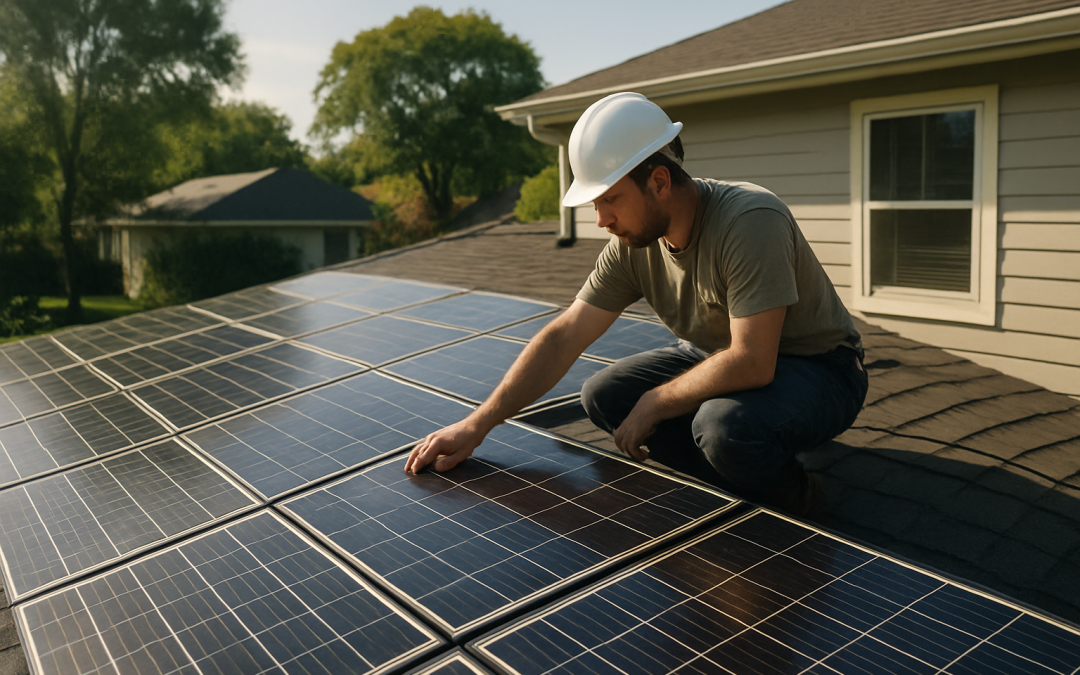
Solar panel efficiency is a measure of how much of the sunlight that hits a panel is turned into usable electricity, and most modern home panels fall in the 19–22% efficiency range. In real life, your actual energy output depends just as much on roof direction, shading, local climate, and system design as it does on the efficiency number on the spec sheet. Higher-efficiency panels can produce more power from a smaller roof area, but they also tend to cost more per watt. For many homeowners, the “right” system is a balance between efficiency, total cost, and long-term savings — not simply buying the highest-efficiency panel available.
Understanding solar panel efficiency helps you predict how much energy your system can realistically produce and whether solar is worth it for your home. This guide is written for U.S. homeowners comparing options, trying to make sense of panel ratings, and deciding what actually matters when choosing a system. We’ll walk through how efficiency is measured, what really affects output on your roof, and how to use that information to choose the right solar setup for your situation.
Table of Contents
- What Is Solar Panel Efficiency? (Plain-English Definition)
- How Solar Panel Efficiency Is Measured in the Lab
- Why Real-World Solar Output Is Different From the Spec Sheet
- Key Numbers: Typical Efficiencies, Costs, and Savings
- When High-Efficiency Panels Are a Big Advantage
- When Solar Panel Efficiency Matters Less Than You Think
- How to Choose the Right Solar System for Your Home
- How Your State and Location Affect Real-World Efficiency
- Questions to Ask Installers About Efficiency and Output
- Should You Act Now? Making a Decision Based on Efficiency and Payback
- Frequently Asked Questions
- Summary: Key Takeaways on Solar Panel Efficiency
What Is Solar Panel Efficiency? (Plain-English Definition)
Simple definition
Solar panel efficiency is the percentage of sunlight that a panel can convert into electricity under standard test conditions. If a panel is rated at 20% efficiency, that means 20% of the sunlight energy hitting it becomes electrical energy, and the rest is lost as heat or reflected light.
For homeowners, efficiency mainly affects how much power you can get from a given amount of roof space. Two systems with the same total wattage (for example, 8 kW) can produce similar annual energy even if one uses more lower-efficiency panels and the other uses fewer higher-efficiency panels.
Typical efficiency ranges for home solar panels
- Older or budget panels: about 16–18% efficiency
- Most modern residential panels (2026): about 19–22%
- Premium residential panels: up to around 22–23%
- Lab records (not what you buy for your roof): over 25% for some silicon cells
In practice, a 20% vs. 21.5% panel is not a night-and-day difference; it’s a modest bump in power per square foot.
Efficiency vs. power rating (wattage)
It’s easy to mix up efficiency and wattage, but they’re different:
- Wattage (W) is how much power a panel can produce under test conditions (for example, 400 W).
- Efficiency (%) is how effectively the panel uses the sunlight that hits its surface.
A larger, lower-efficiency panel can have the same wattage as a smaller, higher-efficiency panel. What matters for your roof is the combination of both: how many watts you can fit on your available roof area.
How Solar Panel Efficiency Is Measured in the Lab
Standard Test Conditions (STC)
Manufacturers measure efficiency under “Standard Test Conditions” so panels can be compared fairly. STC typically means:
- Sunlight intensity: 1,000 watts per square meter
- Cell temperature: 25°C (77°F)
- Sunlight angle: direct, clear-sky conditions
Under STC, a panel’s efficiency is calculated by dividing its power output (in watts) by the sunlight power hitting its surface area. This is how you get numbers like 20.1% or 21.8% on spec sheets.
Why lab conditions don’t match your roof
Your roof almost never matches STC. In real life, you’ll see:
- Higher cell temperatures in summer, which reduce output
- Sun hitting the roof at different angles throughout the day
- Clouds, haze, and seasonal changes in sun intensity
- Dust, pollen, or snow on panels
This is why a 400 W panel rarely produces 400 W on your roof except in near-perfect conditions. The STC rating is a benchmark, not a promise of constant output.
Other ratings: PTC and temperature coefficient
Some panels also list PTC ratings (PVUSA Test Conditions), which are closer to real-world performance and usually lower than STC wattage. Another key spec is the temperature coefficient, which shows how much power the panel loses as it heats up (for example, -0.30% per °C above 25°C).
Panels with a better (less negative) temperature coefficient will perform relatively better in hot climates, even if their STC efficiency is similar.
Why Real-World Solar Output Is Different From the Spec Sheet
Key factors that affect real-world efficiency
Once panels are on your roof, several factors can matter more than the efficiency percentage on the label:
- Roof orientation and tilt – South-facing roofs with a tilt around 25–35° usually perform best in the U.S.
- Shading – Trees, chimneys, and nearby buildings can significantly cut output, especially if they shade panels during peak sun hours.
- Local climate – Cloud cover, humidity, and average temperatures all affect production.
- System design – Inverter type (string vs. microinverters), wiring, and layout impact how well the system handles shade and mismatched panels.
- Soiling and snow – Dust, pollen, bird droppings, and snow reduce how much light reaches the cells.
Performance ratio and system losses
Installers often use a “performance ratio” to estimate how much of the theoretical maximum energy your system will actually deliver. Typical residential systems have total losses of about 10–20% from:
- Inverter losses (about 2–5%)
- Wiring and connection losses (1–3%)
- Temperature losses (5–10% or more in hot climates)
- Soiling, mismatch, and other small factors
This is why a system modeled to produce 10,000 kWh per year on paper might realistically deliver 8,000–9,000 kWh, depending on conditions.
Real-world example
Consider a 7 kW system in a good U.S. solar location:
- Modeled annual production: about 9,500–10,000 kWh
- After real-world losses: about 8,000–9,000 kWh per year
- Year-to-year variation: often ±5–10% due to weather
Two systems of the same size (7 kW), one using 19% panels and one using 21% panels, may only differ by a few hundred kWh per year if both are well-designed and unshaded. Roof layout and shading can easily matter more than that efficiency difference.
Key Numbers: Typical Efficiencies, Costs, and Savings
Typical efficiency and system size for a U.S. home
- Average residential panel efficiency (2026): 19–22%
- Common panel wattages: 380–440 W for home systems
- Average number of panels: about 15–25 panels for a typical U.S. home
- Typical system size: around 6–10 kW, depending on usage and roof space
Higher-efficiency panels let you reach the same system size (kW) with fewer panels, which is especially helpful on small or partially shaded roofs.
Costs and how efficiency affects price
Nationally, as of 2026, typical residential solar costs are:
- Average system cost before incentives: about $28,000–$32,000
- After 30% federal tax credit (ITC): about $19,600–$22,400
- Average cost per watt: about $2.50–$3.50
Higher-efficiency, premium-brand panels often sit at the upper end of that cost-per-watt range. In some cases, they can add a few thousand dollars to the total system price compared with standard-efficiency panels, especially if paired with premium inverters or racking.
Savings, payback, and efficiency
On average, U.S. homeowners see:
- Average annual electric bill savings: about $1,300–$1,500
- Typical payback period: about 7–9 years nationally
- Panel performance warranty: usually 25–30 years
- Typical panel life: often 30–35 years or more
Higher-efficiency panels can slightly improve your total lifetime savings if they allow you to install more capacity on a constrained roof or if they come with stronger performance warranties. But the biggest drivers of payback are your local electricity rates, incentives, and how much sun your roof gets — not just the efficiency percentage.
For a deeper dive into long-term performance, you can review how panels age over time in our guide to how long solar panels actually last.
When High-Efficiency Panels Are a Big Advantage
Situations where efficiency really matters
Paying extra for high-efficiency panels can be worth it in several common scenarios:
- Limited roof space – If you have a small or complex roof and need to offset a large electric bill, higher-efficiency panels help you pack more power into less area.
- Partial shading – If only certain roof areas are usable due to trees or obstructions, you want each available square foot to produce as much as possible.
- Very high electricity rates – In states with expensive power, every extra kWh you generate is more valuable, so squeezing out more production can improve your return.
- Future electric loads – If you plan to add an EV, heat pump, or electric water heater, extra efficiency can help you cover that future usage without expanding the roof footprint.
When premium panels can improve financial returns
High-efficiency panels can improve your numbers when:
- The extra cost per watt is modest compared with the value of the additional energy produced over 25–30 years.
- They allow you to increase system size (kW) on a constrained roof, boosting total annual kWh.
- They come with better degradation rates, meaning they lose less output each year and produce more over their lifetime.
In these cases, the slightly higher upfront cost can be offset by higher lifetime savings and a stronger long-term performance profile.
When Solar Panel Efficiency Matters Less Than You Think
Situations where standard-efficiency panels are usually fine
For many homeowners, mid-range efficiency panels offer the best value. Efficiency matters less when:
- You have plenty of unshaded roof space – If your roof can easily fit more panels, using slightly lower-efficiency modules can save money without sacrificing total system size.
- Your electric usage is moderate – If your bills are already low, chasing maximum efficiency may not change payback much.
- Local electricity rates are low – In areas with cheap power, the extra production from premium panels may not justify the added cost.
- Your main goal is bill stability, not maximum offset – Standard panels can still give you predictable, long-term savings.
When solar itself may not make sense
In some cases, the question isn’t “which efficiency?” but “should I install solar at all?” Solar may not be the right move if:
- Your roof is heavily shaded most of the day and tree removal isn’t an option.
- You plan to move in the next 1–3 years and your local market doesn’t strongly value solar-equipped homes.
- Your roof is in poor condition and needs replacement soon, and you’re not ready to tackle both projects.
- You rent your home or live in a multi-unit building without control over the roof.
If you’re unsure whether solar is a good fit at all, our honest guide on when solar doesn’t make sense and what to do instead can help you evaluate your situation.
How to Choose the Right Solar System for Your Home
Step 1: Look at your electricity usage and roof space
Before worrying about efficiency numbers, gather:
- 12 months of electric bills – Look for total kWh used per month and your average monthly cost.
- Basic roof details – Orientation (north/south/east/west), number of usable roof faces, and any obvious shading.
- Future changes – Plans to add an EV, pool, or electric heating that could increase usage.
This gives installers enough information to size a system and tell you whether roof space will be a limiting factor.
Step 2: Decide your priorities
Common homeowner priorities include:
- Lowest upfront cost – You may lean toward standard-efficiency panels with solid warranties.
- Maximum bill reduction – You might prioritize higher-efficiency panels and a larger system size.
- Fastest payback – You’ll want a balance of cost, efficiency, and strong local incentives.
- Brand and warranty strength – You may choose premium panels with longer or more robust guarantees.
Being clear about your priorities helps you compare quotes more effectively and avoid paying for features you don’t really need.
Step 3: Compare system designs, not just panel efficiency
When you get quotes, look beyond the efficiency percentage and compare:
- Total system size (kW) – How many kilowatts are they proposing, and what annual kWh production do they estimate?
- Panel brand, wattage, and efficiency – Are they using reputable brands with clear warranties?
- Inverter type – Microinverters or optimizers can help in shaded or complex roofs.
- Estimated annual production – How many kWh per year, and what assumptions are they using?
- Total cost and cost per watt – How does the price compare to the national average of $2.50–$3.50 per watt?
Understanding the equipment in your quote can be easier with a reference like a solar panels and equipment guide, which explains the main components in plain language.
How Your State and Location Affect Real-World Efficiency
Sunlight and climate differences
Two identical systems will perform very differently in Arizona versus Vermont. Key location factors include:
- Solar resource (sun hours) – Southwestern states get more annual sun than northern or coastal regions.
- Temperature – Hotter climates reduce panel output more due to higher cell temperatures.
- Weather patterns – Frequent clouds, fog, or snow reduce annual production.
Because of this, a 7 kW system might produce over 11,000 kWh per year in a very sunny state but only 8,000–9,000 kWh in a cloudier region.
State policies and incentives
State-level policies can matter as much as the sun itself:
- Net metering rules – How you’re credited for excess solar sent to the grid affects your savings.
- State and utility incentives – Rebates, performance payments, or state tax credits can shorten payback.
- Electric rate structures – Time-of-use rates and demand charges change how valuable your solar production is.
To see how these factors play out where you live, you can review our state-by-state guide on whether solar is worth it, which breaks down local conditions and incentives.
Questions to Ask Installers About Efficiency and Output
Key questions to get clear, honest answers
When you talk to installers, ask questions that focus on real-world performance, not just lab numbers:
- “What panel brands and efficiency ranges do you recommend for my roof, and why?”
- “How many kWh per year do you estimate this system will produce, and what assumptions are you using?”
- “How do you account for shading, roof orientation, and local weather in your production estimate?”
- “What is the temperature coefficient of these panels, and how will they perform in our summer heat?”
- “What are the panel and inverter warranties, and what do they actually cover?”
- “Can you show me how a slightly larger system with standard-efficiency panels compares to a smaller system with premium panels?”
Red flags to watch for
Be cautious if an installer:
- Promises exact bill elimination without showing detailed production estimates.
- Focuses heavily on “record-breaking efficiency” but avoids discussing total system cost or payback.
- Can’t clearly explain how they modeled your roof and shading.
- Pressures you to sign quickly to “lock in” a special efficiency-related deal.
Reputable installers will be comfortable walking you through the numbers and explaining trade-offs between efficiency, cost, and system size.
Should You Act Now? Making a Decision Based on Efficiency and Payback
Is now a good time to go solar?
From an efficiency and cost standpoint, residential solar is mature technology in 2026. Panels are already highly efficient, and year-to-year improvements are relatively small. Meanwhile, the 30% federal tax credit (ITC) is available through 2032, which significantly reduces net cost for many homeowners.
If your roof is in good shape, you have decent sun exposure, and your electric bills are meaningful, it often makes sense to at least get quotes now rather than waiting for slightly higher-efficiency panels in the future.
What you should have ready before getting quotes
To get accurate, apples-to-apples quotes, gather:
- 12 months of electric bills (kWh and dollar amounts)
- Basic roof information (age, material, any known issues)
- Photos of your roof and any shading from trees or nearby buildings
- Your goals (bill reduction target, budget, interest in batteries or EV charging)
Why multiple quotes matter
Because different installers may propose different panel efficiencies, system sizes, and equipment, getting 2–3 quotes is usually wise. This helps you:
- See how different designs handle your roof constraints.
- Compare total cost per watt and expected annual kWh production.
- Understand whether paying extra for higher-efficiency panels makes sense in your specific case.
For a broader look at how efficiency ties into overall value, you can also review our main guide on whether solar is worth it, which walks through the full financial picture.
Frequently Asked Questions
What is a good efficiency for residential solar panels in 2026?
For home use in 2026, panels in the 19–22% efficiency range are considered very good and are now common. Anything around 20% or higher from a reputable brand is typically more than sufficient for most roofs, especially if you have adequate space.
Do higher-efficiency solar panels always save more money?
Higher-efficiency panels can save more money if roof space is limited or if they allow you to install a larger system overall. However, they also tend to cost more per watt, so the financial benefit depends on your roof, local electricity rates, and how much extra production you actually gain over time.
How much does panel efficiency affect my payback period?
Panel efficiency has a moderate impact on payback compared with bigger factors like your electric rates, sun exposure, and incentives. A well-designed system with standard-efficiency panels can have a similar 7–9 year payback as one with premium panels, especially if you have plenty of roof space.
Will solar panels become much more efficient if I wait a few years?
Efficiency improvements in mainstream residential panels are now incremental, not dramatic. Waiting a few years might bring a small bump in efficiency, but you could miss out on years of bill savings and current incentives like the 30% federal tax credit.
Does panel efficiency affect how long solar panels last?
Efficiency and lifespan are related to design and manufacturing quality, but a higher efficiency rating doesn’t automatically mean a longer life. Most reputable panels, whether standard or premium efficiency, carry 25–30 year performance warranties and often last 30–35 years or more in real-world use.
Is it better to buy more lower-efficiency panels or fewer high-efficiency panels?
If you have plenty of unshaded roof space, more lower-efficiency panels can be a cost-effective way to reach your target system size. If roof space is tight or shading limits usable areas, fewer high-efficiency panels may be the better choice to maximize production per square foot.
Summary: Key Takeaways on Solar Panel Efficiency
- Most modern residential solar panels are 19–22% efficient, and this is already high enough for strong real-world performance.
- Real-world output depends as much on roof orientation, shading, climate, and system design as it does on the efficiency number on the spec sheet.
- Typical systems cost about $28,000–$32,000 before incentives and $19,600–$22,400 after the 30% federal tax credit, with a national average payback of 7–9 years.
- High-efficiency panels are most valuable when roof space is limited or electricity rates are high; standard-efficiency panels are often the best value when space is plentiful.
- The smartest next step is to get a few personalized quotes that show system size, expected annual kWh, and total cost so you can see how efficiency, design, and savings come together for your specific home.
If you’re ready to see how solar panel efficiency translates into real savings on your roof, getting personalized quotes is the most reliable way to move forward. Share your usage, roof details, and goals, and compare a few proposals side by side to find the right balance of efficiency, cost, and long-term value. You can start that process today at /get-my-quote/ and use this guide as a checklist while you review your options.