
Direct answer
The average solar panel cost by system size in 2026 ranges from about $10,000–$14,000 for a small 4 kW system to $28,000–$32,000 for a larger 10–12 kW system before incentives. Most U.S. homeowners pay around $2.50–$3.50 per watt installed, or roughly $19,600–$22,400 after the 30% federal tax credit for a typical 8 kW system. Your exact price depends on your roof, energy use, equipment quality, and local labor and permitting costs. Because every home is different, getting a few personalized quotes is the only way to know your true cost.
Understanding average solar panel cost by system size helps you quickly see what going solar might really cost for your home in 2026. This guide is written for U.S. homeowners who want clear, honest numbers without sales pressure. We’ll walk through typical system sizes, what they cost, what affects those prices, and how to decide whether solar is worth it for you.
Table of Contents
- Average Solar Panel Cost by System Size in 2026
- Solar Cost Per Watt Explained
- What Affects Solar Panel Cost by System Size?
- How State and Location Change Solar Costs
- Key Numbers: Cost, Savings, Payback, and System Size
- When Solar by System Size Works in Your Favor
- When Solar May Not Be the Right Fit
- How to Estimate the Right System Size for Your Home
- What to Do Next: From Research to Quotes
- Frequently Asked Questions
- Summary: Key Takeaways on Solar Cost by System Size
- Next Step: Get Personalized Solar Quotes
Average Solar Panel Cost by System Size in 2026
Typical residential system sizes
Most U.S. homes install solar systems between 4 kW and 12 kW (kilowatts). The system size you need depends mainly on how much electricity you use and how much roof space you have.
As a rough guide:
- Small homes or low usage: 4–6 kW
- Average suburban homes: 7–9 kW
- Larger homes or high usage (EVs, pools, big families): 10–12+ kW
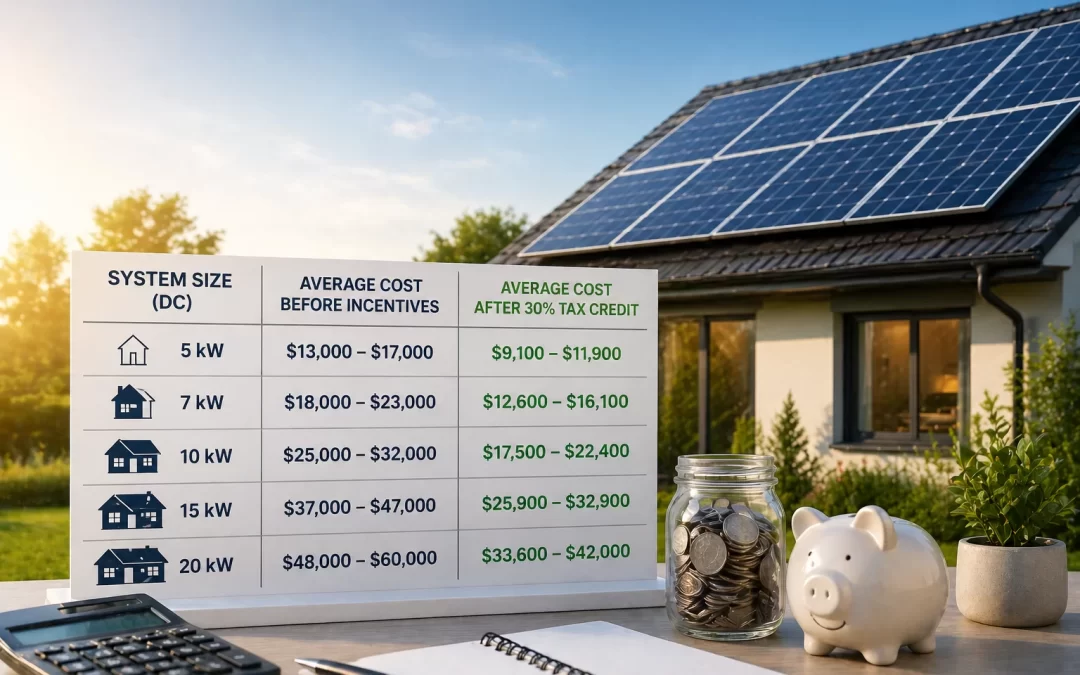
Average solar panel cost by system size (before and after incentives)
In 2026, most homeowners pay between $2.50 and $3.50 per watt for a grid-tied residential solar system before incentives. Using that range, here is what typical system sizes cost:
| System Size | Approx. # of Panels (400 W each) | Cost Before Incentives | 30% Federal Tax Credit | Estimated Net Cost After ITC |
|---|---|---|---|---|
| 4 kW | 10 panels | $10,000–$14,000 | $3,000–$4,200 | $7,000–$9,800 |
| 6 kW | 15 panels | $15,000–$21,000 | $4,500–$6,300 | $10,500–$14,700 |
| 8 kW (typical) | 20 panels | $20,000–$28,000 | $6,000–$8,400 | $14,000–$19,600 |
| 10 kW | 25 panels | $25,000–$35,000 | $7,500–$10,500 | $17,500–$24,500 |
| 12 kW | 30 panels | $30,000–$42,000 | $9,000–$12,600 | $21,000–$29,400 |
These are national averages. Your actual cost can be lower or higher depending on your state, roof, and equipment choices. The 30% federal solar Investment Tax Credit (ITC) is available through 2032, but how it applies to you depends on your tax situation, so it is wise to confirm details with a tax professional.
How these averages compare to a “typical” U.S. home
- A typical U.S. home installs around 7–9 kW of solar capacity.
- That usually means 18–24 panels, depending on panel wattage.
- Average system cost: $28,000–$32,000 before incentives, or roughly $19,600–$22,400 after the 30% ITC.
For many homeowners, that investment pays back in about 7–9 years through lower electric bills, with 25–30 years of panel performance warranty and 30+ years of useful life.
Solar Cost Per Watt Explained
What “cost per watt” means in plain language
Cost per watt is simply the total price of your solar system divided by its size in watts. It’s the most common way to compare solar quotes of different sizes.
For example, if a 7 kW (7,000 watt) system costs $21,000, the cost per watt is $21,000 ÷ 7,000 = $3.00 per watt.
Typical cost per watt in 2026
- National average residential cost per watt: $2.50–$3.50 (before incentives).
- Lower-cost markets and basic equipment: closer to $2.50–$2.80 per watt.
- Higher-cost markets or premium equipment: $3.00–$3.50+ per watt.
Cost per watt usually decreases slightly as system size increases, because some fixed costs (like permits and design) are spread over more watts.
Why cost per watt matters when comparing system sizes
Looking only at total price can be misleading. A 10 kW system will almost always cost more than a 6 kW system, but it may be cheaper per watt.
When comparing quotes:
- Check the system size (kW) and total price.
- Calculate cost per watt for each quote.
- Compare cost per watt for similar equipment quality and warranty levels.
What Affects Solar Panel Cost by System Size?
1. Your energy usage and target offset
The more electricity you use, the larger the system you’ll need to offset your bill. That directly drives cost.
- Low usage (small home, efficient appliances): may only need 4–6 kW.
- Average usage: often 7–9 kW.
- High usage (EVs, electric heating, pool): 10–12+ kW is common.
You can choose to offset 50%, 75%, or close to 100% of your usage. A smaller system costs less upfront but leaves you with a higher remaining electric bill.
2. Roof size, shape, and shading
Your roof can limit how big a system you can install and what equipment you need.
- Limited roof space may require higher-efficiency (more expensive) panels to reach your target size.
- Complex roofs (many angles, dormers) can increase labor and racking costs.
- Shading from trees or nearby buildings may require more panels or higher-output panels to make up for lost production.
3. Equipment choices (panels, inverters, extras)
Not all solar systems are built the same. Equipment choices can change cost per watt significantly.
- Panels: Standard vs. high-efficiency, brand reputation, and aesthetics (all-black panels often cost more).
- Inverters: String inverters are usually cheaper; microinverters or optimizers cost more but can improve performance on shaded or complex roofs.
- Battery storage: Adding a battery can add $8,000–$15,000+ to the project, separate from the panel system size.
- Monitoring, EV chargers, critter guards: Optional add-ons increase total cost but may be worth it for some homeowners.
4. Labor, permitting, and local market conditions
Where you live has a big impact on solar pricing.
- High-cost labor markets (coastal cities, areas with strict permitting) tend to have higher cost per watt.
- Some utilities require extra equipment or engineering, adding to cost.
- Local competition among installers can push prices down.
5. Roof condition and electrical upgrades
Some homes need extra work before solar can be installed safely.
- Roof replacement or reinforcement: If your roof is near the end of its life, you may need to replace it first, which is a separate but related cost.
- Electrical panel upgrades: Older homes may need a new main panel or service upgrade, often adding $1,500–$3,000+.
These costs are not strictly “solar panel cost,” but they affect your total project budget.
How State and Location Change Solar Costs
Why solar cost by system size varies by state
Two homeowners with the same 8 kW system can see very different prices depending on where they live. That’s because:
- Labor rates and permit fees vary widely.
- Some states have strong solar incentives or rebates; others do not.
- Sunlight levels (solar resource) change how much energy each kW produces.
High-cost vs. lower-cost solar markets
In general:
- Higher-cost markets: Northeast, some parts of California and the Pacific Northwest often see cost per watt closer to $3.00–$3.50.
- Lower-cost markets: Parts of the Southwest, Texas, and Midwest may see cost per watt closer to $2.50–$3.00.
However, high-cost markets often have higher electricity rates and better incentives, which can make payback periods similar or even shorter than in lower-cost states.
If you want to see how your state compares, our guide to solar cost by state and where solar saves the most money can help you benchmark your local market.
Net metering and local utility policies
Net metering is a policy that lets you earn bill credits for extra solar power you send back to the grid. Strong net metering can make larger systems more attractive because you’re fairly credited for surplus energy.
Where net metering is limited or has been reduced, it may make more sense to size your system closer to your daytime usage or consider battery storage. For a deeper dive, see our explanation of what net metering is and how much it can save you.
Key Numbers: Cost, Savings, Payback, and System Size
Core benchmarks for 2026
Here are the most important numbers to keep in mind when thinking about solar panel cost by system size in 2026:
- Average system cost: $28,000–$32,000 before incentives for a typical residential system; about $19,600–$22,400 after the 30% federal ITC.
- Cost per watt: $2.50–$3.50 (before incentives).
- Average annual savings: $1,300–$1,500 on electric bills for a well-sized system in an average-rate area.
- Payback period: 7–9 years on average nationwide, depending on local rates and incentives.
- Federal ITC: 30% of eligible project costs through 2032 (consult a tax professional to confirm your eligibility).
- Panel lifespan: 25–30 years performance warranty; 30–35 years typical useful life.
- Average panels needed: 15–25 panels for a typical U.S. home, depending on panel wattage and energy use.
These are national averages; your results will vary based on your utility rates, sun exposure, system size, and incentives.
How system size changes savings and payback
As system size increases:
- Total cost goes up, but cost per watt often goes down slightly.
- Annual savings usually increase, as you offset more of your bill.
- Payback period can stay similar or even improve if your utility rates are high.
However, oversizing a system beyond your realistic usage (especially in areas with weak net metering) can lengthen payback because you may not be fully compensated for excess production.
Example: 6 kW vs. 10 kW system
Assume both systems are installed at $3.00 per watt before incentives:
- 6 kW system: 6,000 W × $3.00 = $18,000 before ITC; about $12,600 after 30% ITC.
- 10 kW system: 10,000 W × $3.00 = $30,000 before ITC; about $21,000 after 30% ITC.
If the 6 kW system saves you $1,000 per year and the 10 kW system saves $1,700 per year, the payback periods might both land in the 7–9 year range. The larger system costs more but also delivers more long-term savings, as long as your utility policies support it.
When Solar by System Size Works in Your Favor
Situations where a larger system size is a smart move
Going toward the higher end of the typical 7–12 kW range often makes sense when:
- Your electric rates are high (often $0.18–$0.30+ per kWh).
- You plan to add an EV, electric heat pump, or other major electric loads soon.
- Your state has strong net metering or time-of-use rates that reward solar production.
- You have plenty of unshaded roof space facing south, southwest, or west.
In these cases, a larger system can lock in more of your future energy needs at today’s prices, improving long-term savings.
When a smaller system can still be a good investment
A modest 4–6 kW system can be a smart choice if:
- You have limited roof space or some shading issues.
- Your budget is tight, but you still want to reduce your bill and hedge against future rate increases.
- Your utility has weaker net metering, so you want to avoid large excess exports.
Even a smaller system can meaningfully cut your bill and shorten payback, especially in high-rate areas.
How to check if solar is worth it for your home
Before focusing too much on system size, it helps to confirm whether solar makes financial sense at all for your situation. Our honest guide on whether solar is worth it for your home walks through the main variables: your rates, roof, incentives, and time horizon in the home.
When Solar May Not Be the Right Fit
Situations where solar cost by system size may not pencil out
Solar is not a good fit for every homeowner. You may want to hold off or skip solar if:
- Your roof is heavily shaded most of the day and tree removal is not an option.
- You plan to move within 3–5 years and your local market doesn’t strongly value solar yet.
- Your electric rates are very low, so annual savings are modest even with a well-sized system.
- Your roof is in poor condition and you’re not ready to replace it.
When a smaller system or efficiency upgrades may be better
In some cases, downsizing your solar plans or focusing on efficiency first can be smarter than installing a large system:
- Start with a smaller 4–6 kW system and add more later if your usage grows and policies remain favorable.
- Invest in insulation, LED lighting, smart thermostats, and efficient appliances to reduce the system size you need.
- Consider whether a community solar program (if available) might be a lower-commitment option.
Honest limitations and caveats
Even with a well-sized system, solar will not usually take you completely “off-grid” unless you add significant battery storage and design for that purpose. Also, incentives and policies can change over time, which can affect long-term savings. That’s why it’s important to base your decision on current, confirmed information and realistic expectations, not promises of “free electricity forever.”
How to Estimate the Right System Size for Your Home
Step 1: Gather your electric bills
To estimate system size, you’ll need your last 12 months of electric bills. Look for:
- Total kWh used each month.
- Your average monthly usage (kWh) and cost ($).
- Your current rate per kWh (often shown on the bill).
Step 2: Convert your usage into a rough system size
A simple rule of thumb many installers use is:
- System size (kW) ≈ Annual kWh usage ÷ 1,200 to 1,500
The exact number depends on how sunny your area is. For example, if you use 9,000 kWh per year:
- In a sunnier state, you might need around 6–7 kW.
- In a cloudier state, you might need closer to 7–8 kW.
Step 3: Adjust for your goals and constraints
Once you have a rough size, adjust based on:
- How much of your bill you want to offset (e.g., 70% vs. 100%).
- Roof space and shading limitations.
- Future changes like EVs or electrifying heating.
An experienced installer will run a detailed production estimate for your roof and location, but this rough math helps you sanity-check quotes and understand why one installer might recommend 7 kW while another suggests 9 kW.
What to Do Next: From Research to Quotes
Is now the right time to act?
For many homeowners, 2026 is still a strong time to go solar:
- The 30% federal tax credit is in place through 2032.
- Equipment prices have stabilized at relatively affordable levels.
- Electric rates in many areas continue to rise faster than inflation.
If your roof is in good shape, you expect to stay in your home for at least 7–10 years, and your bills are meaningful, it’s worth getting quotes to see real numbers for your home.
What information you should have before getting quotes
To get accurate, apples-to-apples quotes, have these ready:
- 12 months of electric bills (or at least your average monthly kWh usage).
- Basic roof details: age, material (asphalt shingle, tile, metal), and any known issues.
- Your goals: maximum savings, shortest payback, backup power, or lowest upfront cost.
- Whether you prefer to buy, finance, or consider a lease/PPA.
Understanding your financing options ahead of time can help; our guide on solar loans vs. leases vs. PPAs explains the trade-offs in plain language.
Questions to ask installers about system size and cost
When you speak with installers, ask:
- What system size (kW) are you recommending, and why?
- What percentage of my current usage will this system offset?
- What is the total price and cost per watt for this proposal?
- What equipment brands and models are included (panels, inverters, racking)?
- What warranties are included (equipment, workmanship, roof penetration)?
- How did you estimate my annual production and savings?
Getting at least two or three quotes helps you see whether a recommendation is reasonable or an outlier.
Frequently Asked Questions
How much does a typical 8 kW solar system cost in 2026?
A typical 8 kW residential solar system in 2026 costs about $20,000–$28,000 before incentives, depending on your state, roof, and equipment choices. After applying the 30% federal tax credit, many homeowners end up around $14,000–$19,600, but your exact net cost depends on your tax situation and any local incentives.
Is it cheaper per watt to install a larger solar system?
Yes, larger systems often have a slightly lower cost per watt because fixed costs like design, permitting, and mobilization are spread over more panels. However, the total price is still higher, so you should size the system based on your actual and future energy needs, not just chasing the lowest cost per watt.
How many solar panels do I need for a 2,000 square foot house?
Square footage matters less than your electric usage, but many 2,000 square foot homes end up with 15–25 panels, or roughly 6–10 kW of solar. The exact number depends on how much electricity you use, how efficient your home is, and the wattage of the panels your installer recommends.
How long does it take for a solar system to pay for itself?
The national average payback period is about 7–9 years for a well-sized residential system. In high-rate states with strong incentives, payback can be shorter, while in low-rate areas with fewer incentives it can stretch beyond 10 years.
Does adding a battery change the cost per watt of my solar system?
Yes, adding a battery significantly increases your total project cost and effectively raises your cost per watt if you look at the combined system. Batteries can provide backup power and help with time-of-use rates, but they are usually an optional add-on rather than a way to improve pure financial payback.
Will solar panels still work and save money after the warranty ends?
Most panels carry a 25–30 year performance warranty, but they often keep producing electricity well beyond that, just at a slightly reduced output. As long as your system is functioning and your utility rates remain meaningful, it can continue to save you money past the warranty period.
Summary: Key Takeaways on Solar Cost by System Size
- Most U.S. homeowners install 7–9 kW systems costing about $28,000–$32,000 before incentives and $19,600–$22,400 after the 30% federal tax credit.
- Average residential solar cost in 2026 is $2.50–$3.50 per watt, with larger systems often seeing slightly lower cost per watt.
- Annual savings of $1,300–$1,500 and a 7–9 year payback are common benchmarks, but your results depend heavily on local rates, sun, and incentives.
- System size should be based on your actual usage, roof conditions, and future plans (like EVs), not just the biggest system you can fit.
- The most reliable way to know your true cost and ideal system size is to get multiple personalized quotes and compare them carefully.
Next Step: Get Personalized Solar Quotes
Average solar panel cost by system size is a helpful starting point, but your home, roof, and utility rates are unique. A few no-obligation quotes will show you the real numbers for your situation, including system size, cost, incentives, and expected savings.
If you’re ready to see what solar could look like for your home, you can get personalized solar quotes here and compare options side by side, with no pressure to commit.