
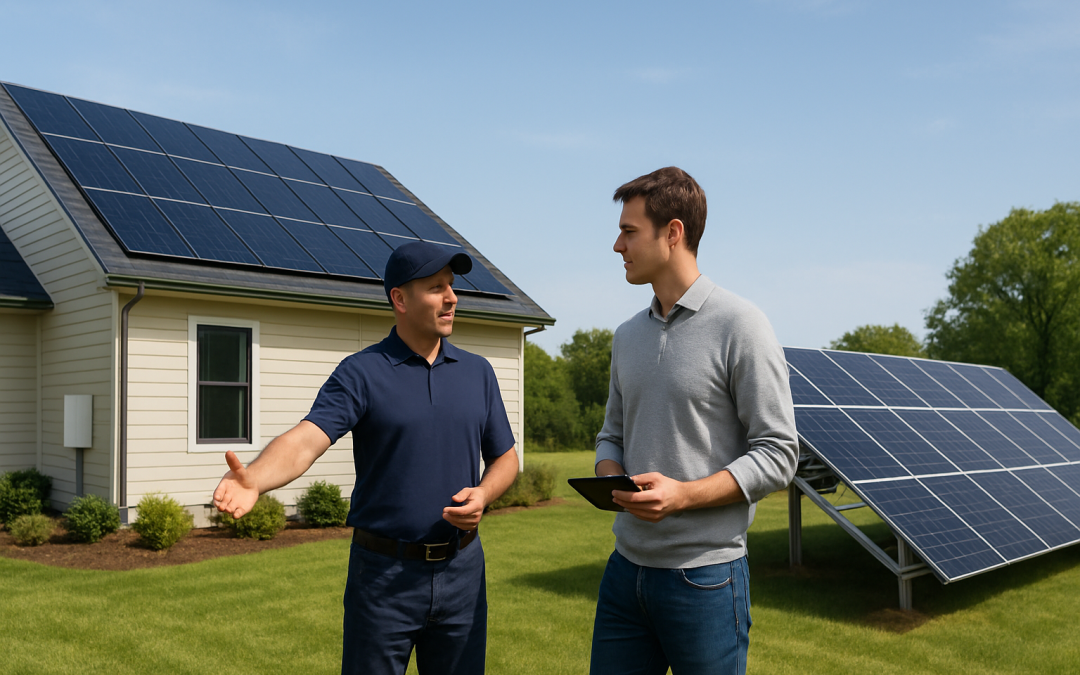
Ground-mounted vs. rooftop solar panels: which is better? For most homeowners, rooftop solar is cheaper and easier to permit, while ground-mounted solar costs more but can produce more energy if you have the space and good sun exposure. Rooftop systems typically work best when your roof is in good condition and faces south, west, or east. Ground mounts make sense when your roof is shaded, too small, or difficult to work on, but you’ll need enough open yard space and a higher budget.
In many cases, the “better” option is the one that fits your property, budget, and long-term plans—not just the one with the highest output. A qualified installer can model both options for your home so you can compare cost, production, and payback side by side.
Choosing between ground-mounted and rooftop solar panels is one of the first big decisions in a solar project. This guide is written for U.S. homeowners who want clear, honest information before talking to installers. We’ll walk through costs, energy output, space needs, pros and cons, and how to decide which option is better for your specific home.
Table of Contents
- Ground-Mounted vs. Rooftop Solar: The Basics
- Cost Comparison: Ground-Mounted vs. Rooftop Solar
- Energy Output and Performance Differences
- Space Requirements and Property Impact
- Installation, Permitting, and Maintenance
- Key Numbers: Costs, Savings, and Payback
- When Rooftop Solar Is Usually the Better Choice
- When Ground-Mounted Solar Is Usually the Better Choice
- How to Decide What to Do Next
- Frequently Asked Questions
- Summary: Ground vs. Roof Solar in a Nutshell
- Get Personalized Quotes for Your Home
Ground-Mounted vs. Rooftop Solar: The Basics
What each option actually means
Rooftop solar means panels are attached directly to your home’s roof using racking (mounting hardware). This is the most common setup for U.S. homes.
Ground-mounted solar means panels are installed on a separate structure anchored into the ground, usually in your yard or on open land. The panels sit on posts or a metal frame, often a few feet off the ground.
Both systems use the same core components—panels, inverters, wiring, and monitoring. The main differences are where the panels sit, how they’re mounted, and how much the structure itself costs.
Key differences at a glance
- Cost: Rooftop is usually cheaper; ground mounts add structural and trenching costs.
- Energy output: Ground mounts can be angled and oriented perfectly, often producing more energy per panel.
- Space: Rooftop uses existing space; ground mounts take up yard or land area.
- Maintenance: Ground mounts are easier to access; rooftop systems are higher up and may require safety equipment.
- Permits and aesthetics: Rooftop is more common and often easier to approve; ground mounts can face more zoning or HOA scrutiny.
Who should consider each option?
Rooftop solar is usually best if:
- Your roof is in good condition and has decent sun exposure.
- You have limited yard space or want to keep your yard open.
- You want the lowest upfront cost for a given system size.
Ground-mounted solar is worth exploring if:
- Your roof is shaded, small, steep, or complex (lots of dormers, vents, or hips).
- You have plenty of open land with good sun exposure.
- You want maximum production and flexibility in panel orientation.
Cost Comparison: Ground-Mounted vs. Rooftop Solar
Typical rooftop solar costs
For a typical U.S. home, a standard rooftop solar system usually falls in these ranges:
- System size: 6–10 kW (about 15–25 panels)
- Average cost per watt: $2.50–$3.50
- Total cost before incentives: about $28,000–$32,000
- After 30% federal tax credit (ITC): about $19,600–$22,400
These are national averages; your actual price depends on your state, roof type, equipment, and installer. For a deeper dive into how solar pricing works, see the site’s solar cost and savings resources such as the solar cost and savings guide.
How much more do ground-mounted systems cost?
Ground-mounted solar uses the same panels and inverters, but the structure and extra labor add cost. Typical differences:
- Extra cost per watt: often $0.25–$0.75 more than rooftop
- Typical ground-mount cost per watt: around $3.00–$4.25
- For a 10 kW system:
- Rooftop: roughly $28,000–$32,000 before incentives
- Ground mount: roughly $30,000–$42,500 before incentives
The 30% federal tax credit generally applies to both rooftop and ground-mounted systems, but always confirm with a tax professional and your installer. Local incentives may also treat them the same, but some programs have specific rules.
What drives cost differences?
Ground-mounted systems cost more mainly because of:
- Structural materials: posts, concrete footings, rails, and framing.
- Trenching and wiring: running conduit from the array to your home’s electrical service.
- Site work: grading, clearing vegetation, and possible fencing.
- Labor: more time on site, especially for larger arrays.
Rooftop systems avoid most of this extra work by using your existing roof structure as the “frame.” However, if your roof needs replacement soon, that cost can narrow the gap or even make a ground mount more attractive.
When rooftop solar wins on cost
Rooftop solar is usually the lower-cost option when:
- Your roof is in good shape and doesn’t need replacement for 10–15+ years.
- You have a simple roof layout (few obstructions, reasonable pitch).
- Your electrical panel is close to where the array will connect, minimizing wiring runs.
When ground-mounted solar can be cost-competitive
Ground-mounted solar can be surprisingly competitive when:
- Your roof is old or needs major work, and you’d rather not pay for a new roof now.
- Your roof layout would require multiple small arrays, increasing labor and complexity.
- You can install a larger, more efficient ground array that produces significantly more energy, improving long-term savings.
In some rural or suburban areas with low site-prep costs, the price gap between roof and ground can be relatively small, especially for larger systems.
Energy Output and Performance Differences
How much energy can each option produce?
Both rooftop and ground-mounted systems use the same panels, so the potential energy per panel is similar. The difference is how well you can position those panels:
- Rooftop solar: Panel angle and direction are limited by your roof’s pitch and orientation.
- Ground-mounted solar: You can usually choose the ideal tilt and direction for maximum sun.
In many parts of the U.S., a well-oriented ground mount can produce 5–20% more energy per watt than a suboptimal roof array, especially if the roof faces east/west or has shading.
Key factors that affect output
- Orientation (azimuth): South-facing is usually best in the U.S.; southeast and southwest are also good. East or west can still work but produce less.
- Tilt angle: Often between 25–35 degrees for fixed arrays, depending on latitude.
- Shading: Trees, chimneys, nearby buildings, and terrain can all reduce output.
- Panel efficiency: Higher-efficiency panels produce more power in the same space. See the site’s solar panel efficiency ratings guide for details.
- Temperature and airflow: Panels work slightly better when cooler; ground mounts often have better airflow.
When ground mounts outperform rooftop systems
Ground-mounted solar tends to produce more energy when:
- Your roof faces east/west or has multiple orientations.
- Your roof has shading during key sun hours (roughly 9 a.m.–3 p.m.).
- You can place a ground array in a wide-open, south-facing area.
- You use a tracking system (panels that follow the sun), which can boost output but adds cost and complexity.
When rooftop solar performs just as well
Rooftop solar can match or nearly match ground-mounted performance when:
- Your roof faces south or southwest with minimal shading.
- The roof pitch is in a good range (often 20–35 degrees).
- You use high-efficiency panels to maximize limited roof space.
In these cases, the extra production from a ground mount may be small compared to the extra cost, making rooftop solar the better value.
Space Requirements and Property Impact
How much roof space do you need?
Most modern residential panels are around 350–450 watts and measure roughly 3.5 feet by 5.5–6.5 feet (about 18–23 square feet each). For a typical home:
- Average system size: 6–10 kW
- Average number of panels: 15–25
- Approximate roof area needed: 300–600 square feet of usable, unshaded roof
“Usable” means areas without chimneys, vents, skylights, or heavy shading. Complex roofs may have enough total area but not enough continuous, usable space.
How much yard space does a ground mount need?
Ground-mounted systems need more total area than the panels themselves to allow for spacing, access, and avoiding shading between rows. As a rough guide:
- Panel area for 6–10 kW: about 300–600 square feet
- Total ground area needed: often 600–1,200+ square feet, depending on layout
You’ll also want to consider:
- Setbacks from property lines and structures (local codes vary).
- Access paths for maintenance and mowing.
- Potential fencing if required by code or for safety.
Visual and practical impact on your property
Rooftop solar:
- Minimal impact on yard use.
- Visible on the roof but often blends in, especially with all-black panels.
- May be restricted by HOA rules in some communities (though many states have “solar access” laws).
Ground-mounted solar:
- Takes up yard or field space that could be used for other purposes.
- More visible from the ground; can be screened with landscaping in some cases.
- May face stricter zoning, setback, or height rules, especially in suburban or HOA-governed neighborhoods.
When space favors rooftop solar
Rooftop solar is usually better when:
- You have a small lot or limited open yard space.
- You want to preserve yard space for kids, pets, gardening, or future projects.
- Your HOA or local zoning is strict about ground structures.
When space favors ground-mounted solar
Ground-mounted solar shines when:
- You have plenty of unused land (rural or large suburban lots).
- Your roof is small, shaded, or architecturally complex.
- You want the option to expand your system later without reworking the roof.
Installation, Permitting, and Maintenance
Installation differences
Rooftop solar installation typically involves:
- Attaching mounting hardware to roof rafters.
- Installing rails and panels on the roof.
- Running wiring through the attic or along the exterior to your electrical panel.
Ground-mounted solar installation typically involves:
- Digging and pouring concrete footings or driving ground posts.
- Building the racking structure and mounting panels.
- Trenching and running conduit underground to your home.
Ground mounts can take longer to install due to site work and trenching, especially in rocky or sloped terrain.
Permitting and approvals
Both options require electrical and building permits in most areas. Additional considerations:
- Rooftop: Often a more standard process; many building departments are familiar with it.
- Ground mount: May trigger zoning reviews, setback requirements, or height limits.
- HOAs: Some are more restrictive about ground arrays than rooftop systems.
A good installer will handle permitting and help you navigate any HOA or zoning issues. Ask upfront whether they have experience with ground mounts in your area if you’re leaning that way.
Maintenance and access
Rooftop solar maintenance:
- Panels are generally low-maintenance; rain often keeps them clean enough.
- Access for cleaning or repairs requires roof work and safety precautions.
- Snow removal (if you choose to do it) can be more difficult and risky.
Ground-mounted solar maintenance:
- Easy access for cleaning, inspections, and repairs.
- May require vegetation control (mowing, trimming) to prevent shading.
- Snow removal is easier if you choose to clear it.
Roof condition and future repairs
With rooftop solar, roof condition is critical:
- If your roof is near the end of its life, you may need to replace it before installing solar.
- Removing and reinstalling panels for a future roof replacement adds cost.
Ground mounts avoid this issue entirely, which can be a big advantage if your roof is older or you plan major renovations.
Key Numbers: Costs, Savings, and Payback
National average solar numbers
For a typical U.S. homeowner installing rooftop solar:
- System size: 6–10 kW (15–25 panels)
- Cost per watt: $2.50–$3.50
- Total cost before incentives: $28,000–$32,000
- After 30% federal tax credit: $19,600–$22,400
- Average annual bill savings: about $1,300–$1,500
- Typical payback period: 7–9 years (national average)
- Panel performance warranty: 25–30 years
- Typical panel lifespan: 30–35 years
These are broad averages; your results depend heavily on your local electricity rates, sun exposure, system size, and incentives. For a full overview of incentives, see the site’s solar incentives and tax credits guide.
How ground mounts change the math
With ground-mounted solar, the main differences are:
- Higher upfront cost: Often 10–25% more than rooftop for the same system size.
- Potentially higher production: Often 5–20% more energy per watt if optimally sited.
In practice, this means:
- Your payback period might be similar if the extra production offsets the higher cost.
- Or it might be 1–3 years longer if the production gain is small but the cost increase is large.
What affects your personal numbers the most
- Your utility rate: Higher electricity prices make solar more valuable.
- Net metering rules: How your utility credits excess solar power.
- Sun exposure: Shading and orientation can change output by 10–30% or more.
- System size: Larger systems cost more but can reduce your bill further.
- Local incentives: State, utility, or city rebates and programs.
Because these variables are so local, it’s important to get site-specific quotes rather than relying only on national averages.
When Rooftop Solar Is Usually the Better Choice
Situations where rooftop solar makes the most sense
Rooftop solar is usually the better option when:
- Your roof is in good condition (10–15+ years of life left).
- You have a decent amount of unshaded, south- or west-facing roof area.
- You want to minimize upfront cost and keep payback as short as possible.
- You have limited yard space or want to keep your yard open.
- Your HOA or local zoning is more friendly to rooftop than ground-mounted systems.
Advantages of rooftop solar
- Lower cost per watt: No need for separate structures or extensive trenching.
- Smaller footprint: Uses space you’re not otherwise using.
- Faster, simpler permitting: Often a more standard process for building departments.
- Less visible from the ground: Especially with low-profile, all-black panels.
When rooftop solar may not be ideal
Rooftop solar can be less attractive when:
- Your roof is heavily shaded and tree removal isn’t an option.
- Your roof is complex, small, or has many obstructions, limiting system size.
- Your roof needs replacement soon and you don’t want to combine projects.
- You strongly dislike the look of panels on your home.
In these situations, a ground-mounted system—or even waiting until a roof replacement—may be the smarter move.
When Ground-Mounted Solar Is Usually the Better Choice
Situations where ground mounts shine
Ground-mounted solar is often the better choice when:
- You have plenty of open, sunny land near your home.
- Your roof is shaded, small, or has poor orientation.
- Your roof is older and you’d rather not replace it now.
- You want a larger system than your roof can support (for EVs, heat pumps, or future load growth).
Advantages of ground-mounted solar
- Optimal orientation and tilt: You can aim panels exactly where they’ll get the most sun.
- Easy access: Simpler cleaning, inspections, and repairs.
- No roof concerns: No roof penetrations, and no need to remove panels for future roof work.
- Scalability: Easier to expand later if you have the space.
Drawbacks and limitations of ground mounts
- Higher upfront cost: Extra structure, trenching, and labor.
- Yard impact: Takes up usable space and can change the look of your property.
- Potential permitting hurdles: Zoning, setbacks, and HOA rules can be stricter.
- Vegetation management: Grass and plants must be kept from shading panels.
For some homeowners, these trade-offs are worth it for the extra production and flexibility. For others, the visual and space impact is a deal-breaker.
How to Decide What to Do Next
Is now the right time to act?
Solar can make sense whenever:
- Your electric bills are significant (often $80–$100+ per month).
- You plan to stay in your home for at least 5–7 years.
- You have a reasonably sunny property and stable roof or land situation.
The 30% federal tax credit is currently available through 2032, but local incentives can change quickly. If you’re seriously considering solar, it’s reasonable to start getting quotes now so you understand your options.
Information to gather before getting quotes
Before you talk to installers, it helps to have:
- 12 months of electric bills: Shows your usage and seasonal patterns.
- Basic roof info: Age, material, and any known issues.
- Photos or notes about your yard: Especially open, sunny areas that could host a ground array.
- Future plans: EV purchase, heat pump, pool, or other changes that might increase usage.
Questions to ask installers about ground vs. roof
When you get quotes, ask each installer:
- “Can you model both rooftop and ground-mounted options for my property?”
- “What would the system size, cost, and estimated annual production be for each?”
- “How would the payback period and long-term savings compare?”
- “Are there any zoning, setback, or HOA issues with a ground mount here?”
- “How would roof age and condition affect a rooftop system?”
Having side-by-side proposals makes it much easier to see which option is better for you.
Why multiple quotes matter
Solar pricing and design can vary a lot between installers, especially for ground-mounted systems where site approach matters. Getting at least 2–3 quotes helps you:
- See a realistic price range for your area.
- Compare different design approaches (panel types, locations, system sizes).
- Spot red flags like oversized systems or unclear assumptions.
Before you commit, it can also help to review a general overview of solar equipment and system types, such as the site’s solar power systems explained guide, so you’re comfortable with the basics.
Frequently Asked Questions
Is ground-mounted solar more expensive than rooftop solar?
Yes, ground-mounted solar is usually more expensive than rooftop solar for the same system size, often by about $0.25–$0.75 per watt. The extra cost comes from the structure, concrete or posts, trenching, and additional labor. In some cases, higher energy production from an optimally placed ground array can partially offset the higher upfront cost.
Which produces more electricity: ground-mounted or rooftop solar panels?
Per panel, both can produce similar power, but ground-mounted systems often generate more electricity overall because you can choose the ideal tilt and direction and avoid shading. In many situations, a well-sited ground mount can produce 5–20% more energy per watt than a roof system with less-than-ideal orientation or shading.
How much yard space do I need for a ground-mounted solar system?
A typical 6–10 kW ground-mounted system (about 15–25 panels) usually needs around 600–1,200 square feet of open, sunny ground, including space between rows and access paths. Exact space requirements depend on panel size, layout, tilt angle, and local setback rules.
Will a ground-mounted solar array hurt my property value?
Most studies show that owned solar systems tend to increase property value by lowering utility bills, but buyer preferences vary. A well-sited, tidy ground array on a large lot is less likely to be an issue than one that dominates a small yard. A local real estate agent familiar with solar in your area can give more specific guidance.
Can I use the 30% federal tax credit for a ground-mounted solar system?
In many cases, the 30% federal solar tax credit applies to both rooftop and ground-mounted systems installed on residential property you own, but tax rules can be complex. Always confirm eligibility with a qualified tax professional and your installer before relying on any incentive in your financial planning.
What if my roof needs to be replaced soon?
If your roof is near the end of its life, you generally have two options: replace the roof before installing rooftop solar, or choose a ground-mounted system and leave the roof alone for now. Replacing the roof first adds cost but avoids having to remove and reinstall panels later; a ground mount avoids roof work but requires enough open land and a higher solar budget.
Summary: Ground vs. Roof Solar in a Nutshell
- Rooftop solar is usually cheaper and less intrusive, making it the better choice for most homeowners with a solid, sun-exposed roof.
- Ground-mounted solar costs more upfront but can produce more energy if you have open land and want optimal orientation and easy access.
- Key numbers: typical systems cost $28,000–$32,000 before incentives, save about $1,300–$1,500 per year, and pay back in 7–9 years on average.
- Your roof condition, shading, yard space, local rules, and future plans (EVs, heat pumps) are the biggest factors in deciding between ground and roof.
- The smartest next step is to get a few personalized quotes that model both options for your property so you can compare cost, output, and payback side by side.
Get Personalized Quotes for Your Home
Every property is different, and the best way to choose between ground-mounted and rooftop solar panels is to see real designs and numbers for your home. Getting multiple quotes lets you compare options, understand trade-offs, and move forward only if the numbers make sense for you.
When you’re ready, you can start by requesting tailored estimates at /get-my-quote/ so you can see exactly what rooftop and ground-mounted solar would look like on your property, with no obligation to proceed.