
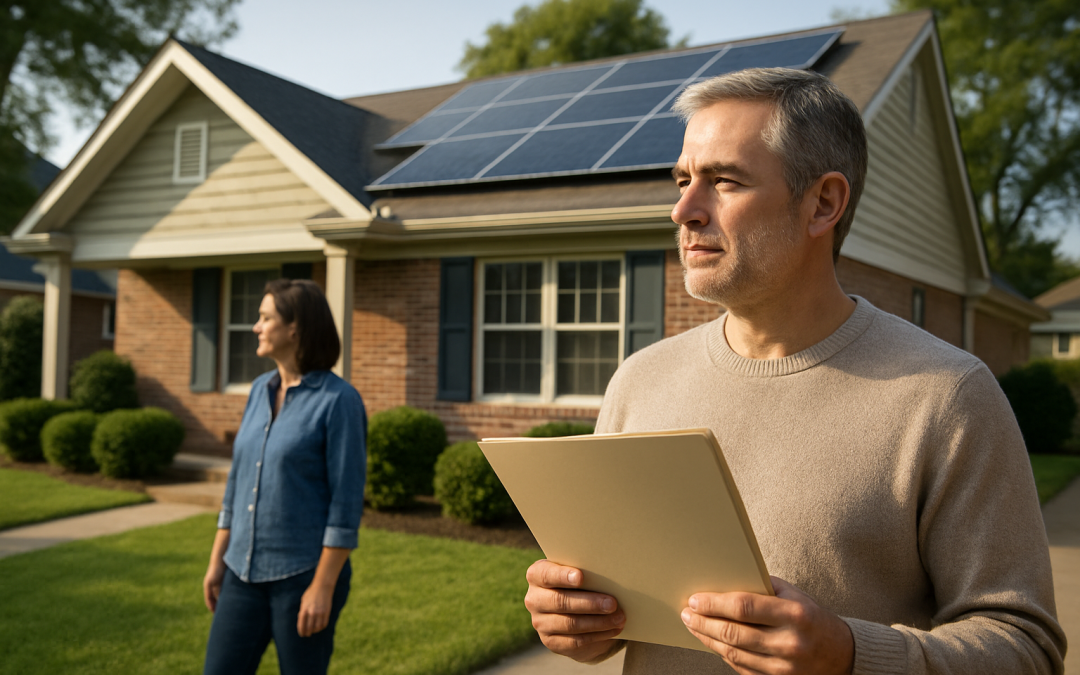
Does solar increase property taxes? In most states, adding solar panels increases your home’s assessed value, but many states offer partial or full property tax exemptions so your tax bill does not go up because of the solar system. Whether your property taxes increase depends on your state and sometimes your county or city rules. You should expect your home’s market value to rise with solar, but in many areas the added value from the system is legally ignored for tax purposes. Always confirm the rules with your local assessor or a tax professional before you install.
For U.S. homeowners, the connection between solar panels, home value, and property taxes can be confusing. This guide explains how solar is typically assessed, which states offer exemptions, and what that means for your actual tax bill. If you’re weighing solar, you’ll see how property taxes fit into the bigger picture of costs, incentives, and long-term savings.
Table of Contents
- How Solar Affects Property Taxes: The Simple Version
- Does Solar Increase Home Value?
- State Solar Property Tax Exemptions (Overview)
- How Assessors Treat Solar Panels
- Key Numbers: Costs, Savings, and Tax Impact
- When Solar Helps — and When It Can Hurt — Your Property Tax Situation
- What Homeowners Should Do Before Installing Solar
- Frequently Asked Questions
- Summary: What to Remember About Solar and Property Taxes
How Solar Affects Property Taxes: The Simple Version
There are three separate pieces to understand:
- Home value: Solar usually increases what your home is worth on the market.
- Assessed value: Local assessors may add some or all of that value to your tax assessment.
- Property tax bill: Many states have laws that exclude solar’s added value from property tax calculations, at least for a set number of years.
In practice, that means:
- In a state with a solar property tax exemption, your home can be worth more, but your tax bill may stay the same because the solar value is ignored for tax purposes.
- In a state without an exemption, your assessed value can go up, and your property taxes may rise modestly.
Because rules vary by state and sometimes by county, you should always verify how your local assessor handles residential solar before you sign a contract.
Does Solar Increase Home Value?
What the research shows
Multiple studies have found that solar tends to increase home resale value:
- A Lawrence Berkeley National Laboratory (LBNL) study found homes with solar sold for about $15,000 more on average for a typical 3–4 kW system, with premiums roughly tracking system size.
- Other analyses suggest a range of about $3,000–$4,000 in home value per installed kilowatt (kW), depending on location and electricity prices.
For a typical 6–8 kW residential system, that implies a potential value increase of roughly $18,000–$32,000, though actual results vary by market, system age, and quality.
Why solar adds value
Buyers often pay more for homes with solar because:
- They expect lower electric bills immediately.
- They avoid the hassle of designing and installing a new system.
- They may value the environmental benefits and energy independence.
However, higher market value does not automatically mean higher property taxes if your state has an exemption that tells assessors to ignore that added value.
How this ties into property taxes
Property taxes are usually calculated as:
Assessed value × Local tax rate = Annual property tax
If your solar system adds, say, $20,000 to your assessed value and your combined local tax rate is 1.2%, your annual property tax could increase by about $240 per year — unless your state exempts that solar value from taxation.
State Solar Property Tax Exemptions (Overview)
How common are solar property tax exemptions?
As of 2026, a majority of U.S. states offer some form of property tax relief for residential solar. These policies generally fall into three categories:
- Full exemption: 100% of the solar system’s added value is excluded from property tax calculations.
- Partial exemption: A percentage of the added value is exempt, or the exemption applies only for a set number of years.
- No specific exemption: Solar is treated like any other home improvement and may increase your assessed value and tax bill.
Examples of states with strong solar property tax exemptions
While you should always confirm current rules with your state or local assessor, many solar-friendly states have clear exemptions. Examples include:
- California: A long-standing property tax exclusion for active solar energy systems on existing buildings (subject to periodic legislative updates).
- New York: State law allows local jurisdictions to offer a 15-year property tax exemption on the added value from solar; many municipalities opt in.
- Texas: Provides a property tax exemption for the appraised value increase from solar or wind-powered energy devices.
- Florida: Constitutional amendment and statutes exempt the added value of residential renewable energy devices from property taxes.
Other states, such as Massachusetts, New Jersey, Colorado, and Maryland, also have favorable property tax treatment for residential solar, often with time-limited exemptions (e.g., 10–20 years).
States with limited or no specific exemptions
Some states either:
- Do not have a statewide solar property tax exemption, or
- Leave it largely to local governments to decide how to treat solar.
In these states, your solar system is more likely to be treated like a kitchen remodel or finished basement: it can increase your assessed value and potentially your tax bill. Because policies change, it’s important to check your state energy office or local assessor’s website for the most current rules.
How to check your state’s rules
To find out whether your state exempts solar from property taxes:
- Search for your state name plus “solar property tax exemption” on your state energy office or tax department website.
- Call your county assessor’s office and ask specifically how residential solar PV is treated for property tax purposes.
- Ask your solar installer; reputable companies usually track local tax rules, though you should still verify with an official source.
How Assessors Treat Solar Panels
Real property vs. personal property
Most residential solar systems are considered part of the home’s real property once installed (similar to a roof or HVAC system). That means:
- The system is typically included in the home’s value for appraisal and sale.
- It can be included in the assessed value for property tax purposes, unless exempted.
In some jurisdictions, especially for leased systems, assessors may treat the equipment differently, but the impact on your tax bill is usually tied to your home’s assessed value, not the ownership structure alone.
How assessors estimate solar’s value
Assessors may use different methods to estimate the value added by solar, such as:
- Cost approach: Based on the installed cost of the system, sometimes adjusted for depreciation.
- Income approach: Based on the energy savings the system is expected to produce over time.
- Market approach: Based on comparable sales of similar homes with and without solar.
In states with a solar property tax exemption, assessors may still estimate this value but then exclude it from the taxable portion of your assessment.
Leased vs. owned systems
Ownership can affect how solar is treated:
- Owned systems: More likely to be counted as part of the property’s value (and thus subject to exemption rules).
- Leased or power purchase agreement (PPA) systems: The solar company often owns the equipment; some assessors may treat it as separate from your real property, which can reduce or eliminate any property tax impact.
However, leased systems can be viewed differently by buyers and lenders, so property tax treatment is only one factor to consider when choosing between owning and leasing.
Local variations
Even within a state, local practices can differ:
- Some counties automatically apply exemptions; others require you to file an application.
- Some assessors may not adjust your value immediately after installation, especially if they rely on periodic revaluations.
- In rapidly changing markets, the impact of solar can be overshadowed by broader home price trends.
Because of these variations, it’s wise to ask your assessor directly how and when solar installations are reflected in assessments.
Key Numbers: Costs, Savings, and Tax Impact
Typical solar system costs
For a typical U.S. home, as of 2026:
- System size: 15–25 panels, usually around 6–10 kW.
- Cost per watt: About $2.50–$3.50 per watt before incentives.
- Total system cost: Roughly $28,000–$32,000 before incentives for a common residential system.
- Federal tax credit (ITC): 30% of eligible costs through at least 2032.
- Net cost after 30% ITC: About $19,600–$22,400 for many homeowners, before any state or utility incentives.
Actual costs depend on your roof, local labor rates, equipment choices, and whether you add batteries.
Typical savings and payback
National averages (your results may differ):
- Average annual electric bill savings: About $1,300–$1,500.
- Payback period: Roughly 7–9 years on average, shorter in high-electricity-cost states.
- Panel lifespan: 25–30 years performance warranty, with many systems lasting 30–35 years or more.
Over the life of the system, many homeowners see tens of thousands of dollars in net savings, even after accounting for maintenance and potential property tax changes.
How property taxes fit into the math
Consider a simple example:
- You install a system that adds $20,000 in appraised value.
- Your local property tax rate is 1.2%.
- Potential annual tax increase: $20,000 × 1.2% = $240 per year.
- Typical annual electric bill savings: $1,400 (midpoint of the $1,300–$1,500 range).
Even without an exemption, your net benefit could still be around $1,160 per year in this scenario ($1,400 savings – $240 extra tax). In a state with a full exemption, that extra $240 may not apply at all.
Other incentives that matter
Beyond property tax rules, incentives can significantly improve your solar economics:
- The 30% federal solar tax credit is the single biggest incentive for most homeowners; our guide to claiming the solar tax credit explains how it works.
- Many states and utilities offer rebates, performance payments, or low-interest loans that reduce your upfront cost.
- If you have limited tax liability, you may need to plan carefully to use the federal credit; see our resource on solar incentives when you have little or no tax liability.
When you combine these incentives with property tax exemptions, the overall financial case for solar can be very strong in many states.
When Solar Helps — and When It Can Hurt — Your Property Tax Situation
When solar usually helps your overall finances
Solar tends to be financially attractive, even considering property taxes, when:
- Your state or locality offers a full or long-term property tax exemption for solar.
- Your electricity rates are relatively high, so your annual savings are closer to or above $1,500.
- You plan to stay in your home long enough to reach or pass the 7–9 year payback period.
- You can use the 30% federal tax credit and any state or utility incentives.
In these situations, any small property tax impact (if there is one at all) is usually outweighed by bill savings and increased home value.
When solar might increase your property taxes noticeably
Solar can have a more noticeable property tax impact when:
- Your state has no specific solar property tax exemption.
- Your local property tax rate is relatively high (for example, 2% or more).
- Your system is large and adds significant appraised value.
- Your assessor updates values frequently and explicitly includes solar.
Even then, the increase is usually modest compared with your electric bill savings, but it’s important to factor it into your decision, especially if you’re on a tight budget.
When solar may not be the right choice
Solar is not always a good fit, regardless of property tax rules. You may want to hold off if:
- Your roof is heavily shaded or faces directions that limit production.
- You expect to move within a few years and your local market does not strongly value solar yet.
- You cannot comfortably afford the net cost after incentives, even with financing.
- Your local incentives are weak and electricity rates are very low, leading to a long payback period.
Before focusing on property taxes, it’s wise to step back and ask whether solar makes overall financial sense for your home; our honest “Is solar worth it?” guide walks through that bigger picture.
Special considerations for retirees and fixed-income homeowners
If you’re on a fixed income, even a small property tax increase can feel significant. In that case:
- Confirm whether your state offers senior property tax relief or “circuit breaker” programs that cap taxes based on income.
- Ask your assessor how solar would affect your specific situation.
- Weigh the predictability of lower electric bills against any potential tax increase.
For many retirees, the stability of lower utility bills can be worth a modest tax change, but this is a personal decision that may benefit from input from a financial or tax professional.
What Homeowners Should Do Before Installing Solar
Step 1: Confirm your local property tax rules
Before you sign a solar contract, take these practical steps:
- Call or email your county assessor’s office and ask:
- “Does a residential solar PV system increase my assessed value?”
- “Does our state or county offer a solar property tax exemption?”
- “Do I need to file any forms to claim that exemption?”
- Check your state energy office or tax department website for written guidance.
- Ask your solar installer what they’ve seen with other customers in your area.
Step 2: Gather the information you’ll need for quotes
To get accurate solar quotes and understand the property tax impact, have these details ready:
- Your last 12 months of electric bills (kWh usage and costs).
- Basic information about your roof (age, material, shading, orientation).
- Your property tax rate and current assessed value (usually on your tax bill).
- Any plans to add electric vehicles, heat pumps, or other major loads.
This information helps installers size your system correctly and gives you a clearer picture of savings versus any tax changes.
Step 3: Ask installers specific questions about property taxes
When you talk to installers, consider asking:
- “How does solar typically affect property taxes for your customers in this county?”
- “Are there any local property tax exemptions for solar I should know about?”
- “Will you provide documentation I can share with my assessor if needed?”
- “How much value do you expect this system to add to my home, based on local sales?”
Reputable installers should be able to share real-world examples from your area, though they cannot give official tax advice.
Step 4: Get multiple quotes and compare the full picture
Because solar is a long-term investment, it’s smart to:
- Get at least 2–3 quotes from vetted installers.
- Compare:
- System size (kW) and equipment quality.
- Total cost and cost per watt.
- Estimated annual production and savings.
- Any assumptions about property tax impact.
- Ask each installer to explain their assumptions in plain language.
For help understanding how costs and savings fit together, you may find our solar cost and savings guide useful as you review quotes.
Frequently Asked Questions
Will adding solar panels increase my property taxes?
In many states, solar panels increase your home’s value but are partially or fully exempt from property taxes, so your tax bill does not rise because of the system. In states without an exemption, your assessed value may go up modestly, which can increase your taxes. Always check with your local assessor to understand the rules where you live.
How much could my property taxes go up if solar is not exempt?
If your solar system adds about $20,000 in value and your local tax rate is 1.2%, your annual property tax could increase by roughly $240. This is usually much less than the typical $1,300–$1,500 in annual electric bill savings many homeowners see. The exact impact depends on your system’s value and your local tax rate.
Do leased solar panels affect property taxes the same way as owned systems?
Leased systems are often owned by the solar company, so some assessors treat them differently from owned systems. In many cases, the leased equipment is not fully included in your home’s assessed value, which can reduce property tax impact. However, treatment varies by jurisdiction, so confirm with your local assessor.
Do I need to file anything to get a solar property tax exemption?
Some states and counties automatically apply solar property tax exemptions, while others require you to submit an application or form after installation. Your county assessor’s office can tell you whether you need to file paperwork and what documentation is required. It’s best to ask before or soon after your system is installed.
Can solar panels lower my property taxes?
Solar panels typically do not lower your property taxes directly; at best, they prevent an increase by being exempt from taxation. The main financial benefit of solar comes from lower electric bills and potential home value gains, not from reduced property taxes. Some homeowners may also benefit from other tax credits and incentives unrelated to property tax.
Should I worry about property taxes when deciding to go solar?
Property taxes are worth understanding, but for most homeowners they are a smaller factor than system cost, incentives, and energy savings. In many states, exemptions limit or eliminate property tax increases from solar. It’s still smart to confirm local rules and include any expected tax change in your overall financial analysis.
Summary: What to Remember About Solar and Property Taxes
- Solar usually increases home value, but many states offer property tax exemptions so that added value does not raise your tax bill.
- Typical residential systems cost about $28,000–$32,000 before incentives and $19,600–$22,400 after the 30% federal tax credit, with average annual savings of $1,300–$1,500.
- In places without exemptions, property tax increases are usually modest compared with long-term bill savings, but they should still be factored into your decision.
- Rules vary widely by state and county, so always confirm with your local assessor and consider speaking with a tax professional.
- The best next step is to understand your local tax treatment, then get multiple quotes so you can compare costs, savings, and any potential property tax impact side by side.
If you’re ready to see how solar would pencil out for your specific home, getting personalized quotes is the most reliable way to move forward. Compare offers from vetted installers, ask directly about property tax implications, and see your projected savings in writing by starting at /get-my-quote/.