
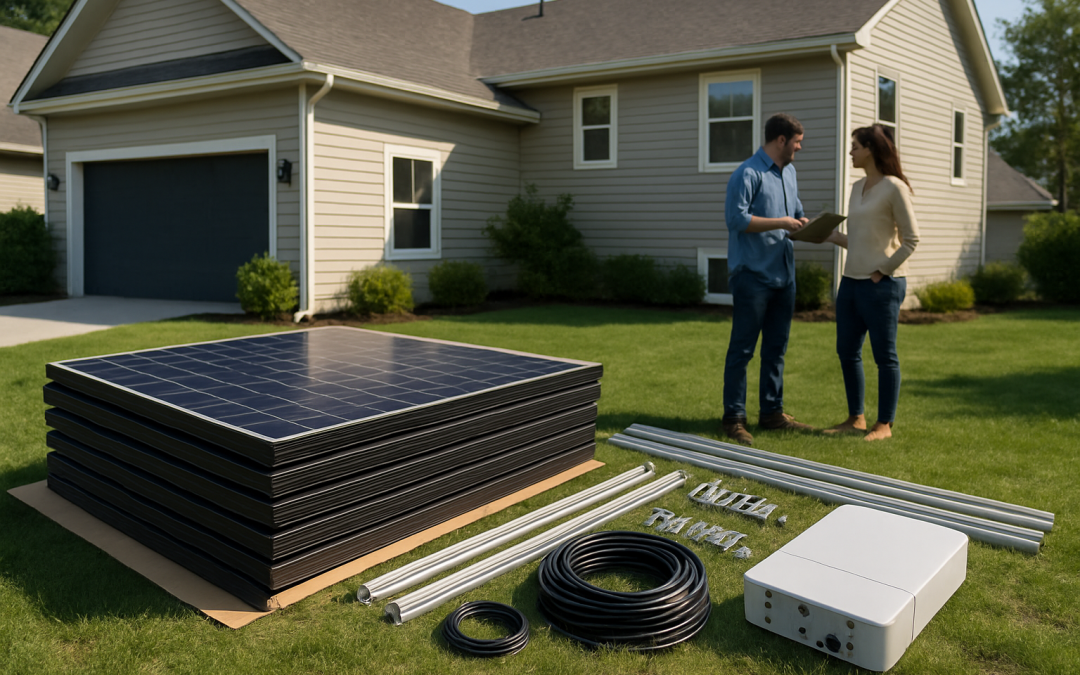
Home solar panel kits typically cost between $8,000 and $18,000 for equipment only, depending on system size and quality, but that does not include professional installation or electrical upgrades. A full, professionally installed home solar system usually runs closer to $28,000–$32,000 before incentives, or about $19,600–$22,400 after the 30% federal tax credit. Kits can be a good fit for handy homeowners with simple roofs and modest energy needs, but they come with trade-offs in safety, permits, warranties, and long-term performance. For most U.S. homeowners, a professionally designed and installed system offers better value and fewer headaches over 25–30 years.
Home solar panel kits promise a “do-it-yourself” path to solar, but the real question is whether they actually save money and work well for your home. This guide breaks down what’s included in a solar kit, how much it really costs, what’s missing compared to a full installation, and when a kit makes sense versus hiring a pro. If you’re a U.S. homeowner trying to decide the smartest way to go solar, this article is for you.
Table of Contents
- What Is a Home Solar Panel Kit?
- How Much Does a Home Solar Panel Kit Cost?
- What’s Included in a Home Solar Panel Kit (and What’s Not)
- Installation Options: DIY vs. Professional
- Key Numbers: Costs, Savings, and Payback
- When a Solar Panel Kit Is Worth It (and When It Isn’t)
- Solar Kit vs. Professionally Installed System
- How to Decide Your Next Step
- Frequently Asked Questions
- Summary & Next Steps
What Is a Home Solar Panel Kit?
A home solar panel kit is a bundled package of solar equipment sold as a set, usually aimed at DIY or “semi-DIY” homeowners. It typically includes solar panels and basic hardware, and sometimes an inverter and wiring, but it usually does not include full design, permitting, or installation services.
There are three main types of kits marketed to homeowners:
- Grid-tied home solar kits – Designed to connect to your utility grid and offset your electric bill.
- Off-grid or cabin kits – Include batteries and are meant for locations without utility power.
- Backup power kits – Focus on keeping essential loads running during outages, often with batteries.
Most homeowners researching “home solar panel kit cost” are looking at grid-tied kits to reduce their monthly electric bill. These kits can be a starting point, but they are not a complete, ready-to-use solution in most U.S. jurisdictions.
How Much Does a Home Solar Panel Kit Cost?
Home solar panel kit cost depends mainly on system size (how many watts), equipment quality, and whether batteries are included. For a typical U.S. home, here are realistic 2026 price ranges for equipment-only kits:
- Small kits (2–4 kW) – $3,000–$7,000 (often for RVs, cabins, or partial home use)
- Medium kits (5–8 kW) – $8,000–$14,000 (can offset a portion of a typical home’s usage)
- Large kits (9–12 kW) – $14,000–$18,000+ (aimed at whole-home offset in sunny regions)
- Kits with batteries – Add roughly $8,000–$18,000+ depending on battery size and brand
By comparison, a professionally installed residential solar system in the U.S. typically costs:
- Total system cost: $28,000–$32,000 before incentives
- After 30% federal tax credit: about $19,600–$22,400 (if you qualify)
- Cost per watt (installed): $2.50–$3.50 per watt
Why the big gap between kit cost and installed cost?
- Kits are equipment only – no labor, design, permits, or inspections.
- Professional systems include engineering, permitting, labor, warranties, and support.
- DIY projects may still require paid electricians, roofers, and permit fees, which can narrow the savings.
Actual costs vary by state, utility rules, roof type, and how complex your home’s electrical system is.
What’s Included in a Home Solar Panel Kit (and What’s Not)
Typical Components Included in a Solar Kit
Most grid-tied home solar kits include some or all of the following:
- Solar panels – The main power-producing components, usually 350–450 watts each.
- Inverter – Converts DC power from panels into AC power for your home. This may be:
- A single “string” inverter, or
- Microinverters (one per panel) in higher-end kits.
- Racking and mounting hardware – Rails, clamps, and roof attachments to secure panels.
- Basic wiring and connectors – Cables, MC4 connectors, and sometimes combiner boxes.
- Monitoring hardware/software – Some kits include basic online monitoring.
Higher-end kits may also include:
- Rapid shutdown devices (required by code in many areas)
- Basic design layout or a generic wiring diagram
- Limited technical support by phone or email
What’s Usually NOT Included (But You’ll Likely Need)
This is where many homeowners are surprised. Most home solar panel kits do not include:
- Site-specific system design – Custom sizing based on your usage, roof, and shading.
- Structural review – Ensuring your roof can safely support the system.
- Permits and inspections – Required by most cities and counties.
- Utility interconnection paperwork – Needed to connect to the grid and receive bill credits.
- Professional installation labor – Roof work, electrical work, trenching (if needed).
- Electrical upgrades – Panel upgrades, subpanels, or new service lines if your existing panel is full.
- Battery storage – Most basic kits are solar-only; batteries are a separate cost.
- Long-term workmanship warranties – You’re the installer, so you own the workmanship risk.
In many jurisdictions, a licensed electrician must connect the system to your main panel and sign off on permits. This adds cost and coordination even with a DIY kit.
How This Affects Real-World Cost
When you factor in everything that’s not in the box, the “true” cost of a home solar kit often includes:
- Kit price (equipment)
- Shipping and freight (can be $500–$2,000 for large kits)
- Permits and inspection fees ($200–$1,000+ depending on your city)
- Electrician labor ($1,000–$4,000+ depending on complexity)
- Roofing work or reinforcements (varies widely)
- Miscellaneous materials (conduit, breakers, disconnects, labels)
For many homeowners, this narrows the gap between a DIY kit and a turnkey professional installation more than expected.
Installation Options: DIY vs. Professional
Option 1: Full DIY Installation
With a full DIY approach, you handle everything: ordering the kit, designing the layout, pulling permits, mounting panels, running wiring, and coordinating inspections. You may still need a licensed electrician for final connections, depending on local rules.
Pros:
- Lowest potential upfront cost if done correctly
- Full control over equipment selection and layout
- Satisfaction of building your own system
Cons:
- Steep learning curve for electrical and code requirements
- Risk of roof leaks or damage if mounting is done incorrectly
- Safety risks working at heights and with high-voltage DC
- Possible issues with permits, inspections, and utility approval
- Limited or no workmanship warranty
Option 2: Hybrid Approach (You Help, Pros Do the Critical Parts)
Some homeowners choose a middle path: they buy a kit, do the physical panel mounting themselves, and hire a licensed electrician or solar installer for electrical work and paperwork.
Pros:
- Can save on labor while improving safety and code compliance
- Professionals handle the most technical and risky tasks
- Better chance of passing inspections and getting utility approval
Cons:
- Still requires significant time and effort on your part
- Coordinating between kit vendor, electrician, and inspector can be complex
- Responsibility for roof integrity and some system issues remains with you
Option 3: Fully Professional Installation (No Kit)
With a turnkey installation, a solar company designs, permits, installs, and commissions your system. You may not see the word “kit” at all—just a complete system proposal.
Pros:
- One point of contact for design, permits, installation, and support
- Professional engineering and code-compliant installation
- Workmanship warranties (often 10–25 years) and ongoing support
- Better integration with your roof type, electrical panel, and utility rules
Cons:
- Higher upfront cost than a basic kit
- Less “hands-on” involvement if you enjoy DIY projects
- Quality and transparency vary by installer—getting multiple quotes is important
If you’re leaning toward a professional install, it helps to understand the equipment in your quote; the solar panels and equipment guide on BestSolarAdvice.com walks through the main components.
Key Numbers: Costs, Savings, and Payback
Whether you use a home solar panel kit or hire a pro, the long-term economics are driven by the same core numbers: system cost, your electric rates, how much sun you get, and available incentives.
Typical System Size and Output
- Average panels needed: 15–25 panels for a typical U.S. home
- Panel wattage: 350–450 watts each (varies by brand and efficiency)
- Typical system size: 6–10 kW (6,000–10,000 watts)
- Panel lifespan: 25–30 years performance warranty; 30–35 years typical life
Higher-efficiency panels can produce more power in the same roof area, which matters if your roof space is limited. For a deeper dive into how efficiency ratings work, see the guide on solar panel efficiency ratings.
Installed Cost Benchmarks (Professional Systems)
- Cost per watt: $2.50–$3.50 installed (national average)
- Total system cost: $28,000–$32,000 before incentives for a typical home
- After 30% federal tax credit: $19,600–$22,400 (if you qualify and can use the credit)
The 30% federal Investment Tax Credit (ITC) is currently available through 2032 for qualifying systems, but tax rules are complex. Always consult a tax professional to understand how the credit applies to your situation; the BestSolarAdvice.com solar incentives and tax credits guide explains the basics.
Typical Savings and Payback
- Average annual bill savings: $1,300–$1,500 for a typical U.S. home
- Payback period: 7–9 years national average (shorter in high-cost electricity states)
- System life: 25–30+ years, so you may get 15–20 years of “free” power after payback
These numbers assume a professionally installed, well-designed system. A DIY kit that’s undersized, poorly oriented, or shaded may produce less energy and extend your payback period.
How Kits Change the Math
If you successfully install a home solar panel kit and keep total costs lower, your payback can be faster. For example:
- Scenario A (Professional install): $20,000 net cost after incentives, $1,400/year savings → ~14-year simple payback (before factoring in utility rate increases).
- Scenario B (DIY kit + some pro help): $14,000 total cost, $1,200/year savings → ~11–12-year simple payback.
However, if DIY mistakes reduce system output, cause roof issues, or delay interconnection, those savings can quickly erode. Individual results vary widely based on your roof, utility, and how well the system is designed and installed.
When a Solar Panel Kit Is Worth It (and When It Isn’t)
When a Home Solar Panel Kit Can Work in Your Favor
A kit may be a good option if several of these are true:
- You’re comfortable with DIY projects and basic electrical concepts.
- Your roof is simple, unshaded, and in good condition (e.g., a straightforward south-facing roof).
- Your local jurisdiction is DIY-friendly and allows homeowners to pull electrical permits.
- You have time to learn about code requirements, safety, and best practices.
- You’re okay with owning the risk of workmanship issues and future troubleshooting.
- You’re installing a smaller system (e.g., for a cabin, garage, or partial offset) where a full-service install might not be cost-effective.
When a Kit Is Usually NOT the Best Choice
A home solar panel kit is often not ideal if:
- Your roof is complex, shaded, or older and may need replacement soon.
- You’re not comfortable working on roofs or around high-voltage electrical systems.
- Your city or utility has strict permitting and interconnection rules.
- You want strong warranties and a single company to call if something goes wrong.
- You’re planning a large system (8–12 kW) that will be a major investment either way.
- You want to maximize long-term performance and resale value with documented professional installation.
In these cases, a professionally installed system may offer better long-term value, even if the upfront cost is higher.
State and Utility Considerations
Where you live has a big impact on whether a kit makes sense:
- Permitting rules: Some states and cities make it easy for homeowners to DIY; others require licensed contractors.
- Net metering policies: Rules for how you’re credited for excess solar power vary by utility and state.
- Local incentives: Some state or utility rebates may require professional installation to qualify.
- Electric rates: Higher rates (e.g., parts of CA, NY, HI, MA) make solar more valuable; lower rates lengthen payback.
Before committing to a kit, check with your local building department and utility to understand what’s required for grid-tied solar at your address.
Solar Kit vs. Professionally Installed System
Side-by-Side Comparison
| Factor | Home Solar Panel Kit (DIY/Semi-DIY) | Professional Installation |
|---|---|---|
| Upfront equipment cost | Lower | Higher |
| Total project cost | Lower to similar (after adding labor, permits, etc.) | Higher, but more predictable |
| Design & engineering | Generic or homeowner-designed | Custom-designed for your home |
| Permits & utility paperwork | You handle (or pay extra for help) | Handled by installer |
| Installation labor | You (plus any pros you hire) | Licensed professionals |
| Workmanship warranty | Usually none | Often 10–25 years |
| Time & effort | High | Low |
| Risk of issues | Higher (roof leaks, code problems, delays) | Lower if you choose a reputable installer |
Impact on Long-Term Value
A well-installed system—kit or professional—can add value to your home and reduce your electric bills for decades. However:
- Buyers and appraisers may place more confidence in documented professional installations.
- Transferable warranties and clear paperwork can make your system more attractive at resale.
- Professional installers often size systems more accurately to your usage and future needs (EVs, heat pumps, etc.).
If your main goal is long-term reliability and minimal hassle, a professional installation is usually the safer path.
How to Decide Your Next Step
Is Now the Right Time to Act?
It may be a good time to move forward with solar—kit or professional—if:
- Your roof is in good condition and won’t need replacement soon.
- Your electric bills are consistently high (often $100+/month).
- You plan to stay in your home for at least 5–7 years.
- Your state has supportive solar policies and reasonable interconnection rules.
If your roof is near the end of its life, or you’re unsure how long you’ll stay in the home, it may be worth addressing those questions first.
Information to Gather Before Getting Quotes
Whether you’re comparing kits or professional installers, gather:
- 12 months of electric bills – Shows your actual usage and costs.
- Roof details – Age, material, pitch, and any shading from trees or nearby buildings.
- Future plans – EV purchase, electrifying heating, adding AC, or other changes that may increase usage.
- Local rules – Basic understanding of your city’s permitting process and your utility’s solar policy.
If you’re unsure whether your roof is a good candidate, the guide to the best roof types for solar panels can help you assess it.
Questions to Ask an Installer (Even If You’re Considering a Kit)
Talking to a few installers can clarify your options—even if you ultimately choose a kit. Ask:
- “What system size do you recommend for my usage, and why?”
- “What is the total installed cost per watt, including permits and interconnection?”
- “What warranties do you provide on equipment and workmanship?”
- “How do you handle roof penetrations and leaks?”
- “Can you show me examples of similar installations in my area?”
Getting multiple quotes helps you understand fair pricing and realistic system sizes for your home. The solar cost and savings guide on BestSolarAdvice.com can help you interpret those quotes.
Frequently Asked Questions
How much does a home solar panel kit really cost for a typical house?
For a typical U.S. home, a grid-tied solar panel kit large enough to make a meaningful dent in your bill usually costs $8,000–$18,000 for equipment only. Once you add shipping, permits, electrician labor, and other materials, the total project cost can approach or overlap with a professionally installed system, especially for larger setups.
Can I install a home solar panel kit myself?
You can physically install a solar kit yourself in many areas, but you’ll still need to follow electrical codes, obtain permits, and pass inspections. In many jurisdictions, a licensed electrician must make the final connections and sign off on the work, so fully DIY installations are not always practical or allowed.
Do solar kits qualify for the 30% federal tax credit?
In many cases, equipment you purchase for a qualifying home solar installation can be eligible for the 30% federal tax credit, whether you buy a kit or use an installer. However, eligibility depends on how and where the system is installed and on your personal tax situation, so you should consult a tax professional before assuming you’ll receive the full credit.
Are home solar panel kits cheaper than hiring a solar company?
Solar kits usually have a lower sticker price because they’re equipment only, without labor, design, or permitting. Once you factor in electrician costs, permits, and your own time, the savings compared to a professional installation may be smaller than expected, especially for larger systems.
How long will a solar kit system last?
Most modern solar panels come with 25–30 year performance warranties and can last 30–35 years or more, whether they’re part of a kit or a professionally installed system. The difference is that with a DIY kit, you typically don’t have a workmanship warranty, so any installation-related issues are your responsibility to fix.
Is a home solar panel kit worth it if I only want backup power?
If your main goal is backup power rather than bill savings, a smaller solar-plus-battery kit or even a battery-only backup system may make sense. However, integrating batteries safely with your home’s electrical system is complex, so professional help is strongly recommended for backup systems tied into your main panel.
Summary & Next Steps
- Home solar panel kits typically cost $8,000–$18,000 for equipment only, while a full professional system averages $28,000–$32,000 before incentives or about $19,600–$22,400 after the 30% federal tax credit.
- The most important differences are what’s not included in kits: design, permits, labor, and workmanship warranties.
- Average U.S. homeowners see $1,300–$1,500 in annual savings and a 7–9 year payback with a well-designed, professionally installed system.
- Kits can work well for experienced DIYers with simple roofs, but they’re often not ideal for complex homes, strict jurisdictions, or homeowners who want minimal hassle.
- The smartest next step is to gather your electric bills, roof details, and local rules, then compare the real cost of a kit (including labor) against a few professional quotes.
If you’re serious about going solar, getting personalized quotes is the best way to see real numbers for your home and compare them to kit pricing. You can start that process in a few minutes at /get-my-quote/, with no obligation—just clearer information to decide whether a home solar panel kit or a full-service installation is the better fit for you.