
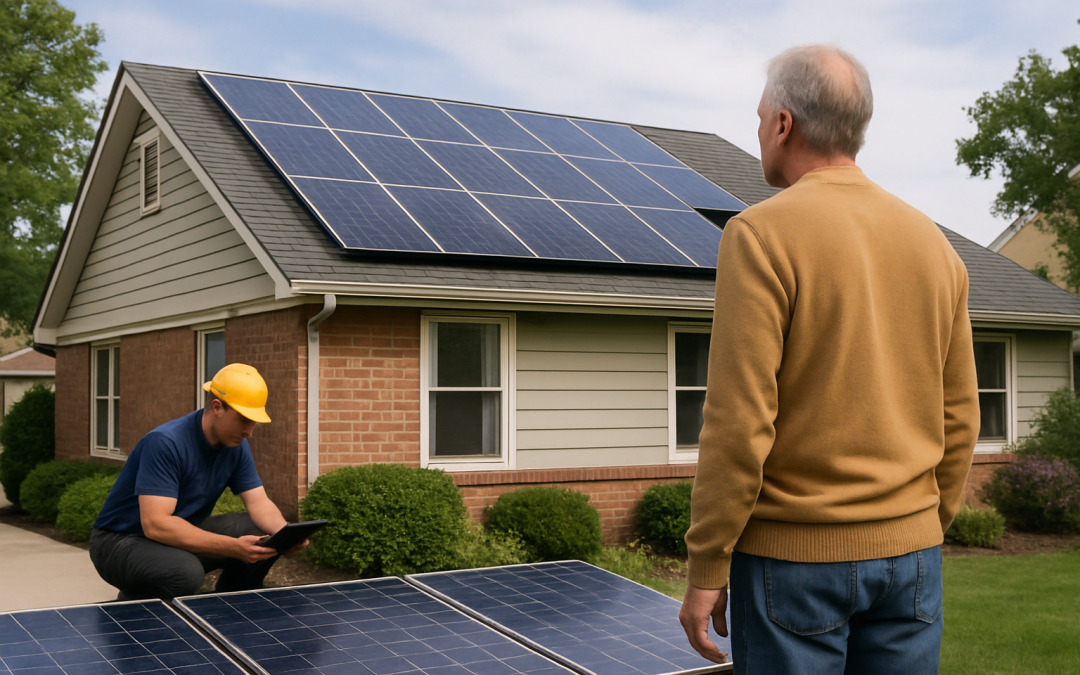
Solar panels on a typical U.S. home are designed to last 25–30 years under warranty and often keep producing usable power for 30–35 years or more. Most homeowners see gradual performance loss of about 0.4%–0.8% per year, not a sudden failure. You’ll usually replace inverters or other electronics before you replace the panels themselves. The main caveat: in harsh climates, with poor installation, or with very cheap equipment, real-world lifespan can be shorter.
Understanding solar panel lifespan helps you decide if solar is worth it, how long your investment will pay you back, and when you might face replacement costs. This guide is written for U.S. homeowners who want clear, honest expectations about how long residential solar panels really last, what “degradation” means, and how warranties actually work in the real world.
Table of Contents
- What “Solar Panel Lifespan” Really Means
- How Long Do Residential Solar Panels Really Last?
- Solar Panel Degradation Rates Explained
- Solar Panel Warranties: Performance vs. Product
- Inverters, Racking & Other Equipment Lifespan
- Solar Panel Replacement & Upgrade Costs
- Key Numbers: Costs, Savings, Lifespan & Payback
- When Long Solar Panel Lifespan Works in Your Favor
- When Solar Panel Lifespan Might Not Work in Your Favor
- What to Do Before You Get Quotes
- Frequently Asked Questions
- Summary: Solar Panel Lifespan in 5 Key Points
- Get Personalized Solar Lifespan & Cost Estimates
What “Solar Panel Lifespan” Really Means
Two different ideas: usable life vs. warranty life
When people ask, “How long do solar panels last?” they’re usually mixing two related but different ideas:
- Warranty life: How long the manufacturer guarantees the panels will perform to a certain level (typically 25–30 years).
- Usable life: How long the panels keep producing enough electricity to be worth keeping on your roof (often 30–35+ years).
Solar panels don’t suddenly die at year 25. Instead, they slowly lose output over time. At some point, the reduced output plus the age of the rest of the system makes replacement or an upgrade more attractive.
What “end of life” usually looks like for homeowners
For most homeowners, “end of life” is a financial and practical decision, not a technical one. You might consider your panels at the end of their life when:
- They still work, but produce much less than when they were new.
- Roof replacement makes it a good time to upgrade panels.
- Newer panels can produce far more power in the same roof space.
- Multiple components (inverters, wiring, racking) are aging at once.
So when we talk about solar panel lifespan in this article, we’ll focus on both the warranty period and the realistic usable life you can plan around.
How Long Do Residential Solar Panels Really Last?
Typical lifespan and warranty ranges
Most modern residential solar panels in the U.S. fall into these ranges:
- Performance warranty: 25–30 years (guaranteed to produce at least 80–88% of original output at the end of the warranty, depending on brand).
- Product (materials) warranty: 12–25 years (covers defects and failures, not normal wear).
- Real-world usable life: 30–35 years is common; some systems installed in the 1980s are still operating today, though at reduced output.
With a typical degradation rate of 0.5% per year, a 25-year-old panel would still produce about 88% of its original power. Many homeowners keep panels beyond the warranty period as long as the system is safe and the output is still valuable.
Key factors that affect how long your panels last
Solar panel lifespan is not the same for every home. It depends on:
- Panel quality and brand: Tier 1 manufacturers and reputable brands tend to have better long-term performance and stronger warranties.
- Climate and weather: Extreme heat, heavy snow loads, hail, and high winds can stress panels and mounting hardware.
- Installation quality: Proper mounting, wiring, and roof integration reduce the risk of damage and water intrusion.
- Maintenance and care: Occasional cleaning and inspections can prevent small issues from becoming big ones.
- Shading and soiling: Heavy dirt, leaves, or shading don’t usually shorten lifespan, but they reduce output and can hide problems.
Location matters too. Panels in Arizona or Nevada will see more UV and heat stress than panels in Maine, even if both are rated for 25+ years.
How this compares to other home systems
For context, here’s how solar panel lifespan compares to other major home components:
- Asphalt shingle roof: 15–30 years (depending on quality and climate).
- Central air conditioner: 12–20 years.
- Gas furnace: 15–30 years.
- Solar panels: 25–30 years under warranty, often 30–35+ years of usable life.
In other words, solar panels are one of the longest-lasting systems you can put on your home, especially if you choose quality equipment and a good installer.
Solar Panel Degradation Rates Explained
What is solar panel degradation?
Solar panel degradation is the gradual loss of power output over time. It’s normal and expected. Panels don’t “wear out” like a battery; instead, their ability to convert sunlight into electricity slowly declines.
Manufacturers test and certify panels to specific degradation rates, which are then written into the performance warranty.
Typical degradation numbers (with real data)
Modern crystalline silicon panels (the most common type on U.S. homes) typically have:
- First-year degradation: Often 1–3% in the first year as the panel “settles.”
- Annual degradation after year 1: Around 0.25%–0.7% per year for most reputable brands.
- Common warranty guarantees:
- At least 90–92% of original output after 10 years.
- At least 80–88% of original output after 25–30 years.
For example, at a 0.5% annual degradation rate, a 400-watt panel would still produce about 352 watts after 25 years (88% of original output).
What affects degradation in real homes?
Several real-world factors can push your degradation rate higher or lower:
- Heat: High temperatures accelerate aging of materials and solder joints.
- UV exposure: Strong sun over many years can slowly break down plastics and sealants.
- Mechanical stress: Wind, snow loads, and thermal expansion/contraction can stress frames and connections.
- Manufacturing quality: Better encapsulation, backsheet materials, and cell interconnections reduce long-term degradation.
- Microcracks: Tiny cracks in cells (from handling, transport, or hail) can slowly reduce output.
Choosing panels from reputable manufacturers and ensuring professional installation are the two biggest things you can do to keep degradation low.
Solar Panel Warranties: Performance vs. Product
Two main types of solar panel warranties
Every homeowner considering solar should understand these two warranty types:
- Product (equipment) warranty:
- Typically 12–25 years.
- Covers defects in materials and workmanship.
- Applies if a panel fails outright or has a manufacturing defect.
- Performance (power output) warranty:
- Typically 25–30 years.
- Guarantees the panel will produce at least a certain percentage of its original rated power by each milestone year.
- Protects you against unusually fast degradation.
What a “25-year performance warranty” really promises
A typical performance warranty might say something like:
- “No more than 2% loss in year 1, and no more than 0.5% per year from years 2–25, with at least 84.8% of original output at year 25.”
That means if your panels degrade faster than that (for example, they’re at 70% of original output at year 20), the manufacturer may repair, replace, or compensate you according to the warranty terms.
Limitations and fine print to watch for
Solar warranties are valuable, but they’re not unlimited protection. Common limitations include:
- Labor coverage: Some warranties cover only the panel, not the labor to remove and replace it.
- Shipping costs: You may be responsible for shipping defective panels back.
- Installer vs. manufacturer: The installer’s workmanship warranty is separate from the panel manufacturer’s warranty.
- Transferability: Some warranties are fully transferable to a new homeowner; others are not.
Before signing a contract, ask your installer to provide the actual warranty documents for the panels, inverters, and racking, and read the sections on exclusions and labor coverage.
Inverters, Racking & Other Equipment Lifespan
Inverters: usually replaced before panels
Inverters convert the DC power from your panels into AC power your home can use. They typically have shorter lifespans than the panels themselves:
- String inverters:
- Typical lifespan: 10–15 years.
- Warranty: often 10–12 years, sometimes extendable to 20–25 years for an extra cost.
- Microinverters:
- Typical lifespan: 20–25 years.
- Warranty: often 20–25 years, closer to panel lifespan.
Most homeowners should plan on at least one inverter replacement during the life of their solar panels, especially with string inverters. This is a normal part of system ownership and should be factored into long-term cost expectations.
Racking and mounting hardware
The racking system holds your panels to the roof or ground. It’s usually made of aluminum and stainless steel, with a lifespan similar to or longer than the panels:
- Typical lifespan: 25–35+ years.
- Warranty: often 10–25 years, depending on the manufacturer.
Properly installed racking should outlast at least one set of panels, but roof replacement can require temporarily removing and reinstalling the system.
Batteries and other add-ons
If you add battery storage, its lifespan is much shorter than the panels:
- Lithium-ion batteries: typically 10–15 years, or a certain number of cycles (e.g., 6,000–10,000 cycles).
- Warranty: often 10 years with specific performance guarantees.
Because batteries are a separate investment with different lifespans and economics, it’s worth reviewing a dedicated guide on solar energy storage systems and battery options if you’re considering backup power.
Solar Panel Replacement & Upgrade Costs
When do homeowners actually replace panels?
Most homeowners don’t replace panels just because the warranty ends. Common triggers for replacement or major upgrades include:
- Roof replacement: If your roof needs to be replaced after 20–25 years, it may make sense to upgrade panels at the same time.
- Major storm damage: Hail, falling branches, or wind damage that affects multiple panels.
- System expansion: You want more power (EV, heat pump, home addition) and decide to upgrade to higher-wattage panels.
- Technology leap: New panels offer significantly more output per square foot, making an upgrade financially attractive.
Cost to replace individual panels vs. full system
Replacement costs depend on how much of the system you’re changing:
- Single panel replacement (out of warranty):
- Panel hardware: often $250–$450 per panel (modern 350–450W panels).
- Labor and small parts: $200–$400 per visit, depending on your market and roof complexity.
- Total: commonly $450–$850 per panel for a one-off replacement.
- Full system replacement:
- Modern residential systems typically cost $28,000–$32,000 before incentives.
- After the 30% federal tax credit, that’s about $19,600–$22,400, assuming you qualify.
- Cost per watt: usually $2.50–$3.50, depending on equipment and location.
Replacing a full system is essentially like installing new solar from scratch, though you may be able to reuse some racking or wiring if it’s in good condition and compatible with new equipment.
Planning for long-term costs
When you think about solar panel lifespan, it’s smart to plan for:
- At least one inverter replacement over 25–30 years.
- Possible roof work during the life of the system (especially if your roof is older when you install solar).
- Potential panel upgrades if your energy needs grow significantly.
These long-term costs are usually outweighed by decades of electric bill savings, but they should be part of your planning and your conversations with installers.
Key Numbers: Costs, Savings, Lifespan & Payback
Typical system size and lifespan for a U.S. home
For a typical U.S. single-family home:
- Average number of panels: 15–25 panels, depending on panel wattage and your energy use.
- System size: Often 6–10 kW (kilowatts).
- Panel lifespan:
- Performance warranty: 25–30 years.
- Usable life: 30–35+ years in many cases.
Costs and savings over the life of the panels
National averages (your numbers may be higher or lower):
- Upfront system cost: $28,000–$32,000 before incentives.
- After 30% federal tax credit: about $19,600–$22,400 (if you’re eligible; always confirm with a tax professional).
- Cost per watt: $2.50–$3.50 installed.
- Average annual electric bill savings: $1,300–$1,500.
- Typical payback period: 7–9 years on a national average basis.
Because panels often last 25–30+ years, many homeowners enjoy 15–20 years of “paid-off” solar power after the system has already paid for itself.
What affects your personal numbers most
Your actual costs, savings, and payback depend on:
- Local electricity rates: Higher rates usually mean faster payback.
- Sun exposure: States like Arizona, Nevada, and California get more sun than northern states.
- Roof orientation and shading: South-facing, unshaded roofs perform best.
- Local incentives: State, utility, or local rebates and tax credits can significantly reduce net cost.
- Equipment choices: Premium panels and microinverters cost more but may offer better performance and warranties.
For a deeper dive into how these variables affect your bottom line, our solar cost and savings guide walks through real-world examples and scenarios.
When Long Solar Panel Lifespan Works in Your Favor
Situations where long lifespan is a big win
Solar panel lifespan works strongly in your favor when:
- You plan to stay in your home long-term: The longer you stay, the more years of low-cost power you enjoy after payback.
- Your local electricity rates are high or rising: Each year of panel life protects you from future rate increases.
- You choose quality equipment: Strong warranties and low degradation rates mean more reliable long-term performance.
- Your roof is in good shape: A newer roof reduces the chance you’ll need to remove and reinstall panels soon.
In these cases, a 25–30+ year panel lifespan can translate into tens of thousands of dollars in avoided utility costs over the life of the system.
Resale value and lifespan
Long panel lifespan can also help with resale value if you sell your home before the system reaches the end of its life. Buyers often see:
- A relatively new solar system as a long-term asset with many years of remaining life.
- Lower expected electric bills as a selling point.
- Transferable warranties as added peace of mind.
Policies and buyer preferences vary by market, but a well-installed, relatively new solar system is generally a plus, not a minus, for resale.
When Solar Panel Lifespan Might Not Work in Your Favor
Situations where long lifespan is less beneficial
There are cases where the long lifespan of solar panels doesn’t automatically mean solar is a good fit:
- You expect to move within a few years: If you’ll sell the home in 3–5 years, you may not personally see full payback, even though the panels will outlast your ownership.
- Your roof is near the end of its life: Installing solar on a roof that needs replacement soon can add cost and complexity.
- Very low electricity rates: In areas with cheap power and limited incentives, long panel life may not translate into strong financial returns.
- Heavily shaded roof: If trees or nearby buildings block much of the sun, your panels will last a long time but won’t produce enough to justify the cost.
Technology changes and “future-proofing” concerns
Some homeowners worry that solar technology will improve so much that their panels will be “obsolete” long before they wear out. It’s true that:
- Panel efficiency has improved over time and will continue to improve.
- Newer panels may produce more power in the same roof area.
However, most homeowners don’t regret installing earlier. The years of bill savings usually outweigh the benefit of waiting for slightly better panels, especially given the 30% federal tax credit currently available through 2032 (subject to change; always confirm current policy and consult a tax professional).
What to Do Before You Get Quotes
Key information to gather about your home
Before you talk to installers, gather a few basics so you can get accurate, apples-to-apples quotes:
- Recent electric bills: Ideally 12 months of usage (kWh) and costs.
- Roof details: Age, material (asphalt shingle, metal, tile), and any known issues.
- Shading: Note any large trees, chimneys, or nearby buildings that cast shade on your roof.
- Future plans: Electric vehicle, heat pump, home addition, or other changes that may increase your electricity use.
Questions to ask installers about lifespan and warranties
When you’re comparing quotes, ask each installer:
- “What is the product and performance warranty on the panels you’re quoting?”
- “What degradation rate do these panels guarantee over 25–30 years?”
- “How long is the inverter warranty, and what is the expected inverter lifespan?”
- “Is labor covered if a panel or inverter fails under warranty?”
- “How do you handle roof replacement if it’s needed during the life of the system?”
- “What brands are you using, and why did you choose them?” (You can cross-check with resources like our guide to solar panel brands to avoid.)
Good installers will answer these questions clearly and provide documentation, not just verbal assurances.
Why getting multiple quotes matters
Solar is a long-term investment, and panel lifespan is only one piece of the puzzle. Getting multiple quotes helps you:
- Compare equipment quality and warranties, not just price.
- See how different installers size your system and estimate production.
- Spot unrealistic promises about “lifetime free power” or zero maintenance.
- Understand how each company handles service, monitoring, and long-term support.
Because your panels may be on your roof for 25–30+ years, choosing the right installer is just as important as choosing the right equipment.
Frequently Asked Questions
How long do residential solar panels actually last in real life?
Most residential solar panels last 25–30 years under warranty and often continue producing useful power for 30–35 years or more. Output gradually declines over time, but panels don’t typically fail all at once at the end of the warranty period.
Do solar panels need to be replaced after 25 years?
No, you don’t have to replace solar panels just because they reach 25 years. If they’re still structurally sound and producing enough electricity to be worthwhile, many homeowners keep them in service beyond the warranty period.
How much power do solar panels lose over time?
Most modern panels lose about 0.25%–0.7% of their output per year after the first year, with many warranties guaranteeing around 80–88% of original output after 25–30 years. Actual degradation depends on panel quality, climate, and installation conditions.
What fails first: solar panels or inverters?
Inverters almost always need replacement before the panels themselves. String inverters typically last 10–15 years, while microinverters often last 20–25 years, compared with 25–30+ years for panels.
How much does it cost to replace solar panels?
Replacing a single out-of-warranty panel can cost roughly $450–$850 including labor, depending on your area and roof. Replacing an entire system is similar to a new installation, often $28,000–$32,000 before incentives or about $19,600–$22,400 after the 30% federal tax credit, if you qualify.
Will I need to replace my roof before installing solar panels?
If your roof is near the end of its life (often 10 years or less of life remaining), it’s usually wise to replace or repair it before installing solar. This avoids the cost and hassle of removing and reinstalling panels later for roof work.
Summary: Solar Panel Lifespan in 5 Key Points
- Most residential solar panels have a 25–30 year performance warranty and often deliver 30–35+ years of usable life.
- Panels typically degrade at about 0.25%–0.7% per year, so they still produce 80–88% of their original power after 25–30 years.
- Inverters and batteries usually need replacement before the panels, so plan for at least one inverter replacement over the system’s life.
- Real-world lifespan depends heavily on equipment quality, installation quality, climate, and roof condition.
- The best next step is to get multiple quotes that clearly show equipment brands, warranties, and expected production so you can judge long-term value for your specific home.
Get Personalized Solar Lifespan & Cost Estimates
Every home is different, and the best way to understand how long solar panels will last on your roof—and what that means for your wallet—is to see customized numbers. Getting a few no-obligation quotes lets you compare equipment quality, warranties, and projected savings side by side.
If you’re ready to see what solar could look like for your home, you can start by getting personalized estimates at /get-my-quote/. Use what you’ve learned here to ask better questions, compare options confidently, and choose a system designed to perform for decades.