
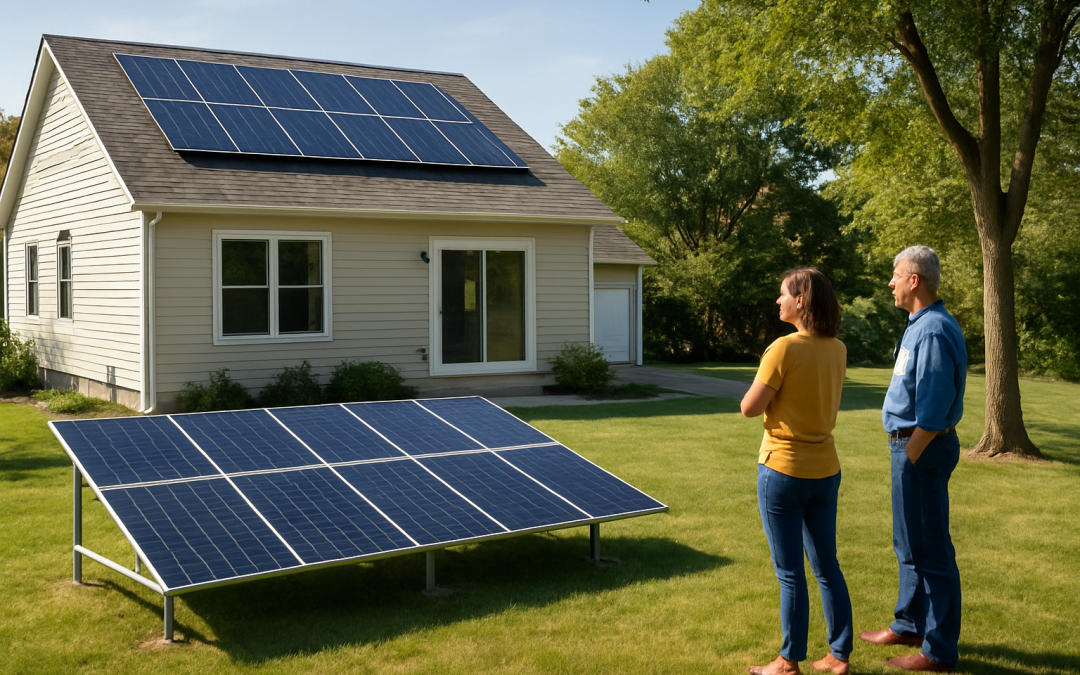
Rooftop solar vs. ground-mounted solar mainly comes down to space, cost, and energy output. For most U.S. homeowners, rooftop solar is cheaper to install and usually the better value, while ground-mounted solar can produce more energy per panel if you have the land and the right conditions. Ground mounts typically cost more per watt because of extra materials and labor, but they offer better placement, easier maintenance, and room to expand. The best choice depends on your roof condition, shading, local rules, and how much energy you want to offset.
This guide compares rooftop and ground-mounted solar in plain language so you can see which option fits your home, budget, and property. It’s written for U.S. homeowners at any stage of research, from “Is solar worth it?” to “Which system type should I install?” By the end, you’ll know the trade-offs, real-world costs, and what to ask installers before you sign anything.
Table of Contents
- Rooftop vs. Ground-Mounted Solar: The Big Picture
- Cost Comparison: Rooftop vs. Ground-Mounted Solar
- Energy Output and Performance Differences
- How Your Roof, Yard, and Location Affect the Choice
- When Rooftop Solar Is Usually the Better Choice
- When Ground-Mounted Solar Is Usually the Better Choice
- Key Numbers and Data: What to Expect
- Decision Guide: How to Choose and What to Do Next
- Frequently Asked Questions
- Summary: Rooftop vs. Ground-Mounted Solar in a Few Bullet Points
Rooftop vs. Ground-Mounted Solar: The Big Picture
What each option actually is
Rooftop solar means solar panels are attached directly to your home’s roof using racking (mounting hardware). This is the most common setup for U.S. homes.
Ground-mounted solar means panels are installed on a frame or posts anchored in the ground somewhere on your property, usually in a sunny part of the yard or field.
Both systems use the same basic components—panels, inverters, wiring, and (optionally) batteries. The main differences are:
- Where the panels sit (roof vs. yard)
- How much the structure and labor cost
- How much control you have over panel angle and direction
- How easy the system is to access and maintain
Key pros and cons at a glance
Rooftop solar – Pros:
- Usually lower upfront cost per watt
- Uses existing space (no loss of yard or landscaping)
- Shorter wiring runs and simpler permitting in many areas
- Often faster to install
Rooftop solar – Cons:
- Limited by roof size, shape, and condition
- Harder to access for cleaning and repairs
- Less flexibility in panel angle and direction
- May require roof work or replacement before installation
Ground-mounted solar – Pros:
- Can be placed in the sunniest, least-shaded spot
- Panels can be tilted and oriented for maximum output
- Easy access for maintenance and snow removal
- Expandable if you have extra land
Ground-mounted solar – Cons:
- Higher cost per watt due to extra materials and labor
- Requires open land and may affect yard use or aesthetics
- More trenching and longer wire runs
- May face stricter zoning or HOA rules
Cost Comparison: Rooftop vs. Ground-Mounted Solar
Typical rooftop solar costs
For a typical U.S. home, a standard rooftop solar system usually falls in these ranges (national averages):
- System size: 6–10 kW (about 15–25 panels)
- Cost per watt: $2.50–$3.50 before incentives
- Total cost: $28,000–$32,000 before incentives
- After 30% federal tax credit (ITC): about $19,600–$22,400
- Average annual savings: $1,300–$1,500 on electricity bills
- Typical payback period: 7–9 years (national average)
These numbers are for rooftop systems because they are the most common and usually the baseline in installer quotes.
How ground-mounted solar costs compare
Ground-mounted systems use the same panels and inverters, but they need more structure, posts, concrete, and trenching. That usually makes them more expensive per watt.
Typical ranges for ground-mounted residential systems:
- Cost per watt: roughly $3.00–$4.50 before incentives (often 10–30% more than rooftop)
- Total cost for a similar 6–10 kW system: about $30,000–$40,000 before incentives
- After 30% federal tax credit: about $21,000–$28,000
In some rural or high-labor-cost areas, the gap can be larger, especially if soil conditions require deeper foundations or if the array is far from the house (more trenching and wire).
What drives cost differences
Key factors that make ground-mounted solar more expensive than rooftop solar include:
- Racking and structure: Ground mounts need posts, rails, and sometimes concrete footings.
- Trenching and wiring: Running conduit underground from the array to your home’s electrical panel adds labor and materials.
- Site work: Leveling, clearing vegetation, or dealing with rocky soil increases costs.
- Permitting and inspections: Some jurisdictions treat ground mounts more like small structures, which can add fees and steps.
When ground mounts can still make financial sense
Even with higher upfront cost, ground-mounted solar can be a smart investment when:
- Your roof is heavily shaded but your yard is sunny, so ground mounts produce far more energy.
- You have high electricity rates and want a larger system than your roof can fit.
- You plan to add electric vehicles or electrify heating and need room to expand your array later.
Before focusing on system type, it can help to understand the overall economics of going solar; our solar cost and savings guide walks through how to estimate payback and long-term value.
Energy Output and Performance Differences
How much more energy can ground mounts produce?
Ground-mounted solar often produces more energy per panel than rooftop systems because you can:
- Point panels due south (in the U.S.) for maximum sun exposure.
- Set the tilt angle close to your latitude for better year-round performance.
- Avoid shading from trees, chimneys, and nearby buildings more easily.
In many real-world cases, a well-designed ground mount can produce 5–25% more energy per watt than a rooftop system on a less-than-ideal roof. The exact difference depends on your roof’s direction, tilt, and shading.
Rooftop solar performance basics
Rooftop solar performance is tied to your existing roof:
- Roof direction: South-facing roofs usually perform best, followed by west and east. North-facing roofs often underperform.
- Roof pitch (steepness): A moderate pitch (around 25–40 degrees) is often close to ideal in many U.S. locations.
- Shading: Trees, dormers, chimneys, and nearby buildings can reduce output significantly.
Even if your roof isn’t perfect, modern high-efficiency panels and smart inverter choices can still make rooftop solar worthwhile. If you want to dig deeper into panel performance, see our guide on solar panel efficiency ratings.
Ground-mounted performance basics
With ground-mounted solar, you can design the array for performance first and aesthetics second:
- Orientation: Usually due south in the U.S. for maximum annual output.
- Tilt: Often set near your latitude or slightly lower to balance summer and winter production.
- Shading: Easier to avoid by placing the array away from trees and structures.
Some ground-mounted systems use single-axis trackers that follow the sun across the sky. These can increase energy production by roughly 15–25% compared to fixed-tilt systems, but they add cost and moving parts that require more maintenance.
Inverters and equipment choices
Both rooftop and ground-mounted systems can use:
- String inverters (one central inverter for many panels)
- Microinverters (one small inverter per panel)
- DC optimizers (devices on each panel feeding a central inverter)
Ground mounts are often easier to wire and service, which can make string inverters more attractive. Rooftop systems with partial shading often benefit from microinverters or optimizers. For a deeper comparison, see our guide on microinverters vs. string inverters.
How Your Roof, Yard, and Location Affect the Choice
Roof condition and age
If your roof is old or in poor condition, rooftop solar may require extra work:
- Many installers recommend your roof have at least 10–15 years of life left.
- If you need a new roof soon, it’s often best to replace it before installing rooftop solar.
- Removing and reinstalling panels for a future roof replacement adds cost.
In some cases, a homeowner chooses ground-mounted solar specifically to avoid touching a complex or aging roof.
Available yard space
Ground-mounted solar requires clear, open land. As a rough guide:
- A 6–10 kW residential system might need about 400–800 square feet of usable area, depending on layout and spacing.
- You’ll also want space around the array for access and maintenance.
- Steep slopes, wetlands, or rocky ground can make ground mounts harder or more expensive.
If you have a small lot or want to preserve yard space for kids, pets, or gardening, rooftop solar is usually more practical.
Local climate and snow
In snowy climates, ground mounts can be easier to clear and may shed snow better if tilted steeply. However:
- Rooftop systems on steeper roofs can also shed snow well.
- Ground mounts may be more exposed to drifting snow and require manual clearing.
- Both system types are designed to handle local wind and snow loads when installed correctly.
State and local rules
Local regulations can influence your choice:
- HOAs: Some homeowners’ associations are stricter about visible ground arrays than rooftop systems.
- Zoning: Ground mounts may be treated as accessory structures, with height limits, setback requirements, or special permits.
- Setbacks and easements: You may need to keep arrays a certain distance from property lines or underground utilities.
An experienced local installer can explain what’s allowed on your property and how it affects design and cost.
When Rooftop Solar Is Usually the Better Choice
Situations where rooftop solar shines
Rooftop solar is usually the better fit when:
- Your roof is in good condition and has at least one reasonably sunny face (south, west, or east).
- You don’t have a lot of extra land or don’t want to give up yard space.
- You want to minimize upfront cost and keep the project as simple as possible.
- Your HOA or city is more comfortable with rooftop systems than ground arrays.
Financial advantages of rooftop systems
Because rooftop systems typically cost less per watt, they often offer:
- Lower total upfront cost for the same system size.
- Shorter payback periods (often closer to the 7–9 year national average).
- Higher return on investment if energy output is similar to a ground mount.
For many homeowners, rooftop solar is the “default” choice unless there’s a clear reason it won’t work well.
When rooftop solar may not be ideal
Rooftop solar can be a poor fit when:
- Your roof is heavily shaded most of the day.
- Your roof faces mostly north or has complex shapes that limit panel placement.
- Your roof is nearing the end of its life and you’re not ready to replace it.
- You strongly dislike the look of panels on your roof.
In these cases, a ground-mounted system—or waiting until a roof replacement—may be the better move.
When Ground-Mounted Solar Is Usually the Better Choice
Situations where ground mounts are a strong option
Ground-mounted solar often makes sense when:
- You have a large, sunny yard or field with minimal shading.
- Your roof is shaded, complex, or in poor condition.
- You want a larger system than your roof can support (for EVs, heat pumps, or future electrification).
- You want the ability to adjust tilt or add tracking for maximum output.
Performance and flexibility benefits
Ground mounts give you more control over design:
- You can optimize orientation and tilt for your exact location.
- You can place the array where it’s easiest to access and maintain.
- You can plan for future expansion if your energy use increases.
For some rural or semi-rural properties, the extra output and flexibility can outweigh the higher upfront cost.
Drawbacks and trade-offs
Ground-mounted solar isn’t perfect. Consider:
- Higher cost per watt: Often 10–30% more than rooftop systems.
- Land use: The array will occupy part of your yard or field and may change how you use that space.
- Aesthetics: Some homeowners prefer panels on the roof rather than in the yard.
- Potential for damage: Ground arrays are more exposed to kids, pets, lawn equipment, and wildlife.
These trade-offs are highly personal. What feels like a downside to one homeowner (visible panels in the yard) may not matter at all to another.
Key Numbers and Data: What to Expect
Core solar numbers for both system types
Whether you choose rooftop or ground-mounted solar, some key benchmarks are similar:
- Average system size: 6–10 kW for a typical U.S. home (about 15–25 panels).
- Panel lifespan: 25–30 years performance warranty; 30–35 years typical useful life.
- Federal tax credit (ITC): 30% of eligible system cost through at least 2032 (consult a tax professional for your situation).
- Average annual savings: $1,300–$1,500 on electricity bills (varies widely by state and utility rates).
- Typical payback period: 7–9 years nationally, shorter in high-cost electricity states.
How rooftop vs. ground-mounted changes the numbers
Here’s how system type can shift those benchmarks:
- Upfront cost: Ground mounts often add $0.50–$1.00 per watt compared to rooftop systems.
- Energy output: Ground mounts may produce 5–25% more energy per watt if optimally placed and tilted.
- Payback period: A ground mount with higher output but higher cost might have a similar or slightly longer payback than a rooftop system, depending on your rates and incentives.
- Maintenance: Ground mounts are easier to access, which can reduce long-term maintenance hassle, though both system types are generally low-maintenance.
What affects your personal numbers most
Your actual costs and savings will depend on:
- Your electricity rate: Higher rates mean bigger savings from each kilowatt-hour of solar.
- Your usage: Homes with higher usage (especially daytime) often benefit more.
- State and local incentives: Some states, utilities, or cities offer extra rebates or credits.
- Roof or yard conditions: Shading, orientation, and available space directly affect output.
- Equipment choices: Panel efficiency, inverter type, and whether you add a battery.
For a deeper look at incentives and how they change your payback, see our solar incentives and tax credits guide. Always confirm details with a qualified tax professional.
Decision Guide: How to Choose and What to Do Next
Step 1: Clarify your goals
Before choosing rooftop vs. ground-mounted solar, ask yourself:
- Do I want to maximize savings, or is aesthetics/yard space more important?
- How much of my electric bill do I want to offset—50%, 80%, close to 100%?
- Do I plan to add EVs, electric heating, or other big loads in the next 5–10 years?
- How long do I expect to stay in this home?
Step 2: Evaluate your roof and property
Walk around your home and note:
- Which roof faces get the most sun (south, west, east)?
- Any major shading from trees or nearby buildings?
- Approximate age and condition of your roof.
- Open, sunny areas in your yard that could host a ground array.
Take photos of your roof and yard from multiple angles. These will be useful when you start getting quotes.
Step 3: Get site-specific designs and quotes
The best way to decide between rooftop and ground-mounted solar is to compare actual proposals. When you talk to installers, ask them to:
- Model both rooftop and ground-mounted options if your property allows.
- Show estimated annual production (kWh) and payback for each design.
- Explain any extra costs for ground mounts (trenching, concrete, longer wire runs).
- Confirm how local zoning, setbacks, and HOA rules affect each option.
It’s wise to get at least 2–3 quotes from reputable installers so you can compare designs, equipment, and pricing side by side.
Questions to ask potential installers
- “Based on my roof and yard, would you recommend rooftop or ground-mounted solar, and why?”
- “What is the cost per watt and estimated annual production for each option?”
- “How will shading be handled in your design?”
- “What permits are required for a ground-mounted system here?”
- “How will maintenance and access work for each system type?”
Is now the right time to act?
For many homeowners, waiting doesn’t improve the math much. Panel prices have stabilized, and the 30% federal tax credit is available through at least 2032, but local incentives can change with little notice. If your roof is in good shape and you plan to stay in your home for at least 5–7 years, it’s worth getting quotes now to see real numbers for your situation.
If you’re still deciding whether solar itself makes sense, our honest overview, Is Solar Worth It?, can help you weigh the bigger picture before you choose between rooftop and ground-mounted systems.
Frequently Asked Questions
Is rooftop solar or ground-mounted solar cheaper?
Rooftop solar is usually cheaper because it uses your existing roof structure and needs less material and labor. Ground-mounted solar often costs 10–30% more per watt due to posts, racking, trenching, and longer wire runs, though it can sometimes produce more energy per panel.
Does ground-mounted solar produce more electricity than rooftop solar?
A well-designed ground-mounted system can produce 5–25% more energy per watt than a rooftop system because you can optimize panel tilt, direction, and shading. However, the actual difference depends on your roof’s orientation, shading, and local climate.
How much land do I need for a ground-mounted solar system?
A typical 6–10 kW residential ground-mounted system usually needs about 400–800 square feet of clear, sunny space, plus room around the array for access. Larger systems or trackers will need more area and may require specific setbacks from property lines.
Will a ground-mounted solar array hurt my property value?
Most studies show that owned solar systems, whether rooftop or ground-mounted, tend to increase property value by lowering utility bills. That said, some buyers may have personal preferences about aesthetics or yard use, so it’s important to choose a location and design that fits your property well.
Can I add a battery to either rooftop or ground-mounted solar?
Yes, you can pair a battery with either rooftop or ground-mounted solar; the battery connects to your home’s electrical system, not directly to the roof or ground structure. The choice between rooftop and ground-mounted mainly affects panel placement, not whether you can add storage.
Do I need special permits for a ground-mounted solar system?
Most areas require building and electrical permits for ground-mounted solar, and some treat it as an accessory structure with height limits and setback rules. A local installer can explain the specific requirements in your city or county and handle the permitting process for you.
Summary: Rooftop vs. Ground-Mounted Solar in a Few Bullet Points
- Rooftop solar is usually less expensive and is the default choice for most U.S. homeowners with a decent, sunny roof.
- Ground-mounted solar typically costs 10–30% more per watt but can produce 5–25% more energy per watt if optimally placed and tilted.
- Key factors are your roof’s age, orientation, and shading, plus how much open, sunny land you have.
- Both options share similar long-term numbers: 25–30 year panel warranties, 7–9 year average payback, and $1,300–$1,500 in typical annual bill savings, though your results will vary.
- The best next step is to get multiple, site-specific quotes that model both rooftop and ground-mounted options where possible.
Every property is different, and the only way to know whether rooftop or ground-mounted solar is better for your home is to see real designs and numbers. Getting personalized quotes from vetted installers will show you costs, production, and payback for each option so you can make a confident decision. When you’re ready to see what solar could look like for your home, you can start by requesting tailored estimates at /get-my-quote/ with no obligation to move forward.