
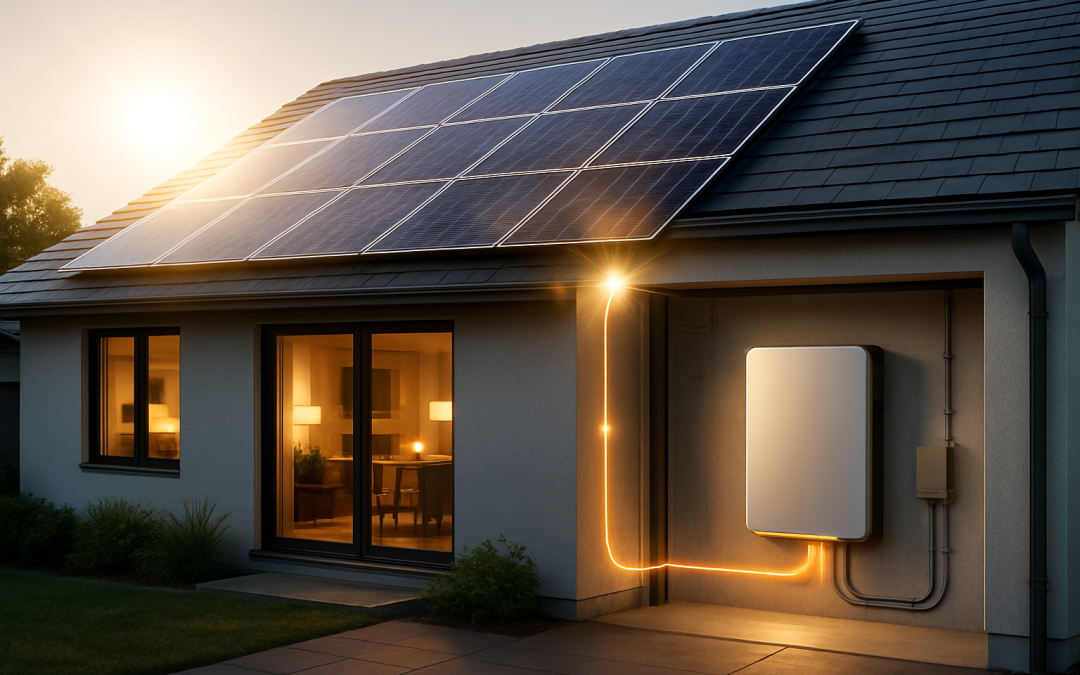
Solar energy storage systems let you store excess solar power in a home battery so you can use it later, especially at night or during grid outages. For most U.S. homes, a complete solar-plus-storage system costs roughly $28,000–$40,000 before incentives, depending on battery size and equipment choices. Batteries provide backup power, bill savings under time-of-use rates, and more energy independence, but they add cost and don’t always pay for themselves in every utility area. The right system size and battery type depend on your goals, your utility rates, and how often your power goes out.
This guide explains how solar energy storage works, what different battery options cost, how much backup power you can realistically expect, and how to choose the right system for your home. It’s written for U.S. homeowners who are considering solar, already have solar, or are comparing quotes that include a battery. The goal is to give you clear, honest information so you can decide whether storage is worth it for your situation.
Table of Contents
- What Is a Solar Energy Storage System?
- How Solar Energy Storage Works in a Home
- Solar Energy Storage System Costs and Key Numbers
- Solar Battery Options: Types, Sizes, and Brands
- Backup Power Benefits: What a Home Battery Can (and Can’t) Do
- When Solar Storage Makes Financial Sense — and When It Doesn’t
- How to Choose the Right Solar Energy Storage System
- Key Numbers and Data: Costs, Savings, and Payback
- Decision Guide: Is Now the Right Time to Add Storage?
- Frequently Asked Questions
- Summary
What Is a Solar Energy Storage System?
Simple definition
A solar energy storage system is a setup that lets your home store electricity from your solar panels in a battery instead of sending all of it back to the grid. You can then use that stored energy later, such as at night, during peak-rate hours, or when the grid goes down.
In a typical home, the system includes:
- Solar panels (on your roof or ground-mounted)
- An inverter (converts DC from panels/battery to AC for your home)
- One or more batteries (usually wall-mounted in a garage or utility area)
- A smart control system or app to manage charging and discharging
Key reasons homeowners add storage
- Backup power for outages (keep lights, fridge, Wi‑Fi, and sometimes AC running)
- Bill savings under time-of-use (TOU) rates by using stored power when electricity is most expensive
- More self-consumption of your own solar energy instead of exporting it to the grid
- Energy independence and resilience during storms, wildfires, or grid reliability issues
How this differs from “solar only” systems
A standard grid-tied solar system without a battery shuts off during an outage for safety reasons, even on a sunny day. With a properly designed solar-plus-storage system, your home can form a “mini-grid” (island) and keep critical loads powered when the grid is down. This is the main practical difference most homeowners notice.
How Solar Energy Storage Works in a Home
Day-to-night energy flow (simple overview)
In a typical solar-plus-battery setup:
- Daytime: Solar panels power your home first. Any extra power charges the battery. Once the battery is full, remaining excess goes to the grid (if allowed by your utility).
- Evening / night: Your home draws from the battery instead of the grid until the battery reaches its minimum charge level.
- Outages: The system automatically disconnects from the grid and powers selected circuits from the battery and, if sunny, from the panels.
Key components and what they do
- Battery: Stores energy in kilowatt-hours (kWh). Think of this like the size of your “energy tank.”
- Inverter or hybrid inverter: Manages power flows between panels, battery, home, and grid.
- Backup/load panel: A sub-panel with the circuits you want to keep on during an outage (fridge, lights, outlets, maybe a small AC or well pump).
- Monitoring app: Lets you see production, battery level, and usage in real time and adjust settings.
AC-coupled vs. DC-coupled (in plain language)
You may hear installers talk about “AC-coupled” or “DC-coupled” systems:
- AC-coupled: The battery connects on the AC side of your system. This is common when adding a battery to an existing solar array.
- DC-coupled: The battery connects on the DC side, before the inverter. This is more common in new, integrated solar-plus-storage installs and can be slightly more efficient.
For most homeowners, the main takeaway is that both approaches work well; the best choice depends on whether you already have solar and which brands your installer offers.
Solar Energy Storage System Costs and Key Numbers
Typical cost ranges in 2026
Costs vary by state, utility, and installer, but as of 2026, typical U.S. homeowner ranges are:
- Solar-only system (no battery): $28,000–$32,000 before incentives for a typical 7–10 kW system
- Battery add-on (per home battery, installed): $9,000–$16,000 before incentives, depending on brand and capacity
- Solar + one battery package: Roughly $37,000–$48,000 before incentives
With the 30% federal clean energy tax credit (ITC) through 2032, your net cost can drop significantly, but you should confirm eligibility with a tax professional.
Cost per kWh of storage
Home batteries are often compared by cost per usable kilowatt-hour (kWh) of storage:
- Many popular lithium-ion batteries (like Tesla Powerwall or Enphase) end up around $700–$1,200 per usable kWh installed.
- A typical 10–13.5 kWh battery will therefore run in the $9,000–$16,000 installed range.
What affects solar storage costs the most
- Battery capacity: Larger kWh = higher cost, but sometimes better value per kWh.
- Brand and warranty: Premium brands with strong warranties and integrated apps cost more.
- Electrical work complexity: Older panels, long wire runs, or service upgrades add cost.
- Local labor and permitting: Labor rates and permit fees vary widely by state and city.
- Incentives: Some states/utilities offer battery rebates that can cut costs by thousands of dollars.
How storage changes your overall solar investment
On a national average basis:
- Solar-only: $28,000–$32,000 before incentives / $19,600–$22,400 after 30% ITC
- Solar + one battery: Often $37,000–$48,000 before incentives / $25,900–$33,600 after 30% ITC (if eligible)
Adding storage usually increases your payback period compared to solar-only, but it adds resilience and can improve savings under certain rate structures. Individual results vary widely by utility and usage pattern.
Solar Battery Options: Types, Sizes, and Brands
Main battery chemistries for home storage
Most modern home batteries use lithium-based chemistries because they are compact, efficient, and long-lasting:
- Lithium iron phosphate (LFP): Very common in newer systems; known for safety, long cycle life, and good performance in daily cycling.
- Lithium nickel manganese cobalt (NMC): Used in some earlier systems; high energy density but more heat-sensitive.
Lead-acid batteries (like car batteries) are rarely used in new residential systems today because they are bulkier, require more maintenance, and have shorter lifespans.
Typical battery sizes for U.S. homes
Common residential battery capacities:
- 10–14 kWh: One battery; enough for essential loads overnight for many homes.
- 20–30 kWh: Two or more batteries; better for larger homes, longer outages, or partial whole-home backup.
- 30+ kWh: Multiple batteries; used for large homes, heavy loads, or frequent long outages.
Most homeowners start with one battery and size their backup panel to match. Our detailed guide on how to choose the right solar battery size walks through this step-by-step.
Popular brands and how to compare them
Top home battery brands in 2026 include Tesla, Enphase, Franklin, and several others. When comparing options, look at:
- Usable capacity (kWh): How much of the battery’s total capacity you can actually use.
- Power rating (kW): How many appliances you can run at once.
- Warranty: Typical warranties are 10 years with a certain number of cycles and guaranteed remaining capacity (often 60–70% at year 10).
- Integration: How well the battery works with your inverter, app, and existing solar system.
If you want a deeper brand comparison, see the dedicated review of the best solar batteries of 2026, including Tesla Powerwall vs. Enphase vs. Franklin.
When to prioritize battery quality over price
It usually makes sense to prioritize a reputable brand and strong warranty if:
- You live in an area with frequent or long outages.
- You plan to cycle the battery daily for bill savings.
- You expect to stay in your home for 10+ years.
Cheaper, lesser-known brands may look attractive upfront but can cost more in the long run if they fail early or have weak support. Always review the warranty details and ask your installer about service history.
Backup Power Benefits: What a Home Battery Can (and Can’t) Do
What a typical battery can power
A single 10–13.5 kWh battery can usually keep essential loads running for many hours, such as:
- Refrigerator and freezer
- Wi‑Fi, lights, and outlets for phone/computer charging
- Gas furnace fan (if you have gas heat)
- Garage door opener and a few small appliances
With careful use, this can cover an overnight outage or multiple shorter outages. If the sun is shining during the day, your solar panels can help recharge the battery.
What usually requires multiple batteries
You may need two or more batteries if you want to back up:
- Central air conditioning or multiple mini-splits
- Electric heat or electric water heaters
- Well pumps, sump pumps, or large workshop tools
- Whole-home backup for larger houses
Even with multiple batteries, you may still need to manage usage during long outages to avoid draining the system too quickly.
Limitations to be aware of
- Not a full generator replacement in all cases: For heavy loads or very long outages, a battery may not fully replace a large standby generator.
- Weather dependence: During multi-day storms with little sun, your battery may not fully recharge from solar each day.
- Load management: You’ll likely need to choose which circuits are backed up and avoid running everything at once.
When backup benefits are strongest
Solar storage shines in areas with:
- Frequent outages from storms, wildfires, or grid issues (e.g., parts of California, Texas, Florida, the Southeast).
- Critical home medical equipment that must stay powered.
- Remote locations where grid repairs can take days.
In these cases, many homeowners value peace of mind and resilience as much as, or more than, pure financial payback.
When Solar Storage Makes Financial Sense — and When It Doesn’t
Situations where storage often pays off better
Solar energy storage tends to make stronger financial sense when:
- You have time-of-use (TOU) rates with high evening prices and lower daytime prices.
- Your utility offers demand charges (fees based on your highest power draw in a month).
- Your state has limited net metering or low export rates, so storing your own solar is more valuable than sending it to the grid.
- You can stack local battery incentives or rebates on top of the federal tax credit.
Situations where storage may not pencil out
Storage may be harder to justify financially if:
- Your utility has flat, low electricity rates and generous net metering.
- You rarely lose power, or outages are very short.
- You would need multiple batteries to cover heavy loads, pushing costs much higher.
In these cases, a solar-only system may offer a shorter payback period and higher return on investment, while a battery is more of a “nice-to-have” for resilience.
How storage affects payback period
Nationally, a typical solar-only system has an average payback period of 7–9 years, with average annual savings of about $1,300–$1,500. Adding a battery often extends payback by several years if you look only at bill savings. However, in TOU or demand-charge markets, smart battery use can significantly reduce peak charges and narrow that gap.
Because rate structures and incentives are complex and change over time, it’s wise to ask installers to model your specific bill savings with and without storage, using your actual usage data.
How to Choose the Right Solar Energy Storage System
Step 1: Clarify your main goal
Before picking equipment, decide what matters most to you:
- Backup power first: Focus on reliability, capacity, and which loads you want to run during outages.
- Bill savings first: Focus on how the battery will operate under your rate plan (TOU, demand charges).
- Energy independence: Aim for higher capacity and good integration with your solar system.
Step 2: Understand your home’s energy use
Gather a few months of electric bills and note:
- Your average monthly kWh usage.
- Your highest-usage months (often summer or winter).
- Whether you’re on TOU rates, demand charges, or flat rates.
This information helps size both your solar array and your battery. For context, a typical U.S. home needs 15–25 solar panels (around 7–10 kW) to offset most of its usage, depending on panel wattage and location.
Step 3: Decide what you want to back up
Make a list of what must stay on during an outage:
- “Must have”: Fridge, lights, Wi‑Fi, medical devices, furnace fan, phone charging.
- “Nice to have”: Some outlets, TV, small window AC or mini-split, garage door.
- “Can live without”: Electric oven, clothes dryer, large central AC (unless you add more batteries).
Your installer will use this list to design a backup panel and recommend the right battery size. For a deeper dive, see the guide on choosing the right solar battery size.
Step 4: Compare system designs and equipment
When reviewing quotes, look for:
- System size (kW of solar, kWh of storage).
- Equipment brands (panels, inverters, batteries) and their warranties.
- Backup configuration (which loads are backed up, how long they expect it to last).
- Estimated bill savings with and without the battery.
Understanding the equipment in your quote is easier if you’ve read a general solar panels and equipment guide first.
Step 5: Ask installers the right questions
Key questions to ask during quotes:
- How did you size the battery for my home and my backup priorities?
- What is the expected backup duration for my essential loads in a typical outage?
- How will the battery operate under my current rate plan (TOU, demand charges, etc.)?
- What is the full warranty (years, cycles, guaranteed capacity) and who handles service?
- Can I add more batteries later if my needs change?
Key Numbers and Data: Costs, Savings, and Payback
Solar system benchmarks (national averages)
For a typical U.S. home in 2026:
- System size: 7–10 kW (about 15–25 panels, depending on panel wattage and efficiency).
- Cost per watt: $2.50–$3.50 before incentives.
- Total system cost (solar-only): $28,000–$32,000 before incentives.
- Net cost after 30% ITC: $19,600–$22,400 (if you qualify; confirm with a tax professional).
- Average annual savings: $1,300–$1,500 on electric bills.
- Payback period: 7–9 years on average.
- Panel lifespan: 25–30 years performance warranty; 30–35 years typical useful life.
How adding storage changes the numbers
When you add a battery:
- Upfront cost increases by roughly $9,000–$16,000 per battery before incentives.
- Federal ITC (30% through 2032) can apply to batteries paired with solar, but eligibility depends on how the system is configured and used; consult a tax professional.
- Annual savings may increase if you can shift usage away from high-rate periods or reduce demand charges.
- Payback period often extends beyond 9 years unless your rate structure strongly rewards storage or you place a high value on backup power.
These are broad averages; your actual results depend on your utility rates, incentives, usage patterns, and system design.
State and utility considerations
Storage economics vary a lot by location:
- California: TOU rates and wildfire-related outages make storage more attractive; some programs have offered battery incentives.
- Northeast and Mid-Atlantic: Higher rates and winter storms can improve the value of backup power.
- Midwest and South: Lower rates in some areas may make batteries more of a resilience purchase than a pure financial play.
Before deciding, it’s worth checking local incentives and reading an honest overview like is solar worth it for your home to understand the bigger picture.
Decision Guide: Is Now the Right Time to Add Storage?
Is this the right time to act?
It may be a good time to move forward with solar-plus-storage if:
- You already know you want solar and value backup power or bill control.
- Your utility has TOU or demand charges that a battery can help manage.
- You live in an area with frequent outages or grid reliability concerns.
- You can take advantage of the 30% federal ITC and any local battery incentives (confirm with a tax professional).
If you’re still unsure whether solar itself makes sense, start with a broader cost and savings overview like the solar cost and savings guide before deciding on storage.
What information you should gather before getting quotes
- 12 months of electric bills (kWh usage and total cost).
- Your current rate plan (flat, TOU, demand charges).
- A list of must-have and nice-to-have loads during an outage.
- Any known electrical issues (old panel, frequent breaker trips, etc.).
Questions to ask installers about storage specifically
- How will this battery operate day-to-day under my current rate plan?
- What is the realistic backup duration for my essential loads in a typical outage?
- What happens during a multi-day outage with limited sun?
- How does your design protect the battery from overuse and extend its life?
- What are my options if I want to expand storage later?
Should you get multiple quotes?
Yes. Because storage design and pricing vary widely, getting at least 2–3 quotes is one of the best ways to:
- Compare system sizes and backup strategies.
- See different battery brands and warranties.
- Understand how each installer models your bill savings and backup performance.
Make sure each quote clearly separates the cost of solar panels and the cost of the battery so you can see the added price and value of storage.
Frequently Asked Questions
Do I need a solar battery for my home?
You don’t need a battery for solar panels to work, but a battery can provide backup power and extra bill savings in certain rate plans. It makes the most sense if you have frequent outages, time-of-use rates, or limited net metering. If your power is reliable and rates are low and flat, solar-only may be the better financial choice.
How long will a home battery last during a power outage?
A typical 10–13.5 kWh battery can often power essential loads (fridge, lights, Wi‑Fi, some outlets) for 8–24 hours, depending on how much you use. If the sun is shining, your solar panels can help recharge the battery and extend that time. Running large loads like central AC or electric heat will shorten backup duration significantly.
Can a solar battery run my whole house?
One battery usually cannot run an entire home with all appliances at once, especially large loads like central AC, electric ovens, or electric dryers. Whole-home backup is possible with multiple batteries and careful system design, but it increases cost and still requires managing usage during long outages.
How long do solar batteries last?
Most modern lithium-based home batteries come with a 10-year warranty and are designed for thousands of charge cycles. After 10 years, they typically still retain around 60–70% of their original capacity, though actual lifespan depends on how often and how deeply they are cycled.
Can I add a battery to my existing solar system?
Yes, many homeowners add a battery to an existing solar array using an AC-coupled setup. The installer will evaluate your current inverter, electrical panel, and available space to recommend compatible battery options and any necessary upgrades.
Is a solar battery better than a generator?
A battery is quieter, cleaner, and can operate automatically without fuel, which many homeowners prefer for frequent short outages. Generators can provide longer-duration backup for heavy loads if you have fuel, but they require maintenance, make noise, and produce emissions; some homes use both for different needs.
Summary
- Solar energy storage systems let you store excess solar power in a home battery for use at night, during peak-rate periods, or when the grid goes down.
- A typical solar-plus-storage system runs about $37,000–$48,000 before incentives, with the 30% federal tax credit potentially reducing net cost if you qualify.
- The value of storage depends heavily on your utility rates, outage frequency, and how much backup power you want.
- Most homes use one 10–13.5 kWh battery for essential-load backup; larger homes or heavier loads may need multiple batteries.
- The best next step is to gather your electric bills, clarify your backup priorities, and compare multiple quotes that clearly show the added cost and benefits of storage.
If you’re considering solar energy storage, personalized quotes based on your home, your utility rates, and your backup needs will give you the clearest picture. You can compare system designs, battery brands, and pricing with no obligation by requesting estimates from vetted installers at /get-my-quote/. Taking this step now helps you decide whether solar-plus-storage is the right investment for your home and budget.