
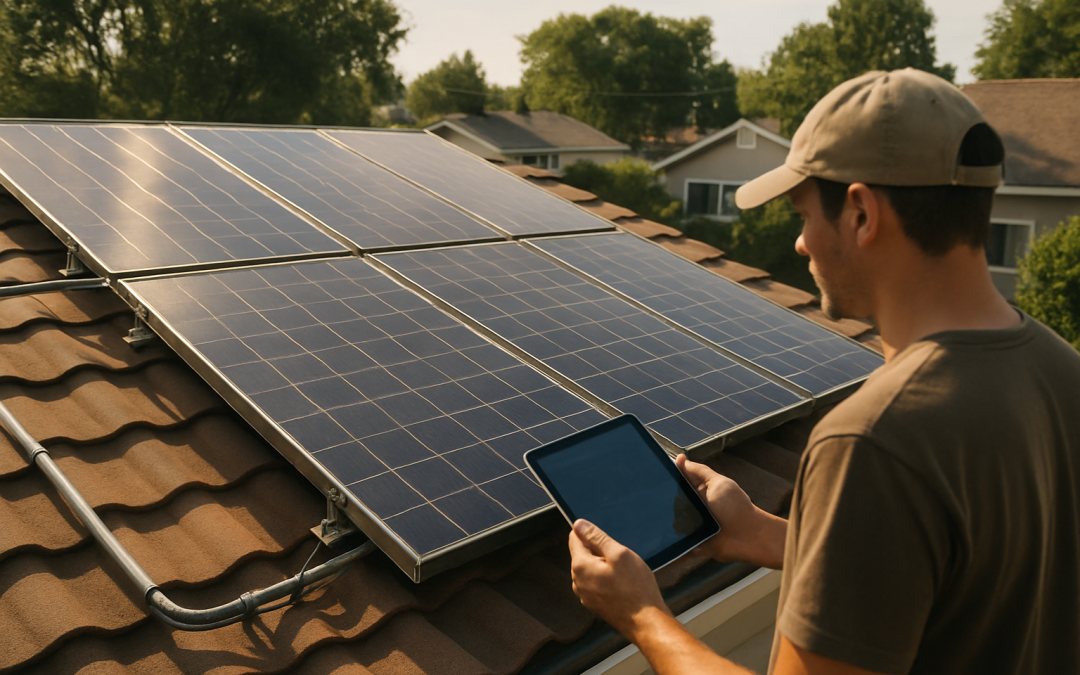
Solar cell efficiency is the percentage of sunlight that a solar panel can turn into usable electricity, and most modern home panels convert about 19–23% of the sun’s energy under standard test conditions. In real-world use on a roof, you’ll usually see effective efficiencies a bit lower because of heat, dirt, wiring losses, and how your roof faces the sun. Efficiency is limited by physics (how silicon works), plus practical factors like temperature, shading, and panel quality. Higher-efficiency panels can produce more power from the same roof space, but they don’t always give the best value per dollar.
If you’re a homeowner trying to decide whether solar is worth it, understanding solar cell efficiency helps you compare equipment, estimate how many panels you’ll need, and see what’s realistic for your roof. This guide explains how solar panels convert sunlight into electricity, what actually limits their performance, and how much efficiency really matters for your bill savings. We’ll keep the language simple, focus on real numbers, and help you decide what to do next.
Table of Contents
- What Is Solar Cell Efficiency? (Plain-English Definition)
- How Solar Panels Convert Sunlight Into Electricity
- Typical Solar Panel Efficiency Numbers in 2026
- What Actually Limits Solar Cell Efficiency?
- Real-World Performance vs Lab Ratings
- How Efficiency Affects System Size, Cost, and Savings
- Climate, Roof, and Location: How Much Do They Matter?
- When High-Efficiency Panels Help (and When They Don’t)
- Key Numbers: Costs, Savings, and Payback
- How to Use Efficiency When Choosing Solar (Decision Guide)
- Frequently Asked Questions
- Summary: What Matters Most About Solar Cell Efficiency
- Get Personalized Solar Quotes for Your Home
What Is Solar Cell Efficiency? (Plain-English Definition)
Solar cell efficiency is simply how much of the sunlight hitting a panel is turned into electricity you can use. If a panel is 20% efficient, that means 20% of the sun’s energy that lands on it becomes electrical power, and the rest is lost as heat or reflected light.
For homeowners, efficiency mainly affects:
- How much power you get per square foot of roof
- How many panels you need to cover your electric usage
- Sometimes, the price per watt (higher-efficiency panels can cost more)
Efficiency does not tell you everything about panel quality or savings, but it’s one of the key specs to understand when comparing quotes.
How Solar Panels Convert Sunlight Into Electricity
Step-by-step: From sunlight to usable power
Most home solar panels use silicon solar cells. Here’s what happens when the sun hits them:
- Sunlight hits the panel. Sunlight is made of tiny packets of energy called photons.
- Silicon cells absorb photons. When photons hit the silicon, they knock electrons loose inside the material.
- An electric field guides the electrons. The way the cell is built creates a built-in electric field that pushes those electrons in one direction.
- Wires collect the electrons. Metal contacts on the cell and panel collect the moving electrons, creating direct current (DC) electricity.
- The inverter converts DC to AC. Your home uses alternating current (AC), so an inverter changes the DC from the panels into AC that can power your lights, appliances, and HVAC.
Each of these steps has some losses. Not every photon is absorbed, not every freed electron makes it to the wires, and the inverter also wastes a small percentage. All of this adds up to the efficiency number you see on the spec sheet.
Why some sunlight can’t be used
Even in perfect conditions, a solar cell can’t use all the sun’s energy because:
- Some wavelengths of light pass straight through the silicon
- Some energy turns into heat instead of electricity
- Some light is reflected off the panel surface
These are fundamental physics limits, which is why even the best commercial panels today are in the low 20% range, not 50% or 80%.
Typical Solar Panel Efficiency Numbers in 2026
What homeowners actually see on quotes
As of 2026, most residential solar panels on the U.S. market fall into these ranges:
- Standard panels: about 19–21% efficiency
- High-efficiency panels: about 21–23% efficiency
- Older or budget panels: about 16–18% efficiency
In terms of power rating (how much power a panel can produce under standard test conditions):
- Typical home panels: 380–450 watts each
- High-efficiency premium panels: up to about 450–500 watts each
These numbers are based on current offerings from major manufacturers like Qcells, REC, Canadian Solar, and others as of 2026. Exact specs vary by brand and model.
How efficiency relates to panel wattage
Efficiency and wattage are linked by panel size. A higher-efficiency panel of the same physical size will have a higher wattage rating. For example:
- A 19% efficient panel might be around 400 W
- A 22% efficient panel of the same size might be around 460 W
Both panels could be perfectly good; the higher-efficiency one just squeezes more power out of the same roof area.
What Actually Limits Solar Cell Efficiency?
1. Physics limits of silicon
Most home panels use crystalline silicon, which has a theoretical maximum efficiency of about 29–33% for a single-layer cell (the “Shockley–Queisser limit”). Commercial panels are in the low 20% range because:
- Not all wavelengths of light have the right energy to free electrons
- Some energy is always lost as heat
- Real-world manufacturing introduces small defects and resistance
Multi-layer “tandem” cells can go higher in labs, but they’re not yet common or affordable for typical home rooftops.
2. Temperature (heat is the enemy)
Solar cells work better when they’re cool. As panels heat up in the sun, their voltage drops and efficiency falls. Most panels lose about 0.3–0.5% of power per °C above 25°C (77°F).
On a hot summer day, your panels might be 140°F or more, which can reduce output by 10–20% compared to their lab rating. This doesn’t mean solar is bad in hot states; it just means the real-world output is lower than the nameplate rating.
3. Reflection and shading
Some sunlight simply bounces off the glass or frame. Modern panels use anti-reflective coatings to reduce this, but it’s never zero. Shading is even more important:
- Shadows from trees, chimneys, or nearby buildings can cut output dramatically
- Even partial shading on one part of a panel can affect the whole string of panels
- Microinverters or power optimizers can reduce shading losses but not eliminate them
4. Wiring, inverters, and system losses
Panel efficiency only covers the panel itself. In a full system, you also lose some energy in:
- DC wiring: resistance in cables
- Inverter: typically 96–98% efficient, so 2–4% loss
- Connections and junction boxes: small additional losses
Overall, a well-designed system might deliver about 80–90% of the panels’ rated DC energy as usable AC power at your main panel.
Real-World Performance vs Lab Ratings
Standard Test Conditions vs your roof
Panel efficiency is measured under “Standard Test Conditions” (STC):
- Cell temperature: 25°C (77°F)
- Sunlight intensity: 1,000 W/m²
- Perfect angle and direction to the sun
Your roof almost never matches these conditions. Real-world performance is affected by:
- Higher temperatures
- Less-than-perfect tilt and orientation
- Dust, pollen, and dirt on the glass
- Clouds and seasonal sun angle changes
Performance ratio: a more realistic metric
Installers often talk about “performance ratio” (PR), which compares actual energy produced to what you’d expect under ideal conditions. A good residential system might have a PR of about 75–90%.
That means if your panels are rated for 10,000 kWh per year under perfect conditions, you might realistically see 7,500–9,000 kWh depending on your climate, roof, and system design.
Degradation over time
Solar panels slowly lose efficiency as they age. Most modern panels are warranted to produce at least 80–88% of their original output after 25 years. Typical annual degradation rates are around 0.3–0.6% per year.
That means a 20% efficient panel today might effectively be around 17–18% efficient after 25 years, but still producing useful power. For more detail on long-term performance, see how long solar panels actually last.
How Efficiency Affects System Size, Cost, and Savings
Efficiency and roof space
Efficiency matters most when roof space is limited. Higher-efficiency panels let you:
- Get more kilowatts of capacity on the same roof area
- Offset a larger share of your electric bill
- Potentially avoid needing a second roof surface (like a detached garage)
If you have a large, unshaded roof, standard-efficiency panels often provide the best value per dollar, even if they take up a bit more space.
Efficiency and cost per watt
System pricing is usually quoted in cost per watt of installed capacity. Nationally in 2026, typical residential pricing is about:
- $2.50–$3.50 per watt before incentives
- That’s about $28,000–$32,000 for a typical 8–10 kW system before incentives
- After the 30% federal tax credit, net cost is often around $19,600–$22,400 (if you qualify and can use the credit; always confirm with a tax professional)
Higher-efficiency panels can cost more per watt, but not always. Some installers price premium panels slightly higher; others use them as standard. What matters most is the total system cost per watt, not just the panel brand.
Efficiency and your electric bill savings
For most homeowners, bill savings are driven by:
- Total system size in kilowatts (kW)
- How much sun your roof gets (kWh per kW per year)
- Your utility rates and how they change over time
Whether you reach 8 kW with 20 panels or 18 panels doesn’t change your savings much. Efficiency mainly changes how many panels you need to reach that 8 kW, not the total energy produced, assuming the same total system size.
Climate, Roof, and Location: How Much Do They Matter?
Sunlight by state
Solar cell efficiency is a property of the panel, but your location determines how much energy that efficiency turns into each year. Roughly:
- Sunny Southwest states (AZ, NV, NM, parts of CA): 1,600–1,900 kWh per kW per year
- Many central and southern states: 1,300–1,600 kWh per kW per year
- Northeast and upper Midwest: 1,100–1,300 kWh per kW per year
The same 20% efficient panel will produce more energy in Arizona than in New York simply because it sees more sun. To see whether solar is worth it in your specific state, our state-by-state solar value guide breaks down the numbers.
Roof direction and tilt
In the U.S., south-facing roofs generally get the most sun, followed by west and east. North-facing roofs usually produce significantly less. Typical impacts:
- South-facing: baseline (100%)
- West or east-facing: often 10–20% less annual production
- North-facing: can be 30–40% less, sometimes more
Roof tilt also matters, but installers can often adjust racking to improve the angle if needed.
Climate and temperature
Cool, sunny climates (like parts of Colorado or the Northeast) can be surprisingly good for solar because panels run cooler and more efficiently. Hot, humid climates (like Florida or Texas) still work very well, but you’ll see more temperature-related losses.
Rain and snow can reduce production in certain months, but over a full year, many cloudy or snowy states still see strong solar output.
When High-Efficiency Panels Help (and When They Don’t)
When higher efficiency works in your favor
Paying extra for higher-efficiency panels can make sense if:
- Your roof space is limited and you need to maximize power per square foot
- You have high electricity usage (EVs, electric heat, pool heaters) and want to offset as much as possible
- Your roof has shading and only certain areas are usable
- You care about aesthetics and want fewer, more powerful panels instead of more, lower-wattage ones
When standard-efficiency panels are usually fine
Standard 19–21% efficient panels are often the best value if:
- You have plenty of unshaded roof space
- Your installer can easily fit the system size you need with standard panels
- The price difference for premium panels doesn’t clearly pay back in extra production
In many cases, it’s smarter to choose a slightly larger system with standard panels than a smaller, more expensive system with ultra-premium panels, as long as your roof allows it.
When solar itself may not make sense
Even with high-efficiency panels, solar isn’t always the right move. It may not be ideal if:
- Your roof is heavily shaded most of the day
- You plan to move in the next 1–3 years and your local market doesn’t value solar highly
- Your electric rates are very low and there are few incentives
- Your roof is in poor condition and needs replacement soon
If you’re in one of these situations, it’s worth reading our guide on when solar doesn’t make sense and what to do instead.
Key Numbers: Costs, Savings, and Payback
Typical system size and panel count
For a typical U.S. home, you’ll often see:
- Average system size: about 8–10 kW
- Average panels needed: about 15–25 panels, depending on panel wattage and your usage
- Panel lifespan: 25–30 years performance warranty, with many systems lasting 30–35 years or more
Higher-efficiency panels mean you can hit 8–10 kW with fewer panels. For example:
- 400 W panels (around 20% efficiency): 20–25 panels for 8–10 kW
- 450 W panels (around 22–23% efficiency): 18–22 panels for 8–10 kW
Costs and incentives
As of 2026, national averages for residential solar are roughly:
- Cost per watt: $2.50–$3.50 before incentives
- Total system cost: about $28,000–$32,000 for an 8–10 kW system before incentives
- Federal tax credit (ITC): 30% of eligible system costs through 2032
- Net cost after 30% ITC: often around $19,600–$22,400 (if you qualify and can use the credit; consult a tax professional)
State and utility incentives can further reduce your net cost, but they vary widely. Our solar incentives and tax credits guide explains how these programs typically work and what to ask a tax advisor.
Savings and payback period
Across the U.S., a typical homeowner might see:
- Average annual bill savings: about $1,300–$1,500
- Simple payback period: about 7–9 years on a purchased system
- Total lifetime savings: often $20,000–$40,000+ over 25–30 years, depending on rates and usage
Efficiency affects these numbers indirectly by influencing system size and cost. But the biggest drivers are your local electricity rates, how much sun you get, and whether you can use available incentives. For a personalized estimate, tools like a solar payback period calculator can help you see how long it might take panels to pay for themselves.
How to Use Efficiency When Choosing Solar (Decision Guide)
Is now the right time to act?
Solar cell efficiency is already high enough that most homeowners who:
- Have a sunny or moderately sunny roof
- Pay average or above-average electric rates
- Plan to stay in their home at least 7–10 years
can benefit from going solar today, without waiting for some future “breakthrough.” Panel efficiency has been improving slowly, not dramatically, in recent years, while incentives like the 30% federal tax credit are available now but not guaranteed forever.
What information you should gather before getting quotes
Before you talk to installers, it helps to have:
- 12 months of electric bills (kWh usage and costs)
- Basic roof info: age, material (asphalt, metal, tile), and any shading concerns
- Your goals: maximum savings, fastest payback, or highest clean energy offset
- Budget and financing preferences: cash, loan, or other options
This will help installers design a system that fits your needs and lets you compare proposals more easily.
Questions to ask installers about efficiency
When reviewing quotes, ask:
- What is the efficiency and wattage of the panels you’re proposing?
- Why did you choose these panels instead of higher- or lower-efficiency options?
- How many panels and what total system size (kW) are you proposing?
- What is the expected annual production (kWh) and how did you model shading and roof orientation?
- What is the degradation rate and performance warranty over 25 years?
Also ask about inverter type (string inverter vs microinverters), as that affects how shading and panel-level performance are handled.
Should you get multiple quotes?
Yes. Because panel efficiency, equipment choices, and pricing can vary a lot between installers, getting at least 2–3 quotes is one of the best ways to:
- See how different companies size your system
- Compare panel efficiency and brands
- Understand how each installer models your roof and shading
- Make sure you’re getting a fair price per watt
When you compare quotes, focus on total system size, expected annual production, total cost, and warranty terms—not just the efficiency percentage on the spec sheet.
Frequently Asked Questions
What is a good solar panel efficiency for a home system in 2026?
For most U.S. homeowners in 2026, a “good” solar panel efficiency is around 19–21%, with high-efficiency options in the 21–23% range. Anything in that band from a reputable manufacturer is considered modern and reliable for residential use.
Do higher-efficiency solar panels always save more money?
Higher-efficiency panels produce more power per square foot, but they don’t always save more money per dollar spent. If you have plenty of roof space, standard-efficiency panels can often deliver similar bill savings at a lower cost per watt.
How many solar panels do I need for my house?
Most U.S. homes need about 15–25 panels to cover a typical electric bill, depending on panel wattage, your annual usage, and how much sun your roof gets. An installer will size your system based on your last 12 months of electricity use and your roof layout.
Does solar panel efficiency decrease over time?
Yes, solar panels slowly lose efficiency as they age, typically around 0.3–0.6% per year. Most panels are warranted to produce at least 80–88% of their original output after 25 years, and many systems continue working well beyond that.
Is it worth waiting for more efficient solar panels?
For most homeowners, it’s not worth waiting, because efficiency improvements are now incremental, not dramatic. The savings you miss by delaying several years often outweigh the small gains from slightly more efficient future panels, especially while the 30% federal tax credit is available.
Can I mix different efficiency panels in one system?
It’s technically possible but not ideal; mixing panels with different wattages and efficiencies can complicate system design and reduce performance if they’re on the same string. If you need to expand later, installers often use similar or compatible panels and may use microinverters to handle differences better.
Summary: What Matters Most About Solar Cell Efficiency
- Modern home solar panels are typically 19–23% efficient, and that’s already high enough for strong savings in most sunny or moderately sunny locations.
- Efficiency mainly affects how many panels you need and whether you can fit your target system size on your roof, not whether solar “works” at all.
- Real-world performance is lower than lab ratings due to heat, shading, and system losses, and panels slowly degrade about 0.3–0.6% per year.
- Typical systems cost about $28,000–$32,000 before incentives, with a 7–9 year payback and $1,300–$1,500 in average annual savings, though your results will vary.
- The smartest next step is to get a few quotes that show system size, expected annual production, and total cost so you can see how efficiency, roof space, and savings come together for your specific home.
Get Personalized Solar Quotes for Your Home
Solar cell efficiency is just one piece of the puzzle—your roof, your electric rates, and your local incentives matter just as much. The only way to know what solar can really do for your home is to see a few customized proposals side by side.
If you’re ready to see real numbers for your roof, you can get personalized solar quotes with no obligation. Comparing multiple offers will help you find the right balance of efficiency, cost, and long-term savings for your situation.