
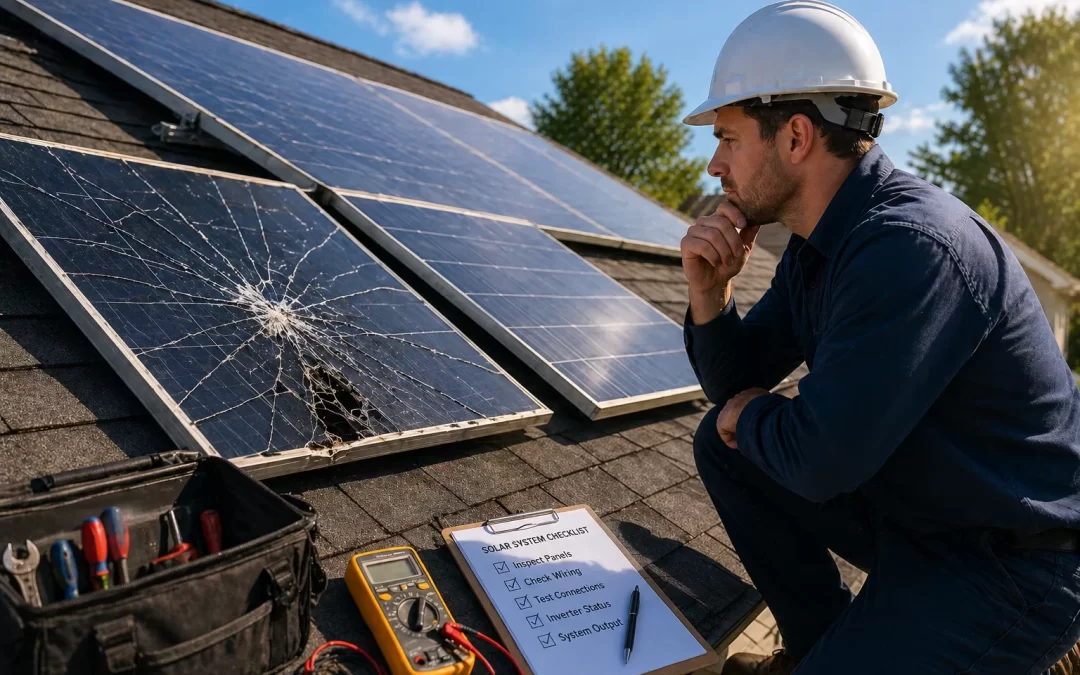
If a solar panel breaks or stops working, start by checking your monitoring app or inverter screen to confirm which panel or part of the system is affected, then safely shut off power if you see exposed wiring, burning smells, or obvious damage. Take photos, review your warranties, and contact your installer or a licensed solar professional before touching the equipment yourself. Many issues are covered under 10–25+ year equipment and workmanship warranties, but physical damage from storms or accidents may go through your homeowner’s insurance instead. Avoid walking on the roof or opening electrical boxes—improper handling can void warranties and create safety risks.
When a solar panel stops working, it can be stressful—especially if you’re counting on those energy savings. This guide is for U.S. homeowners who already have solar (or are researching it) and want to know what really happens when something breaks. We’ll walk through how to tell what’s wrong, what you can safely do yourself, what your installer should handle, and when it’s time to use warranties or insurance.
Table of Contents
- What It Means When a Solar Panel Breaks or Stops Working
- Common Signs Your Solar Panel or System Isn’t Working Right
- First Steps to Take When a Solar Panel Stops Working
- Safety First: What You Should NOT Do
- Most Common Reasons Solar Panels Stop Working
- Should You Repair or Replace a Broken Solar Panel?
- Warranties, Insurance, and Who Pays for What
- Key Numbers: Costs, Lifespan, and Savings When Panels Fail
- When a Broken Panel Is (Almost) in Your Favor
- When a Broken Panel Is a Real Problem
- What to Do Next: How to Decide Your Best Move
- Frequently Asked Questions
- Summary: Key Takeaways
What It Means When a Solar Panel Breaks or Stops Working
“Broken” can mean very different things with solar panels—from a hairline crack in the glass to a completely dead system. Understanding the difference helps you respond appropriately and avoid unnecessary costs.
Types of solar panel problems
- Physical damage: Cracked glass, shattered cells, bent frame, or visible impact marks (hail, tree branch, golf ball, etc.).
- Electrical failure: The panel looks fine, but it’s not producing power due to internal cell damage, wiring issues, or connector problems.
- Performance loss: The panel still works but produces less than expected—often due to shading, dirt, aging, or microcracks.
- System-level issues: The panel is fine, but the inverter, wiring, or monitoring system is causing production to drop or stop.
In many cases, a “broken panel” turns out to be a wiring or inverter issue, which is often easier and cheaper to fix than replacing the panel itself.
Common Signs Your Solar Panel or System Isn’t Working Right
Most homeowners don’t notice a problem by looking at the roof—they notice it on a bill or in an app. Here’s what to watch for.
Typical warning signs
- Monitoring alerts: Your solar app or web portal shows a fault, offline status, or sudden drop in production.
- Inverter warnings: Blinking red lights, error codes, or “fault” messages on the inverter screen.
- Higher electric bills: Your utility bill jumps back up toward pre-solar levels, especially in sunny months.
- Visible damage: Cracked or shattered glass, discolored spots, burn marks, or loose wiring visible from the ground.
- Snow or debris buildup: Panels covered by snow, leaves, or heavy dirt can mimic a “broken” panel by blocking sunlight.
If your system is producing less but not zero, it may be a performance issue rather than a complete failure. Our guide on why solar systems produce less than expected can help you sort out normal variation from real problems.
First Steps to Take When a Solar Panel Stops Working
When you suspect a solar panel problem, a simple, structured approach will save time and protect your warranties.
Step 1: Confirm it’s really a solar issue
- Check if your whole house has power. If not, it may be a utility outage, not your solar.
- Look at your solar monitoring app or inverter screen:
- If production is zero during a sunny day, something is likely wrong.
- If production is just lower than usual, compare to past days with similar weather.
- Check the weather. Cloudy, smoky, or hazy days can cut output dramatically.
Step 2: Do a safe visual check from the ground
- Walk around your property and look at the array from the ground or a safe window.
- Look for:
- Broken or shattered glass
- Panels that look out of alignment or bent
- Obvious debris (branches, heavy leaves, thick dust, bird nests)
- Loose or hanging wires (do not touch)
- Take clear photos of anything unusual—these help with warranty and insurance claims.
Step 3: Check your documentation
- Find your installation contract and warranty documents (panel, inverter, and workmanship warranties).
- Locate your installer’s service phone number or email.
- Note your system’s installation date and equipment brands/models.
Step 4: Contact your installer or a licensed solar professional
- Describe the symptoms (monitoring data, inverter codes, visible damage).
- Share photos and any error messages.
- Ask:
- Is this covered under my equipment or workmanship warranty?
- Do I need to file a homeowner’s insurance claim?
- What are the next steps and expected timeline?
Most reputable installers will help you diagnose remotely first, then schedule a site visit if needed.
Safety First: What You Should NOT Do
Solar panels and inverters deal with high voltage DC and AC power. Even when the grid is off, panels can still generate electricity in sunlight.
Things to avoid as a homeowner
- Do not walk on your panels—you can crack the glass, damage cells, and void warranties.
- Do not open junction boxes, inverters, or electrical panels unless you are a qualified electrician.
- Do not disconnect wiring or connectors on the roof.
- Do not spray high-pressure water directly at panels or electrical components.
- Do not attempt DIY repairs on broken glass, frames, or wiring.
When to shut the system down
If you notice any of the following, it’s reasonable to shut off the system using the labeled disconnect switches and call a professional immediately:
- Burning smell or visible smoke near solar equipment
- Sparking, arcing, or buzzing sounds from electrical boxes
- Panels or wiring damaged by fire, a fallen tree, or severe impact
- Water intrusion into inverters or combiner boxes
Your installer should have shown you how to safely shut down the system after installation. If you’re unsure, ask them to walk you through it by phone before touching anything.
Most Common Reasons Solar Panels Stop Working
Not all failures are equal. Some are minor and cheap to fix; others may require panel replacement or insurance claims.
1. Inverter or electronics failure
- The inverter (which converts DC to AC) is one of the most common failure points.
- Typical inverter warranties are 10–25 years, depending on the type and brand.
- Symptoms: whole system offline, error codes, or no AC output despite sunny conditions.
- Often covered under manufacturer warranty, with labor sometimes covered by your installer.
For more detail on this specific issue, see our guide to solar inverter problems and how to diagnose them.
2. Physical damage from weather or impact
- Hail, wind-blown debris, falling branches, or roof work can crack or shatter panels.
- Most modern panels are tested to withstand hail up to about 1-inch diameter at 50 mph, but extreme storms can exceed this.
- Visible cracks, shattered glass, or punctures usually mean the panel should be replaced, not repaired.
- Often handled through homeowner’s insurance, not equipment warranty.
3. Wiring, connectors, and junction issues
- Loose or corroded connectors, damaged conduit, or rodent-chewed wires can interrupt power.
- These issues may affect one panel, one string, or the whole array.
- Typically diagnosed and repaired by a licensed solar electrician.
4. Degradation and age
- All panels slowly lose output over time—usually around 0.5% per year for modern modules.
- Most have a 25–30 year performance warranty guaranteeing around 80–85% of original output at year 25.
- Gradual loss is normal and not considered “broken” unless it exceeds the warranty limits.
5. Dirt, shading, and temporary issues
- Heavy dust, bird droppings, leaves, or snow can make a panel look “dead” in your monitoring data.
- Nearby tree growth can slowly increase shading over the years.
- These are usually maintenance or landscaping issues, not equipment failures.
Our guides on how to clean solar panels and how weather affects solar panel output explain how to handle these without damaging your system.
Should You Repair or Replace a Broken Solar Panel?
Once you know what’s wrong, the next question is whether to fix, replace, or leave it alone for now.
When repair makes sense
- Minor wiring or connector issues that can be fixed without replacing the panel.
- Inverter or electronics failures where replacing the inverter restores full system output.
- Loose mounting hardware or minor roof-related issues that don’t involve the panel itself.
When replacement is the better option
- Panels with cracked or shattered glass—even if they still produce power, water intrusion can cause safety issues.
- Panels with burn marks, hot spots, or delamination (layers separating).
- Panels that have failed well within warranty and qualify for a manufacturer replacement.
- Older systems where multiple panels are failing and a partial repower (new panels and/or inverter) is more cost-effective.
What if only one panel is broken?
- In systems with microinverters or DC optimizers, one bad panel usually only affects that panel’s output.
- In older string inverter systems, one failed panel can drag down the whole string’s performance.
- Your installer may recommend:
- Replacing the single panel with a similar model, or
- Reconfiguring strings or adding electronics to maintain performance.
Warranties, Insurance, and Who Pays for What
Who pays for a broken solar panel depends on the cause, your warranties, and your insurance policy.
Typical solar warranties
- Panel product warranty: Usually 10–25 years against defects in materials and workmanship.
- Panel performance warranty: Typically guarantees at least 80–85% output at year 25.
- Inverter warranty: Around 10–25 years, depending on type and brand.
- Workmanship / installation warranty: Often 5–25 years from the installer, covering roof penetrations and labor for certain issues.
Our detailed guide on solar panel warranty claims explains how to read these documents and file a claim effectively.
What warranties usually cover
- Manufacturing defects that cause early failure or abnormal degradation.
- Inverter or electronics failures not caused by external damage.
- Sometimes labor to replace defective equipment (varies by brand and installer).
What warranties usually do NOT cover
- Storm damage (hail beyond test limits, wind-blown debris, hurricanes, tornadoes).
- Damage from roof work, foot traffic, or improper cleaning.
- Rodent damage or other pest-related issues.
- Owner modifications or unauthorized repairs.
When homeowner’s insurance comes into play
- Most rooftop solar systems are covered as part of your dwelling under a standard homeowner’s policy, but you should confirm with your insurer.
- Insurance may cover:
- Storm damage (hail, wind, lightning, falling trees)
- Fire damage
- Vandalism or theft
- You’ll typically pay your deductible, and the insurer covers the rest up to policy limits.
Always review your policy or talk to your insurance agent before filing a claim, especially if the damage is minor relative to your deductible.
Key Numbers: Costs, Lifespan, and Savings When Panels Fail
Understanding the typical costs and savings helps you decide how urgent a repair or replacement is.
System cost and value at risk
- A typical residential solar system in the U.S. costs about $28,000–$32,000 before incentives.
- After the 30% federal solar tax credit, that’s roughly $19,600–$22,400 (consult a tax professional to confirm your eligibility).
- Average cost per watt is around $2.50–$3.50, depending on your state, roof, and equipment choices.
- Most homes need about 15–25 panels, depending on panel wattage and energy use.
What a single broken panel means financially
- If your 7 kW system has 20 panels, each panel is about 350 watts.
- At $2.50–$3.50 per watt, that panel represents roughly $875–$1,225 of your system’s installed value.
- However, the replacement cost for one panel (parts and labor) is usually lower, often in the few hundred to low thousand dollar range, depending on access and matching equipment.
Impact on savings and payback
- Average annual savings from a full system are about $1,300–$1,500 nationwide.
- With a typical 7–9 year payback period, a non-functioning system can delay your break-even point.
- One dead panel in a microinverter system might reduce output by 5% or less; one dead panel in a string could reduce a whole string’s output significantly.
Because panels have a 25–30 year performance warranty and often last 30–35 years, it’s usually worth fixing issues promptly to protect decades of future savings.
What affects your actual costs and outcomes
- Your state and utility rates (higher electricity prices mean each lost kWh costs you more).
- Your system design (string inverter vs. microinverters, shading, roof layout).
- Whether the issue is warranty-covered or an out-of-pocket repair.
- Your insurance deductible and whether it makes sense to file a claim.
When a Broken Panel Is (Almost) in Your Favor
No one wants equipment to fail, but sometimes a problem can lead to a better outcome long-term.
Situations where it can work out well
- Early failure under warranty: You may get a newer, higher-efficiency replacement panel at no equipment cost.
- System upgrade opportunity: If your inverter fails after many years, you might upgrade to a more efficient or battery-ready model.
- Insurance-funded replacement: Storm damage covered by insurance can result in newer equipment with minimal out-of-pocket cost beyond your deductible.
- Improved monitoring and safety: Modern replacements often come with better monitoring and safety features than older gear.
When a Broken Panel Is a Real Problem
There are also scenarios where a broken panel or system failure is more painful financially or practically.
Less favorable situations
- Out-of-warranty failures on older systems where parts are hard to match or source.
- High insurance deductibles that make small claims uneconomical.
- Multiple failures across an aging system, suggesting a larger repower is needed.
- Installer out of business, leaving you to coordinate with manufacturers and new contractors on your own.
When solar might not be worth repairing immediately
- If your system is near the end of its 25–30 year life and multiple components are failing.
- If your roof needs replacement soon and you’d be paying to remove and reinstall panels twice.
- If the repair cost is close to the value of remaining savings over the system’s expected life.
In these cases, it may be smarter to plan a combined roof and solar upgrade rather than chasing repeated small repairs.
What to Do Next: How to Decide Your Best Move
Once you know something is wrong, you need a clear plan. Here’s how to decide what to do next.
1. Gather the right information
- System age and size (kW, number of panels).
- Equipment brands and models (panels, inverters, racking).
- Warranty terms and remaining coverage.
- Photos, monitoring screenshots, and inverter error codes.
2. Decide who to call first
- Your original installer if they’re still in business and responsive.
- A licensed solar contractor if your installer is unavailable or unresponsive.
- Your homeowner’s insurance agent if damage is clearly storm- or accident-related.
3. Questions to ask an installer or service provider
- What do you think is the most likely cause of the problem?
- Is this likely covered by equipment or workmanship warranties?
- What is your service call fee and typical repair cost range for this issue?
- Can you provide a written estimate before doing any non-emergency work?
- Will any work you do affect my existing warranties?
4. When to get multiple quotes
- If the repair or replacement estimate is more than a few hundred dollars.
- If you’re considering a system upgrade or repower, not just a simple fix.
- If your original installer’s quote seems high or they’re pushing unnecessary equipment.
Before you invest in major repairs or upgrades, it can also be helpful to revisit whether solar still makes sense for your home. Our honest solar worth-it guide and solar cost and savings guide walk through the key numbers and variables.
Frequently Asked Questions
What should I do first if my solar panels stop working?
Start by checking your monitoring app or inverter screen to confirm that production is actually down and not just a display issue. Then do a safe visual check from the ground, take photos of any visible damage, review your warranties, and contact your installer or a licensed solar professional for diagnosis before attempting any DIY fixes.
Will my homeowner’s insurance cover a broken solar panel?
Homeowner’s insurance often covers solar panels for sudden, accidental damage like hail, wind, fire, or falling trees, but policies vary. It usually does not cover normal wear and tear or manufacturing defects, which are handled under equipment warranties, so it’s important to review your policy or speak with your insurance agent.
Can I still use my solar system if one panel is broken?
In systems with microinverters or DC optimizers, one failed panel usually only affects that panel’s output, so the rest of the system can keep running. In older string inverter systems, one bad panel can reduce or stop production for the entire string, so you’ll want a professional to evaluate the impact and recommend a fix.
How much does it cost to replace a single solar panel?
Replacing a single panel typically costs a few hundred to around a thousand dollars, depending on roof access, matching equipment, and local labor rates. If the failure is covered under a manufacturer warranty, the panel itself may be free, and you may only pay for labor and any related hardware.
How long do solar panels last before they need replacement?
Most modern solar panels come with a 25–30 year performance warranty and often keep producing power for 30–35 years or more. They gradually lose output over time—about 0.5% per year on average—so replacement is usually driven by performance and economics rather than a hard expiration date.
Is it safe to clean or inspect my solar panels myself?
It’s generally safe to visually inspect panels from the ground and gently rinse them from a safe location if needed, but you should avoid walking on the roof or touching any wiring or electrical boxes. For anything involving roof access, electrical work, or visible damage, it’s best to hire a qualified solar professional to avoid safety risks and warranty issues.
Summary: Key Takeaways
- If a solar panel breaks or stops working, confirm the issue with your monitoring or inverter, then safely inspect from the ground and contact a professional—don’t attempt electrical repairs yourself.
- A typical residential system costs $28,000–$32,000 before incentives, so protecting your 25–30 year investment with timely repairs and warranty claims is important.
- Most problems are caused by inverters, wiring, or weather damage, and may be covered by equipment warranties or homeowner’s insurance, depending on the cause.
- Your actual costs and decisions will depend on system age, design, remaining warranties, insurance deductibles, and local electricity rates.
- The best next step is to gather your documentation, talk with your installer or a licensed solar contractor, and get clear estimates before deciding whether to repair, replace, or upgrade.
If you’re dealing with a broken panel or just want to understand your options, getting personalized quotes and advice from qualified installers can clarify your best path forward. Compare recommendations, costs, and warranty support so you can protect your investment and your long-term savings. When you’re ready, you can start that process at /get-my-quote/ without any obligation.