
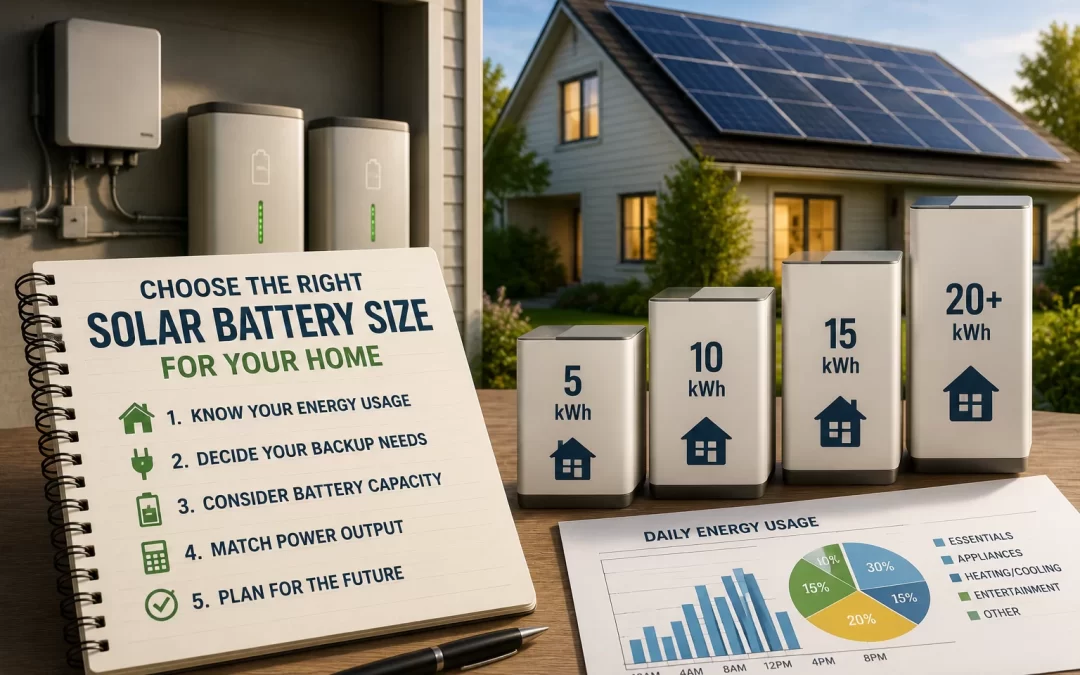
To choose the right solar battery size for your home, start with your daily electricity use (in kWh), decide how many hours or days of backup you want, and match that to a battery (or multiple batteries) with enough usable capacity. Most U.S. homes that add storage install 10–20 kWh of usable battery capacity, which usually covers one night of essential loads, not full “off‑grid” living. Your ideal size depends heavily on your utility rates, whether you have time-of-use pricing, and how much of your home you want to back up. Because battery sizing is complex and incentives vary by state, it’s smart to confirm your numbers with a qualified solar installer before you buy.
Solar batteries can make your solar system more useful, but only if they’re sized correctly for your home and goals. This guide is for U.S. homeowners who are considering solar with storage or adding a battery to an existing solar system. We’ll walk through how to think about battery size in plain language, with real numbers and examples so you can have an informed conversation with installers.
Table of Contents
- What “solar battery size” really means
- How to estimate the right solar battery size for your home
- Typical solar battery sizes for common homeowner goals
- Real numbers: costs, savings, and payback with batteries
- What affects the battery size you actually need
- State and utility considerations that change the right size
- When a larger solar battery makes sense — and when it doesn’t
- How to decide your next step and talk to installers
- Frequently Asked Questions
- Key takeaways
- Get personalized solar battery quotes
What “solar battery size” really means
Capacity vs. power: two different “sizes”
When people talk about solar battery size, they usually mean capacity — how much energy the battery can store, measured in kilowatt-hours (kWh). But there are actually two important numbers:
- Energy capacity (kWh): How much electricity the battery can store. This tells you how long it can run your loads.
- Power rating (kW): How much electricity the battery can deliver at once. This tells you how many things you can run at the same time.
For example, a 13.5 kWh battery with a 5 kW power rating might run a 1 kW fridge for 13 hours, but it can’t run a 10 kW central AC unit by itself because that exceeds its power rating.
Usable capacity vs. nameplate capacity
Most modern lithium batteries don’t let you use 100% of their stored energy to protect battery life. Manufacturers list:
- Total (nameplate) capacity: The full size of the battery, e.g., 13.5 kWh.
- Usable capacity: The portion you can actually use, often 90–100% of nameplate for home batteries.
When sizing your system, always look at usable kWh, because that’s what you’ll actually get during an outage or for bill savings.
How battery size relates to your solar panels
Your battery doesn’t have to match your solar panel size exactly, but they should work together:
- A typical U.S. solar system is 6–10 kW, using about 15–25 panels.
- That system might produce 20–40 kWh per day, depending on your location and roof.
- A 10–20 kWh battery can usually be recharged by a system of that size on a sunny day.
If your battery is too large for your solar array, it may rarely charge fully. If it’s too small, it may fill up quickly and “waste” potential solar production during the day.
How to estimate the right solar battery size for your home
Step 1: Know your daily electricity use
Look at your electric bill for “kWh used” each month. Then:
- Find your average daily use: Monthly kWh ÷ number of days in the billing period.
- Typical U.S. homes use 25–30 kWh per day, but this can range from 10–60+ kWh depending on home size, climate, and electric heating or EVs.
This daily kWh number is your starting point for sizing a battery.
Step 2: Decide what you want the battery to do
Your ideal battery size depends more on your goal than on your total usage. Common goals:
- Backup essentials only: Fridge, Wi‑Fi, a few lights, maybe a gas furnace fan.
- Whole-home backup (short outages): Most circuits, but you’re okay turning off big loads if needed.
- Whole-home backup (long outages): You want to run almost everything for 1–2+ days.
- Bill savings / time-of-use arbitrage: Use stored energy during expensive evening hours.
Each goal points to a different battery size range, which we’ll detail in the next section.
Step 3: Estimate how many hours or days of backup you want
Ask yourself:
- How often do you lose power now, and for how long?
- Is anyone in your home medically dependent on powered equipment?
- Do you live in an area with severe storms, wildfires, or grid shutoffs?
Rough guidelines:
- 8–12 hours of essentials: Often 5–10 kWh usable capacity.
- One night of essentials: Often 10–15 kWh.
- One full day of whole-home backup: Often 20–30+ kWh, depending on your usage.
Remember, your solar panels can recharge the battery during the day if the sun is out and your system is wired for backup operation.
Step 4: Match your needs to a battery size range
Here’s a simple way to translate your goals into a starting battery size:
- If your daily use is 20–30 kWh and you want:
- Essentials for one night: 10–15 kWh usable.
- Most of the home for one night: 15–20 kWh usable.
- Whole home for 24 hours: 20–30+ kWh usable (often 2+ batteries).
- If your daily use is 40–60 kWh (large home, electric heat, or EV):
- Essentials for one night: 10–20 kWh usable.
- Whole home for 24 hours: 30–50+ kWh usable (multiple batteries, significant cost).
These are ballpark ranges; an installer can refine them based on your specific loads and priorities.
Step 5: Check your main panel and critical loads
For backup, your installer will usually create a “critical loads” subpanel. Common items to include:
- Refrigerator and freezer
- Wi‑Fi, modem, and key outlets
- Gas furnace fan or boiler controls
- Some lights and small appliances
- Well pump or sump pump (if needed)
High-draw items like central AC, electric ovens, electric water heaters, and EV chargers may not be practical to back up with a single battery. This is where power rating (kW) and smart load management matter as much as total kWh.
Typical solar battery sizes for common homeowner goals
Typical battery sizes on the U.S. market
Most popular home batteries fall in these ranges:
- Single-battery systems: 9–16 kWh usable (e.g., Tesla Powerwall, Enphase IQ Battery, FranklinWH).
- Two-battery systems: 18–30+ kWh usable.
- Three or more batteries: 30–60+ kWh usable, usually for large homes or special needs.
For a deeper look at specific models, our comparison of the best solar batteries of 2026 covers Tesla, Enphase, Franklin, and others.
Scenario 1: Backup essentials only
This is the most common and cost-effective use case. You want to keep food cold, stay connected, and run a few lights during outages.
- Typical home usage: 20–30 kWh/day.
- Recommended battery size: 10–15 kWh usable.
- What it usually powers: Fridge, Wi‑Fi, some lights, phone charging, maybe a gas furnace fan.
In many homes, a single 10–15 kWh battery can provide 12–24 hours of essential backup, especially if you’re conservative with usage and have solar to recharge during the day.
Scenario 2: Whole-home backup for short outages
You want the house to feel mostly “normal” during outages that last a few hours to a day, but you’re okay turning off big loads if needed.
- Typical home usage: 25–40 kWh/day.
- Recommended battery size: 15–25 kWh usable (often 1–2 batteries).
- What it usually powers: Most circuits, but you may avoid running electric ovens, EV charging, or central AC continuously.
This setup can ride through evening outages comfortably and handle overnight, especially if the grid is usually back by the next day.
Scenario 3: Whole-home backup for long outages
You live in an area with frequent, multi-day outages (e.g., wildfire shutoffs, hurricanes) and want serious resilience.
- Typical home usage: 30–60+ kWh/day.
- Recommended battery size: 30–60+ kWh usable (2–4+ batteries), plus a well-sized solar array.
- What it usually powers: Nearly everything, but you’ll still want to manage high-draw loads carefully.
This level of backup is expensive and often only makes sense where outages are common or critical (medical needs, home business, remote locations).
Scenario 4: Time-of-use savings and rate arbitrage
In some states, electricity is much more expensive during evening “peak” hours. A battery can charge from solar (or cheap off-peak power) and discharge when rates are high.
- Typical home usage: 20–40 kWh/day.
- Recommended battery size: 10–20 kWh usable, depending on your evening usage.
- Goal: Cover 3–6 hours of peak pricing each day.
Here, the “right” size is the one that covers your typical peak-period usage without overspending on capacity you rarely use.
Real numbers: costs, savings, and payback with batteries
Baseline solar system costs (without battery)
As of 2026, typical residential solar costs in the U.S. are:
- Average system cost: $28,000–$32,000 before incentives.
- After 30% federal tax credit (ITC): About $19,600–$22,400, if you’re eligible.
- Cost per watt: $2.50–$3.50 installed.
- Average annual savings: $1,300–$1,500 on electricity bills.
- Payback period: 7–9 years on average, depending on your rates and sun.
- Panel lifespan: 25–30 years performance warranty, 30–35 years typical life.
- Average panels needed: 15–25 for a typical U.S. home.
These are national averages; your actual numbers depend on your state, roof, and utility rates. Our solar cost and savings guide explains these factors in more detail.
How much a solar battery adds to the cost
Adding a battery significantly increases your project cost:
- Typical installed cost per home battery: $10,000–$18,000 before incentives, depending on brand and size.
- Two-battery systems: Often $18,000–$30,000 before incentives.
- Incremental cost per kWh of usable storage: Roughly $800–$1,500/kWh installed.
The 30% federal ITC generally applies to batteries installed with solar (and in many cases to standalone batteries), but you should confirm current rules with a tax professional and your installer.
How batteries affect payback and savings
On a pure financial basis, batteries usually lengthen your payback period:
- Solar alone: 7–9 year typical payback.
- Solar + battery: Often 10–15+ years, depending on:
- Time-of-use rates and peak/off-peak price differences.
- Whether your utility offers good net metering.
- State or utility battery incentives (e.g., California, Massachusetts, some Northeast states).
In many areas, the main “return” on a battery is resilience and peace of mind rather than pure bill savings. In some high-rate or incentive-rich markets, batteries can also provide solid financial value.
Battery lifespan and replacement timing
Most modern home batteries are warrantied for:
- 10 years or a certain number of cycles (often around 6,000–10,000 cycles).
- Guaranteed capacity at end of warranty, often 60–70% of original.
That means your battery may need replacement once during your solar panels’ 25–30 year life. Factor this into your long-term planning, especially if you’re sizing a very large system.
What affects the battery size you actually need
Your utility rate structure
Your electric rate plan can change the “right” battery size:
- Flat rates + good net metering: Smaller batteries (or none) often make more sense; focus on outage backup, not arbitrage.
- Time-of-use rates: A 10–20 kWh battery sized to cover peak hours can improve payback.
- Demand charges (less common for homes): Batteries can help reduce peak demand, but sizing is more complex.
Ask your installer to model how different battery sizes perform under your specific rate plan.
Climate and heating/cooling loads
Where you live affects how much energy you use and how hard your battery has to work:
- Hot climates (e.g., AZ, TX, FL): Air conditioning can dominate usage; backing it up may require multiple batteries.
- Cold climates (e.g., MN, ME): Electric heat is very energy-hungry; gas or oil heat with an electric fan is much easier to back up.
- Moderate climates: Easier to get long backup times from a modest battery.
In extreme climates, many homeowners choose to back up essentials and maybe one smaller AC zone, rather than the entire HVAC system.
Roof size and solar production
Your solar array needs to be able to recharge your battery:
- If your roof only fits a small system (e.g., 4–5 kW), an oversized battery may rarely fill up.
- If you have a large roof and can install 10+ kW of solar, you can support larger battery banks more effectively.
Installers can model your expected solar production by month and show how quickly different battery sizes would recharge after an outage.
How much you’re willing to manage loads
Two homes with the same battery can have very different experiences:
- Active management: You’re willing to turn off AC, avoid laundry and oven use, and limit EV charging during outages. You can get by with a smaller battery.
- “Set and forget”: You want the house to run almost normally. You’ll likely need a larger battery bank and possibly smart load controls.
Be honest with yourself about how much you want to think about energy use during an outage.
State and utility considerations that change the right size
States with frequent outages or grid shutoffs
In some regions, resilience is a primary driver for batteries:
- California: Public Safety Power Shutoffs (PSPS) for wildfire risk can cause multi-day outages in some areas.
- Gulf Coast and Southeast: Hurricanes and severe storms can knock out power for days.
- Rural areas nationwide: Outages may be less frequent but longer when they happen.
In these areas, slightly oversizing your battery for longer backup can be reasonable, especially if you have medical or work-from-home needs.
States with strong battery incentives
Some states and utilities offer rebates or performance payments for batteries, which can change the math:
- California (SGIP program): Incentives for storage, especially in high-fire-risk areas.
- Massachusetts (ConnectedSolutions and similar programs): Pays homeowners for allowing utilities to use stored energy during peak events.
- Other states periodically launch storage programs; availability changes over time.
Incentives can effectively lower the cost per kWh of storage, making slightly larger batteries more attractive. Always confirm current programs with your installer and a tax professional.
Net metering and export rules
How your utility treats excess solar affects whether you need a battery and how big it should be:
- Full retail net metering: The grid acts like a “virtual battery,” so you may not need a large physical battery for bill savings.
- Reduced export rates or no net metering: Batteries can store midday solar that would otherwise be undervalued, improving economics.
If your utility pays very little for exported solar, a battery sized to soak up your midday surplus can make more sense.
When a larger solar battery makes sense — and when it doesn’t
When a larger battery works in your favor
Upsizing your battery can be a good idea if:
- You have frequent or long outages and value comfort and safety during those times.
- You live in a time-of-use or high-rate area where shifting usage can save significant money.
- Your state or utility offers strong battery incentives that reduce your out-of-pocket cost.
- You have critical medical equipment or work-from-home needs that can’t tolerate downtime.
- You already plan a larger solar array that can reliably recharge a bigger battery bank.
When a larger battery is probably overkill
On the other hand, a big battery may not be the best use of your money if:
- Your power is very reliable and outages are rare and short.
- Your utility offers good net metering and flat rates, so bill savings from storage are limited.
- You’re mainly interested in financial payback and don’t strongly value backup power.
- Your roof can only support a small solar system, limiting how much you can recharge a large battery.
- Your budget is tight and a larger battery would force you to shrink your solar array, which usually hurts long-term savings.
In many cases, a modest 10–15 kWh battery for essentials strikes a good balance between cost and resilience.
How to decide your next step and talk to installers
Is now the right time to act?
It may be a good time to move forward with a solar battery if:
- You already know you want solar and are ready to compare quotes.
- Your area has time-of-use rates, frequent outages, or strong incentives.
- You plan to stay in your home for at least 7–10 years.
If you’re still unsure whether solar itself makes sense, start with an honest overview like our is solar worth it guide before deciding on storage.
Information to gather before getting quotes
Before you talk to installers, it helps to have:
- 12 months of electric bills (or at least 3–6 months) to show your usage patterns.
- A list of must-have backup loads (fridge, Wi‑Fi, medical devices, etc.).
- Your utility rate plan (flat, time-of-use, or other).
- Any known roof issues or plans to replace your roof soon.
This information lets installers size both your solar and battery more accurately.
Key questions to ask a solar installer about battery sizing
When you’re reviewing quotes, ask:
- “What is the usable kWh of the battery system you’re proposing?”
- “Which loads will be backed up, and which will not?”
- “How long do you estimate this battery will run my critical loads during an outage?”
- “How does my rate plan affect the financial value of this battery size?”
- “Can you show me a comparison of one vs. two batteries for my home?”
- “What happens if I want to add more batteries later?”
Good installers should be able to show you simple scenarios and explain trade-offs in plain language.
Why getting multiple quotes matters
Battery sizing and pricing can vary a lot between installers. Getting at least 2–3 quotes helps you:
- See different battery brands and size recommendations.
- Compare how each installer models outages and bill savings.
- Spot any quotes that seem under- or over-sized for your needs.
Use each conversation to refine your understanding of what you truly need and what you’re comfortable spending.
Frequently Asked Questions
How many kWh battery do I need for my house?
Most U.S. homes that add storage install 10–20 kWh of usable battery capacity, which usually covers one night of essential loads or several hours of whole-home backup. If you want full-house backup for 24 hours or more, you may need 20–40+ kWh, often using multiple batteries. The exact size depends on your daily kWh usage, what you want to power, and how long outages typically last.
Is a 10 kWh solar battery enough?
A 10 kWh battery is often enough to run essentials like a fridge, Wi‑Fi, some lights, and a gas furnace fan through an overnight outage, especially if you conserve energy. It’s usually not enough for full-house backup with central AC, electric heat, or heavy appliance use. For many homeowners, 10–15 kWh is a good starting point for basic resilience.
How long will a 13.5 kWh battery last during a power outage?
A 13.5 kWh battery might last 10–20 hours running essential loads, or just a few hours if you try to power most of the house, including large appliances. The actual runtime depends on how many watts you’re using at any moment and whether your solar panels can recharge the battery during the day. Installers can estimate runtime for your specific critical loads.
Can I add more batteries later if I start small?
Many modern systems are designed to be expandable, so you can start with one battery and add more later, but there are limits. It’s important to choose an inverter and battery brand that support future expansion and to size your electrical equipment accordingly from the start. Ask your installer what adding capacity later would involve and whether any extra costs are likely.
Do I need a solar battery if my utility has net metering?
If your utility offers strong net metering and you rarely lose power, you may not need a battery for financial reasons. In that case, the main reason to add storage is for backup power and peace of mind. If outages are rare and you’re focused on payback, solar panels alone often provide better value.
Does the federal tax credit apply to solar batteries?
In many cases, the 30% federal solar tax credit applies to home batteries installed with solar, and often to standalone batteries as well, but rules can change. The credit can significantly reduce your net battery cost if you’re eligible. Always confirm your specific situation with a qualified tax professional and your installer.
Key takeaways
- The “right” solar battery size depends on your daily kWh use, what you want to power, and how long you need backup, not just on your solar system size.
- Most U.S. homes choose 10–20 kWh of usable storage, which typically covers one night of essential loads or several hours of whole-home backup.
- Adding a battery usually increases total project cost by $10,000–$30,000 and can extend payback to 10–15+ years, though incentives and rate structures can improve the math.
- Utility rates, climate, outage frequency, and your willingness to manage loads are the biggest factors that affect ideal battery size.
- The best next step is to gather your bills, define your backup priorities, and get multiple quotes so installers can model different battery sizes for your specific home.
Get personalized solar battery quotes
Online guides can get you close, but the only way to know the right solar battery size for your home is to see customized designs and numbers. Share your usage, backup priorities, and roof details with a few reputable installers and compare how they size and price your storage options. When you’re ready, you can get personalized solar and battery quotes with no obligation and see exactly what makes sense for your home and budget.