
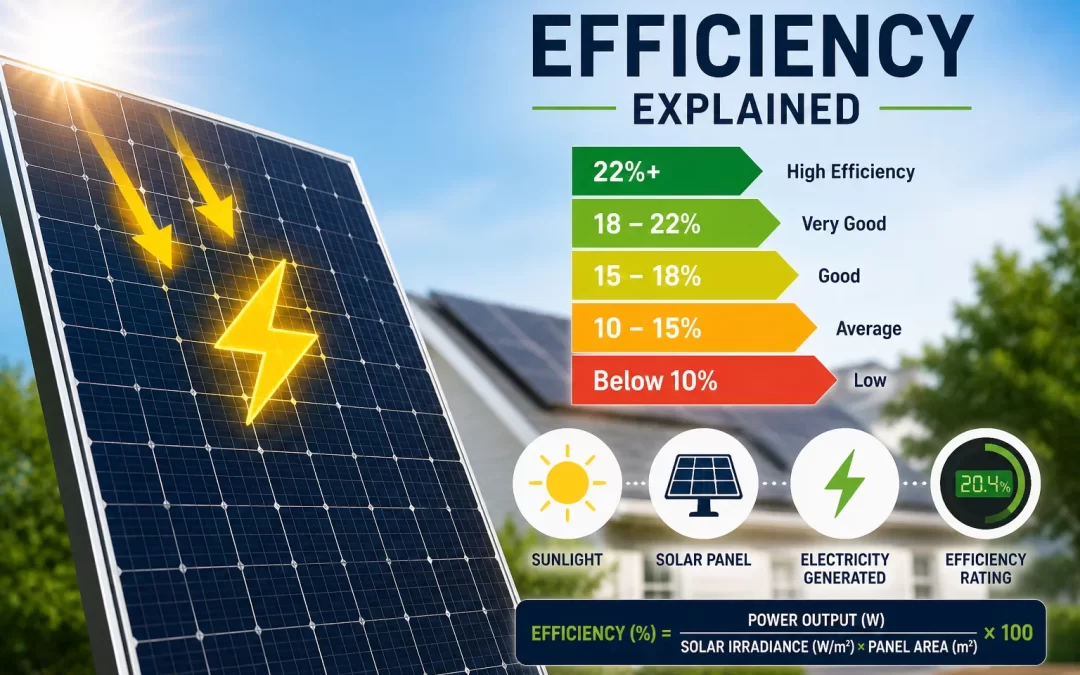
Solar panel efficiency ratings tell you how much of the sunlight that hits a panel is turned into usable electricity, usually shown as a percentage like 18%–22%. For homeowners, higher efficiency means each panel produces more power in the same amount of roof space, which can reduce how many panels you need. Most modern residential panels fall between about 19% and 22% efficiency, and ultra-high-efficiency models can be slightly higher but cost more. Efficiency is only one factor in a good solar system, though — price, warranty, installer quality, and your roof layout matter just as much.
Solar panel efficiency ratings can be confusing when you’re trying to decide which panels are “best” for your home. This guide breaks down what those numbers actually mean, how much they matter in the real world, and when it’s worth paying extra for higher efficiency. It’s written for U.S. homeowners at any stage of research, from “Is solar worth it?” to “Which panels should I choose?”
Table of Contents
- What Is Solar Panel Efficiency? (Plain-English Explanation)
- Typical Solar Panel Efficiency Ratings in 2026
- How Efficiency Is Measured (And Why Lab Numbers Look So Precise)
- What Affects Solar Panel Efficiency in Real Life
- Efficiency, System Size, and Roof Space
- Efficiency vs. Cost, Savings, and Payback
- When High-Efficiency Panels Help — And When They Don’t
- Key Numbers: Costs, Savings, and Lifespan
- How to Compare Panel Efficiency Ratings Between Brands
- Questions to Ask Your Installer About Efficiency
- How to Decide Your Next Step
- Frequently Asked Questions
- Summary: What Solar Panel Efficiency Ratings Really Mean
What Is Solar Panel Efficiency? (Plain-English Explanation)
Solar panel efficiency is the percentage of sunlight that a panel can convert into electricity. If a panel is 20% efficient, that means 20% of the sunlight hitting it becomes usable power, and the rest is lost as heat or reflected light.
For homeowners, the key takeaway is simple:
- Higher efficiency = more power from the same roof area.
- Lower efficiency = you need more roof space to get the same total system size.
Efficiency does not tell you everything about quality or reliability. A slightly lower-efficiency panel from a top-tier brand can easily outperform a high-efficiency panel from a weaker manufacturer over 25–30 years.
Typical Solar Panel Efficiency Ratings in 2026
Most modern residential solar panels sold in the U.S. today are in a fairly tight efficiency range. As of 2026, typical numbers look like this:
- Standard residential panels: about 19%–21.5% efficiency
- Premium/high-efficiency panels: about 21.5%–23.5%
- Older or budget panels: about 16%–18.5%
Many of the “best” panels on the market (from top-tier brands) now advertise efficiencies around 21%–23%. Lab prototypes can reach higher numbers, but those aren’t what you’ll see on a typical home.
Efficiency is usually printed on the panel’s spec sheet as “Module Efficiency” or “Module Conversion Efficiency,” often alongside the panel’s power rating in watts (for example, 400 W at 20.5% efficiency).
How Efficiency Is Measured (And Why Lab Numbers Look So Precise)
Manufacturers measure solar panel efficiency under standardized lab conditions called “STC” (Standard Test Conditions). These conditions include:
- Sunlight intensity of 1,000 watts per square meter
- Panel temperature of 25°C (77°F)
- Perfectly direct sunlight at a specific angle
Under STC, a panel’s efficiency is calculated using:
- Panel power (watts) ÷ Panel area (square meters) ÷ 1,000 W/m²
That’s why you’ll see numbers like 20.3% or 21.7% — they’re precise lab results. In the real world, your panels will rarely operate under perfect conditions, so their effective efficiency on your roof will be lower, especially on hot days or when partially shaded.
What Affects Solar Panel Efficiency in Real Life
Even if two panels have the same lab-tested efficiency, they may perform differently on your roof. Key real-world factors include:
Panel Type and Cell Technology
- Monocrystalline panels (the most common on homes today) typically have the highest efficiencies, often 19%–23%.
- Polycrystalline panels are usually less efficient (around 16%–18.5%) and less common in new residential installs.
- Advanced cell designs (like half-cut cells, multi-busbar, or heterojunction) can improve efficiency and performance in low light.
If you want a deeper dive into panel types, see the comparison of monocrystalline vs. polycrystalline solar panels.
Temperature
Solar panels actually work less efficiently when they get hot. Each panel has a “temperature coefficient” that tells you how much power it loses as temperature rises above 25°C (77°F).
- Typical loss: about 0.3%–0.5% power per °C above 25°C.
- On a hot 95°F (35°C) day, panel temperatures can easily reach 140°F (60°C) or more, cutting real-world output compared to lab ratings.
Shading, Dirt, and Orientation
- Shading from trees, chimneys, or nearby buildings can dramatically reduce effective efficiency, especially with traditional string inverters.
- Dirt, pollen, and snow block sunlight and reduce output until they’re washed or melted away.
- Roof direction and tilt matter: south-facing roofs at a moderate tilt generally get the best annual production in the U.S.
Inverter Type and System Design
How your system is wired affects how much of that panel efficiency turns into usable electricity in your home.
- Microinverters and DC optimizers can help reduce losses from shading and panel mismatch.
- String inverters are simpler and often cheaper but can be more affected by shading on one panel in a string.
If you’re comparing system designs, the guide on microinverters vs. string inverters explains how this impacts real-world performance.
Efficiency, System Size, and Roof Space
For most homeowners, the most practical impact of efficiency is how many panels you need and whether they’ll fit on your roof.
How Efficiency Translates to Panel Wattage
Higher efficiency usually means higher wattage for the same physical panel size. For example (approximate numbers):
- Standard-size panel at 18% efficiency → around 350 W
- Same-size panel at 21% efficiency → around 410–430 W
- Same-size panel at 23% efficiency → around 440–470 W
This matters when you’re trying to reach a target system size (like 8 kW or 10 kW) on limited roof space.
Typical Home System Sizes and Panel Counts
For a typical U.S. home, you’ll often see:
- Average system size: about 6 kW–10 kW, depending on your usage and location.
- Average panels needed: about 15–25 panels for most homes.
Higher-efficiency panels can reduce the number of panels needed for the same system size. For example, to build an 8 kW system:
- Using 350 W panels (lower efficiency): about 23 panels
- Using 420 W panels (higher efficiency): about 19 panels
If your roof is small or has limited unshaded areas, that difference can be the deciding factor in whether solar works well for you.
To estimate how many panels you might need based on your usage and roof, try the guide on how many solar panels you need.
Efficiency vs. Cost, Savings, and Payback
Higher efficiency panels generally cost more per watt, but the impact on your total system cost and payback can be smaller than you might expect.
Typical Costs in 2026
As of 2026, national averages for residential solar in the U.S. are roughly:
- Cost per watt: about $2.50–$3.50 before incentives
- Typical system cost: about $28,000–$32,000 before incentives for a standard system
- After the 30% federal tax credit, that’s about $19,600–$22,400 (consult a tax professional to confirm your eligibility)
Premium, high-efficiency panels may push you toward the higher end of that range, while standard-efficiency panels may be closer to the lower end, assuming similar system sizes and equipment quality.
Impact on Savings and Payback Period
On average, U.S. homeowners see:
- Annual electric bill savings: about $1,300–$1,500
- Payback period: about 7–9 years nationally
Switching from standard to premium efficiency panels might:
- Increase your system cost slightly (for example, a few thousand dollars more on a $30,000 system).
- Increase your annual production by a modest amount if roof space is not the limiting factor.
If you have plenty of roof space, it’s often more cost-effective to use slightly lower-efficiency panels and install a few more of them, rather than paying a premium for the highest efficiency available.
When High-Efficiency Panels Help — And When They Don’t
When High Efficiency Works in Your Favor
Paying extra for higher-efficiency panels can make sense when:
- Your roof space is limited and you need to maximize power in a small area.
- You have partial shading and only certain roof sections are usable.
- You plan to add an EV or electrify heating and want room to expand your system later.
- You value aesthetics and prefer fewer, higher-power panels for a cleaner look.
When High Efficiency May Not Be Worth the Extra Cost
On the other hand, ultra-high-efficiency panels may not be the best value if:
- You have plenty of unshaded roof space and can easily fit a slightly larger array.
- Your budget is tight and you want the fastest possible payback period.
- Your electric rates are relatively low, so the extra production doesn’t add much extra savings.
- The premium brand doesn’t offer better warranties or proven reliability compared to slightly lower-efficiency competitors.
In many cases, a solid mid-range panel (around 20%–21% efficiency) from a reputable brand offers the best balance of cost, performance, and long-term reliability.
Key Numbers: Costs, Savings, and Lifespan
Efficiency is just one part of the bigger solar picture. Here are the key numbers most homeowners should keep in mind:
- Panel efficiency: typically 19%–22% for modern residential panels.
- Cost per watt: about $2.50–$3.50 installed, before incentives.
- Total system cost: about $28,000–$32,000 before incentives; $19,600–$22,400 after the 30% federal tax credit (if you qualify).
- Average annual savings: about $1,300–$1,500, depending on your utility rates and usage.
- Payback period: about 7–9 years on average in the U.S.
- Panel performance warranty: typically 25–30 years.
- Typical panel lifespan: about 30–35 years of useful production.
- Average number of panels: about 15–25 panels for a typical home system.
Your actual numbers will vary based on your state, utility rates, roof, shading, equipment choices, and whether you add a battery. For a deeper look at how costs and savings work together, see the solar cost and savings guide.
How to Compare Panel Efficiency Ratings Between Brands
When you’re looking at quotes from different installers, you’ll often see several panel options with different wattages and efficiencies. Here’s how to compare them in a practical way.
Step 1: Look at Panel Wattage and Efficiency Together
On the spec sheet, check:
- Module power (Pmax): for example, 400 W, 420 W, 450 W.
- Module efficiency: for example, 20.1%, 21.3%, 22.5%.
Higher wattage usually means higher efficiency for the same panel size, but not always. If two panels are the same physical size, the one with higher wattage is more efficient.
Step 2: Compare Degradation and Performance Warranties
Efficiency on day one is less important than how the panel performs over 25–30 years. Look for:
- Annual degradation rate: lower is better (for example, 0.25%–0.5% per year).
- End-of-warranty output: many good panels guarantee around 84%–92% of original output after 25 years.
A panel with slightly lower initial efficiency but better long-term degradation can produce more total energy over its lifetime.
Step 3: Consider Brand Quality and Installer Recommendation
Ask your installer why they recommend a particular panel brand or model:
- Do they have a strong track record and financial stability?
- How responsive is the manufacturer on warranty claims?
- Does the installer have extensive experience with that brand?
Efficiency is easier to print on a brochure than long-term reliability, so lean on your installer’s experience and independent reviews when choosing between similar options.
Questions to Ask Your Installer About Efficiency
When you’re close to making a decision, these questions can help you cut through the marketing and focus on what matters:
- What is the efficiency and wattage of the panels in my quote?
- Why did you choose these panels instead of higher- or lower-efficiency options?
- Will my roof space or shading limit how many panels we can install?
- How much more would it cost to upgrade to a higher-efficiency panel, and how much extra energy would that produce per year?
- What is the panel’s degradation rate and guaranteed output after 25 years?
- How will inverter choice (string vs. microinverters) affect real-world performance on my roof?
A good installer should be able to show you side-by-side production estimates and explain, in plain language, whether higher-efficiency panels are worth it for your specific home.
How to Decide Your Next Step
Deciding what to do with solar panel efficiency ratings comes down to your roof, your budget, and your goals.
Is Now the Right Time to Act?
For many homeowners, now is a reasonable time to move forward because:
- Panel efficiencies are already high and improving only slowly year to year.
- The 30% federal tax credit is available through 2032 (consult a tax professional for your situation).
- Electricity rates in many areas continue to rise, improving solar’s long-term value.
Waiting for a small bump in efficiency (for example, from 21% to 22%) rarely changes the overall economics as much as another year of utility bills does.
Information to Gather Before Getting Quotes
Before you talk to installers, it helps to know:
- Your average monthly electric bill and annual kWh usage (from your utility statements).
- Whether your roof has good south, southeast, or southwest exposure and minimal shading.
- Whether you plan to add an EV, heat pump, or other big electric loads in the next few years.
Why Getting Multiple Quotes Matters
Because different installers use different panel brands and efficiency levels, getting at least 2–3 quotes can show you:
- How panel efficiency choices affect your system size and layout.
- Whether you’re being pushed toward premium panels you may not need.
- Which installer explains trade-offs clearly and honestly.
Use the quotes to compare not just efficiency, but total system cost, warranties, equipment quality, and the installer’s reputation.
Frequently Asked Questions
What is a good efficiency rating for residential solar panels?
For a home system in 2026, a “good” solar panel efficiency is typically between 19% and 22%. Anything in that range from a reputable brand is considered modern and efficient, and you don’t need the absolute highest efficiency available for solar to make financial sense.
Do higher-efficiency solar panels always save more money?
Higher-efficiency panels can produce more power from the same roof area, but they also tend to cost more. If you have plenty of roof space, using slightly lower-efficiency panels and installing a few more of them can be just as cost-effective, or even cheaper, than paying a premium for ultra-high-efficiency models.
Is a 25% efficient solar panel worth the extra cost?
Panels near 25% efficiency are at the very high end of what’s available for homes and usually come with a noticeable price premium. They can be worth it if your roof space is very limited or you want to maximize production in a small area, but for many homeowners, a 20%–22% panel offers a better balance of cost and performance.
How much does panel efficiency affect my payback period?
Panel efficiency affects how much energy your system can produce, but its impact on payback is often smaller than utility rates, system cost, and incentives. In many cases, choosing slightly lower-efficiency panels with a lower price per watt can shorten your payback more than chasing the highest efficiency available.
Will solar panels lose efficiency over time?
Yes, all solar panels slowly lose efficiency as they age, a process called degradation. Most modern panels are warranted to produce around 84%–92% of their original output after 25 years, and many will continue generating useful power for 30 years or more.
Should I choose panels based on efficiency or brand reputation?
Both matter, but brand reputation and warranty support are often more important than squeezing out an extra 1%–2% efficiency. A slightly lower-efficiency panel from a strong, established manufacturer is usually a safer long-term choice than a marginally higher-efficiency panel from a brand with a weak track record.
Summary: What Solar Panel Efficiency Ratings Really Mean
- Solar panel efficiency ratings show how much sunlight a panel turns into electricity, with most modern home panels in the 19%–22% range.
- Higher efficiency helps you get more power from limited roof space, but it usually comes with a higher price per watt.
- Real-world performance depends on temperature, shading, roof orientation, inverter choice, and long-term degradation — not just the lab-tested efficiency number.
- Typical systems cost about $28,000–$32,000 before incentives, save about $1,300–$1,500 per year, and pay back in about 7–9 years, though your results will vary.
- Your best next step is to get a few quotes that clearly show panel efficiency, system size, and expected production for your specific roof.
If you’re ready to see how panel efficiency, roof space, and costs come together for your home, getting personalized quotes is the most reliable next step. Compare at least two or three proposals so you can see how different panel options affect price and performance. You can start that process today at /get-my-quote/ and use this guide to ask smarter questions and choose the right setup for your home.