
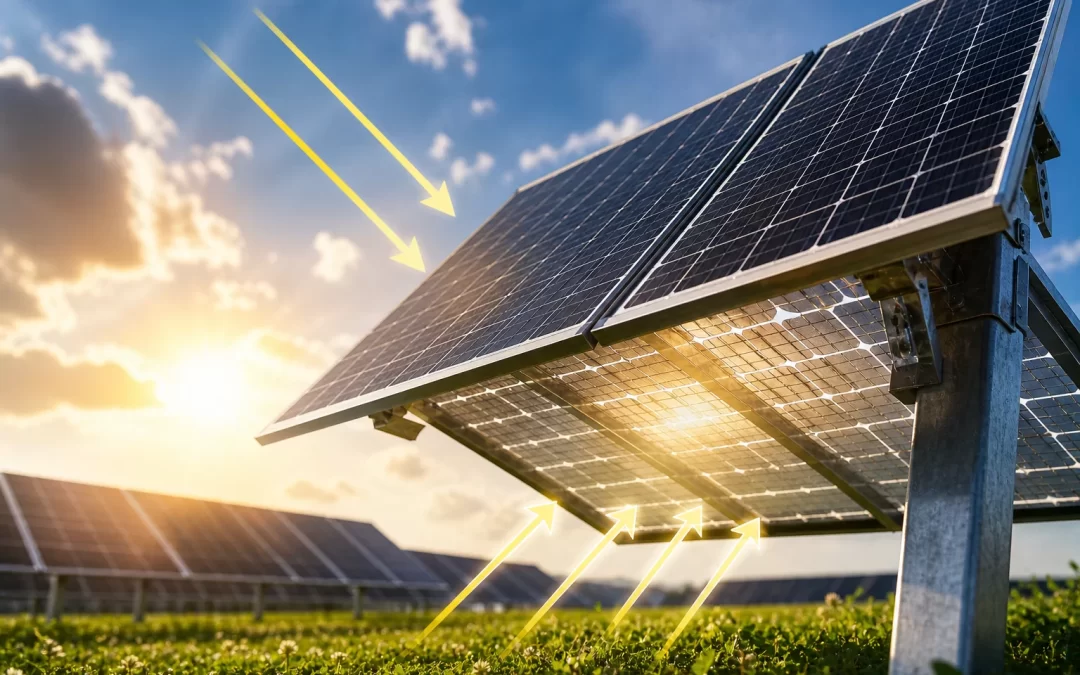
Bifacial solar panels can be worth the extra cost in specific situations, but they are not the best choice for every home. They make the most sense when you have a bright, reflective surface under the panels (like white TPO roofing, light concrete, or snow) and enough tilt or elevation for light to hit the back side. In those conditions, bifacial panels can boost energy production by roughly 5–20% compared to standard panels. If your roof is dark, shaded, or very tight on space, the extra cost of bifacial panels often won’t pay off.
Bifacial solar panels are becoming more common in commercial and utility-scale projects, and some homeowners are starting to hear about them from installers. This guide is for U.S. homeowners who want to know if bifacial panels are actually better for a typical house roof. We’ll walk through how they work, when they add real value, when they don’t, and how to decide what to ask for in your solar quotes.
Table of Contents
- What Are Bifacial Solar Panels (In Plain English)?
- How Bifacial Panels Work and How Much Extra Power They Produce
- Costs, Savings, and Key Numbers for Homeowners
- When Bifacial Solar Panels Are Worth the Extra Cost
- When Bifacial Panels Usually Aren’t Worth It
- Roof Type, Mounting Style, and Location Considerations
- Bifacial vs. Standard Solar Panels: Side‑by‑Side Comparison
- Decision Guide: Should You Ask for Bifacial Panels in Your Quote?
- Frequently Asked Questions
- Summary: Key Takeaways
What Are Bifacial Solar Panels (In Plain English)?
Simple definition
A standard solar panel only collects sunlight on one side (the front). A bifacial solar panel collects light on both the front and the back. The front side works just like a normal panel; the back side captures light that bounces off the ground, roof, or other surfaces.
Most bifacial panels:
- Use glass on both sides instead of a solid, opaque backsheet
- Have visible solar cells “floating” between two glass layers
- Are built with high-efficiency monocrystalline cells
Where bifacial panels are most common today
As of 2026, bifacial panels are used mainly in:
- Ground-mounted solar farms with panels raised several feet off the ground
- Commercial flat roofs with white or reflective membranes
- Carports and pergolas where light can pass underneath
They are still relatively uncommon on typical pitched residential roofs with asphalt shingles, but some installers do offer them for certain homes.
How Bifacial Panels Work and How Much Extra Power They Produce
The key concept: “bifacial gain”
The extra energy a bifacial panel produces from the back side is called bifacial gain. It’s usually expressed as a percentage increase over what the front side alone would produce.
Real-world bifacial gain typically falls in these ranges:
- 5–10% on bright, reflective flat roofs with low tilt
- 10–20% on raised ground mounts over light gravel, concrete, or snow
- 0–5% on dark roofs (asphalt shingles) with panels close to the surface
Lab tests sometimes show higher gains, but homeowners should focus on realistic field data.
What affects bifacial gain the most
The back-side boost depends heavily on your setup:
- Surface color and reflectivity (“albedo”)
- White TPO or PVC roof, light concrete, or snow: high reflectivity
- Standard dark asphalt shingles, dark soil, grass: low reflectivity
- Height above the surface
- Higher mounting (2–4 feet or more) lets more light reach the back
- Panels mounted just a few inches above a roof get much less back-side light
- Tilt angle
- Steeper tilt exposes more of the back side to reflected light
- Very low tilt (5–10°) reduces back-side exposure
- Shading and obstructions
- Rails, junction boxes, and nearby objects can block back-side light
Realistic production expectations
For a typical U.S. home with a dark shingle roof and flush-mounted panels, the extra energy from bifacial panels is often small or negligible. On the other hand, a homeowner with a bright, flat white roof or a raised ground-mount array in a snowy climate might see a meaningful bump in production.
Costs, Savings, and Key Numbers for Homeowners
Baseline residential solar numbers (standard panels)
For context, here are typical U.S. residential solar numbers as of 2026, using standard monofacial panels:
- Average system size: 6–10 kW (about 15–25 panels)
- Cost per watt: $2.50–$3.50
- Total system cost: about $28,000–$32,000 before incentives
- After 30% federal tax credit (ITC): about $19,600–$22,400 (if you qualify; consult a tax professional)
- Average annual bill savings: roughly $1,300–$1,500
- Typical payback period: 7–9 years nationally
- Panel performance warranty: 25–30 years
- Typical panel life: 30–35 years
Your actual numbers depend on your state, utility rates, roof size, shading, and incentives. Our solar cost and savings guide explains these variables in more detail.
How bifacial panels change the cost
Bifacial panels themselves are usually a bit more expensive than comparable one-sided panels, but the installed system cost difference can be modest or significant depending on your installer and racking:
- Panel hardware premium: often $0.05–$0.20 per watt more than standard panels
- System-level premium: commonly $0.10–$0.30 per watt higher installed cost, especially if special racking or higher mounting is used
On a 8 kW system, that could mean:
- Standard system: 8,000 W × $3.00/W = $24,000 (example price, before incentives)
- Bifacial system: 8,000 W × $3.20/W = $25,600 (about $1,600 more)
These are illustrative numbers; local quotes may be higher or lower.
How extra production affects payback
If bifacial panels increase your energy production by, say, 10%, then:
- Your annual savings might rise from $1,400 to about $1,540
- Your payback period might drop from 8 years to around 7.3 years, assuming the cost premium is reasonable
But if your roof conditions only allow a 2–3% gain, the extra cost often doesn’t meaningfully change your payback time. That’s why site conditions matter more than the panel label.
When Bifacial Solar Panels Are Worth the Extra Cost
Best-case homeowner scenarios
Bifacial solar panels are most likely to be worth it if you have:
- A bright, reflective surface under the array
- White TPO or PVC flat roof
- Light-colored concrete or gravel under a ground mount
- Regular snow cover in winter (northern states, mountain regions)
- Panels elevated off the surface
- Ballasted racking on a flat roof with panels raised several inches to a foot or more
- Ground-mount system with panels 2–4 feet above the ground
- Limited roof area but high electricity use
- You need to squeeze more production out of each square foot
- High electricity rates (e.g., parts of California, New England, Hawaii)
- Each extra kWh you generate is more valuable, so the production boost matters more
Examples where bifacial can shine
- Flat white commercial-style roof on a home: A modern home with a white TPO roof and a low-tilt array may see a solid 5–15% gain.
- Ground-mount in a snowy climate: A homeowner in Colorado or Minnesota with a raised ground mount over light gravel or snow could see 10–20% extra production in winter.
- Solar pergola or carport: Bifacial panels used as a roof over a patio or parking area can generate power from both sides while providing shade.
When the math usually works
Bifacial panels are more likely to be worth it when:
- The cost premium is small (for example, less than 5–8% more than a similar standard system)
- Your installer can show a modeled production increase of at least 8–10%
- You plan to stay in the home long enough to benefit from the extra production (ideally 10+ years)
When Bifacial Panels Usually Aren’t Worth It
Common residential situations where they add little value
For many U.S. homes, bifacial panels simply don’t have the right conditions to shine. They are often not worth the extra cost if you have:
- Standard dark asphalt shingle roof with panels mounted close to the surface
- Limited mounting height (flush-mounted rails with only a few inches of clearance)
- Complex roof shapes with dormers, valleys, and multiple small roof faces
- Significant shading from trees, chimneys, or nearby buildings
Why the back side may not help much
On a typical pitched shingle roof:
- The roof is dark and absorbs most of the light instead of reflecting it
- The panels are close to the roof, so little light reaches the back side
- Racking, rails, and junction boxes can block back-side light
In these conditions, the bifacial gain might only be a few percent at best, which usually doesn’t justify paying more for the panels and potentially more complex racking.
Situations where you may be better off with standard panels
- Budget is tight and you want the fastest payback possible
- You can easily fit enough standard panels on your roof to cover your usage
- Your installer can offer a higher-wattage monofacial panel at a better price per watt
- You’re in a state with lower electricity rates, so each extra kWh is worth less
In these cases, high-quality standard monocrystalline panels are usually the smarter, simpler choice.
Roof Type, Mounting Style, and Location Considerations
Roof type and color
Your roof is one of the biggest factors in whether bifacial solar panels make sense:
- Flat white or light-colored roof
- Best candidate for bifacial on a home
- Good potential for 5–15% extra production
- Standard dark asphalt shingles
- Low reflectivity; usually poor candidate
- Back-side gain often too small to matter
- Metal roofs
- Light-colored or reflective metal may help
- Dark standing-seam metal behaves more like shingles
Mounting style
How your panels are mounted also matters:
- Flush-mount on pitched roof
- Most common residential setup
- Limited back-side light; bifacial usually not worthwhile
- Ballasted racking on flat roof
- Panels tilted and raised off the roof
- Good candidate for bifacial, especially with white membrane
- Ground mount
- Height and surface under array can be optimized
- Often the best residential use case for bifacial
- Carports and pergolas
- Panels elevated with open space below
- Back side can capture reflected light from pavement or patio
Location and climate
Where you live also affects the value of bifacial panels:
- High-sun states (AZ, NV, CA, NM, TX, FL)
- More total sunlight means more benefit from any efficiency boost
- Snowy regions (CO, UT, MN, upper Midwest, Northeast)
- Snow can dramatically increase reflectivity in winter
- Ground mounts or raised arrays can benefit more
- States with high electricity rates (CA, HI, parts of New England)
- Extra production is more valuable, improving the economics
Bifacial vs. Standard Solar Panels: Side‑by‑Side Comparison
Performance and efficiency
- Standard monofacial panels
- Front-side efficiency typically 19–22% for good residential panels
- All energy comes from direct and diffuse light on the front
- Bifacial panels
- Front-side efficiency often similar (19–22%)
- Plus 0–20% extra from the back side, depending on conditions
Cost and complexity
- Standard panels
- Lower cost per watt in most residential markets
- Simple, proven racking and installation methods
- Bifacial panels
- Higher panel cost and sometimes more expensive racking
- Design and modeling are more complex; installer experience matters
Durability and aesthetics
- Durability
- Many bifacial panels use glass on both sides, which can be very robust but also heavier
- Both types typically carry 25–30 year performance warranties
- Aesthetics
- Some homeowners like the “glass-glass” look of bifacial panels, especially on pergolas
- On standard roofs, the visual difference is often minimal from the street
Which is better for most homes?
For a typical U.S. home with a pitched shingle roof, high-quality standard monocrystalline panels are usually the best balance of cost, performance, and simplicity. Bifacial panels are more of a niche upgrade that can make sense in the right physical and economic conditions.
Decision Guide: Should You Ask for Bifacial Panels in Your Quote?
Step 1: Look at your roof and mounting options
Ask yourself:
- Is my roof flat and white/light-colored, or will I use a ground mount or carport?
- Can the panels be mounted higher off the surface (not tightly flush)?
- Is there room to optimize tilt and spacing for back-side light?
If you answered “yes” to most of these, bifacial panels might be worth exploring. If not, standard panels are likely the smarter default.
Step 2: Consider your electricity rates and usage
- If your utility rates are high and you use a lot of electricity, extra production is more valuable.
- If your rates are low and your usage is modest, the incremental gain from bifacial panels may not justify the cost.
Before diving into equipment choices, it can help to confirm that solar itself makes financial sense for your home; our honest solar worth-it guide walks through the key variables.
Step 3: Get side‑by‑side quotes
When you talk to installers, you can ask for:
- A quote with standard monofacial panels
- A quote with bifacial panels (if they recommend them for your roof type)
For each option, ask the installer to show:
- Total installed cost (before and after incentives)
- Modeled annual production (kWh per year)
- Assumed bifacial gain and what it’s based on
- Estimated payback period and 25-year savings
Key questions to ask an installer about bifacial panels
- “How much extra production are you modeling from the bifacial panels, and why?”
- “What surface reflectivity (albedo) are you assuming under the array?”
- “How high will the panels be mounted above the roof or ground?”
- “What is the cost difference between bifacial and standard panels in this design?”
- “Have you installed bifacial systems on similar homes in this area?”
Is now a good time to act?
If your roof is in good shape and your electricity bills are high, it’s usually worth getting quotes now rather than waiting, regardless of whether you choose bifacial or standard panels. The 30% federal tax credit is currently available through 2032, but equipment prices and local incentives can change. For a deeper dive into incentives, see our solar incentives and tax credits guide and always confirm details with a tax professional.
Frequently Asked Questions
Do bifacial solar panels produce power at night?
No. Bifacial panels only produce electricity when there is sunlight. The back side captures reflected daylight, but at night there is no usable light for either side of the panel, so they do not generate power.
How much more do bifacial solar panels cost for a home system?
Bifacial panels themselves often cost about $0.05–$0.20 more per watt than similar standard panels, and the total installed system can be roughly $0.10–$0.30 per watt higher if special racking or mounting is needed. On an 8 kW system, that might mean around $1,000–$2,500 more before incentives, depending on your market and installer.
Can I use bifacial panels on a typical asphalt shingle roof?
Yes, you can physically install bifacial panels on an asphalt shingle roof, but the back side usually adds very little extra production because the roof is dark and the panels are close to the surface. In most cases, high-quality standard monocrystalline panels are a better value for typical shingle roofs.
Do bifacial solar panels need special inverters or batteries?
No. Bifacial panels connect to inverters and batteries just like standard panels, and they work with common equipment such as string inverters and microinverters. The main difference is in the panel and racking design, not in the rest of the system.
How long do bifacial solar panels last?
Most bifacial panels carry similar warranties to standard panels, with 25–30 years of performance coverage and an expected life of 30–35 years. As with any solar equipment, actual lifespan depends on product quality, installation quality, and local weather conditions.
Will bifacial panels reduce my payback time?
They can, but only if your site conditions allow a meaningful production boost and the cost premium is reasonable. On a bright flat roof or raised ground mount, a 10% production increase can shave months to a year off your payback, while on a dark shingle roof the impact is usually too small to matter.
Summary: Key Takeaways
- Bifacial solar panels can boost energy production by about 5–20% in the right conditions, but often add little on typical dark shingle roofs.
- They usually cost $0.10–$0.30 more per watt installed, so you should see a clear production benefit to justify the extra expense.
- Roof type, surface color, mounting height, and local electricity rates have the biggest impact on whether bifacial panels are worth it.
- For most pitched residential roofs, standard monocrystalline panels remain the best value; bifacial panels shine on flat white roofs, ground mounts, and carports.
- The smartest next step is to get multiple quotes and compare standard vs. bifacial designs side by side, including cost, production, and payback.
If you’re serious about going solar, getting personalized quotes is the only way to see whether bifacial or standard panels make more sense for your specific home. You can compare options, ask installers to model both designs, and choose the setup that gives you the best long-term value. Start by getting tailored offers from vetted installers at /get-my-quote/ so you can make a confident, numbers-backed decision.