
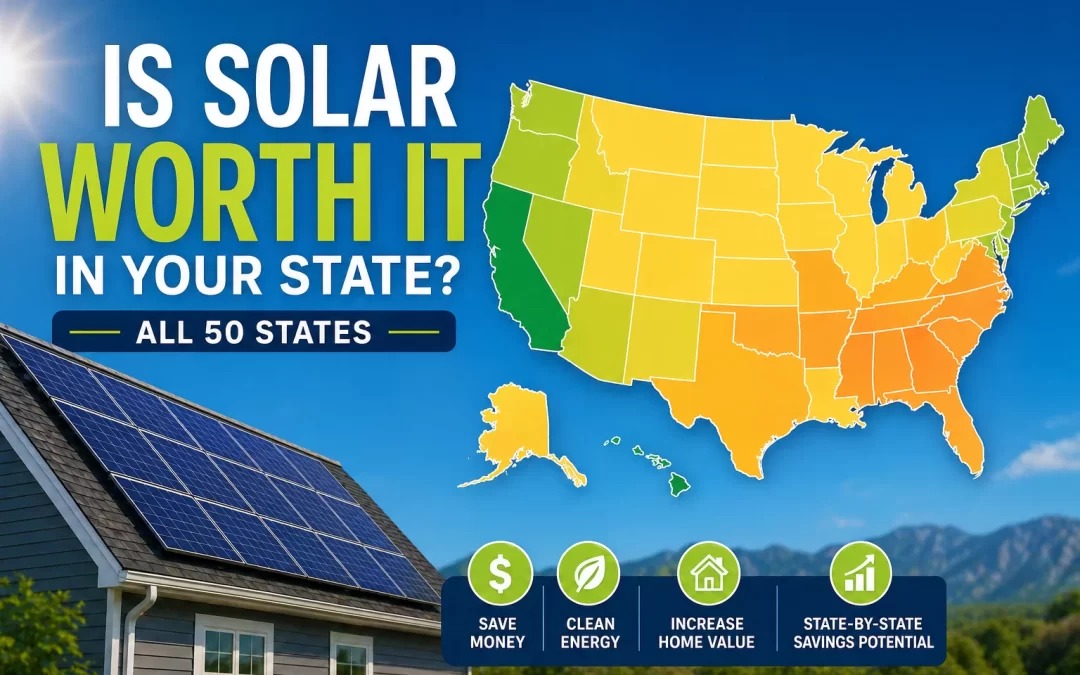
Solar is financially worth it for many U.S. homeowners in most states, but not in every situation or every roof. In states with higher electricity prices, decent sun, and solid incentives, solar can often pay for itself in about 7–9 years and then keep cutting your bills for 15–20 more. In states with cheap power, weak incentives, lots of shade, or restrictive utility rules, the payback can stretch much longer or never fully pencil out. The only way to know if solar is worth it in your state and on your specific home is to combine local numbers (rates, incentives, rules) with your roof and usage details.
This guide walks through how to tell if solar is worth it in your state, what numbers matter most, and when solar does not make sense. It’s written for U.S. homeowners who want a clear, honest, and practical answer before talking to installers. We’ll cover national averages, state-by-state factors, and how to quickly estimate your own payback time.
Table of Contents
- How “Is Solar Worth It in Your State?” Is Really Decided
- Key National Solar Numbers (What You Can Expect on Average)
- The 5 State-Level Factors That Matter Most
- Regional Breakdown: How Solar Tends to Perform by Region
- When Solar Is Usually Worth It in Your State
- When Solar Often Isn’t Worth It (Even in “Good” States)
- Quick Checklist: Is Solar Likely Worth It for Your Home?
- Numbers by State: What Typically Changes
- What to Do Next Before Getting Quotes
- Frequently Asked Questions
- Summary: Is Solar Worth It in Your State?
- Next Step: Get Local, Personalized Quotes
How “Is Solar Worth It in Your State?” Is Really Decided
What “worth it” actually means
When homeowners ask “Is solar worth it in my state?”, they’re usually asking two things:
- Will solar save me more money than it costs over the life of the system?
- How long will it take before I “break even” and start seeing real savings?
In simple terms, solar is worth it if the long-term bill savings and incentives are greater than the total cost of the system, within a payback period you’re comfortable with (often under 10–12 years).
The three big pieces of the solar value puzzle
Whether solar is worth it in your state comes down to three main pieces:
- What you pay for power now (your electricity rate and how fast it’s rising)
- What solar costs locally (equipment, labor, permits, and financing)
- What your state and utility allow and incentivize (net metering, rebates, tax credits)
Your roof, shade, and usage pattern then fine-tune the result.
Why state lines matter—but don’t tell the whole story
State policies and average electricity prices set the “baseline” for whether solar is usually strong, borderline, or weak. But two homes in the same state can have very different outcomes because of:
- Roof direction and shading
- Home size and energy use
- Local installer pricing and competition
- Utility-specific rules (which can vary inside the same state)
So think of your state as the starting point, not the final answer.
Key National Solar Numbers (What You Can Expect on Average)
Typical residential solar costs in the U.S.
As of 2026, here are realistic national averages for a home solar system:
- Average system size: 6–10 kW (about 15–25 panels)
- Cost per watt: $2.50–$3.50 (before incentives)
- Total system cost: $28,000–$32,000 before incentives
- After 30% federal tax credit (ITC): about $19,600–$22,400, if you qualify
These are national averages. Some states and utilities are consistently higher or lower due to labor costs, permitting, and competition among installers.
Typical savings and payback
Across the U.S., a well-designed system in a decent state typically sees:
- Average annual bill savings: $1,300–$1,500
- Simple payback period: 7–9 years (national average)
- Panel performance warranty: 25–30 years
- Typical panel life: 30–35 years
That means many homeowners get 15–20 years of “mostly free” electricity after payback, assuming normal maintenance and no major equipment failures.
What affects these numbers in your state
Your actual numbers will vary based on:
- State and utility electricity rates (higher rates usually mean faster payback)
- Sun exposure (more sun hours = more production)
- State and local incentives (rebates, extra tax credits, performance payments)
- Local installation costs (labor, permitting, and competition)
- Financing method (cash, loan, lease, or power purchase agreement)
Because incentives and utility rules can change, it’s wise to confirm current programs with a local installer and a tax professional before making decisions.
The 5 State-Level Factors That Matter Most
1. Electricity prices in your state
This is usually the biggest driver of whether solar is worth it in your state.
- States with high electricity rates (often $0.18–$0.30+ per kWh) tend to see shorter paybacks.
- States with low electricity rates (around $0.09–$0.13 per kWh) often have longer paybacks.
Examples (rates vary by utility and over time):
- Higher-rate states often include: California, Hawaii, New York, Massachusetts, Connecticut, New Jersey, Rhode Island, New Hampshire, Vermont.
- Lower-rate states often include: Washington, Idaho, Wyoming, North Dakota, Louisiana, Oklahoma, Kentucky.
Even in lower-rate states, solar can still be worth it if incentives are strong and installation costs are reasonable.
2. Sun exposure (solar resource)
Sun exposure is often measured in “peak sun hours” per day. More sun hours = more energy from the same system.
- Excellent sun: Southwest and parts of the Mountain West (often 5.5–7+ peak sun hours/day)
- Good sun: Much of the South, Plains, and parts of the Midwest (around 4.5–5.5 hours/day)
- Moderate sun: Northeast, Upper Midwest, Pacific Northwest (around 3.5–4.5 hours/day)
Cloudier states can still be good for solar if electricity prices and incentives are strong enough to offset lower production.
3. State and local incentives
On top of the 30% federal tax credit (available through at least 2032), some states and utilities offer:
- State tax credits or deductions
- Upfront rebates
- Performance-based incentives (payments per kWh produced)
- Sales tax or property tax exemptions
These can shave thousands off your net cost and shorten payback by several years. Incentives change frequently, so always verify current programs and consult a tax professional before relying on any tax-related benefit.
For a deeper dive into how incentives work and how to claim them, see our solar incentives and tax credits guide.
4. Net metering and utility rules
Net metering is the policy that decides how you’re credited for extra solar power you send back to the grid.
- Full retail net metering: You get credited at roughly the same rate you pay for power. This usually leads to strong savings.
- Reduced or “net billing” rates: You may be credited at a lower rate for exports, which can lengthen payback.
- Time-of-use (TOU) rates: Your rate changes by time of day; solar can be very valuable if it offsets high-peak rates.
Some states have strong, stable net metering policies; others have reduced or are phasing them out. Utility rules can vary even within the same state, so local details matter.
5. Local installation costs and competition
Even in the same state, solar quotes can differ by thousands of dollars.
- Areas with many installers and streamlined permitting often have lower prices per watt.
- Rural areas or places with complex permitting can see higher labor and soft costs.
Getting multiple quotes is one of the easiest ways to see whether your local pricing is in line with the $2.50–$3.50 per watt national range.
Regional Breakdown: How Solar Tends to Perform by Region
Western states (CA, AZ, NV, CO, UT, NM, OR, WA, etc.)
General pattern: Excellent sun in much of the West, but policies and rates vary widely.
- Often strong for solar: California, Arizona, Nevada, Colorado, New Mexico, Utah
- More mixed: Oregon, Washington, Montana, Idaho, Wyoming (good sun in some areas but lower rates or weaker incentives)
In many western states, solar can be worth it with paybacks in the 6–10 year range, especially where electricity prices are high. In low-rate states like Idaho or Washington, payback may stretch longer, but solar can still be attractive for long-term planners or those expecting rate increases.
Southwest and South (TX, OK, LA, AR, MS, AL, GA, FL, etc.)
General pattern: Lots of sun, but electricity prices and incentives vary.
- Often strong or moderate: Texas, Florida, Georgia, South Carolina, North Carolina
- More challenging: Louisiana, Mississippi, Oklahoma, Arkansas (often lower rates and fewer incentives)
In sunny states with moderate rates and decent policies, solar can still hit 8–12 year paybacks. In very low-rate states with limited incentives, solar may be more of a long-term hedge than a quick financial win.
Midwest and Plains (MN, WI, IL, IA, MO, KS, NE, ND, SD, MI, OH, IN)
General pattern: Moderate sun, moderate rates, and a patchwork of incentives.
- Often solid: Minnesota, Illinois, Michigan (where incentives or higher rates help)
- Mixed: Iowa, Missouri, Kansas, Nebraska, the Dakotas, Indiana, Ohio, Wisconsin
In many Midwestern states, solar can be worth it with paybacks around 8–13 years, depending on local rates and incentives. Snow and clouds reduce production but usually don’t kill the economics if other factors are favorable.
Northeast and Mid-Atlantic (ME, NH, VT, MA, RI, CT, NY, NJ, PA, MD, DE)
General pattern: Higher electricity prices, moderate sun, and often strong incentives.
- Frequently very strong: Massachusetts, Rhode Island, New York, New Jersey, Connecticut, Maryland
- Generally good: Vermont, New Hampshire, Maine, Pennsylvania, Delaware (though specifics vary by utility)
Despite cloudier weather, high electricity prices and incentives often make solar very attractive here, with paybacks sometimes in the 5–9 year range for well-sited homes.
Southeast and Mid-Atlantic South (VA, NC, SC, TN, KY, WV)
General pattern: Good sun, moderate rates, evolving policies.
- Often good: North Carolina, South Carolina, Virginia (especially where net metering is favorable)
- More mixed: Tennessee, Kentucky, West Virginia (often lower rates and fewer incentives)
In many of these states, solar is worth it for homeowners with higher usage or those planning to stay long-term, even if payback is closer to 10–14 years in some areas.
When Solar Is Usually Worth It in Your State
Common situations where solar shines financially
Solar is more likely to be worth it in your state if you have:
- Electricity rates above about $0.15/kWh and rising
- Good sun exposure (mostly south-, southwest-, or west-facing roof with little shade)
- Access to full or near-full net metering or strong time-of-use savings
- State or utility incentives on top of the 30% federal tax credit
- Higher-than-average usage (large home, electric heating, EV charging, pool, etc.)
- Plans to stay in the home at least 7–10 years
In these cases, it’s common to see payback periods in the 6–10 year range and lifetime savings in the tens of thousands of dollars.
Examples of “worth it” scenarios by state type
- High-rate, high-incentive states (e.g., CA, MA, NY, NJ): Solar is often a strong financial move, with many homeowners seeing 5–9 year paybacks.
- Moderate-rate, good-sun states (e.g., TX, FL, CO, AZ, NC): Solar is usually worth it for well-sited homes, with paybacks around 7–11 years.
- Lower-rate, good-sun states (e.g., OK, LA, ID): Solar can still be worth it, but payback may be closer to 12–16 years unless incentives are strong or rates rise quickly.
Non-financial reasons solar may still be “worth it”
Even where the pure dollar payback is longer, some homeowners still choose solar because they value:
- More predictable long-term energy costs
- Backup power when paired with batteries (during outages)
- Lower personal carbon footprint
- Increased home appeal to energy-conscious buyers
These benefits are real but harder to put into a simple payback calculation.
When Solar Often Isn’t Worth It (Even in “Good” States)
Home and roof situations that hurt the math
Solar may not be worth it for your home—even in a strong solar state—if:
- Your roof is heavily shaded most of the day
- Your main roof faces north or is very complex (lots of dormers, small planes)
- Your roof is in poor condition and needs replacement soon (adding cost)
- You have very low electricity usage (small bills to offset)
In these cases, the system may produce too little to justify the cost, or the added roof work may push payback out too far.
State and utility situations that reduce value
Solar may also be less attractive in your state if:
- Your utility has very low rates and they’re not rising much
- Net metering has been replaced by low export rates that pay you far less than you pay for power
- There are no state or local incentives and installation costs are high
- Your state or utility adds extra fixed fees for solar customers
These factors can stretch payback beyond 15–20 years, which many homeowners find too long.
Financing and contract types that can make solar not worth it
How you pay for solar matters as much as where you live.
- High-interest loans can eat into your savings and lengthen payback.
- Leases and power purchase agreements (PPAs) can offer low or no upfront cost, but may:
- Provide smaller long-term savings
- Complicate selling your home
- Lock you into escalators (annual payment increases)
These options can still be worthwhile in some cases, but they require careful reading of the contract and comparison with a purchase or standard loan.
If you suspect your situation might fall into the “maybe not worth it” category, our guide on when solar doesn’t make sense walks through alternatives like efficiency upgrades and community solar.
Quick Checklist: Is Solar Likely Worth It for Your Home?
Step 1: Look at your current electric bill
- Average monthly bill under $60: Solar may still work, but savings will be modest.
- $60–$150/month: Solar can be worthwhile in many states, especially with good sun and incentives.
- $150+/month: Solar is often very attractive if your roof is suitable.
Step 2: Check your roof and shade
Walk outside and look at your roof between 10 a.m. and 3 p.m. on a sunny day:
- Mostly clear, with sun hitting a large south, southwest, or west roof plane? Good sign.
- Large trees or nearby buildings shading most of the roof? Potential red flag.
- Roof older than 15–20 years or in poor condition? Factor in replacement cost.
Step 3: Consider how long you’ll stay
- Plan to move within 3–5 years? Solar can still add value, but you may not see full payback.
- Plan to stay 7–10+ years? You’re more likely to benefit from the full savings.
Step 4: Think about your state’s general profile
Ask yourself:
- Are electricity rates in my state above or below the national average?
- Does my state or utility offer solar incentives or full net metering?
- Is my area generally sunny or cloudy?
If you’re unsure, a reputable local installer can usually give you a quick, data-based estimate of payback time for your address.
Numbers by State: What Typically Changes
What stays the same in every state
No matter where you live in the U.S., a few things are consistent:
- Federal tax credit: 30% of eligible system costs through at least 2032, if you have enough tax liability (consult a tax professional).
- Equipment life: Panels are typically warrantied for 25–30 years and often last 30–35 years.
- Typical system size: Most homes need 15–25 panels (around 6–10 kW) to cover a large share of usage.
- Basic components: Panels, inverters, racking, wiring, and monitoring are standard everywhere.
What changes from state to state
The main differences by state are:
- Electricity rates: From under $0.10/kWh in some states to over $0.30/kWh in others.
- State and local incentives: Some states add thousands in extra value; others offer none.
- Net metering rules: Full retail, reduced export rates, or no net metering at all.
- Installation costs: Labor and permitting can push costs above or below the $2.50–$3.50 per watt range.
- Sun exposure: More sun means more kWh per installed watt.
How to quickly estimate payback in your state
You can get a rough sense of whether solar is worth it in your state with this simple approach:
- Find your average monthly electric bill and multiply by 12 to get annual cost.
- Assume a system cost of $28,000–$32,000 before incentives, then subtract 30% if you expect to use the federal tax credit.
- Estimate annual savings at $1,300–$1,500 in an average state; adjust up if your rates are high, down if they’re low.
- Divide your net cost by estimated annual savings to get a rough payback period.
This won’t be perfect, but it will tell you if you’re likely in the 7–9 year national average range, or far outside it. A detailed quote will refine these numbers using your exact roof, rates, and incentives.
If you want a deeper walkthrough of how costs and savings interact, our solar cost and savings guide breaks down the math step by step.
What to Do Next Before Getting Quotes
Information to gather about your home
Before you talk to installers, it helps to have:
- 12 months of electric bills (or at least a recent bill showing usage in kWh)
- Basic roof details: age, material (asphalt, metal, tile), and any known issues
- Your plans: How long you expect to stay, and whether you might add an EV, heat pump, or other big loads
Questions to ask installers in your state
When you’re ready to get quotes, ask each installer:
- What is the total system cost and cost per watt for my quote?
- What state, local, and utility incentives apply in my area right now?
- How does net metering or export crediting work with my utility?
- What payback period and lifetime savings do you estimate, and what assumptions are you using?
- What are the warranties on panels, inverters, and workmanship?
- How will this system interact with time-of-use rates or other special rate plans?
Why getting multiple quotes matters
Because pricing and design can vary widely even within the same state, it’s smart to:
- Get at least 2–3 quotes from reputable, licensed installers
- Compare system size, equipment brands, and total cost—not just monthly payment
- Ask each installer to explain why their design and size is right for your home
This will help you see whether solar is truly worth it for your specific situation, and whether one installer is offering better value than another.
Frequently Asked Questions
Is solar worth it in all 50 states?
No, solar is not equally worth it in all 50 states. It tends to be most attractive where electricity prices are high, sun exposure is good, and policies like net metering and state incentives are strong. In states with very low rates, weak incentives, or restrictive utility rules, payback can be long enough that solar is only worthwhile for some homeowners.
How do I know if solar is worth it in my specific state and utility?
The best way is to combine your actual electric usage with local solar pricing and your utility’s rules. A reputable installer can model your roof, local sun, and rate plan to estimate payback and lifetime savings, and you can compare that to the 7–9 year national average. Always ask them to show the assumptions behind their numbers so you can judge how realistic they are.
Does the 30% federal tax credit apply in every state?
Yes, the 30% federal solar tax credit applies nationwide, but you must have enough federal tax liability to use it. It reduces the amount of federal income tax you owe, not your system price at the point of sale. Because tax situations are personal, it’s important to confirm your eligibility with a qualified tax professional.
What if my state doesn’t have net metering?
If your state or utility doesn’t offer full net metering, you may be paid a lower rate for excess power you send to the grid. Solar can still be worth it, but system design becomes more important—you may size closer to your daytime usage and consider batteries or rate plans that maximize self-consumption. A local installer can model how your utility’s rules affect payback.
Is solar still worth it if I plan to move in a few years?
If you expect to move within 3–5 years, you may not reach full payback before selling, but solar can still add value and appeal to your home. In strong solar states, buyers often see a modern, owned solar system as a plus, especially if it significantly lowers bills. If you’re considering a lease or PPA, be sure you understand how the contract transfers to a new owner.
What if solar isn’t worth it on my roof in my state?
If rooftop solar doesn’t pencil out due to shade, roof issues, or local policies, you still have options. Energy efficiency upgrades, rate plan optimization, and in some areas community solar subscriptions can reduce your bills without installing panels on your home. A local energy professional can help you prioritize the best alternatives.
Summary: Is Solar Worth It in Your State?
- Solar is financially worth it for many U.S. homeowners, especially in states with higher electricity prices, good sun, and supportive policies, with a typical 7–9 year payback.
- Average system costs run about $28,000–$32,000 before incentives and $19,600–$22,400 after the 30% federal tax credit, with 15–20 years of potential savings after payback.
- Your state’s electricity rates, incentives, net metering rules, and sun exposure are the biggest drivers of whether solar is worth it where you live.
- Roof condition, shade, usage level, and financing type can make solar either a strong investment or a marginal one—even in the same state.
- The most reliable next step is to gather your bills and get multiple local quotes so you can compare real numbers against national averages.
Next Step: Get Local, Personalized Quotes
Whether solar is worth it in your state ultimately comes down to your roof, your utility, and your actual energy use. A few tailored quotes will show you real costs, incentives, and payback times for your home—not just state averages.
When you’re ready, you can compare offers from vetted installers and see exactly how the numbers look for your address by visiting /get-my-quote/. There’s no obligation, and having real quotes in hand is the fastest way to decide if solar is truly worth it for you.