
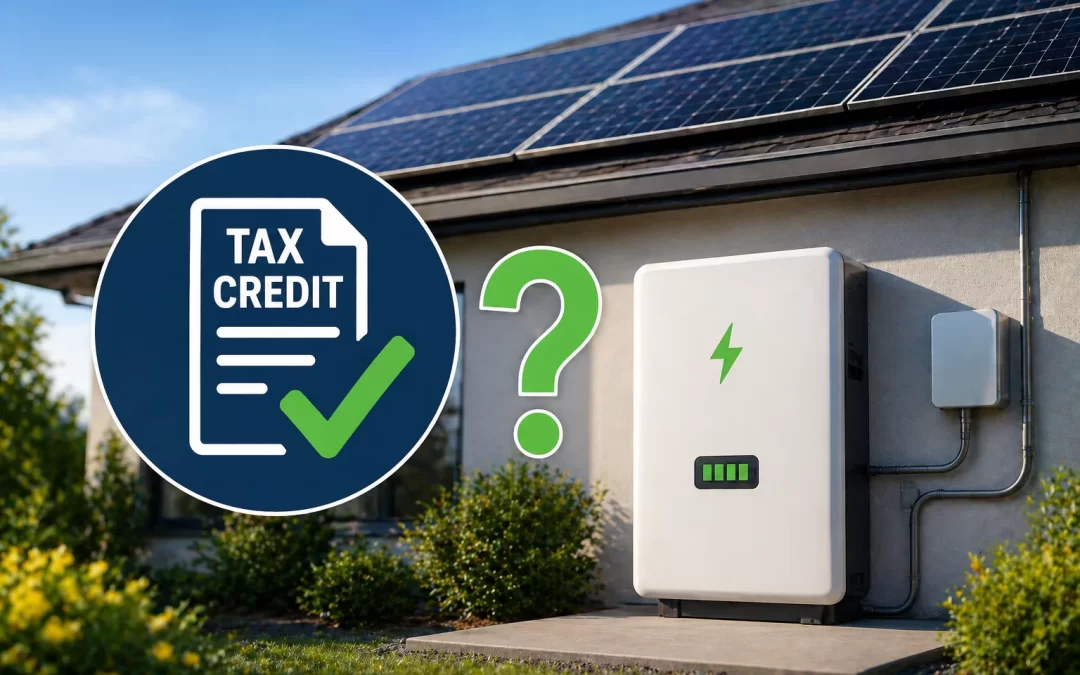
Yes, the federal solar tax credit (Investment Tax Credit, or ITC) does apply to battery storage for most homeowners, as long as the battery is charged primarily by solar panels. In 2024–2026, you can typically claim 30% of the total installed cost of a qualifying home battery system, whether it’s installed with new solar or added later. However, your actual benefit depends on your tax situation, the way the system is designed, and current IRS rules, so it’s important to confirm details with a tax professional before you rely on the credit.
The question “Does the solar tax credit apply to battery storage?” comes up a lot as more homeowners look at backup power and time-of-use savings. This guide explains, in plain language, when batteries qualify for the 30% federal solar tax credit, what rules you need to follow, and how this affects the real cost of going solar. It’s written for U.S. homeowners who want clear, practical guidance before talking to installers or filing taxes.
Table of Contents
- Does the Solar Tax Credit Apply to Battery Storage?
- How the Solar Tax Credit Works for Batteries
- Real Numbers: How Much the Battery Tax Credit Is Worth
- What Battery Systems Qualify for the 30% Credit?
- State Incentives and Utility Programs for Battery Storage
- When Using the Tax Credit for Batteries Works in Your Favor
- When a Solar Battery May Not Be Worth It (Even With the Credit)
- What to Do Before You Get Quotes
- Frequently Asked Questions
- Key Takeaways
- Next Step: Get Personalized Quotes
Does the Solar Tax Credit Apply to Battery Storage?
The short answer is yes: under current law, most residential battery storage systems can qualify for the 30% federal solar tax credit through at least 2032. This is true whether you install the battery at the same time as your solar panels or add it later.
However, there are important conditions:
- The battery must be installed at your home (your primary or secondary residence in the U.S.).
- The battery must be charged primarily by renewable energy (for homeowners, that’s usually your solar panels).
- You must have enough federal income tax liability to actually use the credit.
The IRS has updated its guidance over time, and rules can change, so you should always confirm the latest requirements with a tax professional before you make a purchase decision based on the credit.
How the Solar Tax Credit Works for Batteries
Quick overview of the 30% federal solar tax credit
The federal solar tax credit, officially called the Investment Tax Credit (ITC), lets you reduce your federal income tax by a percentage of what you spend on qualifying solar and battery equipment and installation. For systems placed in service from 2022 through 2032, that percentage is 30%.
For example, if you install a $20,000 solar + battery system in 2026 and it fully qualifies, the ITC could reduce your federal tax bill by $6,000 (30% of $20,000), assuming you owe at least that much in taxes.
For a deeper dive into how the ITC works and its schedule, see the dedicated guide on the 30% credit: Solar Tax Credit 2026: Everything You Need to Know.
How the credit applies to battery storage specifically
When a battery qualifies, you can typically include:
- The cost of the battery itself
- Associated hardware (inverters, wiring, disconnects, monitoring)
- Labor for installation and integration with your solar system
- Sales tax on these items, where applicable
All of these costs are added together as part of your “qualified solar electric property” basis. The 30% credit is then calculated on that total.
Standalone batteries vs. batteries installed with solar
Historically, batteries had to be charged 100% (or nearly 100%) by solar to qualify. Recent changes under the Inflation Reduction Act expanded eligibility, and in many cases, standalone residential batteries (installed without new solar) can now qualify as long as they are primarily charged by renewable energy.
In practice, most homeowners install batteries with solar panels or connect them to existing solar. If you’re considering a battery without solar, ask your installer and tax professional to confirm that your specific setup will meet the current IRS rules for the credit.
How you actually claim the credit
You don’t get a rebate check at installation. Instead, you claim the solar tax credit when you file your federal income tax return for the year your battery system is placed in service (turned on and operational).
- You (or your tax preparer) complete IRS Form 5695, “Residential Energy Credits.”
- You enter the total qualified costs for your solar and battery system.
- The resulting credit amount reduces your tax liability, and any unused portion may be carried forward to future years, subject to IRS rules.
For a step-by-step walkthrough of the process, see How to Claim the Solar Tax Credit (ITC) on Your Tax Return. Always confirm your specific situation with a tax professional.
Real Numbers: How Much the Battery Tax Credit Is Worth
Typical solar and battery costs
National averages for residential solar (without batteries) as of 2026:
- System cost: $28,000–$32,000 before incentives
- Cost per watt: $2.50–$3.50
- Average panels needed: 15–25 panels for a typical U.S. home
- Federal ITC: 30% through 2032
- Average annual savings: $1,300–$1,500 on electric bills
- Payback period: 7–9 years (national average)
- Panel lifespan: 25–30 years performance warranty; 30–35 years typical life
Adding a battery increases the upfront cost but can still benefit from the same 30% credit if it qualifies.
What a typical home battery costs
Battery pricing varies by brand, capacity, and installation complexity, but as a rough guide:
- Single home battery (e.g., 10–13.5 kWh usable capacity): $10,000–$16,000 installed
- Two-battery setup (for larger homes or longer backup): $18,000–$28,000 installed
These ranges include equipment and typical installation labor but not unusual electrical upgrades (like a full service panel replacement), which can add $1,000–$3,000 or more.
How the 30% credit changes the math
Here’s how the solar tax credit can apply to battery storage in real numbers:
- Example 1: Solar + one battery
Solar system: $30,000
Battery system: $12,000
Total qualified cost: $42,000
30% ITC: $12,600 potential tax credit - Example 2: Adding a battery to existing solar
Battery system: $14,000
30% ITC: $4,200 potential tax credit
These examples assume the battery qualifies and you have enough tax liability to use the full credit. If you don’t, you may be able to carry the unused portion forward to future years, but that depends on your tax situation.
How batteries affect payback period and savings
On their own, batteries rarely “pay for themselves” as quickly as solar panels. They add cost and may or may not increase your bill savings enough to keep the same 7–9 year payback period that solar alone often achieves.
Batteries can improve your economics if:
- Your utility has high time-of-use rates and the battery can shift usage from expensive evening hours to cheaper daytime solar.
- You participate in a utility or state program that pays you for battery capacity or grid support.
- You live in an area with frequent outages where backup power has high personal value, even if the strict financial payback is longer.
Individual results vary widely, so it’s important to have installers model your bill savings with and without a battery.
What Battery Systems Qualify for the 30% Credit?
Basic eligibility checklist
While only a tax professional can confirm your specific situation, most residential battery systems qualify for the solar tax credit if:
- The battery is installed at a home you own in the U.S. (primary or secondary residence).
- The system is new (not used or refurbished) and placed in service during the tax year you claim the credit.
- The battery is integrated with a renewable energy system, typically rooftop solar.
- The system is primarily charged by solar or other qualifying renewable sources, per current IRS guidance.
Solar-charged requirement and grid charging
Historically, the IRS required that residential batteries be charged 100% (or nearly 100%) by solar to qualify for the ITC. Recent legislation has broadened eligibility, but the safest approach is still to design your system so that:
- The battery is configured to charge from your solar system as the primary source.
- Any grid charging is limited or clearly secondary, especially if you’re relying on the credit.
Your installer should be familiar with current rules and able to document that your system is primarily solar-charged. Ask them to explain how your system will be configured and what records they keep.
New construction vs. existing homes
If you’re building a new home, you can typically claim the solar tax credit for solar and batteries installed as part of the build, as long as you own the home and place it in service during the tax year. For existing homes, the same rules apply: the credit is based on when the system is installed and operational, not when you sign the contract.
Ownership matters: no credit for leased batteries
To claim the solar tax credit for battery storage, you must own the system. That usually means:
- You paid cash, or
- You financed the system with a loan (secured or unsecured).
If you lease your solar and battery system or sign a power purchase agreement (PPA), the company that owns the equipment may claim the credit instead of you. In exchange, they might offer lower monthly payments, but you personally won’t get the tax benefit.
State Incentives and Utility Programs for Battery Storage
How state and local incentives stack with the federal credit
Many states and utilities offer additional incentives for solar batteries, such as:
- Upfront rebates per kWh of battery capacity
- Performance-based payments for providing grid services
- Extra incentives for low-income households or certain neighborhoods
These incentives can sometimes be combined with the federal solar tax credit, but the order in which they’re applied can affect your tax basis. For example, some rebates may reduce the amount you can claim under the ITC. This is another area where a tax professional’s guidance is important.
Examples of state and utility battery programs
Programs change frequently, but as of 2026, some common types include:
- California: Self-Generation Incentive Program (SGIP) rebates for batteries, with higher amounts for low-income and high-fire-risk areas.
- Massachusetts: Battery incentives through programs like ConnectedSolutions, which pay homeowners for allowing the utility to use stored energy during peak times.
- Hawaii, New York, and others: Various battery and demand-response programs that can significantly improve battery economics.
To see how your state stacks up for solar incentives in general, including some battery-related programs, review State Solar Incentives: Best States for Solar Rebates in 2026.
Extra help for low-income homeowners
Some states and utilities offer enhanced incentives for low- and moderate-income households, which can dramatically reduce the cost of solar and batteries. These may include:
- Higher rebate amounts
- Grants or no-cost installations
- Special financing with low or no interest
If you think you might qualify, it’s worth exploring programs highlighted in Solar Incentives for Low-Income Homeowners and asking local installers what’s available in your area.
When Using the Tax Credit for Batteries Works in Your Favor
Situations where a battery + solar system is especially compelling
The solar tax credit makes batteries more affordable, but they’re still a significant investment. They tend to make the most sense when:
- You have frequent or long power outages. If you lose power several times a year or for many hours at a time, the value of keeping lights, refrigeration, internet, and medical devices running can easily justify the added cost.
- Your utility has high time-of-use (TOU) rates. In areas where evening electricity prices are much higher than midday prices, a battery can store your cheap daytime solar and use it during expensive evening hours, improving your bill savings.
- You’re in a state with strong battery incentives. When state or utility programs stack on top of the 30% federal credit, the net cost of a battery can drop dramatically.
- You have high energy usage in the evening. If your biggest loads (HVAC, EV charging, cooking) are at night, a battery can help you use more of your own solar instead of buying from the grid.
How the tax credit improves peace-of-mind purchases
Some homeowners choose batteries primarily for peace of mind rather than pure financial return. The 30% credit effectively discounts that peace-of-mind purchase. For example:
- $14,000 battery system – 30% ITC ($4,200) = $9,800 net cost before any state incentives.
That’s still a meaningful investment, but for many families in outage-prone areas, it’s easier to justify when the federal government is covering nearly a third of the cost.
When a Solar Battery May Not Be Worth It (Even With the Credit)
Scenarios where a battery often doesn’t pencil out
To keep this honest: batteries are not the right choice for every homeowner, even when the solar tax credit applies. A battery may not be worth it if:
- Your grid is very reliable. If you rarely lose power and outages are short, the backup value is low.
- Your utility has simple, low flat rates. In areas without time-of-use pricing or demand charges, a battery may not add much bill savings beyond what solar alone provides.
- You’re on a tight budget. If adding a battery means stretching your finances or downsizing your solar array, it may be smarter to install solar only and consider a battery later.
- You don’t have enough tax liability. If you owe little or no federal income tax, you may not be able to use the full 30% credit, which reduces the financial benefit of the battery.
Common misconceptions about “going off-grid”
Many homeowners think a battery will let them disconnect from the grid entirely. In reality:
- Most residential systems are designed as grid-tied with backup, not fully off-grid.
- Going truly off-grid usually requires much more battery capacity, a larger solar array, and often a backup generator, which can be very expensive.
- Staying connected to the grid gives you flexibility and often better economics.
If your main goal is to reduce your electric bill, solar panels alone usually deliver the best return. A battery is more about resilience and fine-tuning your savings.
Why “free battery with solar” offers deserve scrutiny
Some marketing pitches advertise “free batteries” or “no-cost backup.” In most cases, the cost of the battery is simply built into the overall system price, and the company may be counting on the solar tax credit behind the scenes.
Before signing anything:
- Ask for a line-item quote that clearly separates solar and battery costs.
- Compare quotes from at least two or three installers.
- Be wary of high-pressure sales tactics or claims that the credit is “expiring tomorrow.”
What to Do Before You Get Quotes
Clarify your goals for a battery
Before talking to installers, decide what you want the battery to do:
- Provide backup power for critical loads only (fridge, lights, internet, medical devices)
- Back up most of the house for short outages
- Maximize bill savings with time-of-use rates
- Support an electric vehicle or electrified heating system
Your goals will determine how much battery capacity you need and whether the extra cost makes sense.
Key questions to ask installers about the tax credit and batteries
When you request quotes, ask each installer:
- “Will this battery system qualify for the 30% federal solar tax credit under current rules?”
- “How will the system be configured to ensure the battery is primarily charged by solar?”
- “Can you provide a breakdown of solar vs. battery costs in the quote?”
- “How much additional bill savings do you expect the battery to provide each year?”
- “What outages or rate scenarios are you assuming in your savings estimate?”
Also ask if they can share example projects in your area and how those homeowners are using their batteries.
Information to gather before getting quotes
You’ll get better, more accurate proposals if you have:
- 12 months of electric bills (kWh usage and total cost)
- Your utility rate schedule (especially if you’re on time-of-use rates)
- A list of appliances or circuits you want backed up
- Any plans to add EVs, heat pumps, or other major loads
To understand the broader cost and savings picture for solar itself, it can help to review a detailed overview like the solar cost and savings guide before you commit.
Frequently Asked Questions
Can I claim the solar tax credit for a battery added to an existing solar system?
In many cases, yes. If you add a qualifying battery to an existing solar system at your home and it is primarily charged by solar, you can typically claim the 30% federal solar tax credit on the battery’s installed cost in the year it’s placed in service. Always confirm with a tax professional based on current IRS rules.
Does the solar tax credit cover 100% of a battery’s cost?
No. The federal solar tax credit currently covers 30% of the eligible installed cost of a qualifying battery system, not 100%. You are still responsible for the remaining 70%, and your ability to use the full credit depends on your federal tax liability.
Do I need solar panels to get the tax credit for a battery?
Most homeowners pair batteries with solar panels, and that’s the clearest path to qualifying for the credit because the battery is clearly solar-charged. Recent law changes have expanded eligibility for standalone batteries, but the system generally must be primarily charged by renewable energy, so you should confirm your specific setup with an installer and tax professional.
Can I still get the solar tax credit if I finance my battery with a loan?
Yes. As long as you own the system (even if you’re paying for it over time with a loan), you can typically claim the 30% solar tax credit on the full qualifying cost. Leasing or power purchase agreements are different—if you don’t own the equipment, you generally can’t claim the credit yourself.
What happens if I don’t owe enough tax to use the full 30% battery credit this year?
If your federal tax liability is lower than your calculated credit, you may be able to carry the unused portion forward to future tax years, subject to IRS rules. The exact treatment depends on your situation, so it’s important to review this with a tax professional before you rely on the carryforward.
Will a battery make my solar pay back faster?
Not always. Solar panels alone typically deliver the fastest payback (around 7–9 years on average), while adding a battery increases upfront cost and may or may not increase savings enough to keep the same payback period. Batteries tend to make the most financial sense where time-of-use rates, strong incentives, or frequent outages are part of the picture.
Key Takeaways
- The 30% federal solar tax credit generally does apply to residential battery storage when the system is primarily charged by solar and installed at a home you own.
- Typical home batteries cost $10,000–$16,000 installed, so the credit can be worth several thousand dollars, significantly lowering your net cost.
- Solar alone often pays back in 7–9 years, while batteries add resilience and flexibility but don’t always improve pure financial payback.
- Your tax liability, local utility rates, outage frequency, and state or utility incentives all heavily influence whether a battery is a smart investment.
- The best next step is to get detailed quotes from reputable installers and review the tax implications with a professional before making a decision.
Next Step: Get Personalized Quotes
The rules around the solar tax credit and battery storage are complex, and the numbers that matter most are the ones for your home, your utility, and your tax situation. Getting a few personalized quotes will show you exactly how much a solar + battery system would cost after incentives and what kind of backup and savings you can realistically expect.
When you’re ready to see real numbers for your roof and your utility, you can compare offers from vetted installers through our secure quote request page: get my solar and battery quote. There’s no obligation, and having multiple bids puts you in a much stronger position to decide what’s right for your home.