
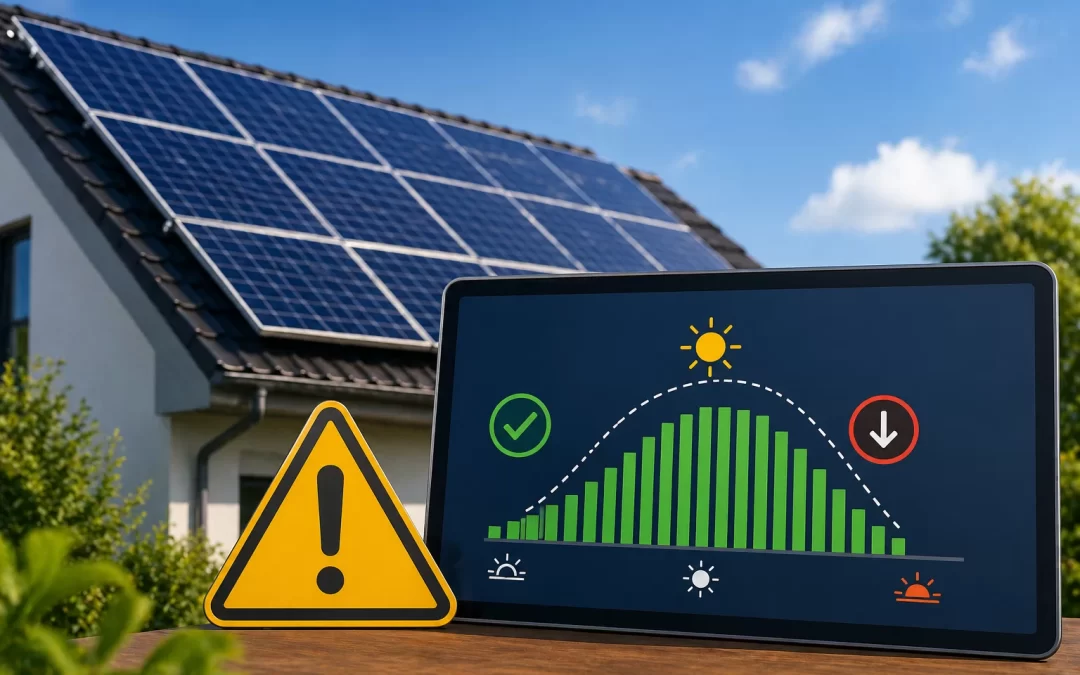
If your solar system is producing less than expected, it usually comes down to a few common issues: shading, dirty panels, seasonal changes in sunlight, equipment problems (often the inverter), or your original estimate being too optimistic. Start by comparing your actual production to your installer’s projections month by month, then check for obvious issues like shade, dirt, or error lights on your inverter or monitoring app. Some drop in output over time is normal (most panels lose about 0.5% efficiency per year), but sudden or large drops usually mean something is wrong. If basic checks don’t explain the loss, it’s time to contact your installer or a qualified solar technician.
This guide is for homeowners asking, “Why is my solar system producing less than expected—and what should I do about it?” We’ll walk through the most common causes, how to tell if your system is really underperforming, and when to call in a professional. You’ll also see realistic numbers for solar output, savings, and what affects them so you can make smart decisions about maintenance and next steps.
Table of Contents
- Is My Solar System Really Producing Less Than It Should?
- Most Common Reasons Solar Systems Produce Less Than Expected
- Seasonal and Weather-Related Drops in Solar Production
- Equipment Problems That Cut Solar Production
- Dirt, Shading, and Roof Changes
- Key Numbers: Output, Degradation, Costs, and Savings
- When Lower Production Is Normal—and When It’s a Problem
- What to Do Next if Your Solar Is Underperforming
- Frequently Asked Questions
- Summary
- Get a Personalized Checkup and Quote
Is My Solar System Really Producing Less Than It Should?
Start by comparing to your original estimate
The first step is to confirm whether your solar system is truly underperforming or just behaving normally for the season. Your installer should have given you a production estimate, often called a “solar production report” or “PV estimate,” showing expected kilowatt-hours (kWh) per month and per year.
To check performance:
- Open your monitoring app or inverter portal and note your total kWh produced for each month.
- Compare those numbers to the same months in your original estimate (not just the annual total).
- Look at at least 6–12 months of data if possible, not just one cloudy month.
If your system is consistently 10–20% below the estimate over several months with normal weather, that’s worth investigating. A difference of 5–10% in any single month is often within normal variation.
Understand how solar estimates are created
Solar production estimates are based on:
- Your system size in kilowatts (kW)
- Roof orientation and tilt
- Historical sun data for your location
- Expected shading from trees, chimneys, or nearby buildings
- Typical system losses (wiring, inverter, temperature)
These are educated projections, not guarantees. Most installers aim to be within about ±10% of actual long-term performance, but short-term weather swings can be much larger.
Key benchmarks for a typical home system
For a typical U.S. home system:
- System size: 6–10 kW (about 15–25 panels)
- Annual production: roughly 1,200–1,600 kWh per kW of solar per year, depending on location
- Example: an 8 kW system might produce about 9,600–12,800 kWh per year
If your actual annual production is far below that range and your installer’s estimate, it’s a sign something may be off.
Most Common Reasons Solar Systems Produce Less Than Expected
The big five causes
Most underperforming systems come back to one or more of these issues:
- Seasonal changes – shorter days and lower sun angles in winter
- Weather – long stretches of clouds, smoke, or haze
- Dirt and debris – dust, pollen, bird droppings, or leaves on panels
- Shading changes – tree growth or new structures blocking the sun
- Equipment problems – inverter faults, wiring issues, or a failed panel
Sometimes the cause is simpler: the original estimate was too optimistic, or your expectations weren’t aligned with how solar actually behaves month to month.
How to quickly narrow it down
Ask yourself:
- Is the drop sudden or gradual? Sudden drops often point to equipment faults; gradual declines may be dirt, shading, or normal panel aging.
- Is it seasonal? Lower winter production is normal; compare this winter to last winter, not to summer.
- Is there an error light or alert? Your inverter or monitoring app may already be flagging a problem.
- Has anything changed around your roof? New trees, additions, or nearby construction can add shade.
Seasonal and Weather-Related Drops in Solar Production
Seasonal variation: why winter looks “bad”
Solar production is not flat across the year. In most of the U.S., you’ll see:
- Summer: highest production (long days, high sun angle)
- Spring/Fall: moderate production
- Winter: lowest production (short days, low sun angle, more storms)
It’s common for a system to produce 2–3 times more in its best summer month than in its worst winter month. That doesn’t mean your system is failing—it’s just how sunlight works.
Weather swings and “bad months”
Even in summer, production can dip if you have:
- Extended cloudy or rainy periods
- Wildfire smoke or heavy haze
- Frequent storms or heavy humidity
One or two low months don’t necessarily mean a problem. Look at your annual production compared to the estimate before assuming your system is underperforming.
Snow, ice, and cold climates
In snowy areas, panels can be covered for days or weeks, cutting production to near zero during that time. The good news is that panels actually work more efficiently in cold temperatures once the snow slides off. For a deeper dive on winter performance, see Do Solar Panels Work in Winter? (Snow, Cold, and Low Sun).
When seasonal and weather impacts are “normal”
Seasonal and weather-related drops are usually normal when:
- Your annual production is still within about 10–15% of the original estimate.
- The pattern repeats each year (low in winter, high in summer).
- Your monitoring shows production rising and falling with sunny vs. cloudy days.
If your production is low even on clear, sunny days compared to past years, it’s time to look beyond weather.
Equipment Problems That Cut Solar Production
Why equipment issues matter so much
Even a small equipment problem can cause a big drop in output. Common issues include:
- Inverter problems – the inverter converts DC from panels to AC for your home; if it fails or derates, production can plummet.
- Panel failure – rare, but a single panel can fail or degrade badly.
- Monitoring failures – sometimes the system is producing fine, but the monitoring data is wrong or offline.
<liString or circuit issues – one bad connection can affect a whole group of panels.
How to check your inverter and monitoring
Steps to take:
- Look at your inverter (usually in the garage, basement, or outside near your meter).
- Check for warning lights, error codes, or an obvious “off” state.
- Open your monitoring app or web portal and look for alerts or gaps in data.
- Compare your inverter’s total kWh reading to your monitoring app to see if they match.
If you see error codes or your inverter is off, don’t try to open or repair it yourself. Contact your installer or a licensed solar electrician. For more detail on this, see Solar Inverter Problems: How to Diagnose and Fix Common Issues.
Warranty coverage and what to expect
Most residential solar systems include:
- Panel performance warranty: 25–30 years
- Panel product warranty: 10–25 years
- Inverter warranty: typically 10–15 years (sometimes 25 for microinverters)
- Workmanship warranty from installer: often 10 years
If your system is only a few years old and has a clear equipment fault, there’s a good chance it’s covered. Our guide on solar panel warranty claims explains how to document issues and work with your installer or manufacturer.
Dirt, Shading, and Roof Changes
How much does dirt really matter?
Light dust usually has a small impact (a few percent), but heavier buildup can cut production by 10–20% or more. Common culprits include:
- Pollen in spring
- Dust in dry, windy areas
- Bird droppings, especially near trees or power lines
- Leaves and organic debris in fall
If you can see obvious dirt or streaks from the ground, cleaning may help. For safe, practical tips, see How to Clean Solar Panels (And How Often You Actually Need To).
Shading: trees grow, neighborhoods change
Shading is one of the most common reasons a system that used to perform well starts to lag. Over 5–10 years, trees can grow enough to shade panels for several extra hours a day. New buildings, additions, or even a neighbor’s second story can also cast new shadows.
Signs shading may be the issue:
- Your system performed well in the first few years, then gradually declined.
- You notice shade on your roof earlier or later in the day than before.
- Your monitoring (if you have panel-level data) shows certain panels consistently underperforming.
What you can do about shading and dirt
Possible actions include:
- Trimming or removing problem trees (check local rules and property lines first).
- Scheduling regular cleanings if you live in a dusty or high-pollen area.
- Asking your installer whether adding optimizers or microinverters could help if shading is unavoidable.
Always prioritize safety—don’t climb on your roof unless you’re trained and properly equipped. Many homeowners hire professionals for cleaning and tree work.
Key Numbers: Output, Degradation, Costs, and Savings
Typical system size, cost, and production
For a typical U.S. home:
- Average system size: 6–10 kW (about 15–25 panels)
- Cost per watt: about $2.50–$3.50 per watt before incentives
- Total system cost: roughly $28,000–$32,000 before incentives for a common 8–10 kW system
- Federal tax credit (ITC): 30% through 2032 (consult a tax professional for your specific situation)
- Net cost after 30% ITC: about $19,600–$22,400 for that same system, if you qualify
On the performance side:
- Annual production: about 1,200–1,600 kWh per kW per year, depending on your state and roof.
- Average annual savings: around $1,300–$1,500 on electricity bills, nationally.
- Payback period: typically 7–9 years on average, faster in high-electricity-cost states.
- Panel lifespan: 25–30 years performance warranty, 30–35 years typical usable life.
Your actual numbers will vary based on your utility rates, roof, shading, and incentives. If your system is producing significantly less than expected, your payback period stretches out, and your long-term savings shrink—another reason it’s worth addressing underperformance early.
Normal panel degradation vs. real problems
Solar panels slowly lose output over time. Most modern panels are warranted to produce:
- About 90% of their original output after 10 years
- About 80–85% after 25 years
This works out to roughly 0.4–0.6% loss per year. If your system is dropping 5–10% per year, that’s not normal degradation—that’s a problem that needs investigation.
Location and state-specific considerations
Where you live affects both expected production and how serious a “low” year is:
- High-sun states (CA, AZ, NV, NM, CO, TX, FL): higher expected kWh per kW; a 15–20% drop is a big deal.
- Cloudier states (WA, OR, Northeast, Midwest): more year-to-year variation; you may see bigger swings from weather alone.
- Snowy states (MN, WI, NY, CO high elevations): snow coverage can cut winter output sharply, but annual production may still be on target.
When in doubt, compare your system’s performance to the original estimate and to past years, not to a friend’s system in another state.
When Lower Production Is Normal—and When It’s a Problem
When lower production is normal (and not worth stressing over)
It’s usually normal when:
- Your annual production is within about 10–15% of the installer’s estimate.
- The drop lines up with seasonal patterns or an unusually cloudy year.
- The change is small and gradual, matching expected panel degradation.
- Your electric bills are still much lower than before solar, and your payback timeline is roughly on track.
When lower production is a red flag
Take action if:
- You see a sudden, large drop (20–50% or more) in production that doesn’t match the weather.
- Your monitoring shows error codes, offline devices, or missing data.
- Your system is consistently 15–25% below the original estimate over a full year.
- Your electric bills have jumped back up to near pre-solar levels.
In these cases, it’s likely more than just weather or seasons—and you should involve your installer or a qualified solar technician.
When solar might not be the right fit anymore
In some situations, even a perfectly working system may not deliver the savings you hoped for:
- Your utility changed its net metering rules, reducing credits for excess solar.
- Your electricity rates stayed low or dropped, lengthening your payback period.
- New shading (that you can’t remove) permanently cuts your production.
Solar can still be worthwhile in many of these cases, but the math changes. Our honest guide, Is Solar Worth It?, walks through when solar makes financial sense and when it doesn’t.
What to Do Next if Your Solar Is Underperforming
Step 1: Confirm the problem with data
Before calling anyone, gather some basic information:
- Your original production estimate (monthly and annual kWh).
- Your actual production by month for at least the last 6–12 months.
- Any screenshots of error messages from your monitoring app or inverter.
- Photos of your roof showing any shading or visible dirt/debris.
If you don’t already use your monitoring system regularly, our guide on how to monitor your solar system’s performance can help you get started.
Step 2: Do safe, basic checks
Without climbing on the roof or opening equipment, you can:
- Visually inspect panels from the ground for heavy dirt, leaves, or obvious damage.
- Check for new shade from trees or nearby buildings at different times of day.
- Look at your inverter for error lights or codes.
- Verify that your monitoring app is connected and updating.
Step 3: Decide if DIY cleaning makes sense
If dirt is clearly the issue and your roof is safely accessible, a gentle cleaning with water and a soft brush can help. However:
- Never walk on panels or use harsh chemicals or pressure washers.
- If your roof is steep, high, or difficult to access, hire a professional.
- In many climates, rain does enough cleaning that frequent washing isn’t needed.
Step 4: Contact your installer or a solar professional
If you suspect an equipment problem or can’t explain the drop with weather, dirt, or shading:
- Contact your original installer first—they know your system and warranties.
- Share your production data, photos, and any error codes.
- Ask them to check for warranty coverage on panels, inverters, and workmanship.
If your installer is no longer in business, look for a reputable local solar company or electrician experienced with your inverter brand.
Step 5: Consider a performance checkup or second opinion
For older systems or complex issues, a professional performance audit can:
- Measure actual output at the panel and inverter level.
- Identify wiring, connection, or shading problems.
- Recommend cost-effective fixes or upgrades.
In some cases, small investments (like trimming trees or fixing a bad connection) can restore a lot of lost production and improve your long-term savings.
Frequently Asked Questions
How much solar production loss is normal each year?
Most modern solar panels lose about 0.4–0.6% of their output per year, so a 5–10% drop over 10 years is normal. Anything significantly higher than that, especially in just a year or two, suggests a problem beyond normal aging.
Why is my solar production so low in winter?
Winter has shorter days, a lower sun angle, and often more clouds, all of which reduce solar output. In snowy areas, panels can be covered for days or weeks, temporarily cutting production to near zero until the snow slides off.
Can dirty solar panels really make a big difference?
Yes, heavy dirt, pollen, or bird droppings can reduce production by 10–20% or more, especially if they cover large areas of the panels. Light dust usually has a smaller impact, and in many climates, rain keeps panels clean enough that frequent washing isn’t necessary.
How do I know if my solar inverter is the problem?
If your inverter shows error lights, fault codes, or is completely off, it’s a strong sign it’s affecting production. Your monitoring app may also show the inverter as offline or report zero production even on sunny days—both are reasons to contact your installer or a qualified technician.
What should I do if my installer went out of business?
If your original installer is no longer around, look for another reputable local solar company or licensed electrician familiar with your inverter and panel brands. Your equipment warranties are usually with the manufacturers, not the installer, so you can still pursue warranty claims with proper documentation.
Can I add more panels if my system isn’t producing enough?
In many cases you can add panels, but it depends on your roof space, existing inverter capacity, and utility rules. A solar professional can review your current system and local interconnection rules to see if an expansion is practical and cost-effective.
Summary
- If your solar system is producing less than expected, compare your actual monthly and annual kWh to your original estimate before assuming something is wrong.
- Normal causes include seasons, weather, light dirt, and gradual panel degradation of about 0.4–0.6% per year.
- Red flags are sudden large drops, persistent underperformance of 15–25% or more, error codes, or big jumps in your electric bill.
- Most U.S. systems cost about $28,000–$32,000 before incentives and save around $1,300–$1,500 per year, so protecting performance directly protects your payback period.
- Your best next steps are to gather data, do safe visual checks, and contact your installer or a qualified solar professional if you suspect equipment or wiring issues.
Get a Personalized Checkup and Quote
Every home and solar system is different, and small details—like your roof, shading, and utility rates—can dramatically change your results. If your system is producing less than expected, or you’re considering upgrades or a new installation, getting a few personalized quotes is the best way to understand your options and potential savings.
A professional can review your current performance, check for issues, and show you what realistic production should look like for your home. When you’re ready, you can compare offers and find a trusted installer at /get-my-quote/—with no pressure and no obligation.