
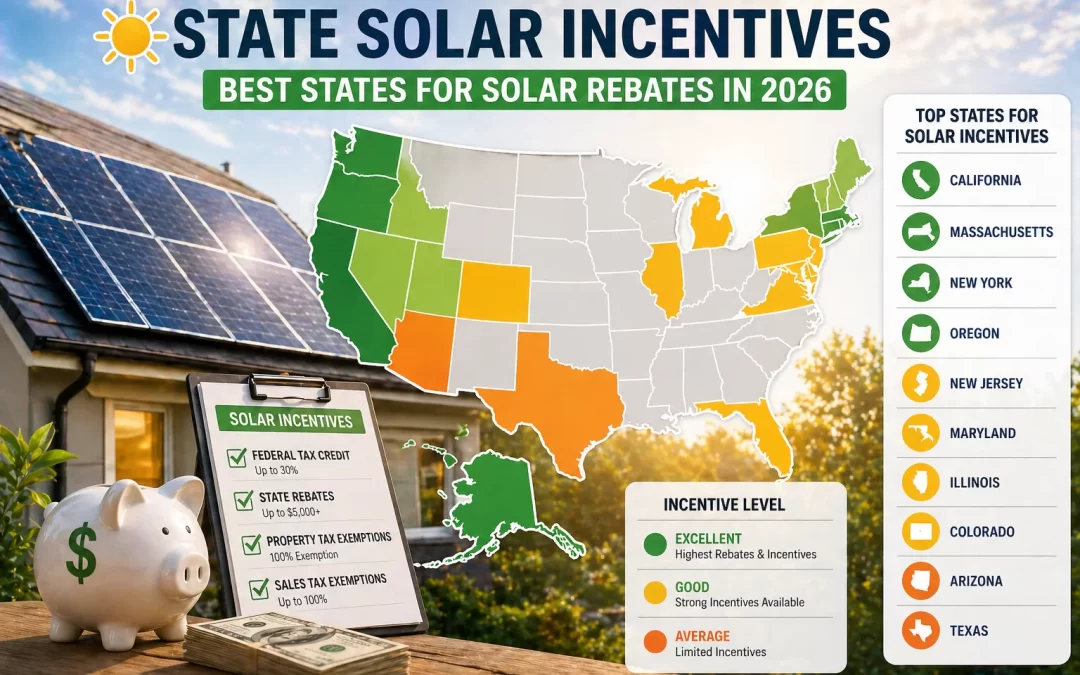
The best states for solar incentives and rebates in 2026 are generally those with a strong state tax credit, upfront rebates, and ongoing performance payments — including states like Massachusetts, New York, New Jersey, California, Illinois, Maryland, and Colorado. These states often combine generous local programs with the 30% federal solar tax credit, which can cut a typical $28,000–$32,000 system down to around $19,600–$22,400 before state benefits. However, the “best” state for you also depends on your utility rates, roof, and how much sun your home gets, so a homeowner in a moderate-incentive state with high electricity prices can still see excellent savings. State programs also change frequently, so always confirm current incentives before you sign a contract.
State solar incentives in 2026 can make the difference between a 7-year and a 12-year payback on a home solar system. This guide is for U.S. homeowners who want to understand which states are most solar-friendly and what that means in real dollars. We’ll walk through how state rebates work, which states stand out, and how to decide if now is the right time to move forward.
Table of Contents
- How State Solar Incentives Work in 2026
- Key Numbers: Solar Costs, Savings, and Incentives in 2026
- Best States for Solar Incentives and Rebates in 2026
- Types of State Solar Incentives You Might Qualify For
- When Strong State Incentives Help You the Most
- When Solar May Not Make Sense Even with Incentives
- How to Check Your State’s Solar Incentives Step-by-Step
- Decision Guide: What to Do Next
- Frequently Asked Questions
- Summary
How State Solar Incentives Work in 2026
State solar incentives are programs created by state governments, utilities, or local agencies to reduce the cost of installing solar panels or increase the income you earn from them. They stack on top of the 30% federal solar Investment Tax Credit (ITC), which is available nationwide through at least 2032.
Most state incentives fall into a few categories:
- Upfront rebates: Cash or bill credits paid per watt or per system after installation.
- State tax credits: A percentage of your system cost that reduces your state income tax.
- Performance payments: Ongoing payments based on how much electricity your system produces (often through SRECs or similar programs).
- Property and sales tax breaks: Exemptions that lower your tax bill on the equipment or added home value.
These programs are usually limited by budget or capacity and can change year to year. That’s why two neighbors in different states can see very different net costs for similar systems.
Key Numbers: Solar Costs, Savings, and Incentives in 2026
To understand which states are “best,” it helps to start with national benchmarks for 2026. These are typical ranges for a residential solar system in the U.S.; your actual numbers may be higher or lower.
Typical system cost and size
- Average system cost (before incentives): $28,000–$32,000 for a typical home.
- Cost per watt: About $2.50–$3.50 per watt, depending on equipment, roof complexity, and local labor rates.
- Average system size: 8–10 kW (kilowatts) for many U.S. homes.
- Average number of panels: 15–25 panels, depending on panel wattage and your energy use.
Federal solar tax credit (ITC)
- Federal ITC rate: 30% of eligible system costs through at least 2032.
- Typical federal credit amount: On a $28,000–$32,000 system, the ITC is roughly $8,400–$9,600.
- Net cost after federal ITC only: About $19,600–$22,400, before any state or local incentives.
How and when you claim the ITC depends on your tax situation; a tax professional can help you understand your eligibility. For a deeper walkthrough, see the federal-focused Solar Tax Credit 2026 guide.
Typical savings and payback
- Average annual bill savings: $1,300–$1,500 nationally, often higher in high-rate states.
- Typical payback period (national): 7–9 years, assuming solid sun exposure and net metering or similar crediting.
- Panel lifespan: 25–30 years performance warranty; 30–35 years typical usable life.
State incentives can shorten payback by several years. For example, a strong state rebate that knocks off another $4,000–$6,000 could turn a 9-year payback into 6–7 years.
Individual results vary based on your roof, shading, local rates, and how much electricity you use. A personalized quote is the only way to get accurate numbers for your home.
Best States for Solar Incentives and Rebates in 2026
“Best” can mean different things: biggest upfront rebate, highest long-term earnings, or fastest payback. The states below consistently rank well because they combine multiple strong programs with relatively high electricity prices.
1. Massachusetts
Massachusetts is often at or near the top for residential solar value.
- Key strengths:
- State-level incentives that have historically included performance-based payments and rebates.
- High electricity rates, which increase bill savings.
- Property and sales tax exemptions on solar equipment.
- What this can mean: Homeowners often see payback periods in the 5–8 year range, depending on system size and local programs.
Programs in Massachusetts have evolved over time (for example, SMART and earlier SREC programs), so it’s important to confirm what’s active in 2026 before you sign a contract.
2. New York
New York combines state incentives with high utility rates, especially downstate.
- Key strengths:
- State tax credit for residential solar (subject to caps and eligibility rules).
- Upfront rebates in some utility territories through state energy agencies.
- Property tax exemptions for solar in many areas.
- What this can mean: In some parts of New York, total incentives (federal + state + local) can reduce out-of-pocket costs by 40–50% or more, with payback often in the 6–8 year range.
3. New Jersey
New Jersey has long been a leader in performance-based solar incentives.
- Key strengths:
- Performance payments through SREC-style programs that pay you for each unit of energy your system produces.
- Net metering or similar crediting structures with many utilities.
- Strong solar market with many competing installers, which can help keep prices competitive.
- What this can mean: Homeowners can earn ongoing income from their solar production, improving lifetime returns beyond simple bill savings.
If you’re in a state with SRECs or similar markets, it’s worth reading more about what SRECs are and how to sell them.
4. California
California has high electricity prices and a long history of solar incentives, though net metering rules have tightened in recent years.
- Key strengths:
- Very high utility rates in many areas, which boosts bill savings.
- Property tax exclusion for solar improvements.
- Targeted incentives for low-income households and certain utility territories.
- What this can mean: Even with less generous net metering than in the past, many California homeowners still see strong economics, especially when pairing solar with batteries to maximize self-consumption.
5. Illinois
Illinois has become a strong solar state thanks to robust performance-based incentives.
- Key strengths:
- State programs that pay for renewable energy credits generated by your system.
- Additional incentives for low- and moderate-income households.
- Growing installer competition and improving solar market maturity.
- What this can mean: Many homeowners can offset a significant portion of their upfront cost through state-level REC payments, on top of the 30% federal ITC.
6. Maryland
Maryland offers a mix of SRECs and tax benefits.
- Key strengths:
- Active SREC market that can provide ongoing income.
- Property tax exemptions for solar in many jurisdictions.
- State and local grants or rebates that may be available depending on your county or city.
- What this can mean: Combined with moderate-to-high electricity rates, Maryland homeowners can see solid returns and payback times in the 7–9 year range or better.
7. Colorado
Colorado combines good sun exposure with a patchwork of strong utility and local incentives.
- Key strengths:
- High solar resource (lots of sunny days) that boosts production.
- Utility-level rebates or performance payments in some territories.
- Net metering policies that can be favorable depending on your utility.
- What this can mean: Even if upfront state-level rebates are modest, strong sun and decent local programs can still deliver attractive payback periods.
Other states worth watching
Several other states may not top every “best of” list but still offer meaningful incentives in 2026, especially when combined with high local rates or strong sun:
- Arizona
- Texas (primarily utility and local incentives)
- Oregon and Washington (regional and utility programs)
- Minnesota
- Rhode Island and Connecticut
In many of these states, the value comes from a combination of smaller incentives, favorable net metering, and good solar resource rather than one huge statewide rebate.
Types of State Solar Incentives You Might Qualify For
Understanding the main types of incentives will help you read quotes and program descriptions more confidently.
1. State tax credits
A state solar tax credit reduces the state income tax you owe, similar to the federal ITC but at the state level.
- Often a percentage of your system cost (for example, 10–25%), sometimes with a dollar cap.
- May be carried forward to future years if you can’t use it all at once, depending on state rules.
- Availability and rules vary widely; some states have no solar tax credit at all.
Because tax situations are personal, it’s wise to confirm with a tax professional how much of any state credit you can realistically use.
2. Upfront rebates
Rebates are usually paid by a state energy office, utility, or local program administrator after your system is installed and inspected.
- Can be a flat amount (for example, $500–$2,000) or based on system size (for example, $0.20–$0.50 per watt).
- Often limited by annual budgets or total program capacity.
- May decline over time as more people install solar (“step-down” structures).
Rebates reduce your upfront cost directly and may also reduce the base amount used to calculate your federal ITC, depending on how the program is structured.
3. Performance-based incentives and SRECs
Performance-based incentives pay you over time based on how much electricity your system produces.
- Often structured as Solar Renewable Energy Credits (SRECs) or similar certificates.
- You earn credits for each megawatt-hour (MWh) your system generates and can sell them into a market.
- Prices can fluctuate, and program rules can change, so income is not guaranteed.
In strong SREC states, these payments can add thousands of dollars in value over the life of your system. For details on how these markets work, see the guide on what SRECs are and how to sell them.
4. Net metering and bill credits
Net metering isn’t a rebate, but it’s one of the most important “incentives” for solar economics.
- When your panels produce more than you use, excess power flows back to the grid.
- Net metering credits you for that excess, often at or near the retail electricity rate.
- Some states have moved to “net billing” or time-of-use structures, which can reduce the value of exported energy.
Strong net metering can be just as valuable as a cash rebate, especially over 25–30 years of system life.
5. Property and sales tax exemptions
Solar can increase your home’s value, which might normally increase your property taxes. Many states and localities exempt solar from this calculation.
- Property tax exemption: The added value from solar is not counted when assessing property taxes.
- Sales tax exemption: You don’t pay sales tax on solar equipment, which can save hundreds or thousands of dollars.
These benefits don’t show up as a check in your hand, but they improve your overall return on investment.
6. Low-income and targeted programs
Many states and utilities offer extra incentives for low-income households, certain neighborhoods, or specific customer groups.
- Higher rebates or grants that can cover a larger share of system cost.
- Community solar options that don’t require owning your roof.
- Special financing or on-bill repayment programs.
If your household qualifies, these programs can dramatically change the math. For a deeper look, see the overview of solar incentives for low-income homeowners.
When Strong State Incentives Help You the Most
State solar incentives are most powerful in certain situations. Knowing where you fit can help you decide how urgent it is to act.
High electricity rates + strong incentives
If you live in a state with:
- Electricity rates above about $0.18–$0.20 per kWh, and
- Good state incentives (tax credits, rebates, or SRECs),
you’re in a “sweet spot” for solar. Your panels offset expensive electricity, and incentives reduce your upfront cost, often leading to:
- Payback in the 5–8 year range.
- Lifetime savings that can easily exceed $25,000–$40,000 over 25–30 years, depending on rate inflation.
Good sun exposure and a solar-friendly roof
State incentives go further when your system performs well.
- South or southwest-facing roof with minimal shading.
- Enough roof area for 15–25 panels.
- Roof in good condition (ideally less than 10–12 years old for asphalt shingles).
In these cases, incentives help you install a system that can reliably produce for decades, maximizing the value of every rebate dollar.
When incentives are scheduled to step down
Some state programs are designed to decline over time as more people install solar.
- Rebate levels may drop after a certain capacity is installed.
- Performance payment rates may be lower for later participants.
- Program budgets can run out mid-year.
If your state has a published step-down schedule, there can be real value in moving sooner rather than later, as long as you’re otherwise ready.
When Solar May Not Make Sense Even with Incentives
Even in a “best” solar state, incentives can’t fix every situation. Being honest about this helps you avoid a poor investment.
Poor roof or site conditions
Solar may not be a good fit if:
- Your roof is heavily shaded by trees or nearby buildings most of the day.
- Your main roof faces north (in the U.S.) with limited east/west options.
- Your roof is in bad condition and needs replacement soon, but you can’t budget for both roof and solar.
In these cases, even generous incentives may not overcome low production. A reputable installer should model your expected output and be upfront if the numbers don’t work.
Very low electricity rates
If your state has low power prices (for example, $0.10–$0.12 per kWh) and only modest incentives, payback can stretch out.
- Annual savings may be closer to $600–$900 instead of $1,300–$1,500.
- Payback could be 12–15+ years, depending on system cost and rate increases.
Solar can still be worthwhile for some homeowners in these states, but it’s less of a slam dunk and requires careful analysis.
Uncertain homeownership timeline
If you expect to move within a few years, you may not fully realize the benefits of state incentives and long-term savings.
- Solar can increase home value, but the exact premium varies by market.
- Buyers may or may not value solar as highly as you expect.
- If you finance the system, you’ll need to consider how the loan transfers or is paid off at sale.
In this situation, it’s especially important to understand your local real estate market and talk with a knowledgeable agent.
Limited tax liability
Many of the most valuable incentives (federal and state tax credits) require that you owe enough income tax to use them.
- If your tax liability is low, you may not be able to use the full credit quickly.
- Some credits can be carried forward; others cannot.
- Refundability rules vary by state.
This doesn’t automatically rule out solar, but it does change the math. A tax professional can help you understand how much of the advertised incentives you can actually benefit from.
How to Check Your State’s Solar Incentives Step-by-Step
Because programs change frequently, the best way to know what’s available in 2026 is to check current sources and confirm with installers.
Step 1: Look up state and utility programs
- Search for your state’s energy office or renewable energy agency website.
- Look for sections labeled “solar incentives,” “renewable energy programs,” or “residential rebates.”
- Check your utility’s website for solar rebates, net metering policies, and special programs.
Step 2: Use a reputable incentive database
- Consult widely used public databases that track state and utility incentives (many are maintained by universities or state agencies).
- Filter by “residential” and “solar PV” to avoid mixing in commercial or non-solar programs.
- Note application deadlines, funding limits, and whether programs are currently “open” or “waitlisted.”
Step 3: Get at least two or three quotes
Installers working in your area should know which incentives are active and how to apply.
- Ask each installer to list all incentives they are including in your quote.
- Have them show how those incentives affect your net price and projected payback.
- Confirm whether they handle the paperwork or if you need to apply yourself.
Step 4: Verify tax-related incentives with a professional
For any state or federal tax credits:
- Confirm eligibility rules and carryforward provisions.
- Ask a tax professional how much of the credit you’re likely to use and over what time frame.
- Review resources like the step-by-step guide to claiming the solar tax credit so you understand the process.
Step 5: Re-run the numbers for your situation
Once you know your incentives, plug them into your personal scenario:
- System cost before incentives.
- Federal ITC amount.
- State tax credits, rebates, and performance payments.
- Expected annual bill savings based on your usage and rates.
This will give you a realistic picture of your payback period and lifetime savings, not just a generic “average.”
Decision Guide: What to Do Next
State solar incentives in 2026 are strong in many parts of the country, but the right move depends on your home and finances.
Is this the right time to act?
It may be a good time to move forward if:
- You live in a state with solid incentives or high electricity rates.
- Your roof is in good condition with decent sun exposure.
- You plan to stay in your home for at least 5–7 years.
- You have enough tax liability to benefit from the federal ITC and any state credits.
If several of these don’t apply, it’s still worth getting information, but you may decide to wait or explore alternatives like community solar.
Information to gather before getting quotes
Having a few details ready will make your quotes more accurate:
- 12 months of electric bills (kWh usage and total cost).
- Basic roof information (age, material, any known issues).
- Photos of your roof and electric panel, if requested.
- Your goals (maximum savings, backup power with batteries, lowest upfront cost, etc.).
Questions to ask potential installers
When you talk with installers, ask:
- Which state, utility, and local incentives are you including in this quote?
- How do these incentives affect my net price and payback period?
- Do you handle the paperwork for rebates and performance payments, or do I?
- How do you estimate my annual production and savings, and what assumptions are you using for electricity rate increases?
- What happens if an incentive program changes before or during my installation?
Should you get multiple quotes?
Yes. Getting at least two or three quotes is almost always worth the effort.
- Different installers may emphasize different incentives or financing options.
- Equipment choices (panels, inverters, batteries) can affect both cost and eligibility.
- Comparing quotes helps you spot unrealistic production or savings claims.
Before you compare offers, it can help to review a broader overview of costs and savings in the solar cost and savings guide, so you know what’s typical.
Frequently Asked Questions
Which state has the best solar incentives in 2026?
There isn’t a single “best” state for everyone, but Massachusetts, New York, New Jersey, California, Illinois, Maryland, and Colorado are consistently strong thanks to a mix of rebates, tax credits, and performance payments. The best state for you depends on your local utility rates, sun exposure, and which specific programs you qualify for. Always check current state and utility websites, as programs can change year to year.
Do state solar incentives stack with the 30% federal tax credit?
Yes, in most cases state incentives stack with the 30% federal solar Investment Tax Credit, which applies nationwide through at least 2032. However, some rebates may reduce the cost basis used to calculate your federal credit, and tax rules vary by state, so it’s important to confirm details with a tax professional or qualified advisor.
How much can state incentives reduce the cost of solar?
On top of the 30% federal tax credit, strong state incentives can sometimes cut another 10–25% off the upfront cost through rebates, tax credits, and performance payments. For a typical $28,000–$32,000 system, that can mean several thousand dollars in additional savings, but the exact amount depends on your state, utility, and eligibility.
Can I still benefit from solar if my state has weak incentives?
Yes, many homeowners in states with modest incentives still see good returns, especially if they have high electricity rates and good sun exposure. In those cases, most of the value comes from long-term bill savings and the 30% federal tax credit rather than big state rebates.
Do state solar incentives apply to battery storage?
Some state and utility programs do include incentives for battery storage, especially where grid reliability or time-of-use rates are a concern. Eligibility rules vary, and in some cases batteries must be paired with solar or meet specific requirements, so it’s important to review program details and the federal rules for storage, which are covered in more depth in the guide on whether the solar tax credit applies to battery storage.
How long will current state solar incentives last?
Many state programs have defined end dates, funding caps, or step-down schedules, so incentive levels can change within a few years or even months. Because of this, it’s wise to treat current incentives as “use them while they’re available” rather than assuming they’ll be the same in the future, and to confirm program status before signing a contract.
Summary
- In 2026, the best states for solar incentives and rebates include Massachusetts, New York, New Jersey, California, Illinois, Maryland, and Colorado, thanks to strong state and utility programs layered on top of the 30% federal tax credit.
- A typical residential system costs $28,000–$32,000 before incentives and $19,600–$22,400 after the federal ITC, with state incentives often reducing costs further and shortening payback below the 7–9 year national average.
- Your actual results depend most on local electricity rates, sun exposure, roof condition, and which specific state, utility, and tax incentives you can use.
- Solar may not be a good fit if your roof is heavily shaded, your power rates are very low, or you expect to move soon, even in a strong incentive state.
- The best next step is to check your state and utility programs, then get multiple quotes that clearly show how incentives affect your net cost and payback.
If you’re ready to see how state incentives and the federal tax credit would work for your home, the most reliable way is to get personalized quotes from vetted installers. A few detailed proposals will show your real costs, incentives, and payback so you can make a confident decision. When you’re ready, you can start that process at /get-my-quote/ with no obligation.