
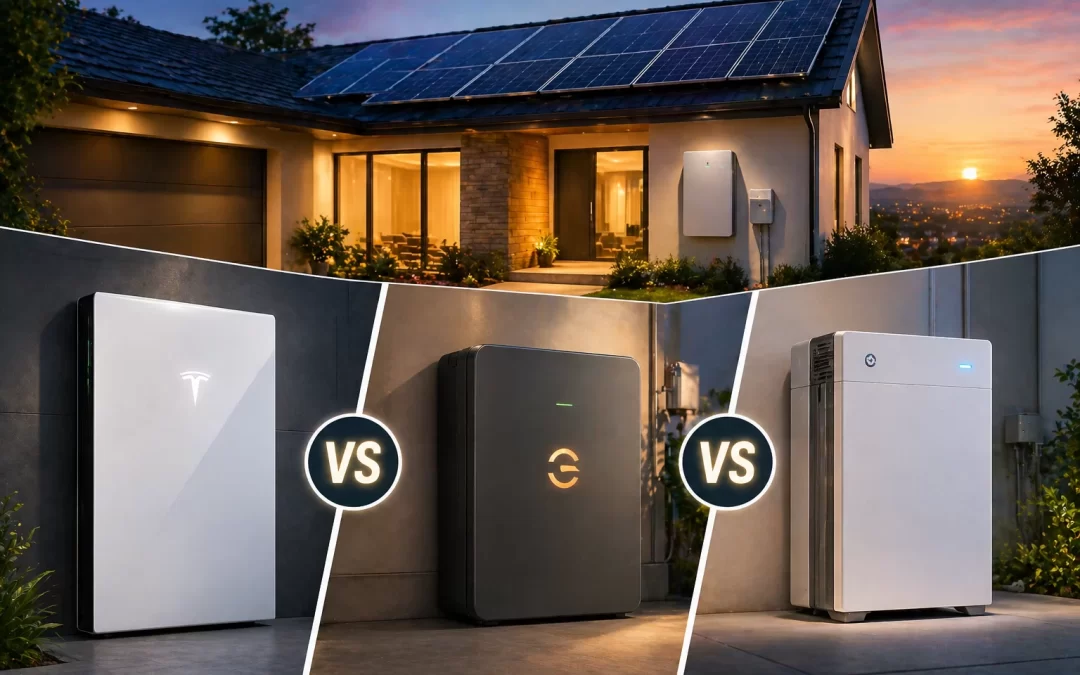
The best solar battery for most U.S. homeowners in 2026 usually comes down to three leaders: Tesla Powerwall 3, Enphase IQ Battery, and FranklinWH aPower. Tesla tends to win on price per kWh and all-in-one simplicity, Enphase is strongest if you already use (or plan to use) Enphase microinverters, and FranklinWH offers excellent backup power and whole-home integration. The right choice depends on your goals (backup vs. savings), your existing equipment, and your installer’s expertise, and in some homes a battery still won’t pay for itself financially.
If you’re comparing the best solar batteries of 2026, you’re probably looking at Tesla Powerwall vs. Enphase vs. Franklin and wondering which one is actually worth it. This guide walks through how these batteries work, what they cost, and how to choose the right one for your home and budget. It’s written for U.S. homeowners with little or no solar experience who want clear, honest, and practical advice.
Table of Contents
- How Solar Batteries Work in a Home System
- Best Solar Batteries of 2026: Tesla vs. Enphase vs. Franklin
- Real Numbers: Costs, Savings, and Payback with Batteries
- Which Battery Is Best for You?
- When a Solar Battery Makes Sense (and When It Doesn’t)
- State and Utility Considerations
- How to Decide and What to Do Before Getting Quotes
- Frequently Asked Questions
- Summary: Key Takeaways
How Solar Batteries Work in a Home System
Simple explanation
A solar battery stores extra electricity your panels produce during the day so you can use it later, usually in the evening or during a power outage. Without a battery, extra solar power is sent back to the grid, often for a credit on your bill. With a battery, more of that energy stays in your home, which can improve backup power and sometimes increase savings.
Most modern home batteries are “AC-coupled” or “DC-coupled” boxes that include the battery cells plus electronics to manage charging, discharging, and safety. They are usually wall-mounted in a garage, basement, or exterior wall and controlled by a smartphone app.
Key terms in plain language
- Capacity (kWh): How much energy the battery can store. Think of this as the size of the “fuel tank.”
- Power (kW): How much energy the battery can deliver at once. This affects how many appliances you can run at the same time.
- Usable capacity: The portion of the battery you can actually use (some systems reserve a small buffer to protect the battery).
- Round-trip efficiency: How much energy you get back compared to what you put in. Higher is better.
- Cycle: One full charge and discharge. Warranties are often based on years and/or number of cycles.
How batteries fit into a solar system
In a typical grid-tied home with solar and a battery:
- Daytime: Solar powers your home first; extra power charges the battery.
- Evening/night: The battery discharges to power your home; once empty, you draw from the grid.
- Outage: The battery and solar can keep critical loads (or your whole home, depending on system size) running.
Some batteries are tightly integrated with specific inverters or microinverters (like Enphase), while others are more “all-in-one” systems (like Tesla Powerwall 3 and FranklinWH).
Best Solar Batteries of 2026: Tesla vs. Enphase vs. Franklin
Tesla Powerwall 3 (2026)
The Tesla Powerwall 3 is one of the most popular home batteries in 2026 because it combines a large capacity, strong backup power, and competitive pricing in a single unit. It’s designed as an all-in-one system with an integrated inverter, which can simplify installation and reduce equipment costs.
Key specs (typical 2026 Powerwall 3)
- Usable capacity: ~13.5 kWh per unit
- Continuous power output: ~11.5 kW (higher than many competitors)
- Round-trip efficiency: ~90%–93%
- Warranty: 10 years, typically with at least 70% capacity remaining at year 10 (check your specific warranty)
- Chemistry: Lithium iron phosphate (LFP) in newer versions, which improves safety and longevity compared to older chemistries
- Scalability: Multiple Powerwalls can be stacked for larger homes
Typical installed cost (2026)
- Single Powerwall 3 installed: About $10,000–$13,000 before incentives
- Additional units: Often $7,000–$10,000 each (incremental cost tends to be lower than the first unit)
- After 30% federal tax credit (if eligible): Roughly $7,000–$9,100 for the first unit
Actual pricing varies by installer, region, and whether the battery is installed with new solar or added later.
Where Tesla Powerwall 3 shines
- You want strong whole-home or near-whole-home backup with a single unit.
- You prefer a widely used, well-known product with a mature app and monitoring platform.
- You’re installing a new solar system and want an integrated inverter + battery solution.
- Your installer is a certified Tesla installer and offers good local support.
Where Tesla may not be the best fit
- You already have Enphase microinverters and want a fully unified ecosystem.
- Your local installers don’t have much Tesla experience or have long wait times.
- You need very granular control over individual circuits or advanced load management beyond what Tesla offers.
Enphase IQ Battery (IQ Battery 5P and similar)
Enphase is best known for its microinverters, and its IQ Battery line is designed to work seamlessly with those systems. If your roof already has Enphase microinverters, or you plan to use them, Enphase batteries can create a tightly integrated, highly reliable system with detailed monitoring down to each panel.
Key specs (IQ Battery 5P as a common 2026 option)
- Usable capacity: ~5 kWh per unit
- Continuous power output: ~3.8 kW per unit
- Round-trip efficiency: ~90%–96% (varies by configuration)
- Warranty: 10 years, often with at least 70% capacity remaining at year 10
- Chemistry: Lithium iron phosphate (LFP)
- Scalability: Multiple units can be combined (e.g., 2–4+ units for typical homes)
Typical installed cost (2026)
- Per 5 kWh unit installed: About $5,000–$7,000 before incentives
- Typical system (10–15 kWh usable): $10,000–$18,000 before incentives
- After 30% federal tax credit (if eligible): Around $7,000–$12,600 for a 10–15 kWh system
Where Enphase batteries shine
- You already have or plan to use Enphase microinverters on your solar panels.
- You value detailed monitoring and a single app for panels, inverters, and batteries.
- You want modularity: you can start small and add more capacity later.
- Your roof layout is complex, and Enphase’s panel-level design is a good fit.
Where Enphase may not be the best fit
- You want the lowest cost per kWh of storage; Enphase is often slightly more expensive per kWh than Tesla or Franklin.
- You need very high backup power from a single unit; Enphase systems often require multiple batteries to match Tesla’s or Franklin’s output.
- Your installer is not an Enphase specialist, which can affect system design and support.
FranklinWH aPower + aGate
FranklinWH (often written as Franklin) is a newer but fast-growing player focused on whole-home backup and smart energy management. The system typically includes the aPower battery plus the aGate energy management unit, which can control loads, integrate with generators, and optimize how your home uses solar, battery, and grid power.
Key specs (FranklinWH aPower)
- Usable capacity: ~13.6 kWh per battery
- Continuous power output: ~5 kW per battery (higher with multiple units)
- Peak power: Often 10+ kW for short bursts (good for starting large loads like AC or well pumps)
- Warranty: 12 years in many configurations, often with at least 70% capacity remaining (check your specific warranty)
- Chemistry: Lithium iron phosphate (LFP)
- Scalability: Multiple batteries can be combined for large homes
Typical installed cost (2026)
- Single aPower + aGate system: About $12,000–$16,000 before incentives
- Additional batteries: Often $7,000–$10,000 each
- After 30% federal tax credit (if eligible): Roughly $8,400–$11,200 for the first unit
Where FranklinWH shines
- You want robust whole-home backup with smart load management.
- You may have (or plan to add) a backup generator and want everything coordinated.
- You like the idea of a dedicated energy management unit (aGate) that can prioritize critical loads automatically.
- Your home has high peak loads (multiple AC units, well pumps, EV charging).
Where FranklinWH may not be the best fit
- You want the most widely known brand with the longest track record; Franklin is newer than Tesla and Enphase.
- Your installer base is limited; not all markets have many Franklin-certified installers yet.
- You prefer a simpler, more standardized system with fewer components.
Head-to-head comparison: Tesla vs. Enphase vs. Franklin
| Feature | Tesla Powerwall 3 | Enphase IQ Battery | FranklinWH aPower |
|---|---|---|---|
| Usable capacity (per unit) | ~13.5 kWh | ~5 kWh (IQ 5P) | ~13.6 kWh |
| Continuous power (per unit) | ~11.5 kW | ~3.8 kW | ~5 kW |
| Chemistry | LFP (newer versions) | LFP | LFP |
| Typical installed cost (first unit) | $10,000–$13,000 | $5,000–$7,000 | $12,000–$16,000 |
| Best for | All-in-one, strong backup, value per kWh | Homes with Enphase microinverters, modular setups | Whole-home backup, smart load control, generator integration |
| Warranty length | 10 years | 10 years | ~12 years (typical) |
All three are high-quality, lithium iron phosphate systems with strong warranties. The “best” one is usually the one that matches your existing equipment, your backup needs, and the brand your local installer knows best.
Real Numbers: Costs, Savings, and Payback with Batteries
Baseline solar numbers (without a battery)
For context, here are typical national averages for a residential solar system in 2026:
- Average system size: 6–10 kW (about 15–25 panels for a typical U.S. home)
- Cost per watt: $2.50–$3.50
- Total system cost: $28,000–$32,000 before incentives
- After 30% federal tax credit: $19,600–$22,400 (if you qualify)
- Average annual bill savings: $1,300–$1,500
- Typical payback period: 7–9 years (national average)
- Panel lifespan: 25–30 years performance warranty; 30–35 years typical life
These are national averages; your actual numbers depend on your roof, local utility rates, and incentives. For a deeper dive into system costs and savings, see your utility bills and consider resources like a detailed solar cost and savings guide from a trusted source.
How a battery changes the math
Adding a battery increases your upfront cost but can improve your comfort and resilience and sometimes your financial return. Typical add-on costs for a battery in 2026:
- Battery equipment + installation: $10,000–$18,000 before incentives for 10–15 kWh of storage
- After 30% federal tax credit (if eligible): $7,000–$12,600
In many markets, a battery adds 2–5 years to your payback period if you look only at bill savings. In some states with strong incentives or high evening electricity rates, the battery can still pay for itself within the system’s life; in others, it’s more of a comfort and backup investment than a pure financial play.
What affects battery savings the most
- Your utility rate structure: Time-of-use (TOU) rates and high evening prices make batteries more valuable.
- Net metering rules: If your utility pays less for exported solar than you pay for electricity, storing your own power can help.
- Local incentives: Some states and utilities offer battery rebates that can cut costs by thousands of dollars.
- How often you cycle the battery: The more you use it for daily shifting (not just outages), the more financial value it can provide.
- System design: Right-sizing the battery to your home’s usage and solar production is critical.
Because incentives and utility rules change frequently, it’s important to review current local programs and discuss them with a qualified installer. For tax-related questions, always consult a tax professional.
Which Battery Is Best for You?
Start with your goals
Before picking Tesla, Enphase, or Franklin, get clear on what you want the battery to do:
- Backup power only: Keep lights, fridge, Wi-Fi, and maybe AC running during outages.
- Bill savings: Use stored solar when grid power is expensive (TOU rates).
- Whole-home resilience: Run most or all of your home almost normally during long outages.
- Future-proofing: Prepare for EV charging, electrification (heat pumps, induction stoves), or changing utility rules.
If your main goal is backup power
- Best fits:
- Tesla Powerwall 3: Strong single-unit power output, good for many whole-home backup setups.
- FranklinWH: Excellent for whole-home backup with smart load control and generator integration.
- Enphase: Also good for backup, but you may need multiple units to match Tesla or Franklin’s power output.
If your main goal is maximizing savings
- Look for:
- Good price per kWh of storage.
- High round-trip efficiency.
- Smart TOU and self-consumption modes in the app.
- Tesla: Often offers strong value per kWh and solid TOU controls.
- Enphase: Can be very effective in TOU markets, especially if you already have Enphase solar.
- FranklinWH: Strong controls and load management can help optimize savings in complex rate structures.
If you already have solar
- Existing Enphase microinverters: Enphase IQ Battery is usually the cleanest, most integrated choice.
- Existing string inverter (non-Enphase): Tesla or FranklinWH may be more straightforward, but Enphase can still work in some retrofit designs.
- Older systems: You may need additional equipment (like a new inverter or gateway) regardless of brand.
Non-technical factors that matter
- Installer expertise: A great installer with a “second-best” battery is usually better than a mediocre installer with the “best” battery on paper.
- Local support and warranty service: Ask who handles warranty claims and how long service typically takes.
- App and monitoring: Make sure you’re comfortable with the app interface and features; you’ll use it often.
When a Solar Battery Makes Sense (and When It Doesn’t)
When a battery works in your favor
- You live in an area with frequent or long power outages (storms, wildfires, grid issues).
- Your utility has time-of-use rates with expensive evening power.
- Your net metering credits are low compared to what you pay for electricity.
- Your state or utility offers strong battery rebates or incentives.
- You value comfort and resilience (keeping food cold, medical devices running, or working from home during outages).
When a battery may not be worth it (financially)
- You have very reliable power and rarely experience outages.
- Your utility offers full retail net metering (you get credited at the same rate you pay).
- Your electricity rates are relatively low, and there are no local battery incentives.
- Your budget is tight, and adding a battery would force you to downsize your solar system.
In these cases, a battery can still be a lifestyle or peace-of-mind choice, but it may not improve your payback period. It’s important to be honest about whether you’re buying it for comfort, savings, or both.
Battery size vs. your home’s needs
Most homes that want basic backup (lights, fridge, Wi-Fi, a few outlets) are comfortable with 10–15 kWh of storage. Homes that want near-whole-home backup, especially with electric heating or multiple AC units, often need 20–30+ kWh and careful load management.
An experienced installer can model your usage and help you decide whether one Tesla Powerwall or FranklinWH unit is enough, or whether you need multiple Enphase units or a larger setup.
State and Utility Considerations
Why your location matters
The value of a solar battery can change dramatically depending on your state and utility. Key factors include:
- Net metering rules: How much you’re paid for extra solar sent to the grid.
- Rate structure: Flat rates vs. time-of-use vs. demand charges.
- Local incentives: State, utility, or city rebates for batteries.
- Grid reliability: Frequency and length of outages.
Examples of where batteries tend to shine
- California: Time-of-use rates, evolving net metering rules, and wildfire-related outages make batteries attractive.
- Hawaii: High electricity prices and export limits on solar often favor self-consumption with batteries.
- Parts of Texas, Florida, Gulf Coast: Storm-related outages make backup power valuable, even if pure financial payback is longer.
Examples of where batteries may be more “nice to have”
- States with full retail net metering and relatively low electricity prices.
- Areas with very reliable grids and few outages.
- Markets where battery incentives are limited or non-existent.
Because policies change, it’s wise to review current state and utility programs and ask installers how they design systems under your specific rules.
How to Decide and What to Do Before Getting Quotes
Is now the right time to act?
For many homeowners, 2026 is a good time to consider a battery because:
- The 30% federal tax credit for solar and batteries is still in place through 2032 (subject to tax eligibility).
- Battery technology has matured, with safer LFP chemistries and strong warranties now standard.
- Utility rate structures are increasingly favoring self-consumption and time-of-use shifting.
However, if your finances are tight or your local policies are especially favorable to simple grid-tied solar, it can be reasonable to install solar now and add a battery later when conditions or incentives improve.
Information to gather before getting quotes
- 12 months of electric bills (kWh usage and total cost each month).
- Any known issues: frequent outages, medical equipment, well pumps, sump pumps, etc.
- Your main goals: backup vs. savings vs. whole-home resilience.
- Future plans: EV purchase, heat pump, home additions, or electrification projects.
Questions to ask potential installers
- Which battery brands do you install most often, and why?
- How many Tesla/Enphase/Franklin systems have you installed in the last 12 months?
- Can you show me a sample monitoring app view and explain how I’ll control the battery?
- Will my system provide whole-home backup or just critical loads? How will you decide which circuits are backed up?
- What is the total installed cost of the battery, and how much of that is eligible for the federal tax credit?
- Who handles warranty claims and service if something goes wrong?
Why getting multiple quotes matters
Battery pricing and design can vary widely between installers, even for the same brand. Getting at least 2–3 quotes helps you compare:
- System size and design (kWh of storage, number of units).
- Total installed cost and estimated incentives.
- Backup capabilities (critical loads vs. whole-home).
- Installer experience and warranty support.
Use the quotes not just to chase the lowest price, but to understand who is designing the best system for your goals.
Frequently Asked Questions
Is Tesla Powerwall, Enphase, or FranklinWH the best solar battery in 2026?
There is no single “best” battery for every home in 2026. Tesla Powerwall 3 often wins on price per kWh and simplicity, Enphase is ideal if you use Enphase microinverters, and FranklinWH is excellent for whole-home backup and smart load control. The right choice depends on your existing equipment, outage risk, utility rates, and installer expertise.
How much does a home solar battery cost in 2026?
Most homeowners pay about $10,000–$18,000 before incentives for a 10–15 kWh battery system in 2026. After the 30% federal tax credit (if you qualify), that can drop to roughly $7,000–$12,600. Costs vary by brand, system size, and whether the battery is installed with new solar or added later.
Will a solar battery pay for itself?
In some states with high evening rates, limited net metering, or strong incentives, a battery can pay for itself over its life through bill savings. In many areas, though, the main value is backup power and comfort during outages, and the payback period is longer than the solar panels themselves. It’s important to run numbers for your specific utility and usage.
How long will a Tesla, Enphase, or Franklin battery last?
Most modern home batteries from Tesla, Enphase, and FranklinWH come with 10–12 year warranties, typically guaranteeing around 70% of original capacity at the end of the warranty period. In real-world use, many systems will continue working beyond that, but with reduced capacity. Actual lifespan depends on how often and how deeply you cycle the battery.
Can a solar battery run my whole house during a power outage?
It depends on the battery size, power rating, and how your system is designed. A single Tesla Powerwall or FranklinWH unit can support many homes’ essential loads and sometimes near-whole-home backup, while Enphase systems often use multiple units to reach similar power levels. Your installer can design either a critical-loads panel or a whole-home backup system based on your priorities and budget.
Should I install a battery now or wait?
If you have frequent outages, time-of-use rates, or strong local incentives, installing a battery now can make sense, especially while the 30% federal tax credit is available. If your power is very reliable and your utility offers generous net metering, you might prioritize solar panels first and consider adding a battery later. Reviewing your bills and talking with a few installers can clarify the best timing for your situation.
Summary: Key Takeaways
- Tesla Powerwall 3, Enphase IQ Battery, and FranklinWH aPower are the leading home solar batteries of 2026, each with different strengths.
- Expect to pay roughly $10,000–$18,000 before incentives for a 10–15 kWh battery system, with the 30% federal tax credit potentially lowering that by thousands of dollars if you qualify.
- The value of a battery depends heavily on your utility rates, net metering rules, outage risk, and local incentives.
- Installer experience and system design often matter more than small spec differences between brands.
- Your best next step is to clarify your goals (backup vs. savings) and get multiple quotes tailored to your home, usage, and location.
Every home is different, and the “best” solar battery in 2026 is the one that fits your goals, budget, and local conditions. Getting personalized quotes from qualified installers is the most reliable way to compare Tesla, Enphase, and FranklinWH options for your specific situation. When you’re ready, take a few minutes to request multiple quotes so you can compare designs, prices, and backup capabilities side by side at /get-my-quote/.