
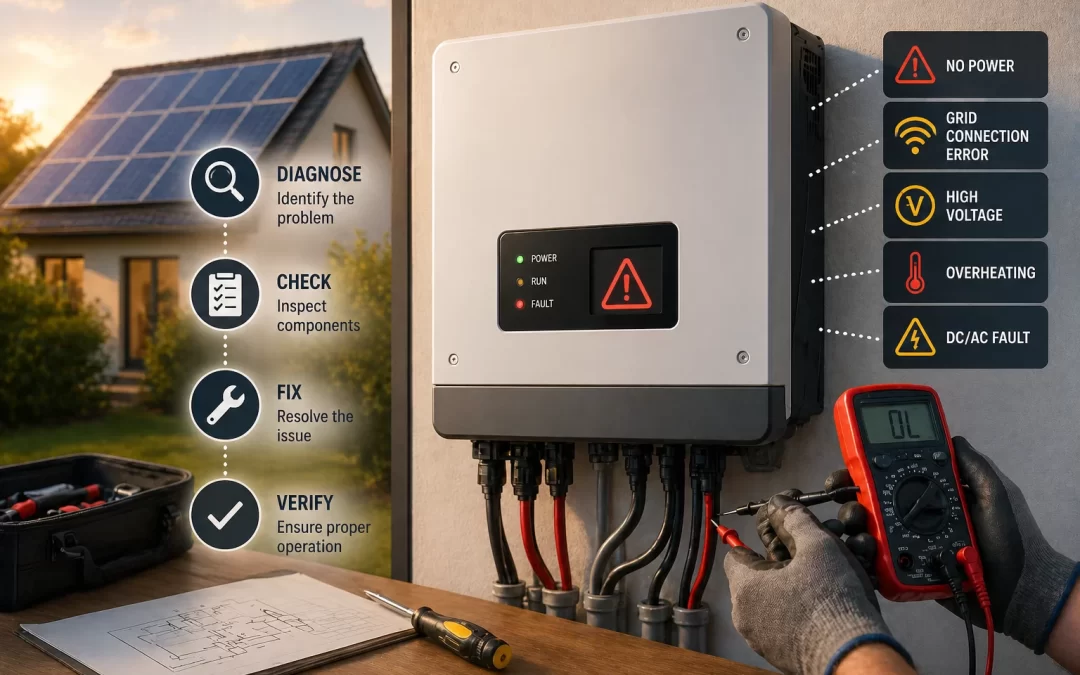
Most solar inverter problems come down to a few common issues: tripped breakers, DC or AC disconnects being off, Wi‑Fi or monitoring glitches, or the inverter shutting down for safety because of grid or wiring faults. You can safely check your breakers, disconnects, and monitoring app, and power-cycle the inverter in a controlled way, but anything involving wiring, burning smells, or repeated error codes should be handled by a qualified solar technician. Many inverter repairs and replacements are covered under warranty for 10–25 years, but labor may not be. If your system is still under warranty or you’re unsure what you’re seeing, it’s usually best to stop troubleshooting and call your installer or inverter manufacturer support.
Solar inverter problems are one of the most common reasons a home solar system stops producing power or underperforms. This guide walks US homeowners through how to recognize inverter issues, what you can safely check yourself, and when to call a professional. The goal is to help you protect your investment, avoid unsafe DIY work, and decide whether it’s time to get service or even a new quote.
Table of Contents
- What a Solar Inverter Does (and Why Problems Matter)
- Common Solar Inverter Problems and Symptoms
- Step-by-Step: Basic Inverter Troubleshooting for Homeowners
- When to Call a Professional (and What They’ll Check)
- Key Numbers: Costs, Warranties, and Savings Impact
- How to Prevent Solar Inverter Problems
- Repair vs. Replace: Making the Right Call on a Bad Inverter
- What to Do Next if You Suspect an Inverter Problem
- Frequently Asked Questions
- Summary: Key Takeaways on Solar Inverter Problems
What a Solar Inverter Does (and Why Problems Matter)
Your solar panels produce direct current (DC) electricity, but your home and the grid use alternating current (AC). The solar inverter is the “translator” that converts DC to AC and manages safety and communication with the utility grid. If the inverter isn’t working correctly, your panels can be in perfect shape and you’ll still get little or no usable power.
Most US homes use one of three inverter types:
- String inverter: One central box (often near your main electrical panel) that handles power from a group of panels.
- String inverter + DC optimizers: Panel-level devices that improve performance, still feeding into a central inverter.
- Microinverters: Small inverters mounted behind each panel, converting DC to AC on the roof.
When an inverter or microinverter fails or misbehaves, you may see:
- Zero or very low solar production
- Frequent shutdowns during the day
- Error codes or red/orange lights on the inverter
- Monitoring app showing “offline” or missing data
Because the inverter is the “brain” of the system, inverter problems can have an outsized impact on your savings and payback period if they’re not caught quickly.
Common Solar Inverter Problems and Symptoms
1. No power or zero production
This is one of the most alarming issues for homeowners: your monitoring app shows 0 kW, or your utility bill suddenly jumps because your solar isn’t offsetting usage.
Typical causes include:
- A tripped solar breaker in your main panel
- AC or DC disconnect switches turned off (often after maintenance or storms)
- Utility outage or grid voltage outside allowed limits
- Internal inverter failure
What you’ll see:
- Inverter screen blank or showing an error
- Red or orange status light instead of green
- Monitoring app showing “no production” or “system offline”
2. Inverter keeps shutting down during the day
If your inverter starts up in the morning but repeatedly shuts off, it may be protecting itself or responding to grid conditions.
Common reasons:
- High grid voltage on your street (the inverter must shut down for safety)
- Overheating due to poor ventilation or high ambient temperatures
- Loose or degraded wiring connections
- Firmware or software issues
Signs to look for:
- Production graph that spikes and drops repeatedly
- Error codes mentioning “over-voltage,” “over-temperature,” or “grid fault”
- Inverter fan running loudly or unit feeling very hot to the touch (do not open the case)
3. Monitoring app shows “offline” but inverter seems fine
Sometimes the inverter is producing power, but the monitoring system has lost its internet connection or internal communication.
Likely causes:
- Wi‑Fi password changed or router replaced
- Weak Wi‑Fi signal where the inverter is installed
- Monitoring gateway unplugged or moved
- Cloud service or app outage from the manufacturer
How this shows up:
- App shows “offline” or “no data” but your electric bill still looks lower than before solar
- Inverter lights are green and display shows normal power output
4. Error codes and warning lights
Most modern inverters display specific error codes when something is wrong. These can look intimidating, but they’re designed to help technicians diagnose the issue.
Common error categories:
- Grid-related: Over/under voltage, frequency issues, utility outage
- DC side: Ground fault, insulation resistance error, string mismatch
- Temperature: Over-temperature or fan failure
- Internal fault: Relay failure, hardware fault, self-test failure
Always write down or photograph the exact error code and message before resetting anything. This information is extremely helpful for your installer or manufacturer support.
5. Buzzing noises, burning smells, or visible damage
Any unusual sound, smell, or visible damage around your inverter is a red flag.
- Loud buzzing or crackling can indicate electrical arcing.
- Burning plastic or “hot electronics” smell can signal overheating or internal failure.
- Discoloration, melted plastic, or scorch marks are serious warning signs.
If you notice any of these, shut the system down using the labeled disconnects and call a professional immediately. Do not open the inverter or attempt internal repairs yourself.
Step-by-Step: Basic Inverter Troubleshooting for Homeowners
There are a few safe checks most homeowners can do before calling for service. Always follow the shutdown/startup procedures in your system manual, and if anything looks or smells unsafe, stop and call a professional.
Step 1: Confirm whether it’s really an inverter problem
- Check if there is a utility outage in your area. If the grid is down, most grid-tied systems will shut off for safety.
- Look at your main electrical panel for any tripped breakers, especially those labeled “solar,” “PV,” or “inverter.”
- Check your monitoring app:
- If it shows “offline” but your inverter lights are green and your bill still looks low, it may be a monitoring-only issue.
- If it shows 0 kW and the inverter has a red light or error code, it’s likely an inverter or system issue.
Step 2: Inspect the inverter from the outside
Without opening the case, look and listen:
- Is the status light green, yellow/orange, or red?
- Is the display (if present) showing normal power output or an error message?
- Do you see any visible damage, melted plastic, or scorch marks?
- Do you hear loud buzzing, crackling, or smell anything burning?
If you see or smell anything concerning, shut down the system using the labeled disconnects and call a professional.
Step 3: Check disconnect switches and breakers
Your system likely has several switches and breakers:
- AC disconnect: Usually near your main panel or meter, often a gray box with a handle.
- DC disconnect: On or near the inverter, sometimes a rotary switch.
- Solar breaker: In your main electrical panel or a subpanel.
Verify:
- All disconnects are in the “ON” position (or as labeled “ON/RUN”).
- No breakers are tripped. If one is, you can try resetting it once:
- Turn it fully to OFF, then back to ON.
- If it trips again, do not keep resetting—call a professional.
Step 4: Safe power-cycle of the inverter
If everything appears normal but the inverter is still not producing or showing an error, a controlled restart can sometimes clear minor glitches.
General shutdown sequence (always confirm with your system’s manual):
- Turn off the AC disconnect or solar breaker feeding your main panel.
- Turn off the DC disconnect to the inverter.
- Wait 3–5 minutes.
Startup sequence (reverse order):
- Turn on the DC disconnect to the inverter.
- Turn on the AC disconnect or solar breaker.
- Wait 5–10 minutes for the inverter to boot and reconnect to the grid.
After restart, check:
- Status lights (ideally green/solid)
- Display for power output and any error codes
- Monitoring app after 10–20 minutes
Step 5: Reconnect monitoring (if that’s the only issue)
If your inverter is producing power but the app is offline:
- Check that any communication gateway (small box near your router or panel) is plugged in and has lights on.
- Confirm your Wi‑Fi network name and password haven’t changed. If they have, follow the inverter manufacturer’s instructions to reconnect.
- Move your Wi‑Fi router or add a range extender if the signal is weak where the inverter is installed.
Monitoring issues don’t usually affect production, but they do make it harder to catch real problems early.
When to stop DIY troubleshooting
Stop and call a professional if:
- Breakers keep tripping after one reset attempt
- You see repeated error codes after a restart
- There are any signs of burning, melting, or arcing
- You’re not comfortable working around electrical equipment
When to Call a Professional (and What They’ll Check)
Solar inverters deal with high voltages and complex electronics. There’s a clear line between safe homeowner checks and work that should only be done by a licensed electrician or solar technician.
Signs you need a pro right away
- Persistent error codes you don’t understand
- Inverter won’t turn on at all after basic checks
- Frequent daytime shutdowns or flickering lights in your home
- Any burning smell, visible damage, or water intrusion
- System is under warranty and you don’t want to risk voiding it
What a technician will typically do
A qualified solar technician or electrician may:
- Use a multimeter to safely test DC and AC voltages
- Check wiring connections, terminations, and torque
- Review detailed inverter logs and error histories
- Update firmware or reset internal settings if needed
- Test for ground faults or insulation resistance issues
- Determine if the inverter needs repair or full replacement
If your system is still under equipment warranty, the technician may coordinate with the inverter manufacturer to approve a replacement unit.
Who to call first
- Your original installer: Best first call if they’re still in business; they know your system layout and warranty details.
- Inverter manufacturer support: Helpful if you can’t reach your installer or they’re out of business.
- Local solar or electrical contractor: If the original installer is unavailable, look for a licensed contractor with residential solar experience.
When inverter problems don’t work in your favor
Inverter issues can be especially painful when:
- Your system is older and the inverter is out of warranty
- The original installer is no longer operating, making warranty claims more complex
- You have a string inverter and a single failure takes down many panels at once
- Problems go unnoticed for months because monitoring wasn’t checked regularly
In these cases, you may face out-of-pocket costs and a longer payback period if production has been low for a while.
Key Numbers: Costs, Warranties, and Savings Impact
Understanding the numbers around solar inverters helps you decide how urgently to act and whether repair or replacement makes more sense.
Typical system and inverter costs
- Average residential solar system cost: $28,000–$32,000 before incentives, or about $19,600–$22,400 after the 30% federal solar Investment Tax Credit (ITC), for a typical 7–10 kW system.
- Average cost per watt: $2.50–$3.50 installed, depending on your state, roof, and equipment choices.
- Average panels needed: 15–25 panels for a typical US home, depending on panel wattage and energy use.
The inverter itself is usually 10–20% of the total system hardware cost:
- String inverter replacement: Often in the $1,500–$3,000 range for equipment, plus $300–$1,000 for labor, depending on complexity and location.
- Microinverter replacement: Typically $150–$250 per microinverter for equipment, plus labor; roof access can increase costs.
These are ballpark ranges; actual pricing varies by brand, installer, and local labor rates.
Warranties and expected lifespans
- Panel performance warranty: 25–30 years, with typical panel life of 30–35 years.
- String inverter warranty: Commonly 10–12 years standard, often extendable to 15–20+ years for an extra fee.
- Microinverter and optimizer warranties: Often 20–25 years, closer to panel life.
Because inverters often have shorter warranties than panels, it’s realistic to expect at least one inverter repair or replacement over a 25–30 year system life, especially for older string inverters.
Impact on savings and payback period
- Average annual savings from solar: About $1,300–$1,500 nationally, depending on your utility rates and system size.
- Typical payback period: 7–9 years on average, faster in high-cost electricity states and slower where power is cheaper.
If your inverter is down:
- Every month of zero production can cost you roughly $100–$150 in lost savings for a typical system.
- Long, unnoticed outages can add months to your payback period.
This is why checking your monitoring app at least monthly is so important. Catching inverter problems early helps protect your long-term return.
What affects your actual costs and savings
Your real numbers will depend on:
- Your utility’s electricity rates and how fast they’re rising
- System size (kW) and production (kWh per year)
- Local climate and shading on your roof
- Whether you have a battery system tied to the inverter
- Labor rates and permit requirements in your area
Incentives and tax credits can also change the math. The 30% federal ITC is in place through 2032, but state and local incentives vary and can change. For details on incentives, it’s wise to review a dedicated resource and consult a tax professional rather than relying on rules of thumb.
How to Prevent Solar Inverter Problems
While you can’t prevent every failure, good habits and basic maintenance can reduce the risk of inverter issues and help you catch them early.
1. Monitor your system regularly
- Check your monitoring app or web portal at least once a month.
- Look for:
- Sudden drops to zero or unusually low production
- Repeated error messages or alerts
- One panel or microinverter underperforming compared to others
- Compare your monthly solar production to the same month in prior years, adjusted for weather.
If you notice a trend of lower-than-expected production, our guide on why your solar system might be producing less than expected can help you separate normal seasonal changes from real problems.
2. Keep the area around the inverter clear and ventilated
- Do not store boxes, tools, or other items directly against the inverter.
- Ensure vents and fans are not blocked by dust, insulation, or debris.
- If the inverter is in a garage or utility room, avoid enclosing it in a tight cabinet without ventilation.
Overheating is a common cause of inverter derating (reduced output) and premature failure, especially in hot climates.
3. Maintain panels and wiring environment
- Keep panels reasonably clean to avoid unnecessary strain on the system. For safe cleaning practices, see our guide to cleaning solar panels and how often it’s actually needed.
- Trim trees that could grow to shade panels or drop branches on wiring.
- After major storms, visually inspect from the ground for any obvious damage to conduit or equipment (don’t climb on the roof unless you’re trained and equipped).
4. Protect your investment with good documentation
- Keep a folder (digital or physical) with:
- System design documents and one-line diagram
- Inverter and panel model numbers and serial numbers
- Warranty certificates and installer contact info
- Shutdown and startup procedures
- Record any error codes and service visits with dates and outcomes.
Good records make warranty claims and troubleshooting faster and smoother.
5. Know what your warranties actually cover
Inverter and panel warranties usually cover equipment, not labor. Some installers add their own workmanship warranty that may include labor for a certain number of years.
- Check whether your inverter warranty is still active and if it’s transferable if you bought the home with solar already installed.
- Understand whether you need to go through your installer or directly to the manufacturer for claims.
For a broader look at how solar equipment warranties work and what’s typically covered, you may find it helpful to review a dedicated solar warranty guide, especially before your system gets older.
Repair vs. Replace: Making the Right Call on a Bad Inverter
When an inverter is clearly failing, you’ll often face a choice: try to repair it under warranty, or replace it (sometimes with a newer or different model).
When repair or warranty replacement makes sense
- The inverter is still under manufacturer warranty.
- The brand is reputable and still actively supported in the US.
- Your installer or a local technician can handle the swap efficiently.
- The rest of your system (panels, wiring) is in good shape and not near end-of-life.
In these cases, your main costs may be labor and any shipping or handling fees, while the inverter hardware itself is covered.
When full replacement or upgrade may be better
- The inverter is out of warranty and repair costs approach the price of a new unit.
- The original brand is no longer supported or parts are hard to find.
- Your system is 10–15+ years old and you’re considering upgrades (like adding a battery).
- You have a central string inverter and want to improve shade performance with optimizers or microinverters.
Sometimes, replacing an older inverter with a modern, more efficient model can slightly boost production and improve monitoring, though the main benefit is reliability.
How inverter issues affect the “is solar worth it?” question
For homeowners still deciding whether to go solar, inverter reliability is part of the long-term picture. A realistic expectation is:
- You may need at least one inverter repair or replacement over a 25–30 year system life.
- Even with that cost factored in, many systems still pay for themselves in 7–9 years on average and then continue to produce mostly free power.
If you’re still in the research phase, an honest overview like our solar “is it worth it?” guide can help you weigh long-term maintenance, including inverter issues, against the savings and environmental benefits.
What to Do Next if You Suspect an Inverter Problem
If you think your solar inverter is having issues, here’s a practical decision path.
1. Gather basic information
- System age and installation date
- Inverter brand and model (from the label on the unit or your paperwork)
- Any error codes or messages (take photos)
- Recent utility bills and monitoring screenshots showing low or zero production
2. Decide if it’s urgent
- Emergency (call immediately):
- Burning smell, smoke, or visible damage
- Repeated breaker trips or flickering lights in your home
- High priority (within a few days):
- Zero production with no obvious external cause
- Frequent daytime shutdowns or persistent error codes
- Routine (within a week or two):
- Monitoring-only issues where production appears normal
- Minor, intermittent warnings that clear on their own but recur
3. Contact the right people
- Start with your original installer if possible.
- If they’re unavailable, contact the inverter manufacturer’s support line with your model, serial number, and error codes.
- If needed, get quotes from local solar or electrical contractors for diagnostics and potential replacement.
4. Questions to ask an installer or technician
- Is my inverter still under manufacturer warranty? If so, what’s covered?
- What’s the likely cause of the problem, and is it a one-time issue or a sign of bigger trouble?
- What are my options and costs for repair versus full replacement?
- Will any work affect my existing warranties or permits?
- How long will my system be offline during the repair or replacement?
5. When getting multiple quotes makes sense
It’s worth getting more than one quote when:
- Your inverter is out of warranty and you’re paying fully out-of-pocket.
- You’re considering upgrading the inverter type (for example, from a basic string inverter to one with optimizers or to microinverters).
- Your original installer is no longer in business and you’re starting fresh with a new company.
Comparing quotes can also be a good opportunity to ask about your overall system health, potential upgrades, and whether your production is on track for your area and roof.
Frequently Asked Questions
How do I know if my solar inverter is bad?
Common signs of a bad inverter include zero or very low solar production, red or orange status lights, persistent error codes on the display, and monitoring apps showing “system offline” when the grid is up. If basic checks of breakers and disconnects don’t resolve the issue, or the inverter won’t power up at all, it’s time to call a qualified solar technician to test the unit.
Can I reset my solar inverter myself?
Most homeowners can safely power-cycle an inverter by following the shutdown and startup sequence in their system manual, usually turning off AC first, then DC, waiting a few minutes, and then turning DC and AC back on. However, if breakers keep tripping, error codes return immediately, or you see or smell anything unusual, stop and contact a professional instead of repeatedly resetting it.
How long should a solar inverter last?
String inverters typically last around 10–15 years, which is why their standard warranties are often 10–12 years, sometimes extendable to 15–20 years. Microinverters and DC optimizers often carry 20–25 year warranties and are designed to last closer to the life of the panels, though individual units can still fail earlier.
How much does it cost to replace a solar inverter?
Replacing a central string inverter commonly costs around $1,500–$3,000 for the equipment plus $300–$1,000 for labor, depending on size, brand, and local rates. If the inverter is still under manufacturer warranty, the hardware may be covered, and you would typically pay only labor and any associated service fees.
Will a bad inverter affect my solar payback period?
Yes. While your system is down, you’re not generating solar power, so you’re missing out on savings that typically average $1,300–$1,500 per year for a typical home system. A few weeks of downtime won’t make a huge difference, but long, unnoticed outages can add months to your payback period, which is why regular monitoring is so important.
Is it safe to use my home’s electricity if the solar inverter is failing?
In most cases, if the inverter shuts down, your home simply goes back to using full power from the grid and remains safe. However, if you notice flickering lights, frequent breaker trips, burning smells, or any signs of overheating near the inverter or electrical panel, shut the system down using the labeled disconnects and contact a licensed electrician or solar technician immediately.
Summary: Key Takeaways on Solar Inverter Problems
- The inverter is the “brain” of your solar system, and most production-stopping issues trace back to a few common inverter or wiring problems.
- Basic checks—like confirming breakers and disconnects are on, reading error codes, and safely power-cycling—are usually safe for homeowners, but anything involving smells, damage, or repeated faults needs a professional.
- Average residential systems cost $28,000–$32,000 before incentives, and inverter repairs or replacements are a normal part of protecting that investment over a 25–30 year panel life.
- Inverter downtime directly reduces your annual savings (often $1,300–$1,500 per year), so regular monitoring is key to catching issues early and keeping your 7–9 year payback on track.
- If you suspect a problem, gather information, contact your installer or manufacturer, and consider multiple quotes for out-of-warranty repairs or upgrades.
Because every home, utility, and solar setup is different, the best way to understand your options and costs for fixing or upgrading an inverter is to get personalized quotes from qualified installers. When you’re ready to see what repair, replacement, or even a new system would look like for your roof and utility rates, you can compare offers at /get-my-quote/ with no obligation and use them as a benchmark for any local contractor you talk to.