
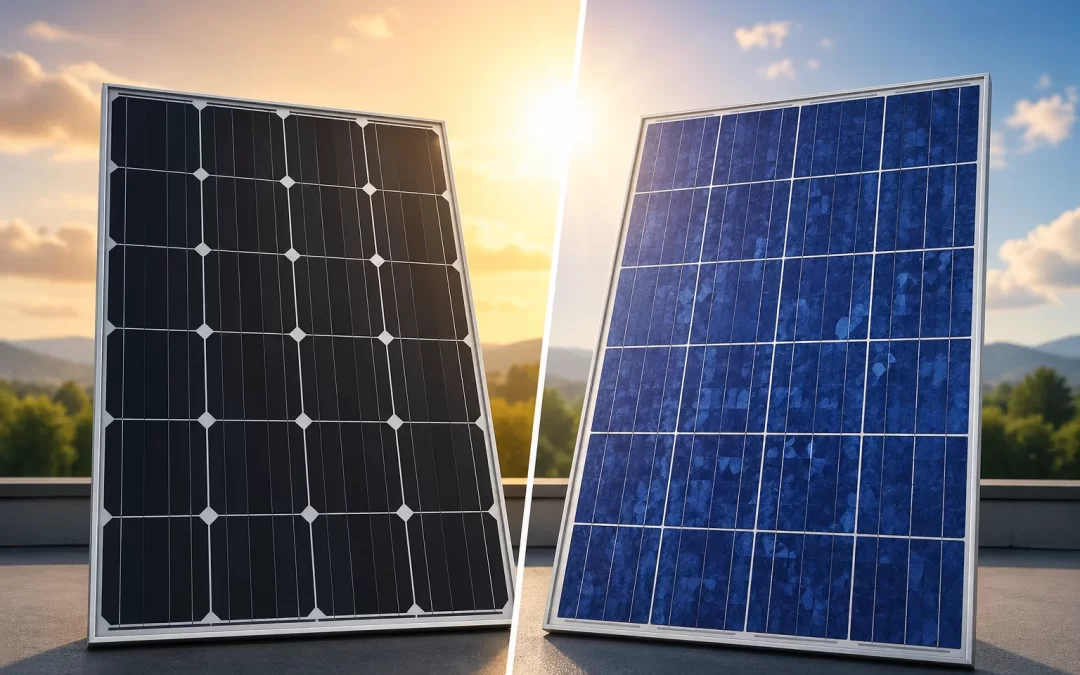
Monocrystalline solar panels are made from a single, pure crystal of silicon and are typically more efficient, produce more power per square foot, and cost a bit more. Polycrystalline panels are made from multiple silicon crystals, are usually less efficient, take up more roof space for the same power, but are more budget-friendly. For most US homeowners with limited roof space or higher electric bills, monocrystalline panels are usually the better long-term choice, while polycrystalline can work if you have plenty of roof area and want to minimize upfront cost. In real quotes, the difference often comes down to specific brands, warranties, and installer recommendations, not just the crystal type.
Choosing between monocrystalline vs. polycrystalline solar panels can feel like a technical decision, but it really comes down to space, budget, and long-term goals. This guide is written for US homeowners who want a clear, no-jargon explanation of the differences and what actually matters on your roof. By the end, you’ll know which type is likely best for your home and what to ask installers before you sign anything.
Table of Contents
- Monocrystalline vs. Polycrystalline Solar Panels: The Basics
- Efficiency and Performance: Which Produces More Power?
- Cost Comparison: Do Monocrystalline Panels Really Cost More?
- Appearance, Durability, and Lifespan
- Key Numbers: Costs, Savings, and Payback
- When Monocrystalline Panels Make More Sense
- When Polycrystalline Panels Can Be a Good Fit
- Roof, Home, and Location Factors That Matter Most
- What to Ask Your Installer About Panel Type
- Decision Guide: How to Choose and What to Do Next
- Frequently Asked Questions
- Summary: Key Takeaways
Monocrystalline vs. Polycrystalline Solar Panels: The Basics
Monocrystalline and polycrystalline panels are both made from silicon, but the way that silicon is formed changes how the panels look, perform, and cost.
What is a monocrystalline solar panel?
Monocrystalline (often called “mono”) panels are made from a single, continuous crystal of silicon. This gives electrons a cleaner path to move, which improves efficiency.
- Typical cell color: dark black
- Shape: usually cells with rounded corners
- Key trait: higher efficiency and power output per square foot
What is a polycrystalline solar panel?
Polycrystalline (often called “poly” or “multi-crystalline”) panels are made by melting many silicon fragments together. This creates multiple crystal boundaries inside each cell.
- Typical cell color: blue or blue-speckled
- Shape: more square-looking cells
- Key trait: slightly lower efficiency, usually lower cost per panel
Do both types work the same way on your home?
Yes. Both monocrystalline and polycrystalline panels:
- Convert sunlight into electricity using the same basic photovoltaic effect
- Connect to inverters (microinverters or string inverters) in the same way
- Can qualify for the same incentives and the 30% federal solar tax credit (consult a tax professional for your situation)
The main differences are efficiency, space required, appearance, and sometimes warranty and brand options.
Efficiency and Performance: Which Produces More Power?
Efficiency is one of the biggest differences between monocrystalline vs. polycrystalline solar panels, and it directly affects how many panels you need and how much roof space they take.
Typical efficiency ranges
- Monocrystalline panels: about 19%–23% efficiency for modern residential panels
- Polycrystalline panels: about 15%–18% efficiency for modern residential panels
That 3–5 percentage point difference may sound small, but it adds up over your whole system.
What this means in real-world terms
Most residential panels today are in the 350–450 watt range, depending on size and efficiency.
- A high-efficiency monocrystalline panel might be 400–440 watts on a standard-sized panel.
- A comparable polycrystalline panel might be 330–380 watts on the same footprint.
On a typical roof, that can mean:
- Fewer mono panels to hit your target system size (for example, 18 mono vs. 22 poly for similar total watts)
- More flexibility fitting a system on smaller or shaded roof sections
Performance in heat and low light
Both panel types lose some efficiency as they heat up, but monocrystalline panels generally have slightly better temperature coefficients (they lose a bit less output as they get hot).
- In hot climates, this can give mono panels a small performance edge over the year.
- In low light (cloudy days, mornings, evenings), modern mono panels often maintain output a bit better, but the difference is usually modest.
When efficiency matters most
Efficiency is especially important if:
- Your roof space is limited or has many obstructions (vents, chimneys, dormers).
- Your electricity use is high and you want to offset as much as possible.
- You may add an electric vehicle, heat pump, or other electric loads in the future.
If you have a large, open, sunny roof and moderate usage, the efficiency difference between monocrystalline vs. polycrystalline panels may matter less.
Cost Comparison: Do Monocrystalline Panels Really Cost More?
Historically, polycrystalline panels were noticeably cheaper than monocrystalline. Today, the gap has narrowed, and in many real quotes, you may only see a small difference in total system price.
Typical cost ranges (all-in system price)
For a complete residential solar system in the US (panels, inverters, racking, labor, permits):
- Average cost per watt: $2.50–$3.50 (mono or poly, depending on brand and installer)
- Typical system cost before incentives: $28,000–$32,000
- After 30% federal tax credit: about $19,600–$22,400 (if you qualify; confirm with a tax professional)
How panel type affects cost
Panel type is just one piece of your total system cost. In many markets:
- Monocrystalline panels may add a small premium, but often only a few hundred to a couple thousand dollars on a full system.
- Labor, permitting, racking, and inverters make up a large share of the total price, and those costs are similar regardless of panel type.
- Brand, warranty, and installer markup can matter more than mono vs. poly alone.
Cost per watt vs. cost per panel
Polycrystalline panels can be cheaper per panel, but because they are less efficient, you may need more of them to reach the same system size in kilowatts (kW).
- If you have plenty of roof space, this can still be cost-effective.
- If your roof is tight, you may end up needing higher-efficiency mono panels anyway to hit your target system size.
When paying more for mono makes sense
Paying a bit more for monocrystalline panels can be worth it if:
- You are space-constrained but want to maximize your solar production.
- You care about aesthetics and prefer the darker, more uniform look.
- You plan to stay in your home long-term and want the best long-term production per square foot.
Appearance, Durability, and Lifespan
For many homeowners, how the panels look on the roof is almost as important as how they perform.
Appearance: black vs. blue
- Monocrystalline: usually deep black cells with a more uniform appearance. Many premium mono panels also have black frames and black back sheets for a “all-black” look.
- Polycrystalline: typically blue or blue-speckled cells with a more “crystalline” pattern. Frames are often silver, though black frames are available.
If curb appeal or HOA rules matter, monocrystalline panels are often preferred because they blend in more with dark shingles and look more uniform.
Durability and lifespan
Both monocrystalline and polycrystalline panels are very durable and designed to last decades.
- Typical performance warranty: 25–30 years (for both types)
- Typical product warranty: 10–25 years, depending on brand and model
- Real-world lifespan: 30–35 years or more, with gradually declining output
Modern panels, regardless of type, are tested to withstand hail, wind, snow loads, and temperature extremes. The quality of the manufacturer and installer matters more than mono vs. poly for durability.
Degradation rates
All panels slowly lose output over time. Many modern monocrystalline panels have slightly better degradation rates (for example, 0.25%–0.5% per year) compared to some older or lower-cost polycrystalline options (around 0.5%–0.7% per year).
Over 25–30 years, that can mean a few percent more output from higher-quality mono panels, but the difference is often modest compared to other factors like shading and system design.
Key Numbers: Costs, Savings, and Payback
Whether you choose monocrystalline or polycrystalline solar panels, the big-picture financials are similar. The panel type can nudge the numbers, but your roof, location, and utility rates matter more.
Typical system size and panel count
- Average US home system size: about 6–10 kW
- Average number of panels: 15–25 panels, depending on panel wattage
- Monocrystalline: often fewer panels (higher watts per panel)
- Polycrystalline: often more panels (lower watts per panel)
Average costs and savings (national averages)
- Cost per watt: $2.50–$3.50 (mono or poly, depending on brand and installer)
- Total system cost before incentives: $28,000–$32,000
- Estimated cost after 30% federal tax credit: $19,600–$22,400 (if you qualify; confirm with a tax professional)
- Average annual electric bill savings: $1,300–$1,500
- Typical payback period: 7–9 years nationally, faster in high-rate states
These are national averages. Your actual numbers will depend on your utility rates, sun exposure, roof orientation, local incentives, and the exact equipment you choose.
How panel type affects these numbers
Monocrystalline vs. polycrystalline panels can influence:
- Total system size you can fit: Mono may allow a larger kW system on the same roof.
- Total energy production: Higher-efficiency mono panels can produce more kWh per year from the same area.
- Payback period: If mono panels let you produce more energy and offset more of a high electric bill, they can slightly shorten your payback period, even if they cost a bit more upfront.
Before focusing too much on panel type, it can help to understand whether solar in general makes financial sense for your home; our honest solar worth-it guide walks through the key variables.
When Monocrystalline Panels Make More Sense
For many modern residential systems, monocrystalline panels are the default choice, and for good reason.
Best situations for monocrystalline panels
Monocrystalline panels are usually the better fit if:
- Your roof space is limited. You have a small roof, multiple roof faces, or obstructions that limit where panels can go.
- You have high electricity usage. You want to offset as much of your bill as possible, or you plan to add an EV or electric heating.
- You live in a high-rate state. In places with expensive electricity, every extra kWh of production is more valuable.
- Aesthetics matter. You prefer the darker, more uniform look and want panels to blend in with your roof.
- You plan to stay in your home long-term. Over 25–30 years, higher efficiency and slightly better degradation can add up.
Advantages of monocrystalline panels
- Higher efficiency and more power per square foot
- Often better performance in heat and low light
- Typically more premium brand and warranty options
- More “future-proof” if your energy needs grow
When monocrystalline might not be worth the premium
Monocrystalline panels might not be necessary if:
- You have a very large, open, unshaded roof and moderate usage.
- Your main goal is the lowest possible upfront cost, and you are comfortable with a slightly larger array.
- Your installer offers a high-quality polycrystalline option with a strong warranty and only a small efficiency difference.
When Polycrystalline Panels Can Be a Good Fit
Polycrystalline panels are less common in new residential installs than they used to be, but they can still be a good option in certain situations.
Best situations for polycrystalline panels
Polycrystalline panels may make sense if:
- You have plenty of roof space. You can easily fit a slightly larger array to make up for lower efficiency.
- You are very cost-sensitive. You want to minimize upfront cost and are okay with slightly lower output per panel.
- Your installer has a strong poly option. Some reputable manufacturers still offer high-quality poly panels with solid warranties.
- Aesthetics are less important. You do not mind the blue or speckled look on your roof.
Advantages of polycrystalline panels
- Potentially lower cost per panel
- Can be cost-effective on large, open roofs
- Similar durability and lifespan to monocrystalline when using reputable brands
Limitations of polycrystalline panels
- Lower efficiency, so more panels and more roof space needed for the same system size
- Less common in premium residential offerings, which may limit brand and warranty choices
- Appearance may be less desirable for some homeowners or HOAs
Roof, Home, and Location Factors That Matter Most
The right choice between monocrystalline vs. polycrystalline solar panels depends heavily on your specific home and location.
Roof size and layout
Key questions to consider:
- How much usable, unshaded roof area do you have?
- Are there vents, chimneys, skylights, or dormers that limit panel placement?
- Do you have multiple roof faces with different orientations?
If roof space is tight or broken up, higher-efficiency monocrystalline panels usually make more sense.
Sun exposure and shading
Both panel types are affected by shading, but system design (panel placement and inverter choice) matters more than mono vs. poly.
- Heavily shaded roofs may need careful design and possibly microinverters or optimizers.
- In very sunny regions, the efficiency advantage of mono can produce more total energy over the year.
If you are comparing equipment options, it can also help to understand inverter choices; our guide on microinverters vs. string inverters explains how they affect performance and shading.
Local electricity rates and incentives
Higher utility rates and strong state or local incentives make every extra kWh more valuable.
- In high-rate states (like California, New York, Massachusetts, Hawaii), maximizing production with mono panels often pays off.
- In lower-rate states, the difference in payback between mono and poly may be smaller.
The 30% federal solar tax credit applies to both panel types equally, but always confirm your eligibility with a tax professional and review our solar incentives and tax credits guide for current details.
Future energy needs
Think about how your energy use might change over the next 5–10 years:
- Planning to buy an electric vehicle?
- Switching from gas to electric heating or water heating?
- Adding a hot tub, pool, or home office?
If your usage is likely to grow, choosing higher-efficiency monocrystalline panels now can give you more flexibility to expand or maximize your roof’s potential.
What to Ask Your Installer About Panel Type
When you start getting quotes, you will likely see specific brands and models, not just “monocrystalline” or “polycrystalline.” Here is how to compare them.
Key questions to ask
- Are the panels in this quote monocrystalline or polycrystalline?
- What is the panel wattage and efficiency?
- What are the product and performance warranty terms (years and guaranteed output)?
- Why do you recommend this specific panel over other options?
- How many panels and how many kilowatts (kW) is this system?
- Could a higher-efficiency panel reduce the number of panels or improve production on my roof?
How to compare quotes fairly
When comparing monocrystalline vs. polycrystalline options:
- Look at total system size in kW, not just number of panels.
- Compare estimated annual production (kWh) for each design.
- Review warranties and manufacturer reputation.
- Consider appearance and how the array will look on your roof.
- Ask for a layout drawing so you can see how many panels go on each roof face.
When to involve a professional
Solar system design is complex, and a reputable installer should be able to explain their recommendations in plain language. If an installer cannot clearly explain why they chose a certain panel type or brand, that is a red flag. Getting multiple quotes from different installers is one of the best ways to see your options and pricing side by side.
Decision Guide: How to Choose and What to Do Next
Choosing between monocrystalline vs. polycrystalline solar panels is ultimately about matching the technology to your roof, budget, and goals.
Is now the right time to act?
It may be a good time to move forward if:
- Your roof is in good condition (ideally less than 10–12 years old if it is asphalt shingles).
- Your electric bills are consistently high enough that solar could save $1,300–$1,500 per year or more.
- You plan to stay in your home at least 7–10 years to realize the full financial benefits.
If your roof needs replacement soon or you are unsure how long you will stay, it may be worth addressing those questions first before committing to solar.
Information to gather before getting quotes
- 12 months of electric bills (or at least your average monthly kWh usage)
- Photos of your roof from the street and, if possible, from above (drone or satellite images)
- Any HOA rules or aesthetic requirements
- Your plans for future electric usage (EV, heat pump, etc.)
Questions to ask every installer
- What panel type (mono vs. poly), brand, and model are you proposing, and why?
- What is the total system size (kW), number of panels, and expected annual production (kWh)?
- What are the warranties on panels, inverters, and workmanship?
- How will shading, roof orientation, and local weather affect my production?
- What incentives or rebates are available in my area, and how do I claim them?
Should you get multiple quotes?
Yes. Getting multiple quotes almost always makes sense. Different installers may propose different panel types, brands, and system sizes for the same roof, and prices can vary significantly. Comparing at least 2–3 quotes helps you see whether paying a bit more for higher-efficiency monocrystalline panels is worth it in your specific case.
Frequently Asked Questions
Are monocrystalline solar panels always better than polycrystalline?
Monocrystalline panels are usually more efficient and produce more power per square foot, which makes them “better” for space-constrained roofs or high-usage homes. However, polycrystalline panels can still be a good choice if you have plenty of roof space and want to minimize upfront cost. The best option depends on your roof, budget, and long-term goals.
Do monocrystalline panels last longer than polycrystalline panels?
Both monocrystalline and polycrystalline panels typically come with 25–30 year performance warranties and can last 30–35 years or more. Lifespan and reliability depend more on the manufacturer and build quality than on whether the panel is mono or poly. Always compare warranties and brand reputation when reviewing quotes.
How can I tell if a panel is monocrystalline or polycrystalline?
Monocrystalline panels usually have dark black cells with a uniform look and often rounded cell corners, while polycrystalline panels tend to be blue or blue-speckled with a more “crystalline” pattern. The spec sheet or label will also state whether the panel is monocrystalline or polycrystalline, along with its efficiency and wattage.
Does panel type affect my eligibility for the 30% federal solar tax credit?
No. The federal solar tax credit applies to qualifying residential solar systems regardless of whether you use monocrystalline or polycrystalline panels. Eligibility depends on factors like ownership, installation date, and tax liability, so you should confirm your situation with a tax professional.
Will I need more maintenance with polycrystalline panels?
Maintenance needs are similar for both monocrystalline and polycrystalline panels. Most homeowners only need occasional cleaning and periodic system checks, regardless of panel type. The quality of installation and monitoring matters more for long-term performance than whether the panels are mono or poly.
How many panels will I need for my home?
Most US homes need about 15–25 panels, depending on panel wattage, roof space, and energy usage. Higher-efficiency monocrystalline panels can reduce the number of panels needed for the same system size, while lower-efficiency polycrystalline panels may require more. Our detailed guide on how many solar panels you need walks through the math step by step.
Summary: Key Takeaways
- Monocrystalline solar panels are more efficient, produce more power per square foot, and usually look better, while polycrystalline panels are slightly less efficient but can be more budget-friendly if you have ample roof space.
- Typical residential systems cost $28,000–$32,000 before incentives and $19,600–$22,400 after the 30% federal tax credit (if you qualify), with average annual savings of $1,300–$1,500 and a 7–9 year payback.
- Roof size, shading, local electricity rates, and future energy needs affect whether monocrystalline vs. polycrystalline panels make more sense for your home.
- Brand quality, warranties, and installer expertise often matter more than panel type alone, so always compare specific models and system designs.
- The best next step is to gather your usage data, get multiple quotes, and ask installers to explain why they recommend a particular panel type for your roof.
Every home is different, and the right mix of monocrystalline vs. polycrystalline solar panels depends on your roof, budget, and long-term plans. Getting personalized quotes from vetted installers is the fastest way to see real numbers for your home and decide what makes sense. When you are ready, you can compare options and pricing with no obligation at /get-my-quote/.