
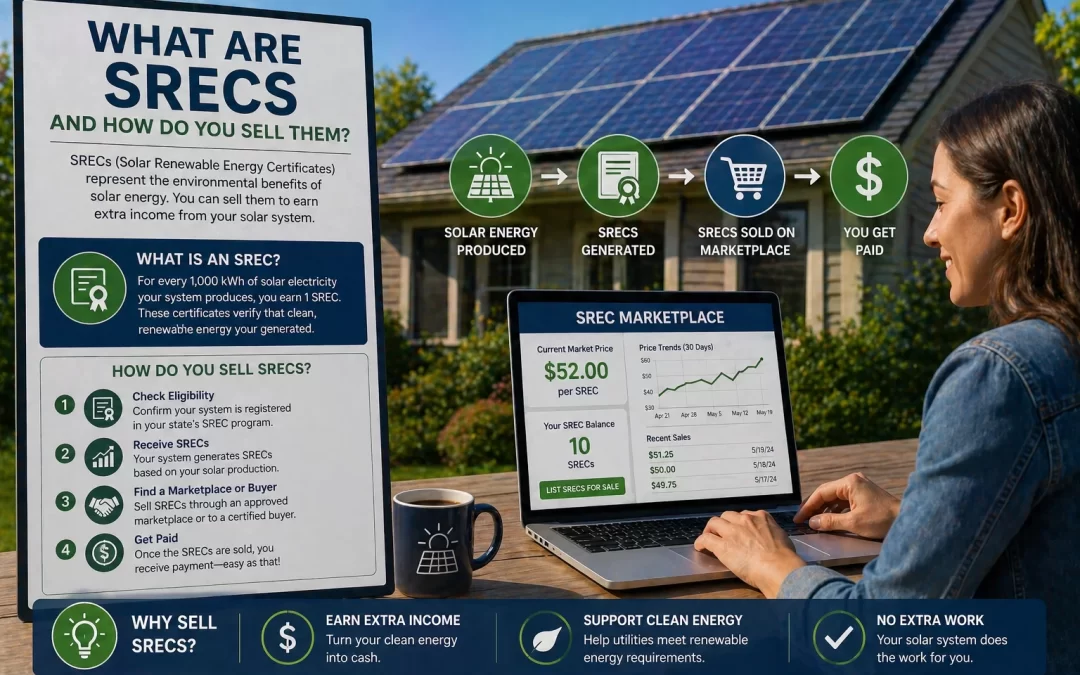
SRECs (Solar Renewable Energy Certificates) are tradable credits you earn for the clean electricity your solar panels produce, usually one SREC for every 1,000 kilowatt-hours (kWh). In states that have SREC markets, you can sell these certificates to utilities or energy suppliers that need them to meet renewable energy requirements, typically through an SREC broker, aggregator, or your installer. Homeowners in active SREC states can earn hundreds to a few thousand dollars per year, depending on system size and SREC prices. However, SRECs are not available everywhere, and prices can change over time, so they should be viewed as a bonus, not a guaranteed income stream.
Solar Renewable Energy Certificates can be a meaningful extra benefit on top of your electric bill savings and tax credits, but they’re often confusing at first glance. This guide explains what SRECs are, how they work, and how homeowners actually sell them in the real world. If you’re considering solar, understanding SRECs can help you better estimate your total financial benefit and decide whether now is the right time to move forward.
Table of Contents
- What Are SRECs in Simple Terms?
- How SRECs Work Step by Step
- Typical SREC Values and Real-World Numbers
- How Do You Actually Sell SRECs?
- Where Are SRECs Available?
- When SRECs Work in Your Favor
- When SRECs Don’t Help Much (or at All)
- How SRECs Fit Into Overall Solar Costs and Payback
- What to Do Next if You’re Considering Solar and SRECs
- Frequently Asked Questions
- Key Takeaways
What Are SRECs in Simple Terms?
SRECs, or Solar Renewable Energy Certificates, are proof that your solar system produced a certain amount of clean electricity. For every 1,000 kWh (1 megawatt-hour) your panels generate, you earn one SREC in eligible states.
Think of it this way:
- Your electricity savings come from using your own solar power instead of buying from the utility.
- Your SRECs are a separate “bonus” you can sell because your power is clean and helps utilities meet state renewable energy rules.
Important points:
- 1 SREC = 1,000 kWh of solar production.
- SRECs are separate from net metering credits on your bill.
- You can usually sell SRECs for cash through a broker, marketplace, or your installer.
- Not every state has an SREC market, and rules can change.
How SRECs Work Step by Step
1. Your state sets renewable energy rules
Many states have Renewable Portfolio Standards (RPS), which require utilities and energy suppliers to get a certain percentage of their electricity from renewable sources. Some of these states have specific solar carve-outs, meaning a portion must come from solar.
When utilities fall short of these targets, they can:
- Buy SRECs from solar owners, or
- Pay a penalty fee (often called an Alternative Compliance Payment).
This creates demand for SRECs and gives them value.
2. Your solar system is registered
To earn SRECs, your system must be registered in your state’s tracking system or SREC registry. This is usually handled by:
- Your solar installer, or
- An SREC broker or aggregator you sign up with.
Once registered, your system’s production is tracked, often through:
- A revenue-grade production meter, or
- Your utility’s meter data, depending on state rules.
3. SRECs are created as your system produces power
As your solar panels generate electricity, your production is recorded. Every time your total production reaches 1,000 kWh, one SREC is issued to your account in the tracking system.
For a typical home system, this might mean:
- 8–12 SRECs per year for a 6–10 kW system, depending on location and sun exposure.
4. You sell SRECs into the market
Once SRECs are in your account, you can sell them. Most homeowners do this through:
- A broker or aggregator that bundles many homeowners’ SRECs and sells them to utilities.
- A long-term contract arranged by your installer.
- In some states, an online SREC marketplace or auction.
You’re paid either:
- Per SREC at a market price that can change, or
- A fixed price per SREC under a contract.
5. Utilities use SRECs to meet requirements
When a utility buys your SRECs, they “retire” them in the tracking system to show they met part of their renewable energy obligation. You still keep the electricity savings from your solar system; you’re just selling the environmental attribute of that clean energy.
Typical SREC Values and Real-World Numbers
SREC prices vary widely by state and over time. They are driven by supply and demand, state rules, and penalty levels for utilities that don’t meet targets.
Typical SREC price ranges
As of the mid-2020s, rough ranges in active markets have been:
- Higher-value markets (historically NJ, DC, MA): often $150–$350+ per SREC at various times.
- Mid-range markets: $40–$150 per SREC.
- Lower-value or oversupplied markets: under $40 per SREC.
These numbers are examples, not guarantees. Actual prices can move up or down based on policy changes and how many systems are installed.
How many SRECs does a typical home system earn?
A typical residential solar system in the U.S. is:
- Size: 6–10 kW (15–25 panels for most homes).
- Annual production: roughly 7,000–12,000 kWh per year, depending on location and shading.
That usually translates to:
- About 7–12 SRECs per year (because 1 SREC = 1,000 kWh).
Example: potential SREC income
For a 8 kW system producing 9,600 kWh per year (9.6 SRECs):
- At $50 per SREC: about $480 per year.
- At $150 per SREC: about $1,440 per year.
- At $250 per SREC: about $2,400 per year.
These are illustrative only. Your actual SREC income depends on your state, your system’s production, and current market prices.
How long do SREC incentives last?
- Many programs allow you to earn SRECs for 10–15 years after your system is installed.
- Some states have end dates or declining values over time.
- Rules can change, so it’s important to ask your installer or SREC broker about current program terms in your state.
How Do You Actually Sell SRECs?
Most homeowners do not sell SRECs directly to utilities. Instead, they use intermediaries that handle the paperwork and market access.
Option 1: Through your solar installer
Many installers in SREC states offer to manage SRECs for you. Common arrangements include:
- Installer keeps SRECs and gives you a lower upfront system price in exchange.
- Installer manages SRECs for a fee and passes most of the value to you.
- Installer sets up your account with a third-party SREC broker as part of the project.
Pros:
- Very simple for the homeowner.
- Paperwork and registration are handled for you.
Cons:
- You may get less flexibility or a lower share of SREC value.
- Important to read the contract carefully to see who owns the SRECs.
Option 2: SREC broker or aggregator
SREC brokers specialize in registering systems, tracking production, and selling SRECs on your behalf. They typically:
- Register your system in the state tracking system.
- Monitor your production data.
- Sell SRECs in bulk to utilities or on exchanges.
- Take a small fee or percentage of the sale price.
Pros:
- Professional management and market access.
- Often transparent online dashboards and regular payments.
Cons:
- Fees reduce your net SREC income.
- You may be subject to contract terms or minimum durations.
Option 3: Long-term SREC contracts
In some states, you can sign a long-term contract (for example, 5–15 years) to sell your SRECs at a fixed price. These contracts may be offered by:
- Utilities or state programs.
- Large SREC buyers or aggregators.
Pros:
- Predictable income per SREC.
- Protection if market prices fall.
Cons:
- You may miss out if market prices rise later.
- Early termination may be difficult or costly.
Option 4: Spot market or auctions
Some states or platforms allow you to sell SRECs on a spot market or in periodic auctions. This is more common for larger system owners but may be accessible through brokers.
Pros:
- Potential to capture higher prices when demand spikes.
Cons:
- More price volatility and uncertainty.
- Usually not something individual homeowners manage directly.
Key steps for homeowners
- Confirm your state has an SREC program and that residential systems qualify.
- Ask installers how they handle SRECs and who will own them.
- If you want to keep your SRECs, make sure your contract does not assign them to the installer or a third party without compensation.
- If using a broker, review their fees, contract length, and payment schedule.
Where Are SRECs Available?
SRECs are not a nationwide incentive. They exist only in certain states with specific solar carve-outs or similar programs.
States with active or historical SREC markets
States that have had SREC or similar solar renewable credit programs include (subject to change):
- New Jersey
- Maryland
- District of Columbia (DC)
- Massachusetts (transitioned to other programs but still has legacy SRECs)
- Pennsylvania
- Ohio
- Delaware
- Virginia (emerging programs)
Program details, eligibility, and pricing vary by state and can change over time. Some states have moved from traditional SRECs to other performance-based incentives.
How to check if your state has SRECs
- Ask local solar installers about current SREC or performance-based incentives.
- Review your state’s public utility commission or energy office website.
- Look at reputable solar incentive databases for up-to-date program information.
If your state doesn’t have SRECs, you may still have other incentives such as rebates, performance payments, or state tax credits. Our state solar incentives guide highlights where state-level programs are strongest.
When SRECs Work in Your Favor
SRECs can significantly improve your solar economics in the right conditions.
1. You live in a strong SREC market
SRECs are most valuable when:
- Your state has a strict solar requirement for utilities.
- Penalties for non-compliance are high.
- There is strong demand for SRECs relative to supply.
In these markets, SRECs can add hundreds or even a few thousand dollars per year for a typical home system.
2. You own your system (not a lease or PPA)
When you own your solar system:
- You usually own the SRECs unless you sign them away in your contract.
- You can choose how to sell them and potentially capture more value.
With leases or power purchase agreements (PPAs), the solar company often keeps the SRECs in exchange for offering you a lower or zero upfront cost.
3. You have a larger or higher-producing system
Because SRECs are tied to production, you benefit more if:
- Your system is on the larger side (8–12 kW or more).
- Your roof has good sun exposure and minimal shading.
- You live in a sunnier region of your state.
4. You lock in a reasonable SREC contract
A fair long-term SREC contract can:
- Provide stable, predictable income.
- Help shorten your payback period.
- Make financing more attractive by improving cash flow.
When SRECs Don’t Help Much (or at All)
It’s important to be realistic: SRECs are not a universal benefit, and they’re not guaranteed.
1. Your state has no SREC program
If your state doesn’t have an SREC or similar performance-based program:
- You will not earn SRECs for your solar production.
- Your financial benefits will come from bill savings, the federal tax credit, and any local rebates instead.
2. SREC prices are low or declining
Even in SREC states, prices can fall if:
- Too many solar systems are installed (oversupply).
- State rules are relaxed or targets are met easily.
- Alternative compliance payments are lowered.
In these cases, SRECs may only add a modest amount to your annual savings.
3. Your installer keeps the SRECs
Some installers structure their offers so they:
- Keep all SRECs in exchange for a lower upfront price, or
- Share only a portion of the SREC value with you.
If you don’t read your contract carefully, you might assume you’re getting SRECs when you’re not. Always confirm who owns the SRECs and how they’re valued in your quote.
4. Small systems or heavily shaded roofs
If your system is small or your roof is shaded:
- Your total annual production may be low.
- You’ll earn fewer SRECs, so the extra income may be modest.
In these cases, SRECs are still a nice bonus if available, but they shouldn’t drive your decision to go solar.
How SRECs Fit Into Overall Solar Costs and Payback
To understand the real impact of SRECs, it helps to look at the full picture of solar costs and savings.
Typical residential solar costs (before SRECs)
National averages for a typical home system in 2026:
- System size: 6–10 kW (about 15–25 panels).
- Installed cost: roughly $28,000–$32,000 before incentives for a typical system.
- Cost per watt: about $2.50–$3.50 per watt, depending on equipment and location.
- Federal tax credit (ITC): 30% of system cost through 2032, reducing net cost to about $19,600–$22,400 for many homeowners.
- Panel lifespan: 25–30 years performance warranty; many systems last 30–35 years or more.
The 30% federal tax credit is a major factor in solar economics. For details on how it works and how to claim it, see our step-by-step guide to claiming the solar tax credit. Always consult a tax professional for advice on your specific situation.
Typical savings and payback (without SRECs)
On average, U.S. homeowners see:
- Annual electric bill savings: about $1,300–$1,500, depending on rates and usage.
- Payback period: roughly 7–9 years nationally, after the 30% federal tax credit.
- System life: 25–30+ years, so many years of “free” power after payback.
These are national averages; your results may be better or worse depending on your utility rates, roof, and local incentives. Our solar cost and savings guide explains how to estimate your own numbers.
How SRECs change the math
In an active SREC market, SRECs can:
- Add a few hundred to a few thousand dollars per year in extra income.
- Shorten your payback period by 1–3 years in strong markets.
- Improve your overall return on investment over the life of the system.
Example (illustrative only):
- System net cost after 30% ITC: $20,000.
- Annual bill savings: $1,400.
- Annual SREC income: $800 (for a system earning ~8 SRECs at $100 each).
- Total annual benefit: $2,200.
- Simple payback: about 9 years without SRECs, closer to 7–8 years with SRECs.
Remember, SREC prices are not guaranteed and can change. It’s wise to treat SRECs as a bonus that improves your numbers, not the primary reason to go solar.
What to Do Next if You’re Considering Solar and SRECs
If you’re in the research phase, here’s how to move forward in a practical way.
1. Confirm your state’s incentives
- Check whether your state has an SREC or similar performance-based program.
- Look into other incentives such as rebates, state tax credits, or low-income programs.
- Our solar incentives and tax credits guide is a good starting point for understanding the bigger picture.
2. Gather basic information about your home
Before getting quotes, it helps to know:
- Your average monthly electric bill and usage (kWh) from the past 12 months.
- Your roof type, age, and any shading from trees or nearby buildings.
- Whether you plan to add electric vehicles, heat pumps, or other major loads.
3. Get multiple quotes from reputable installers
Because SREC handling and ownership can vary by installer, getting more than one quote is especially important. When you talk to installers, ask:
- Does my state have an SREC or similar program, and do I qualify?
- Who will own the SRECs from my system?
- If you keep the SRECs, how is that reflected in my price?
- If I keep the SRECs, will you help register my system and connect me with a broker?
- Do you offer any long-term SREC contracts or performance guarantees?
4. Decide if now is the right time
It may be a good time to act if:
- You live in a strong SREC state and current prices are healthy.
- Your roof is in good condition and won’t need replacement soon.
- You plan to stay in your home for at least 5–7 years.
It may make sense to wait or proceed cautiously if:
- Your state’s SREC program is ending or being phased out.
- Your roof needs major work in the next few years.
- Your finances are tight and you’re not comfortable with any payment or loan.
Frequently Asked Questions
Do all solar owners get SRECs?
No. You only earn SRECs if you live in a state that has an SREC or similar solar renewable credit program and your system is properly registered. In many states, there are no SRECs at all, so your benefits come from bill savings, the federal tax credit, and any local rebates instead.
How much money can I make from SRECs each year?
A typical home system might earn 7–12 SRECs per year, and each SREC could be worth anywhere from under $40 to a few hundred dollars, depending on your state and market conditions. In strong SREC markets, that can mean a few hundred to a few thousand dollars per year, but prices are not guaranteed and can change over time.
Who owns the SRECs from my solar system?
By default, the system owner usually owns the SRECs, but many installer contracts transfer SREC ownership to the installer or a third party in exchange for a lower upfront price. Always read your contract carefully and ask your installer directly who will own the SRECs and how that affects your pricing.
Can I sell SRECs myself without a broker?
In most cases, individual homeowners use brokers, aggregators, or installer-managed programs to sell SRECs because they have the systems and market access needed to reach utilities. Some states offer auctions or marketplaces, but these are typically accessed through intermediaries rather than directly by homeowners.
Are SRECs taxable income?
SREC payments may be considered taxable income, but the rules can vary based on your situation and how the payments are structured. It’s important to keep records of any SREC payments you receive and consult a qualified tax professional for advice specific to your circumstances.
Will SRECs still be around in 10–15 years?
SREC programs are created by state policy, and they can change over time as states adjust their renewable energy goals. Some programs have defined end dates or transition plans, so you should treat SRECs as a valuable bonus rather than a guaranteed long-term income stream and ask your installer about current program timelines in your state.
Key Takeaways
- SRECs are tradable certificates you earn for every 1,000 kWh your solar system produces, and they can be sold to utilities in certain states to help them meet renewable energy requirements.
- Only some states have SREC programs, and SREC prices can range from under $40 to a few hundred dollars per certificate, so actual income varies widely.
- For a typical 6–10 kW home system, SRECs can add a few hundred to a few thousand dollars per year in strong markets and may shorten payback by 1–3 years.
- Who owns the SRECs (you or your installer) and how they’re sold (broker, contract, or marketplace) have a big impact on your benefit, so contracts should be reviewed carefully.
- The best next step is to confirm your state’s incentives, gather your usage information, and get multiple quotes that clearly explain how SRECs are handled and how they affect your overall solar economics.
If you’re ready to see how SRECs, tax credits, and bill savings could work together for your home, the most reliable way is to get personalized quotes. Compare offers from a few vetted installers, paying close attention to who owns the SRECs and how they’re valued in your proposal. You can start that process today at /get-my-quote/ and use this guide as a checklist when you review each quote.