
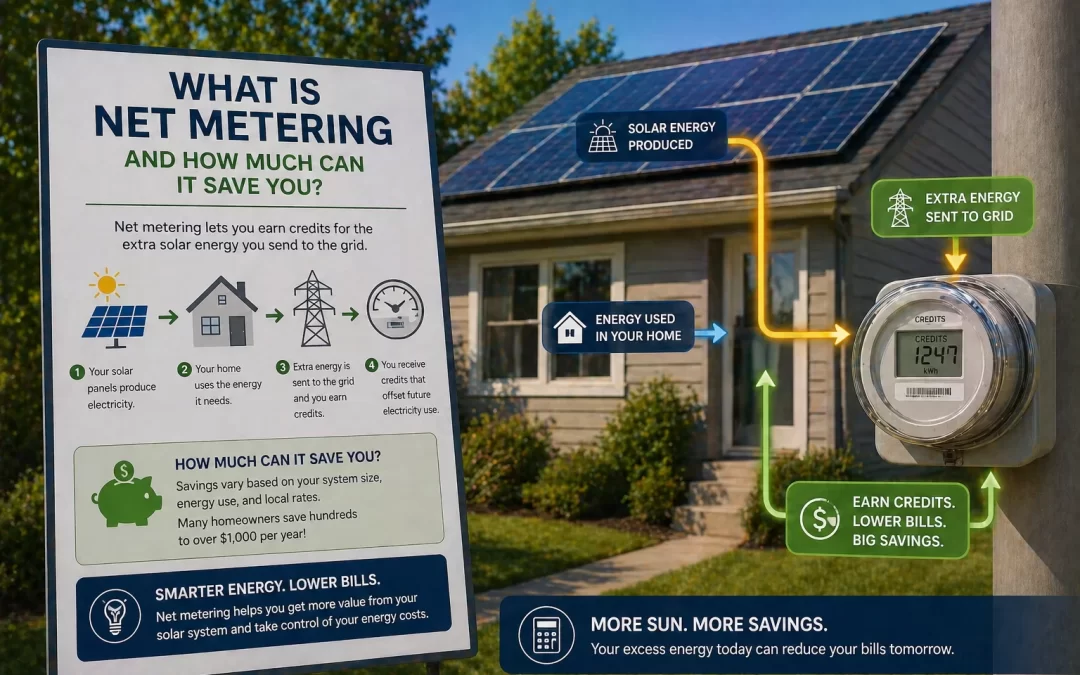
Net metering is a billing system that gives you credit for extra solar electricity your panels send to the grid, which helps offset the power you use when the sun isn’t shining. In states with strong net metering, homeowners can often cut their electric bills by 60%–90% and pay off a solar system in about 7–9 years. In states with weaker or no net metering, savings are still possible but usually smaller and more dependent on your utility’s specific rules. Net metering policies are changing in many areas, so your actual savings will depend heavily on your state, utility, and the details of your solar setup.
Net metering is one of the most important pieces of the solar savings puzzle, but it’s also one of the most confusing. This guide is written for U.S. homeowners who want a clear, honest explanation of how net metering works and how much it can realistically save you. By the end, you’ll know what questions to ask your installer and whether net metering in your area makes solar a smart move.
Table of Contents
- What Is Net Metering?
- How Net Metering Works Step by Step
- How Much Can Net Metering Save You?
- What Affects Your Net Metering Savings?
- State and Utility Differences in Net Metering
- When Net Metering Works in Your Favor
- When Net Metering Might Not Be Worth It
- Key Numbers: Costs, Savings, and Payback With Net Metering
- How to Evaluate Your Local Net Metering Policy
- Decision Guide: What to Do Next
- Frequently Asked Questions
- Summary: Net Metering and Your Solar Decision
- Next Step: Get Personalized Net Metering Savings Estimates
What Is Net Metering?
Net metering is a billing arrangement between you and your electric utility that tracks the difference between:
- The electricity your solar panels produce and send to the grid
- The electricity you pull from the grid when your panels aren’t producing enough
Instead of paying you cash for extra solar power, the utility gives you bill credits. Those credits are used to reduce what you owe on future electric bills, often at or close to the same rate you pay for electricity.
In simple terms: when your solar system makes more than you use, your meter “runs backward” as credits; when you use more than you make, it “runs forward” and uses those credits first.
Key concepts in plain language
- Grid: The network of power lines and equipment that delivers electricity to your home.
- Retail rate: The price you pay per kilowatt-hour (kWh) on your bill (for example, $0.15/kWh).
- Credit rate: The price your utility gives you for extra solar energy; under “full retail net metering,” this equals your retail rate.
- Net usage: Your total electricity used minus what your solar system sends back to the grid.
How Net Metering Works Step by Step
Here’s how net metering typically works for a homeowner with rooftop solar:
- Daytime, sunny hours
- Your solar panels produce electricity.
- Your home uses what it needs first.
- Any extra flows back to the grid through your meter.
- Your utility tracks this exported energy and adds bill credits to your account.
- Nighttime or cloudy hours
- Your panels produce little or no power.
- Your home pulls electricity from the grid as usual.
- Your utility subtracts your previously earned credits from what you owe.
- End of the billing cycle
- If your credits cover all your usage, you may owe only fixed fees (like a basic service charge).
- If you used more than you produced, you pay the difference.
- If you produced more than you used, your credits may roll over to the next month, depending on your utility’s rules.
Types of net metering you may see
- Full retail net metering: You get the same rate for solar exports as you pay for electricity. This usually gives the highest savings.
- Reduced-rate or “buy-all, sell-all” programs: You’re credited at a lower rate than you pay, or all your solar is sold to the utility at a set price. Savings are lower and depend heavily on the rate.
- Time-of-use (TOU) net metering: Credit values change by time of day; power exported during peak hours is worth more than off-peak.
How Much Can Net Metering Save You?
Net metering doesn’t create savings by itself; it unlocks the full value of the solar energy your system produces. The better your net metering policy, the closer you get to offsetting your entire electric bill.
Typical savings with strong net metering
On a national average basis, for a well-sized system in a state with strong net metering:
- Average annual savings: About $1,300–$1,500 on electricity bills
- Bill reduction: Often 60%–90% of your pre-solar electric costs
- Payback period: Roughly 7–9 years for a purchased system
- Lifetime savings: Commonly $25,000–$40,000 over 25–30 years, depending on rates and usage
These numbers assume a typical residential system of 6–10 kW (about 15–25 panels), average U.S. electric rates, and a 30% federal tax credit applied. Individual results vary based on your state, roof, and utility rules.
How net metering changes your bill
With strong net metering, many homeowners see:
- Energy charges (per-kWh costs) drop dramatically
- Only fixed monthly fees remain (often $10–$30/month)
- Seasonal swings: higher credits in sunny months, higher usage in winter
In weaker net metering programs, you may still save, but you’ll likely:
- Offset a smaller share of your bill
- Rely more on shifting usage to sunny hours
- See longer payback periods (sometimes 10–15+ years)
What Affects Your Net Metering Savings?
Several key variables determine how much net metering will actually save you.
Your electric rate and usage
- Higher rates = higher savings: If you pay $0.20/kWh instead of $0.12/kWh, every kWh your solar offsets is worth more.
- Usage level matters: Homes using 800–1,200 kWh/month usually see stronger savings than very low-usage homes, assuming the system is sized appropriately.
- Rate structure: Time-of-use, tiered rates, and demand charges can all change the math.
Your net metering policy details
Important questions to ask or look up:
- Do I get full retail credit for each kWh I export, or a lower rate?
- Do credits roll over month to month, and for how long?
- Is there an annual “true-up” where unused credits are paid out or reset?
- Are there system size caps (for example, can’t exceed 100% of your annual usage)?
- Are there special fees for solar customers?
Your system size and design
- Right-sized systems (designed to cover 80%–100% of your annual usage) usually give the best payback.
- Oversized systems may produce more than you can use or get credit for, especially if export rates are low.
- Under-sized systems still save money but leave more of your bill untouched.
- Panel orientation, shading, and local climate all affect how much energy you produce.
Whether you have batteries
- With batteries, you can store extra solar energy and use it later, reducing how much you export to the grid.
- In areas with poor export rates, batteries can sometimes improve your savings by letting you avoid buying expensive peak power.
- Batteries add cost, so the economics are more complex and very location-specific.
State and Utility Differences in Net Metering
Net metering is not a single national policy; it’s set by states and sometimes by individual utilities. That’s why two neighbors in different states can see very different solar savings.
States with historically strong net metering
Many states have offered full retail net metering or close to it, including (policies can change):
- New York
- New Jersey
- Massachusetts
- Maryland
- Colorado
- Oregon
- Minnesota
In these states, homeowners often see faster payback periods and higher lifetime savings, especially where electric rates are above the national average.
States where net metering has been reduced or changed
Some states have moved away from traditional net metering toward more complex structures:
- California: Under NEM 3.0, export credits are much lower than retail rates and vary by time of day, making batteries and load shifting more important.
- Arizona, Nevada, Hawaii: Have implemented reduced export rates or alternative programs that lower the value of exported solar.
In these markets, solar can still make sense, but the savings depend more on system design, usage patterns, and sometimes batteries.
To see how your state’s electricity costs and incentives affect overall savings, it can help to compare data in a resource like solar cost by state, then layer your local net metering rules on top.
When Net Metering Works in Your Favor
Net metering is most powerful when it lets you treat the grid like a free, virtual battery.
Situations where net metering shines
- You live in a state with full retail net metering or close to it.
- Your electric rates are at or above the national average (around $0.16/kWh or higher in many areas by mid-2020s).
- Your roof has good sun exposure and can support a system sized to cover most of your annual usage.
- Your utility allows monthly credit rollovers and a fair annual true-up.
- You don’t have (or need) batteries, so exporting extra daytime power is your main way to capture value.
Realistic expectations in a “good” net metering area
In a strong net metering market, a typical homeowner might expect:
- Solar to offset 70%–100% of their annual electricity usage
- Monthly bills dropping from, say, $150–$200 to $20–$60 (after solar loan payments, your total monthly out-of-pocket may still be similar at first)
- System payback in 7–9 years, with 15–20+ years of low-cost power after that
When Net Metering Might Not Be Worth It
There are situations where net metering is weak enough—or your circumstances are unique enough—that solar may not be the right financial move.
Warning signs that net metering may not deliver big savings
- Your utility credits exports at a very low rate (for example, only a few cents per kWh while you pay much more).
- Credits expire quickly or don’t roll over across seasons.
- There are high fixed charges or special fees for solar customers that eat into savings.
- Your home has heavy shading or a roof that can’t fit enough panels to cover much of your usage.
- Your electricity rates are already very low, so each kWh offset doesn’t save much money.
When solar might not be the right choice (for now)
Solar may not be ideal if:
- You plan to move in the next 3–5 years and your state has weak net metering and limited incentives.
- You can’t use the 30% federal tax credit (for example, low or no tax liability) and there are no strong state incentives to help.
- Your roof needs major work soon and you’re not ready to replace it.
- Your utility’s solar policies are in flux and about to change in ways that significantly reduce export values.
In these cases, it can be wise to wait, watch policy changes, or explore alternatives like community solar. For a broader look at whether solar makes sense for your situation, you may find our honest solar worth-it guide helpful.
Key Numbers: Costs, Savings, and Payback With Net Metering
To understand how net metering fits into the bigger picture, it helps to look at typical system costs and savings.
Typical residential solar system costs (before and after incentives)
- Average system size: 6–10 kW (about 15–25 panels for a typical U.S. home)
- Average cost per watt: $2.50–$3.50
- Average total system cost: $28,000–$32,000 before incentives
- Federal tax credit (ITC): 30% of system cost through at least 2032
- Average net cost after 30% ITC: About $19,600–$22,400
These are national averages; your actual quote will depend on your roof, equipment choices, labor costs in your area, and any additional work (like electrical upgrades). For a deeper breakdown by system size, see average solar panel cost by system size.
How net metering affects payback
With strong net metering:
- Average annual savings: $1,300–$1,500
- Typical payback period: 7–9 years
- Panel lifespan: 25–30 years performance warranty; many systems last 30–35 years or more
Without strong net metering (for example, low export rates):
- Annual savings may drop significantly, especially if you export a lot of power.
- Payback can stretch to 10–15+ years, depending on how much of your solar you can use directly.
- Adding batteries or shifting usage to daytime may help, but also adds complexity and cost.
These are general ranges, not guarantees. Your actual results depend on your specific utility rates, usage, system design, and future rate changes. For personalized financial guidance, it’s wise to speak with a qualified financial or tax professional.
How to Evaluate Your Local Net Metering Policy
Before you sign a solar contract, you should understand exactly how your utility will treat your solar exports.
Step 1: Find your utility’s net metering or solar export policy
- Search your utility’s name plus “net metering” or “solar export credit.”
- Look for a residential or “customer-owned generation” section.
- If it’s unclear, call customer service and ask for written information or a link.
Step 2: Ask these key questions
- What rate do I get for each kWh I export? Is it the same as what I pay?
- Do credits roll over month to month? For how long?
- Is there an annual true-up? What happens to unused credits?
- Are there any extra fees or minimum bills for solar customers?
- Is there a cap on system size relative to my usage?
- Are there upcoming changes to the policy I should know about?
Step 3: Have installers model your savings under your actual rules
When you get quotes, ask each installer to:
- Use your exact utility rate plan (including time-of-use if applicable).
- Show year-by-year bill savings under your current net metering or export policy.
- Explain how changes in rates or policies could affect your payback period.
Good installers should be able to walk you through this clearly. If they can’t explain it in plain language, consider that a red flag.
Decision Guide: What to Do Next
Net metering is a major factor in whether solar makes financial sense for your home, but it’s not the only one. Here’s how to move forward in a practical way.
Is this the right time to act?
It may be a good time to move forward if:
- Your state still offers strong net metering and there are rumors or plans to reduce it.
- Your electric rates have been rising and are likely to keep increasing.
- Your roof is in good shape and unlikely to need replacement soon.
- You expect to stay in your home for at least 7–10 years.
You might wait or proceed cautiously if:
- Your utility is in the middle of a major policy change and details aren’t final.
- Your roof needs replacement or major repairs in the next few years.
- Your finances are tight and you’re not comfortable with a long-term loan or lease.
Information to gather before getting quotes
- Your last 12 months of electric bills (kWh usage and total cost).
- Your rate plan (standard, time-of-use, tiered, etc.).
- Any future changes you expect (EV purchase, heat pump, pool, home addition).
- Basic roof information: age, material, shading, and orientation (south, east, west).
Questions to ask installers about net metering
- How does my utility’s net metering or export policy work in detail?
- What export rate are you using in your savings estimate?
- How much of my solar production do you expect I’ll use directly versus export?
- What happens to my savings if export rates are reduced in the future?
- Would you recommend batteries in my situation, and why or why not?
It almost always makes sense to get multiple quotes so you can compare assumptions, equipment, and pricing. Understanding the equipment in your quote can also help you compare apples to apples; our solar panels and equipment guide can help with that.
Frequently Asked Questions
Do you still get an electric bill with net metering?
Yes. Even with net metering, you’ll still receive a bill from your utility. In a good net metering setup, your energy charges can drop close to zero in some months, but you’ll usually still pay fixed fees like basic service charges or connection fees.
Can net metering make your electric bill zero?
Net metering can reduce your energy charges to zero in some months if your system is sized well and your policy is strong, but most utilities still charge a minimum or fixed monthly fee. Over a full year, many homeowners can offset 70%–100% of their usage, but a truly $0 bill every month is uncommon.
Is net metering the same as selling power back to the grid?
Not exactly. With net metering, you usually receive bill credits for extra solar power, not cash payments. Those credits reduce what you owe on future bills; only in some programs, and usually only once a year, might you receive a small payment for leftover credits.
What happens to my net metering if I add more panels later?
If you expand your system, your utility may need to approve the new size and could re-evaluate your net metering agreement. Some utilities cap system size based on your past usage, so adding too many panels could reduce the value of your exports or require a different rate plan.
Will net metering go away?
Net metering policies are evolving, and some states have already reduced export rates or changed how credits work. It’s unlikely that all forms of net metering will disappear soon, but the details may become less generous over time, which is why understanding your current policy and any planned changes is important before going solar.
Do I need batteries if I have net metering?
In areas with strong net metering, batteries are optional and mainly used for backup power or extra resilience. In areas with weak export rates or time-of-use pricing, batteries can sometimes improve savings by storing solar for use during expensive peak hours, but they add cost and should be evaluated carefully.
Summary: Net Metering and Your Solar Decision
- Net metering is a billing system that credits you for extra solar power sent to the grid, often allowing you to cut electric bills by 60%–90% in strong-policy areas.
- Typical solar systems cost around $28,000–$32,000 before incentives and $19,600–$22,400 after the 30% federal tax credit, with payback in about 7–9 years when paired with good net metering.
- Your savings depend heavily on your utility’s export rate, credit rollover rules, electric rates, system size, and how much solar you use directly.
- Net metering works best in states with full or near-full retail credit and rising electricity prices; it’s less compelling where export rates are low or policies are restrictive.
- The smartest next step is to understand your local net metering rules, gather your usage data, and get multiple quotes that model savings under your actual utility policy.
Next Step: Get Personalized Net Metering Savings Estimates
Net metering can dramatically change how much solar saves you, but the details are local and specific to your home. The only way to know your true savings potential is to see customized quotes that use your real utility rates, roof, and usage history.
When you’re ready, you can compare multiple installer offers and see how net metering affects your payback period and monthly bills at /get-my-quote/. There’s no obligation, and having real numbers in front of you is the best way to decide whether solar and net metering are worth it for your home.