
Direct answer
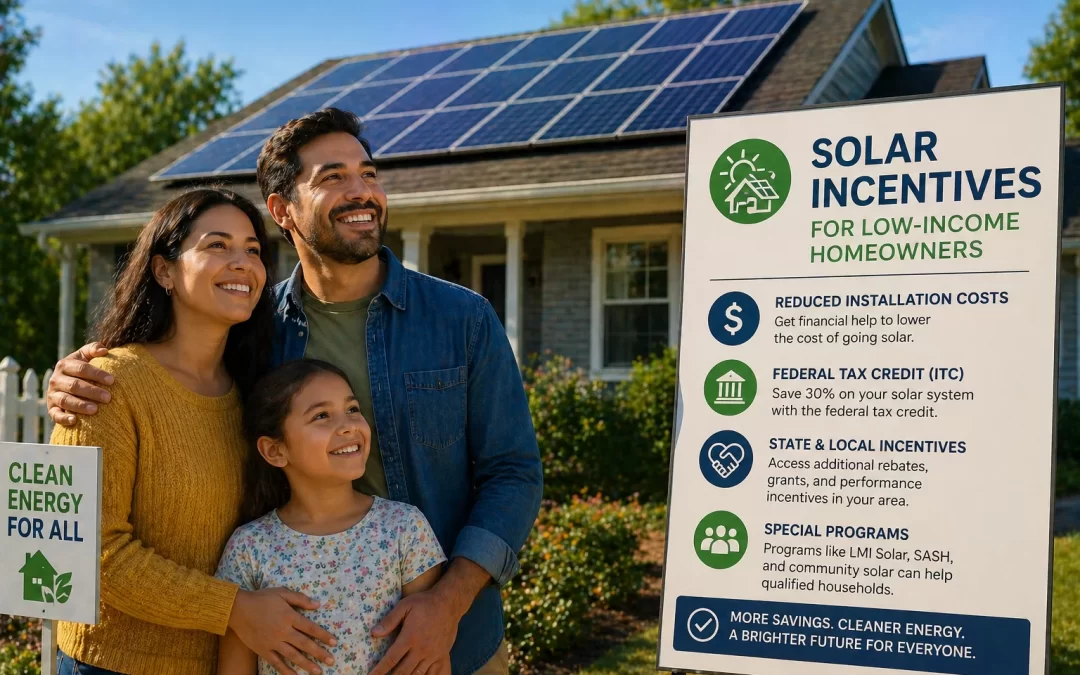
Solar incentives for low-income homeowners are special programs that reduce the upfront cost of going solar through extra rebates, higher tax credits, utility discounts, and no- or low-upfront-cost financing. Depending on your income, location, and roof, these incentives can cut your out-of-pocket cost to a fraction of the normal price and, in some cases, to almost zero. However, programs vary widely by state and utility, and many have limited funding or waitlists, so not every low-income homeowner will qualify or get the maximum benefit.
Solar can be a powerful way for low-income homeowners to lower their electric bills, but only if the incentives line up with your situation. This guide explains how low-income solar incentives work, what programs exist, and how to tell if they’re a good fit for your home. If you’re trying to figure out whether you can realistically afford solar, you’re in the right place.
Table of Contents
- What Are Solar Incentives for Low-Income Homeowners?
- How Much Can Low-Income Solar Incentives Save You?
- Main Types of Low-Income Solar Programs
- Federal Solar Incentives and Low-Income Add-Ons
- State, Utility, and Local Low-Income Solar Programs
- When Low-Income Solar Incentives Work in Your Favor
- When Solar Might Not Be the Right Move (Even With Incentives)
- Key Numbers: Costs, Savings, and Payback With Incentives
- How to Check If You Qualify and What to Do Next
- Questions Low-Income Homeowners Should Ask Installers
- Frequently Asked Questions
- Summary: Key Takeaways
What Are Solar Incentives for Low-Income Homeowners?
Solar incentives for low-income homeowners are targeted financial benefits designed to make solar power affordable for households below certain income levels. Instead of just a single tax credit, these programs often stack multiple benefits to reduce or even eliminate upfront costs.
Common goals of these programs are to:
- Lower monthly energy bills for households that spend a high share of income on utilities
- Reduce reliance on fossil fuels and improve local air quality
- Bring solar access to communities that have historically been left out
Most programs define “low-income” using:
- A percentage of Area Median Income (AMI), often 80% or less
- Enrollment in assistance programs (SNAP, Medicaid, LIHEAP, etc.)
- Location in a “disadvantaged” or “environmental justice” census tract
How Much Can Low-Income Solar Incentives Save You?
For a typical U.S. home, a residential solar system costs about $28,000–$32,000 before incentives, or roughly $2.50–$3.50 per watt. After the standard 30% federal tax credit, the average net cost drops to about $19,600–$22,400.
Low-income incentives can reduce that even further:
- Extra rebates or discounts: $2,000–$10,000+ off the upfront price in some states
- Performance-based incentives: Monthly bill credits that can cover 20–100% of your solar production value
- Special financing: $0-down loans or leases with payments lower than your current electric bill
- Community solar discounts: 20–50% off the value of solar bill credits without installing panels
On average, homeowners with solar save around $1,300–$1,500 per year on electricity, with a 7–9 year payback period nationally. With strong low-income incentives, payback can shorten to 4–7 years, or you may see immediate savings if you join a discounted community solar program. Actual savings depend heavily on your utility rates, roof, and which programs you qualify for.
Main Types of Low-Income Solar Programs
1. Upfront Rebates and Discounts
These programs directly reduce the price of your solar system before or at installation.
- State or utility rebates: A set dollar amount per watt or per system (for example, $1.00–$3.00 per watt for qualifying low-income households in some states)
- Installer-partnered discounts: Installers that participate in state programs may offer special pricing for eligible customers
- Nonprofit or grant-funded projects: In some areas, nonprofits fully or partially fund systems for qualifying homeowners
These are powerful because they reduce the amount you need to finance, which lowers your monthly payment or shortens your payback period.
2. Enhanced Bill Credits and Community Solar
Community solar lets you subscribe to a share of a larger solar farm instead of putting panels on your roof. Low-income versions of these programs often offer:
- Guaranteed bill discounts: For example, 20–50% off the value of the solar credits you receive
- No credit check or low credit requirements: Easier enrollment for households with limited credit history
- No upfront cost: You pay a monthly subscription that is designed to be lower than your bill savings
This can be a good option if you rent, have a shaded or damaged roof, or can’t qualify for a loan.
3. Special Financing and $0-Down Options
Many low-income solar programs pair incentives with financing that’s easier to qualify for and designed to keep payments affordable.
- Low-interest loans: State green banks or credit unions may offer below-market interest rates
- On-bill repayment: Your solar payment appears on your utility bill and is structured so your total bill is lower than before
- Leases and power purchase agreements (PPAs): A third party owns the system; you pay a fixed or per-kWh rate, often lower than your utility rate
Financing can make solar accessible with little or no upfront cost, but you’ll want to compare the long-term cost to owning your system outright.
4. Weatherization and Roof-Repair Tie-Ins
Some low-income solar programs are bundled with home efficiency and repair funds.
- Roof repair or replacement assistance: Helps fix structural issues that would otherwise block solar
- Insulation and efficiency upgrades: Reduce your energy use so your solar system can be smaller and cheaper
- Health and safety fixes: Address electrical or structural hazards before installing solar
These add-ons can be critical if your home needs work before it can safely host a solar system.
Federal Solar Incentives and Low-Income Add-Ons
The 30% Federal Solar Tax Credit (ITC)
The main federal incentive is the 30% Residential Clean Energy Credit, often called the solar tax credit or ITC. It lets eligible homeowners reduce their federal income tax by 30% of the cost of a qualifying solar installation, including panels, inverters, racking, and labor.
Key points:
- Value: 30% of your total system cost (for example, $9,000 on a $30,000 system)
- Timeline: 30% through 2032, then steps down (see details in our 2026 solar tax credit guide)
- Tax liability required: You must owe enough federal income tax to use the credit; unused amounts can usually roll forward
Because this is a tax credit, not a refund, it may be less helpful if your income — and therefore your tax bill — is very low. A tax professional can help you understand how much of the credit you can realistically use.
Low-Income Bonus Credits (Indirect Benefit)
Recent federal laws created “bonus” tax credits for solar projects that serve low-income communities or are built in disadvantaged areas. These are mostly aimed at developers and community solar projects, not individual homeowners.
However, they can still benefit you indirectly by:
- Encouraging more low-income community solar projects in your area
- Helping nonprofits and housing authorities fund rooftop solar on affordable housing
- Supporting programs that offer deeper discounts for low-income subscribers
Battery Storage and the Federal Credit
If you’re considering adding a battery for backup power, standalone batteries can also qualify for the 30% federal tax credit when they meet certain requirements. This can be important for low-income homeowners in areas with frequent outages or medical equipment needs.
For more detail on how batteries interact with the federal credit, see our guide on whether the solar tax credit applies to battery storage, and always confirm specifics with a tax professional.
State, Utility, and Local Low-Income Solar Programs
State and local incentives are where most low-income solar support actually happens. These programs change frequently and vary widely by location.
How States Define “Low-Income” for Solar
Most programs use one or more of these criteria:
- Income thresholds: Household income at or below 80% of Area Median Income (AMI), sometimes 60% or 100% AMI
- Program participation: Enrollment in LIHEAP, SNAP, TANF, Medicaid, or similar assistance programs
- Geographic targeting: Living in a designated disadvantaged or environmental justice community
You’ll usually need to provide income documentation or proof of program participation to qualify.
Examples of Low-Income Solar Programs (Conceptual)
While specific program names and funding levels change, many states offer some combination of:
- Low-income rooftop solar rebates: Higher per-watt incentives than standard programs
- Low-income community solar subscriptions: Guaranteed bill discounts and no upfront cost
- Solar + weatherization bundles: Coordinated upgrades through state energy offices or nonprofits
To see what’s available where you live, start with your state energy office, your utility’s website, and reputable installers who regularly work with low-income programs. Our overview of state solar incentives and best states for rebates can also help you understand the landscape.
Utility and City-Level Programs
Some utilities and cities run their own low-income solar initiatives, which may include:
- Free or heavily discounted community solar subscriptions
- Extra bill credits for low-income solar customers
- Grants or no-interest loans for rooftop solar
These programs often have limited funding and open in “rounds,” so timing can matter. If you’re interested, it’s worth signing up for alerts or waitlists early.
When Low-Income Solar Incentives Work in Your Favor
Low-income solar incentives tend to be most beneficial when several factors line up.
Good Roof and High Electric Bills
You’re in a strong position if:
- Your roof is in good condition and has 10–15+ years of life left
- You have minimal shading from trees or nearby buildings
- Your electric bills are consistently high (for example, $100–$200+ per month)
In this scenario, incentives can dramatically reduce your upfront cost, and your bill savings can quickly outweigh any loan or lease payments.
Access to Multiple Incentives
The best outcomes usually come from stacking incentives:
- Federal 30% tax credit (if you have enough tax liability)
- State or utility low-income rebates
- Performance-based incentives or SRECs where available
- Low-interest financing or on-bill repayment
When these align, it’s possible to see net costs far below the national average and payback periods on the shorter end of the 4–9 year range.
Stable Homeownership and Long-Term Plans
Solar is a long-term investment. It tends to work best if:
- You plan to stay in your home at least 5–10 years
- You can keep up with basic roof and electrical maintenance
- You’re comfortable with a multi-year loan or lease if needed
Panels typically come with 25–30 year performance warranties and can last 30–35 years, so the longer you stay, the more you benefit.
When Solar Might Not Be the Right Move (Even With Incentives)
Solar is not automatically a good fit for every low-income homeowner. Being honest about the downsides protects you from taking on a project that doesn’t help.
Limited or No Tax Liability
If your income is very low and you owe little or no federal income tax, you may not be able to use the full 30% federal tax credit. In that case:
- Leases or PPAs may be more attractive, since the third-party owner can use the tax credit
- Community solar with guaranteed discounts might deliver more reliable savings
- You’ll want to focus on upfront rebates and grants rather than tax-based incentives
A tax professional can help you understand your specific situation before you sign a contract that assumes you’ll receive the full credit.
Roof, Structural, or Ownership Issues
Solar may not be a good fit if:
- Your roof needs major repairs or replacement and you can’t access roof-assistance programs
- You have heavy shading that would severely limit solar production
- You’re in a condo, manufactured home park, or shared-roof situation with unclear ownership rights
In these cases, community solar or energy efficiency upgrades may offer better value than rooftop panels.
Unstable Housing or Financial Situation
Even with incentives, solar usually involves a long-term commitment. It may not be the right time if:
- You expect to move within a few years and your local market doesn’t strongly value solar
- You’re behind on mortgage or utility payments and need immediate, guaranteed relief
- You’re uncomfortable with any new monthly payment, even if projected savings are higher
Before committing to solar, it can be wise to first explore bill assistance programs, weatherization, and energy efficiency measures that have little or no cost.
Key Numbers: Costs, Savings, and Payback With Incentives
Understanding the basic numbers helps you judge whether low-income solar incentives are likely to work for you.
Typical System Size and Cost
- Average system size: 15–25 panels for a typical U.S. home (roughly 6–10 kW)
- Cost per watt: About $2.50–$3.50 nationally
- Total cost before incentives: Around $28,000–$32,000 for many homes
Low-income incentives can change this picture significantly:
- After 30% federal tax credit: About $19,600–$22,400 on average
- With strong low-income rebates: Some households may see net costs in the $5,000–$15,000 range, or even near zero in rare, fully subsidized programs
These are national averages; your actual quote will depend on your roof, location, and installer pricing.
Typical Savings and Payback
- Average annual savings: $1,300–$1,500 on electricity bills
- National average payback: 7–9 years without special low-income incentives
- With strong low-income incentives: Payback can shorten to 4–7 years, or you may see immediate net savings with community solar discounts
Factors that affect your payback include:
- Your current electric rates and how fast they’re rising
- How much sun your roof gets
- Whether your state has net metering or similar bill credit policies
- How much you pay in interest if you finance the system
Because these variables are so local, getting multiple quotes and a detailed savings estimate is essential before deciding.
System Lifespan and Long-Term Value
- Panel performance warranty: Typically 25–30 years
- Expected useful life: Often 30–35 years or more
- Inverter replacement: Many string inverters need replacement once in 10–15 years; microinverters and optimizers may last longer but cost more upfront
Even after the system “pays for itself,” you’ll still have small maintenance or replacement costs over the decades. However, for many homeowners, the long-term bill savings far outweigh these expenses.
How to Check If You Qualify and What to Do Next
If you think low-income solar incentives might help you, a structured approach will save time and reduce frustration.
Step 1: Gather Basic Information About Your Home
Before talking to installers or program administrators, collect:
- 12 months of electric bills (or at least 3–6 months)
- Your household income and number of people in the home
- Any assistance programs you’re currently enrolled in (LIHEAP, SNAP, etc.)
- Basic roof details: age, material (asphalt shingle, metal, etc.), and any known issues
Step 2: Check State and Utility Program Eligibility
Start with:
- Your state energy office website (search “[your state] low-income solar program”)
- Your electric utility’s website under “Programs,” “Renewables,” or “Assistance”
- Local nonprofits or community action agencies that work on energy and housing
Look for programs that mention “low-income,” “income-qualified,” “disadvantaged communities,” or “environmental justice.” Note any income limits, documentation requirements, and application deadlines.
Step 3: Talk to Installers Experienced With Low-Income Programs
Not all installers work with low-income incentives. When requesting quotes, ask directly whether they:
- Participate in your state’s low-income solar programs
- Have experience helping customers apply for rebates and bill credits
- Offer financing options designed for lower-income households
Before you request quotes, it can help to understand the basics of pricing and savings; our solar cost and savings guide explains how installers typically structure proposals.
Step 4: Compare Options, Including Community Solar
For many low-income households, the best option may not be rooftop solar at all. Compare:
- Owning a rooftop system (with or without a loan)
- Leasing or signing a PPA
- Joining a low-income community solar program
- Focusing on efficiency and bill assistance first
Look at total monthly costs, not just the “no money down” pitch. The right choice is the one that reliably lowers your total energy costs without putting your housing at risk.
Questions Low-Income Homeowners Should Ask Installers
When you’re ready to talk to installers, asking the right questions helps you avoid surprises and spot the companies that truly understand low-income incentives.
Key Questions to Ask
- Which low-income solar programs do you work with in my area, and how many projects have you completed under them?
- Will you help me apply for all eligible rebates, bill credits, and incentives, and is there a fee for that service?
- How does this proposal change if I can’t fully use the 30% federal tax credit?
- What are my total monthly costs (loan, lease, or PPA) compared to my current average electric bill?
- What happens if I move or sell my home before the system is paid off?
- Are there any pre-approval steps or waitlists for the low-income programs you’re proposing?
Why Multiple Quotes Matter
Getting at least two or three quotes is especially important for low-income homeowners because:
- Different installers may know about different local programs
- Pricing and financing terms can vary widely
- Some companies may overestimate savings or assume incentives you won’t actually receive
Comparing multiple proposals side by side helps you spot unrealistic promises and choose the option that truly improves your financial situation.
Frequently Asked Questions
Can low-income homeowners really get solar panels for free?
In a few areas, heavily funded programs or nonprofit projects can provide solar at little or no cost to qualifying low-income homeowners, but this is not common nationwide. Most households will still pay something, either upfront or through a loan or lease, even with strong incentives. Always read the fine print to understand your total long-term costs.
What income level counts as “low-income” for solar incentives?
Most programs define “low-income” as a household earning at or below 80% of the Area Median Income (AMI), though some use 60% or 100% AMI or tie eligibility to participation in assistance programs. Because definitions vary by state and program, you’ll need to check the specific rules where you live.
What if I don’t owe enough taxes to use the 30% solar tax credit?
If your federal income tax bill is very low, you may not be able to use the full 30% credit right away, though you can often carry unused amounts forward to future years. In that situation, it’s especially important to look at upfront rebates, grants, community solar, or third-party ownership options where someone else uses the tax credit. A tax professional can help you understand how much of the credit you can realistically benefit from.
Is community solar a good option for low-income households?
Yes, low-income community solar programs can be an excellent option because they usually require no upfront cost and offer guaranteed bill discounts. They’re especially helpful if you rent, have a shaded or damaged roof, or can’t qualify for a loan. The main limitation is availability, as not all areas have active community solar projects.
How many solar panels does a typical low-income household need?
Most U.S. homes need about 15–25 panels (roughly 6–10 kW) to offset a large share of their electricity use, but low-income households often use less energy and may need smaller systems. The exact number depends on your past electric bills, roof size, shading, and local sun conditions. An installer will size the system based on your actual usage and program rules.
Will going solar affect my eligibility for other assistance programs?
In most cases, installing solar does not directly change your eligibility for programs like SNAP, Medicaid, or LIHEAP, but rules can vary and savings on your utility bill may affect how some programs calculate need. Before you sign a contract, it’s wise to ask your caseworker or program administrator whether lower utility bills or new financing obligations could impact your benefits.
Summary: Key Takeaways
- Solar incentives for low-income homeowners can significantly reduce or even eliminate upfront costs, but availability and eligibility vary widely by state, utility, and income level.
- A typical solar system costs about $28,000–$32,000 before incentives and $19,600–$22,400 after the 30% federal tax credit, with average annual savings of $1,300–$1,500 and a 7–9 year payback.
- The biggest factors in your outcome are your income and tax situation, local programs, roof condition, and current electric rates.
- Solar is most likely to help when you have a good roof, high electric bills, and access to stacked incentives; it may not be the right move if your housing or finances are unstable.
- The next step is to check local low-income programs, gather your bills and income information, and get multiple quotes from installers experienced with low-income incentives.
If you’re considering solar, personalized quotes are the only way to see how low-income incentives apply to your specific home and budget. Comparing offers from multiple vetted installers can help you find an option that truly lowers your costs without adding unnecessary risk. When you’re ready, you can explore installers and request tailored proposals at /get-my-quote/.