
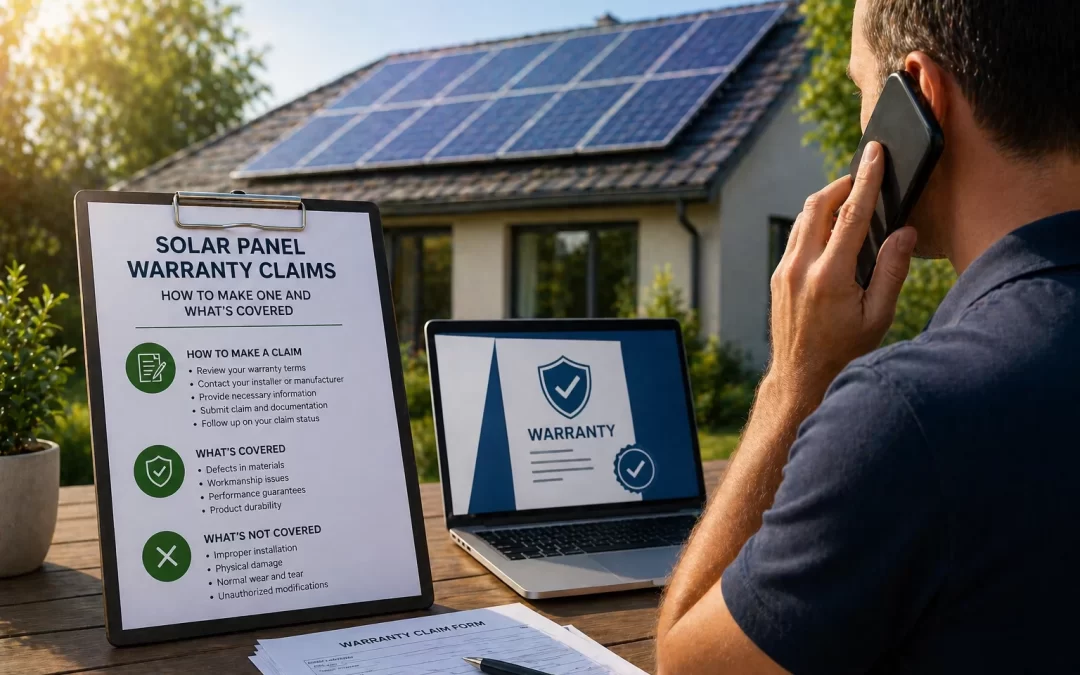
To make a solar panel warranty claim, you first document the problem (photos, production data, invoices), then contact your installer or the panel manufacturer with your system details and proof of purchase so they can verify coverage and arrange repair, replacement, or reimbursement. Most solar panel warranties cover defects in materials and workmanship (usually 10–25 years) and a performance guarantee that panels will still produce a certain percentage of their original power (often 80–92% at year 25). Labor and roof damage are not always covered, and you may pay shipping or service visit fees depending on the warranty. Every warranty is different, so reading your specific documents and getting help from a reputable installer is essential.
Solar panel warranty claims can feel intimidating, especially if you’re not sure what’s covered or who to call first. This guide walks US homeowners through how solar warranties work, what’s typically covered, and the exact steps to take if you think something is wrong. The goal is to help you protect your investment, avoid surprises, and know when it’s time to bring in a professional or get new quotes.
Table of Contents
- What Is a Solar Panel Warranty?
- What’s Usually Covered by Solar Panel Warranties?
- What’s Usually NOT Covered (Common Surprises)
- Key Numbers: Costs, Lifespan, and Why Warranties Matter
- How to Make a Solar Panel Warranty Claim Step-by-Step
- Who to Contact: Installer vs. Manufacturer vs. Financing Company
- State and Location Considerations
- When a Warranty Works in Your Favor
- When a Warranty May Not Help Much
- How to Decide What to Do Next
- Frequently Asked Questions
- Summary
What Is a Solar Panel Warranty?
A solar panel warranty is a written promise from the manufacturer (and sometimes the installer) about how long your panels should last and what happens if they fail early. It’s one of the most important protections you have on a system that can cost tens of thousands of dollars.
Most residential solar systems come with several different warranties:
- Panel product (materials & workmanship) warranty – covers defects in the panel itself.
- Panel performance warranty – guarantees a minimum power output over time.
- Inverter and equipment warranties – cover other components like inverters and optimizers.
- Workmanship or labor warranty – from the installer, covering installation-related issues.
Understanding which warranty applies to your problem is the first step in a successful claim.
What’s Usually Covered by Solar Panel Warranties?
1. Product (Materials & Workmanship) Warranty
This is the “if the panel itself is defective” coverage.
- Typical length: 10–12 years for budget panels, 20–25 years for many premium brands.
- Covers:
- Manufacturing defects (e.g., faulty junction box, bad soldering).
- Premature failure of cells, glass, or frame under normal conditions.
- Water intrusion or delamination not caused by external damage.
- Remedy: Usually replacement panel(s), sometimes repair or a refund/credit.
2. Performance Warranty
Solar panels slowly lose output over time. A performance warranty guarantees they won’t degrade faster than a stated rate.
- Typical guarantee:
- 90–92% of original output at year 10.
- 80–88% of original output at year 25 (varies by brand).
- Covers: Excessive loss of power compared to the warranty’s degradation curve.
- Remedy: Often replacement of underperforming panels or additional panels/credit to make up the shortfall.
To use this warranty, you usually need proof of long-term underperformance, not just a bad week of production.
3. Inverter and Other Equipment Warranties
Inverters are more likely to fail than panels and have different warranty terms.
- String inverters: Commonly 10–12 years standard, sometimes extendable to 20–25 years.
- Microinverters/optimizers: Often 20–25 years to match panel life.
- Covers: Defects and premature failure of the device under normal use.
- May or may not include: Labor to replace the device.
If your system suddenly stops producing, an inverter issue is more likely than a panel defect. Our guide on solar inverter problems and how to diagnose them can help you narrow down the cause before you start a warranty claim.
4. Installer Workmanship / Labor Warranty
This warranty is from the company that installed your system, not the panel manufacturer.
- Typical length: 1–10 years, with 10 years common among reputable installers.
- Covers:
- Roof leaks caused by poor mounting or flashing.
- Loose wiring, poor conduit runs, or bad connections.
- Code or safety issues tied to installation work.
- Remedy: Installer fixes the issue, often including labor and materials.
This warranty is critical for protecting your roof and home, not just the panels.
What’s Usually NOT Covered (Common Surprises)
Many homeowners assume “lifetime coverage,” but solar warranties have clear limits. Common exclusions include:
- Weather and environmental damage such as:
- Hail beyond a certain size (often over 1 inch, check your warranty).
- Hurricanes, tornadoes, or extreme wind uplift.
- Lightning strikes and power surges.
These are usually handled by your homeowner’s insurance, not the panel warranty.
- Physical damage from:
- Falling branches or debris.
- Animals chewing wires.
- People walking on panels or improper cleaning tools.
- Improper installation or modification by unapproved contractors.
- Shading or design issues (e.g., a new tree grows and blocks sun).
- Normal dirt, dust, or snow that temporarily reduces production.
- Lost savings or lost revenue – warranties typically cover equipment, not your electric bill.
Some warranties also exclude labor, shipping, or removal/reinstallation costs, even when the panel itself is covered. Always read the “what we pay for” section carefully.
Key Numbers: Costs, Lifespan, and Why Warranties Matter
Solar panel warranty claims matter because the system is a long-term, high-cost investment. Here are the key numbers for a typical US home system as of 2026:
- Average system cost (before incentives): $28,000–$32,000 for a typical residential system.
- Average system cost (after 30% federal tax credit): about $19,600–$22,400. The 30% federal Investment Tax Credit (ITC) is currently available through 2032, but always confirm current rules and consult a tax professional.
- Cost per watt: roughly $2.50–$3.50 installed, depending on your state, roof, and equipment quality.
- Average panels needed: 15–25 panels for a typical US home, depending on panel wattage and your energy use.
- Average annual electric bill savings: about $1,300–$1,500 nationally, with higher savings in high-rate states like California, New York, and Massachusetts.
- Payback period: 7–9 years on average, faster in high-cost electricity markets and slower in low-cost ones.
- Panel performance warranty: usually 25–30 years.
- Realistic panel lifespan: 30–35 years or more, with gradually declining output.
Because your payback period is often under 10 years but your panels are expected to last 25–30+ years, warranties are your safety net for the second half of the system’s life. A failed panel or inverter at year 12–18 can be a big unexpected cost without coverage.
For a deeper dive into how these numbers work together, you can review our solar cost and savings guide, which explains how system size, rates, and incentives affect your payback.
How to Make a Solar Panel Warranty Claim Step-by-Step
Step 1: Confirm There’s Really a Problem
Before starting a claim, make sure the issue isn’t something simple or temporary.
- Check your monitoring app or portal for:
- Zero production (could be an inverter, breaker, or utility outage).
- One or two panels producing much less than others.
- System offline messages or error codes.
- Visually inspect from the ground:
- Any obvious cracks, broken glass, or hot spots?
- Heavy shading from new trees or objects?
- Snow, leaves, or heavy dirt buildup?
If your system is just producing less than expected, our guide on why your solar system might be underperforming can help you rule out non-warranty issues like shading, seasonal changes, or dirty panels.
Step 2: Gather Your Documents and Evidence
Having everything ready makes your claim smoother and faster. Collect:
- Original contract or purchase agreement.
- Invoices and proof of payment.
- Warranty certificates for:
- Panels.
- Inverter(s).
- Other equipment (optimizers, batteries, etc.).
- Installer workmanship warranty.
- System details:
- Brand and model of panels and inverter.
- System size in kW (e.g., 8 kW).
- Installation date.
- Evidence of the problem:
- Screenshots of monitoring data showing low or zero production.
- Photos of visible damage (cracks, burn marks, water intrusion).
- Any error codes from the inverter or monitoring app.
Step 3: Contact Your Installer First (If They’re Still in Business)
In most cases, your installer is your first point of contact, even if the warranty is from the manufacturer.
- Explain the issue clearly and share:
- When you first noticed the problem.
- Any changes to your home (new roof, tree trimming, etc.).
- Photos and monitoring screenshots.
- Ask them to:
- Diagnose whether it’s a panel, inverter, wiring, or design issue.
- Confirm which warranty applies.
- Handle the claim with the manufacturer on your behalf (many installers do this).
Good installers want to protect their reputation and will usually help you navigate the process, even if the manufacturer is ultimately paying for the replacement.
Step 4: If Needed, Contact the Manufacturer Directly
If your installer is out of business, unresponsive, or your warranty says to contact the manufacturer directly, go to the manufacturer’s website.
- Look for a “Warranty,” “Support,” or “RMA (Return Merchandise Authorization)” page.
- Be prepared to provide:
- Panel model and serial numbers (often on the back of the panel; your installer may have a list).
- Proof of purchase and installation date.
- Photos and monitoring data.
- Your contact information and system location.
- Ask clearly:
- Is this issue covered under my warranty?
- What costs are covered (panel, shipping, labor, removal/reinstallation)?
- What are the next steps and expected timeline?
Step 5: Schedule Inspection or Service Visit
The installer or manufacturer may require an on-site inspection to confirm the issue.
- Ask upfront if there is a service fee for the visit.
- Clarify whether the fee is refunded if a warranty defect is confirmed.
- Make sure the technician documents:
- Test results (e.g., panel output, inverter readings).
- Photos and notes about the cause.
In some cases, the manufacturer will ship a replacement panel or inverter to your installer, who then schedules the swap.
Step 6: Approve Replacement and Understand Any Out-of-Pocket Costs
Even with a valid warranty claim, you may still have some costs.
- Common homeowner costs:
- Labor to remove and reinstall panels.
- Shipping or handling fees.
- Roof work if needed (e.g., replacing shingles under panels).
- Ask for a written estimate before work starts, showing:
- What the warranty covers.
- What you’re paying for.
- Any warranty on the replacement work itself.
Step 7: Keep Records for Future Issues
After the claim is resolved:
- Save all emails, invoices, and warranty approvals.
- Note the date and details of any replacement equipment.
- Monitor your system closely for the next few months to confirm performance is back to normal.
Who to Contact: Installer vs. Manufacturer vs. Financing Company
Start with Your Installer
In most cases, your installer should be your first call because:
- They know your system design and installation history.
- They can quickly rule out simple issues (tripped breaker, loose connection).
- They often have direct contacts at the manufacturers they use.
Contact the Manufacturer When:
- Your installer is out of business or won’t respond.
- Your warranty documents specifically direct you to the manufacturer.
- You bought panels or equipment through a third party and hired a separate installer.
Financing or Leasing Company
If you have a solar lease or power purchase agreement (PPA):
- The leasing company usually owns the system and is responsible for maintenance and warranty claims.
- Your contract may guarantee a certain energy output; if it’s not met, they may owe you credits or repairs.
- Contact the leasing company’s customer service, not the manufacturer, unless they instruct you otherwise.
State and Location Considerations
Solar panel warranties are generally similar across the US, but your location can affect how often you might need to use them and what’s covered by insurance instead.
- High-hail states (e.g., Colorado, Texas, parts of the Midwest):
- Many panels are tested to withstand hail up to about 1 inch at high speeds, but larger hail can still cause damage.
- Hail damage is usually a homeowner’s insurance claim, not a warranty claim.
- Hurricane and high-wind regions (e.g., Florida, Gulf Coast):
- Look for panels and racking systems rated for higher wind speeds.
- Wind uplift or storm damage is typically handled by insurance.
- Snowy climates (e.g., Northeast, upper Midwest):
- Panels are designed to handle a certain snow load, but extreme loads can cause damage.
- Snow temporarily reduces production but is not a warranty issue by itself.
- Very hot climates (e.g., Arizona, Nevada):
- High temperatures can slightly reduce panel efficiency and may accelerate wear on some components.
- Choose equipment with strong high-temperature performance specs and long warranties.
Local building codes and utility rules can also affect how repairs are done and inspected, which may add cost or time but doesn’t usually change the warranty itself.
When a Warranty Works in Your Favor
Solar panel warranties can save you significant money and hassle in the right situations.
- Early panel failure: A panel fails or shows visible defects within the first 10–15 years.
- Inverter failure within warranty: A string inverter dies at year 8–10 and is replaced under warranty instead of costing you $1,500–$3,000 out of pocket.
- Documented underperformance: Long-term monitoring data shows one panel producing far less than others, and the manufacturer replaces it under the performance warranty.
- Installer workmanship issues: A roof leak appears around a mounting point within the installer’s workmanship warranty period, and they fix it at no cost.
In these cases, the combination of equipment and workmanship warranties can protect your payback period and long-term savings.
When a Warranty May Not Help Much
There are also situations where a solar panel warranty claim won’t solve the problem or won’t be worth the effort.
- Minor degradation within spec: Your panels are producing less than you hoped, but still above the warranty’s minimum (e.g., 82% at year 20 when the guarantee is 80%).
- Weather or accident damage: Hail, storms, falling branches, or fire damage are usually insurance issues, not warranty issues.
- Installer out of business and no labor coverage: The manufacturer sends a free replacement panel, but you still pay a few hundred dollars for labor and roof work.
- Very old systems: If your system is 20+ years old and out of warranty, replacing a failed inverter or several panels may not be cost-effective compared to planning a new system.
- Design or shading problems: If your system was poorly designed or new shading appeared, warranties generally won’t cover lost production.
Being realistic about what your warranty can and can’t do helps you decide whether to pursue a claim, call your insurance company, or start planning for upgrades or a new system.
How to Decide What to Do Next
Is This the Right Time to Act?
You should take action now if:
- Your system is producing significantly less than before and it’s not due to season, weather, or obvious shading.
- You see visible damage or safety concerns (cracked glass, exposed wires, burn marks).
- Your inverter is showing error codes or the system is offline.
- You’re still within your product or workmanship warranty period.
You can take a slower, more measured approach if the issue is minor, intermittent, or clearly related to weather or temporary shading.
Information to Have Before Getting Help or Quotes
Before you call an installer, manufacturer, or get new quotes, gather:
- Your last 12 months of electric bills.
- Your original solar contract and warranty documents.
- Monitoring data showing the issue (screenshots or exports).
- Photos of your roof and equipment, if safe to take.
If you’re considering a new system or major upgrade, it also helps to understand your home’s solar potential and whether solar makes sense for you. Our honest guide on whether solar is worth it walks through the main factors.
Questions to Ask an Installer or Service Company
When you talk to an installer or service provider about a warranty issue or potential new system, ask:
- “Can you diagnose whether this is an equipment issue, installation issue, or design issue?”
- “Which warranties apply here, and who handles the claim?”
- “What costs might I still be responsible for (labor, shipping, roof work)?”
- “If my current equipment is out of warranty, what are my options and rough costs?”
- “What are the warranty terms on any replacement equipment you’d install?”
Should You Get Multiple Quotes?
Getting multiple quotes is usually a good idea when:
- Your system is older and out of warranty, and you’re debating repair vs. replacement.
- Your installer is out of business or unresponsive, and you need a new company to service or upgrade your system.
- You’re considering adding more panels, a battery, or replacing a major component like an inverter.
Multiple quotes help you compare not just price, but also warranty terms, equipment quality, and service responsiveness. Strong warranties from stable companies are often worth paying a bit more for, especially on a 25–30 year asset.
Frequently Asked Questions
How long do solar panel warranties last?
Most solar panel product (materials and workmanship) warranties last 10–25 years, depending on the brand and quality level. Performance warranties typically guarantee at least 80–88% of original output at year 25, and many panels continue working for 30–35 years or more with gradual degradation.
Who do I call first for a solar panel warranty claim?
Start by calling your original installer, because they know your system and can help diagnose whether it’s a panel, inverter, or installation issue. If your installer is out of business or your warranty documents direct you to the manufacturer, contact the panel or inverter manufacturer’s support line with your system details and proof of purchase.
Are labor costs covered by solar panel warranties?
Not always. Many manufacturer warranties cover the replacement panel or inverter but not the labor to remove and reinstall it, while some premium brands and installers include limited labor coverage. Always read the warranty’s “exclusions” and “what we pay for” sections to see whether you might owe labor or service fees.
Does my solar warranty cover hail or storm damage?
In most cases, hail, wind, and storm damage are considered external events and are not covered by the panel warranty. Instead, these issues are typically handled by your homeowner’s insurance policy, so it’s important to confirm that your solar system is listed on your policy and understand your deductible.
What if my solar installer went out of business?
If your installer is no longer operating, your equipment warranties with the panel and inverter manufacturers may still be valid, but you’ll likely need a new installer or service company to diagnose issues and perform any replacement work. Contact the equipment manufacturers directly with your proof of purchase, and then get quotes from local installers for any labor that isn’t covered.
Can I transfer my solar panel warranty to a new homeowner?
Many solar panel and inverter warranties are transferable at least once to a new homeowner, but the rules vary by manufacturer and installer. Check your warranty documents for transfer conditions and timelines, and make sure any transfer is documented during the home sale to avoid future disputes.
Summary
- Solar panel warranty claims usually start with your installer, who can help determine whether the issue is covered by product, performance, equipment, or workmanship warranties.
- Most systems cost $28,000–$32,000 before incentives and are backed by 25–30 year performance warranties, making strong, clear warranty coverage a key part of protecting your investment.
- Warranties typically cover defects and excessive degradation, but not weather damage, accidents, or design and shading issues, which may fall under insurance or require paid repairs.
- Your location, installer stability, and equipment brand all affect how useful your warranty will be over the system’s 25–30+ year life.
- If you’re facing major repairs or an aging system, gathering your documents and getting multiple quotes can help you decide between repair, upgrade, or full replacement.
If you’re dealing with a possible warranty issue or thinking about upgrading or replacing your system, getting personalized quotes from vetted installers can clarify your options and real costs. You can compare equipment, warranty terms, and service support by starting with multiple estimates at /get-my-quote/, with no obligation to move forward.